


















































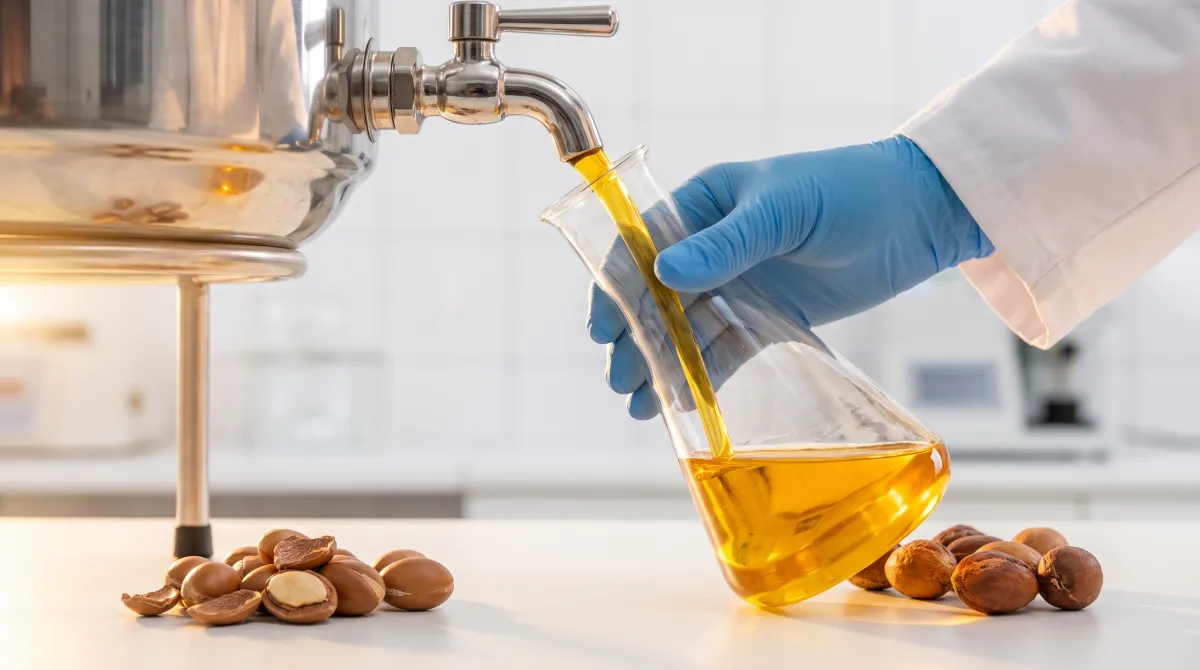
Buying wholesale argan oil for a cosmetics brand means selecting a grade (unroasted virgin, deodorized or certified organic raw material), requesting a batch-specific certificate of analysis against Moroccan standard NM 08.5.090, checking traceability back to the cooperative, then choosing a format: bulk, finished product or white label. Products sold in Europe remain subject to Regulation (EC) 1223/2009.
Argan is exported 93% in bulk while Morocco imports its finished products: read our study of cosmetics imports into Morocco (in French).
Key takeaways
- For cosmetics, choose unroasted virgin argan oil (INCI: Argania Spinosa Kernel Oil). Roasted oil is used for food.
- Moroccan standard NM 08.5.090 classifies virgin oil into four grades by acidity: ‘extra’ has free acidity ≤ 0.8%.
- Each batch should have a certificate of analysis (acidity, peroxide value, UV absorbance and fatty-acid profile).
- Buying bulk oil does not remove regulatory obligations: when you sell a finished product in the EU, you need a Responsible Person, a PIF and a CPNP notification.
- Manufacturing in Morocco, close to the argan forest, shortens the supply chain between raw material and finished product.
What wholesale argan oil grades are available?
There are two main types of argan oil: cosmetic oil, cold-pressed from unroasted kernels, and food oil, made from roasted kernels. According to the Import Promotion Desk export factsheet (GIZ, 2021), roasting is the key difference: it creates a hazelnut scent unsuitable for skincare.
Virgin argan oil is obtained solely through mechanical pressing, without additives; cosmetic grades are cold-pressed. The Moroccan standard permits only roasting, pressing, settling, centrifugation and filtration. Solvent-extracted (hexane) or refined oil therefore cannot be sold as ‘virgin’ under this standard.
Deodorized argan oil is cosmetic oil whose natural odor, which varies between batches, has been reduced. Processes differ by supplier (activated carbon filtration or steam deodorization during refining). Always request the exact process in writing: it determines whether ‘virgin’ can still appear on your label.
| Grade | Process | Typical use | Watch point |
|---|---|---|---|
| Cosmetic virgin oil | Cold-pressing of unroasted kernels | Pure oil, serums, hair care | Natural odor varies between batches |
| Food-grade virgin oil | Pressing of roasted kernels | Food | Roasted hazelnut scent, unsuitable for skincare |
| Deodorized | Virgin oil + odor-reduction process | Fragranced formulas, creams, emulsions | Check the process and eligibility for ‘virgin’ labeling |
| Refined | Full refining | Neutral bases, high volumes | Cannot be labeled ‘virgin’ |
| Certified organic raw material | Virgin or deodorized, certified supply chain | Ranges featuring certified organic raw materials | Certificate valid for the batch and operator |
Organic certification does not replace quality controls: poorly stored certified organic oil can oxidize. If you plan organic-related claims for a finished product, read our comparison of COSMOS, Ecocert and NATRUE standards before choosing a supplier.
How do you verify the quality of wholesale argan oil?
Wholesale argan oil quality is verified through documentation: a certificate of analysis (CoA) for each batch, checked against Moroccan standard NM 08.5.090 limits. According to M. Rahmani’s research in Cahiers Agricultures, this standard dates to 2003 and describes an oleic-linoleic oil rich in tocopherols (600 to 900 mg/kg).
Acid value and free acidity reflect fatty acids released through hydrolysis: lower values generally indicate better raw-material handling. Peroxide value and UV absorbance at 270 nm indicate the oil’s oxidation level.
| Criterion (NM 08.5.090 standard) | Extra virgin | Fine virgin | Ordinary virgin | Lampante |
|---|---|---|---|---|
| Free acidity (% oleic acid) | ≤ 0.8 | ≤ 1.5 | ≤ 2.5 | > 2.5 |
| Peroxide value (meq O2/kg) | ≤ 15 | ≤ 20 | ≤ 20 | not limited |
| UV absorbance at 270 nm (K270) | ≤ 0.35 | ≤ 0.35 | ≤ 0.45 | not limited |
The fatty-acid profile helps detect adulteration. The same source gives around 43 to 49% oleic acid and 29 to 36% linoleic acid for authentic oil. A significant deviation is a warning: dilution with cheaper oils is among the most commonly reported frauds in this supply chain. For more on laboratory controls, see our guide to testing the quality of your cosmetics.
The role of the Argane PGI and traceability
The ‘Argane’ PGI is a Moroccan protected geographical indication formalized in 2009, with specifications covering traceability from production to sale. According to the Import Promotion Desk factsheet, it is not mandatory for exports to Europe, but reassures buyers. In every case, request the same batch number on the sample, drum and certificate of analysis.
Bulk, finished product or white label: which format should you choose?
The right format depends on what you plan to sell and which responsibilities you can manage. Buying wholesale argan oil in bulk provides a raw material, not a compliant retail-ready product. White label provides a formulated, filled and documented finished product.
| Format | What you receive | Your remaining responsibilities | Who it suits |
|---|---|---|---|
| Bulk cosmetic argan oil | Drums or containers, batch-specific CoA | Formulation, filling, safety assessment, PIF, labeling | Labs and brands already manufacturing products |
| Bottled pure oil | Filled bottles under your brand | Regulatory validation, notification, market placement | Brands launching a 100% argan oil product |
| White label or custom formula | Complete argan-based range (serum, cream, shampoo…) | Positioning decisions and document approval | Brands seeking a retail-ready range |
Pure oil is still a cosmetic product when marketed for skin or hair. Moving from bulk to bottles therefore requires documentation, compliant labeling and good manufacturing practices.
What are the requirements for selling argan oil in the EU and UK?
In the European Union, argan oil sold as skincare is a cosmetic product subject to Regulation (EC) no. 1223/2009. The ingredient appears in the European Commission’s CosIng database under the INCI name Argania Spinosa Kernel Oil, with ‘skin conditioning’ and ’emollient’ functions.
The Responsible Person is the individual or legal entity established in the EU that ensures product compliance (Article 4). The PIF (Product Information File) is the technical documentation kept available to authorities and includes the safety report (Articles 10 and 11).
- Product notification on the CPNP portal before market placement (Article 13).
- Compliant labeling (Article 19): INCI list, batch number, shelf life, Responsible Person’s name and address.
- Manufacturing according to GMP, with compliance presumed under ISO 22716 (Article 8).
- Substantiated, non-misleading claims: no therapeutic promises for cosmetic oil.
In the United Kingdom (Great Britain), the same principles apply, with a UK-established Responsible Person and notification through SCPN, as explained in the official UK government guidance. Our article on requirements for exporting cosmetics from Morocco to Europe details each step.
Why manufacture in Morocco, close to the argan forest?
Manufacturing in Morocco shortens the chain from kernel to finished product, improving traceability control. The argan tree is endemic to southwestern Morocco. Its territory has been a UNESCO biosphere reserve since 1998, and argan-related skills have been on UNESCO’s intangible cultural heritage list since 2014. For the history of these uses, read our article on Moroccan cosmetic traditions, from argan oil to henna.
Supply remains limited and climate-dependent, affecting wholesale argan oil. According to LesEco.ma (May 2026), annual argan oil production is estimated at 5 000 tonnes, the sector has faced seven years of drought, and Europe accounted for 76% of exports in 2022. A supplier close to the source that can document every batch is a practical advantage in this context.
How to choose a reliable argan oil supplier: the checklist
A reliable argan oil supplier can substantiate every claim, batch by batch, whether you buy wholesale oil or finished products. Follow these steps before signing, and supplement them with our advice on choosing a white label manufacturer.
- Define the grade: unroasted virgin, deodorized or certified organic raw material, and the target quality level (extra, fine).
- Request a technical datasheet and recent certificate of analysis: acidity, peroxide value, UV absorbance and fatty-acid profile.
- Have a sample analyzed by an independent laboratory and compare it with the supplier’s CoA.
- Check traceability: kernel origin, cooperative or pressing facility, and matching batch numbers on all documents.
- Verify certificates: validity, scope (operator and product) and certification body for organic raw materials.
- Assess storage and transport: inert containers, protection from light and measures against oxidation.
- Clarify the format and regulatory documentation: bulk only, finished product or white label with technical documentation.
The manufacturer’s perspective
Carmel Cosmetics Labs is based in Agadir, in the Souss-Massa region, at the heart of the argan-growing area. We supply bulk cosmetic argan oil and use it in white label and contract manufacturing, within an ISO 22716 and ISO 9001 certified operation, for products compliant with Regulation (EC) 1223/2009. Our establishment is registered with the FDA for exports to the United States.
Our practical advice for wholesale argan oil purchases: set acidity and peroxide limits in your specifications rather than relying on the word ‘pure’. Choose the grade for the formula: strongly scented virgin oil may interfere with a delicate fragrance. Finally, address the Responsible Person and PIF from the outset; leaving them until later often complicates a launch.
With over 500 brands supported in more than 35 countries and an accessible MOQ, we help brands turn argan oil into complete ranges. Explore our approach as a cosmetics manufacturer in Morocco.
Frequently asked questions
What is the difference between cosmetic and food-grade argan oil?
Cosmetic oil is cold-pressed from unroasted kernels. It has a subtle scent and suits skin and hair care. Food oil comes from roasted kernels, giving it a toasted hazelnut flavor and scent. For a cosmetics brand, always request unroasted oil and confirm this on the batch’s technical datasheet.
What is the INCI name for argan oil?
The INCI name for argan oil is Argania Spinosa Kernel Oil. Use this in your EU label’s ingredient list. The European Commission’s CosIng database lists its functions as skin conditioning and emollient. Hydrogenated argan oil has a different INCI name and must not be confused with virgin oil.
How can you detect argan oil adulterated with another oil?
Scent and color are not enough. The reliable approach is independent laboratory analysis of the fatty-acid profile and, if needed, sterols. A profile significantly outside the reference values in Moroccan standard NM 08.5.090 indicates possible adulteration. Always compare results with the certificate of analysis for the same batch number.
Is the Argane PGI mandatory for sales in Europe?
No. According to the Import Promotion Desk export factsheet, the ‘Argane’ PGI is not required to export argan oil to Europe. It is a voluntary quality and traceability designation. The finished product must still comply with Regulation (EC) 1223/2009: Responsible Person, PIF, safety report, CPNP notification and compliant labeling.
Can you launch white label argan oil without your own lab?
Yes. With white label, the manufacturer provides the oil or formula, filling and technical documents, while you manage the brand and sales. You must still designate a Responsible Person for the target market and approve labeling. A manufacturer following ISO 22716 facilitates PIF preparation.
For export figures, read our study: Moroccan argan and other vegetable oils accounted for 6.23 M$ in US imports in 2025.
Conclusion
Buying wholesale argan oil well depends on three things: the right grade, batch analyses meeting NM 08.5.090 and verifiable traceability. The format, from bulk to white label, then determines your remaining regulatory responsibilities. At Carmel Cosmetics Labs, you can start with bulk argan oil and move to finished products or white label as your range develops.
Planning an oil or range featuring Moroccan argan oil? Book a Free consultation to discuss your project and explore our white label cosmetics service.