



In 2025, Moroccan beauty exports to the US were first and foremost a raw-materials business: the United States imported $6.23M of Moroccan vegetable oils, argan oil included, $4.62M of essential oils and just $0.74M of skincare and makeup. About 85% of the value ships in bulk (US Census Bureau, 2025 data).
Key takeaways
- $6.23M of Moroccan vegetable oils, argan included (HS 1515.90), imported by the United States in 2025: No. 1 in the ranking, up 73% from 2024.
- $14.45M across the 8 beauty categories in the 2025 ranking, roughly 85% of it raw materials.
- 0.008%: Morocco’s share of US skincare and makeup imports in 2024 ($0.66M out of $7,792.4M).
- +38% for Moroccan skincare in January–July 2026 ($0.54M, vs. $0.39M a year earlier).
- $1,756.1M of Korean skincare and makeup imported by the United States in 2024, 2.4 times the 2021 level.
Source for all figures: US Census Bureau import records, extracted on October 8, 2026 through the UN Comtrade API, in current US dollars. The methodology is at the end of this article.
What were the top Moroccan beauty imports into the US in 2025?
Argan oil and other vegetable oils top the list, with $6.23M imported by the United States in 2025, ahead of essential oils ($4.62M) and fragrances ($1.27M). Skincare and makeup only rank 5th, at $0.74M. The HS code (Harmonized System) is the international customs nomenclature that identifies every product with a 4- to 6-digit number.
| Rank | Product | HS code | 2025 ($M) | 2024 ($M) | Change |
|---|---|---|---|---|---|
| 1 | Vegetable oils n.e.s., including argan oil | 1515.90 | 6.23 | 3.60 | +73% |
| 2 | Essential oils | 3301.29 + 3301.90 | 4.62 | 5.08 | −9% |
| 3 | Perfumes and eaux de toilette | 3303 | 1.27 | 1.43 | −11% |
| 4 | Plant extracts | 1302.19 | 1.10 | 0.86 | +28% |
| 5 | Skincare, makeup, powders | 3304 | 0.74 | 0.66 | +13% |
| 6 | Clays and minerals, likely including ghassoul | 2508.10 / 2508.40 / 2530.90 | 0.26 | 0.24 | +9% |
| 7 | Hair preparations and shampoos | 3305 | 0.12 | 0.07 | +78% |
| 8 | Soaps, likely including black soap | 3401 | 0.11 | 0.18 | −41% |
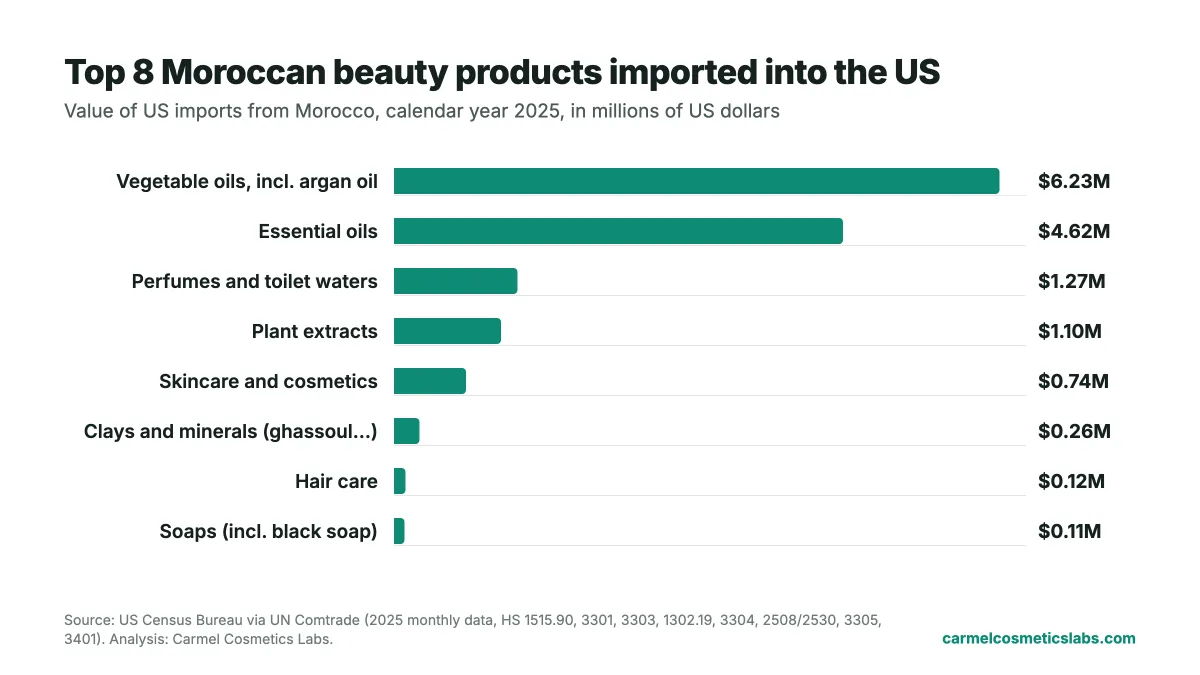
Argan jumped from $3.60M to $6.23M in a single year, though it has not returned to its 2021 level ($7.14M). Essential oils slipped slightly. And finished goods remain a footnote in Moroccan beauty exports to the US: skincare, hair care and soaps combined add up to less than $1M.
What do the first seven months of 2026 show?
From January to July 2026, argan and essential oils each grew 9% and Moroccan skincare grew 38%, while fragrances fell 64% compared with the same period in 2025.
| Category | Jan.–Jul. 2025 ($M) | Jan.–Jul. 2026 ($M) | Change |
|---|---|---|---|
| Vegetable oils / argan | 3.50 | 3.81 | +9% |
| Essential oils | 2.63 | 2.87 | +9% |
| Skincare / cosmetics | 0.39 | 0.54 | +38% |
| Plant extracts | 0.87 | 0.65 | −25% |
| Fragrances | 0.56 | 0.20 | −64% |
| Soaps | 0.06 | 0.08 | +25% |
| Clays | 0.14 | 0.05 | −68% |
| Hair preparations | 0.05 | 0.01 | −73% |
Read these swings with caution. On amounts below $100,000, such as soaps or hair products, a single order can move the figure by more than 50%. The drop in fragrances may simply reflect one importer shifting its purchases.
The strongest signal comes from argan and essential oils, whose volumes smooth out one-off orders. The rise in skincare, on $0.54M, still needs to hold over the full year.
Raw materials or finished goods: why does 85% of the value ship in bulk?
In 2025, about 85% of the value of the 8 beauty categories the United States imported from Morocco was raw materials (vegetable oils, essential oils, extracts, clays). Finished skincare, hair care and soaps weigh in at less than $1M. In Moroccan beauty exports to the US, Morocco supplies the ingredients; the brand value is created elsewhere.
Average 2024 prices per kilo, calculated from declared values and weights, confirm it: about $36/kg for code 1515.90, a level consistent with bulk argan oil, $42/kg for essential oils, but $19/kg for skincare (3304.99) and $10/kg for fragrances.
In 2024, Morocco supplied $0.66M of the $7,792.4M of skincare and makeup imported by the United States, or 0.008%. In essential oils (HS 3301), its share reaches $5.1M out of $1,289.8M, about 0.4%: 50 times higher than in finished skincare.
Argan oil: the flagship product, still sold by the kilo
Argan oil is pressed from the kernels of the argan tree’s fruit (Argania spinosa), a tree endemic to southwestern Morocco. Under code 1515.90, which also covers other oils, US imports rose from $3.60M in 2024 to $6.23M in 2025, mostly in bulk. For a buyer, everything comes down to the grades and quality controls of wholesale argan oil: acidity, peroxide value, batch traceability.
Essential oils and extracts: uneven volumes
Moroccan essential oils totaled $4.62M in 2025, but the series fluctuates: $8.71M in 2021, $3.61M in 2023 and $4.98M in 2024 for code 3301.29 alone. Plant extracts (1302.19), by contrast, grow every year, from $0.52M in 2021 to $1.10M in 2025.
Fragrances and skincare: two finished goods on opposite paths
Fragrances (HS 3303) climbed from $0.17M in 2021 to $1.43M in 2024, then $1.27M in 2025, before a sharp drop in early 2026. Skincare under code 3304.99 grew from $0.23M in 2021 to $0.63M in 2024. That is modest, but it is the segment where the added value stays in Morocco.
Ghassoul and black soap: icons invisible in the numbers
Ghassoul (or rhassoul) is a Moroccan saponifying clay, traditionally used to cleanse skin and hair. With no customs code of its own, it most likely sits within clays and minerals ($0.26M in 2025). Black soap, a paste traditionally made from olive oil and used in the hammam, is probably included in the $0.11M under code 3401.
Why is the environment favorable for Moroccan beauty exports to the US?
Morocco has had a free trade agreement with the United States since 2006, and in 2024 MoCRA clarified the obligations of foreign manufacturers. The 2025–2026 tariff landscape, however, is still shifting.
The US-Morocco Free Trade Agreement
Signed on June 15, 2004, the agreement entered into force on January 1, 2006, according to the US International Trade Administration. It grants preferential duty treatment to goods that meet its rules of origin. For a cosmetic product, the question is whether it is manufactured and sufficiently transformed in Morocco to qualify as Moroccan.
US tariffs in 2025–2026: check case by case
In April 2025, an executive order introduced so-called “reciprocal” tariffs: Moroccan goods became subject to the 10% baseline rate, despite the free trade agreement (Yabiladi, April 2025). On February 20, 2026, the Supreme Court ruled that IEEPA did not authorize those tariffs (Covington, February 2026). A temporary 10% duty (Section 122) took over until July 24, 2026, and was challenged in court (Skadden, May 2026).
Since July 24, 2026, Section 301 tariffs have targeted 60 economies, Morocco among them (EY, July 2026). Under the presidential memorandum of July 23, 2026, the applicable rate is not uniform: it depends on the country, the HS code and the product-specific exemptions listed in the annex. These measures may still change, so have a licensed customs broker confirm the rate for your HS code before any export quote.
MoCRA: clear rules for foreign manufacturers
MoCRA (the Modernization of Cosmetics Regulation Act of 2022) is the law that expanded the FDA’s authority over cosmetics. According to the FDA, it requires facility registration (renewed every two years), annual listing of products and their ingredients, reporting of serious adverse events within 15 business days, and records substantiating safety. Registration and listing have been required since July 1, 2024.
The typical path, which we also cover in our article on manufacturing in Morocco for the US market:
- Choose a manufacturer whose facility is registered with the FDA.
- Designate the responsible person whose name appears on the label.
- Build the safety file: formula, raw materials, stability and compatibility testing.
- List each product with the FDA, then update the listing every year.
- Adapt the labeling to US rules and confirm the HS code and applicable duties.
The M-Beauty opportunity: could Morocco do what Korea did?
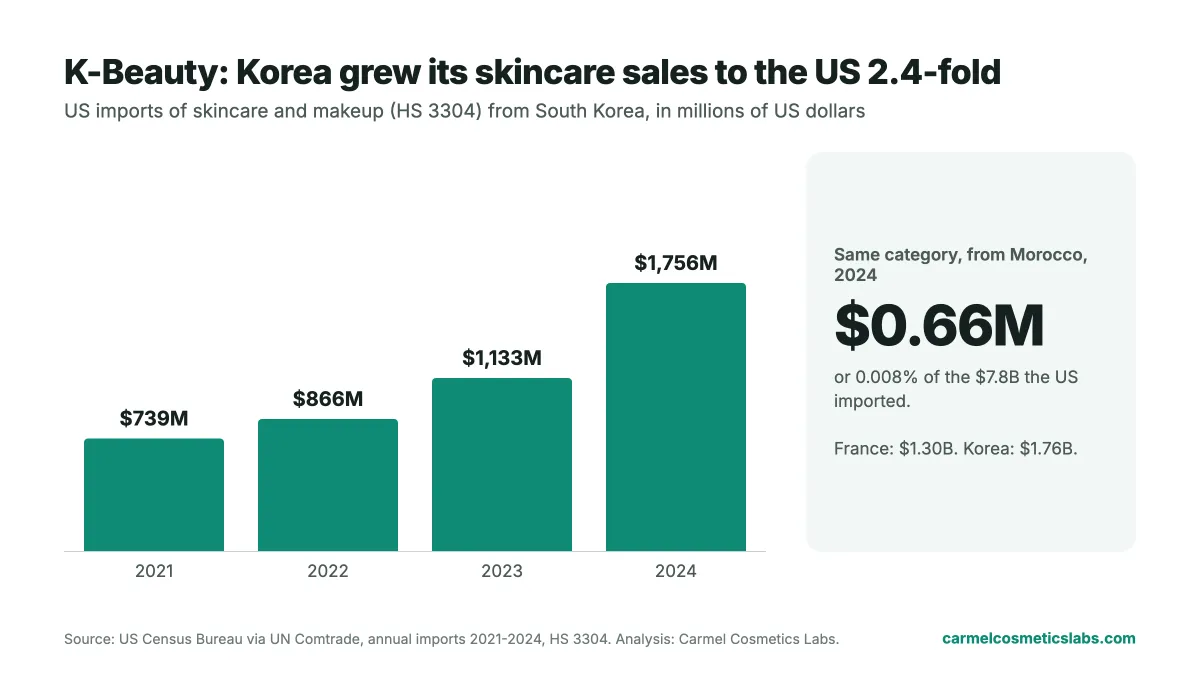
M-Beauty (Moroccan Beauty) is the name we propose for Moroccan beauty sold as brands and finished products, not just in bulk. The model already exists: in 2024, South Korea became the No. 1 supplier of skincare and makeup to the United States, at $1,756.1M, ahead of France ($1,299.4M).
What K-Beauty built
K-Beauty refers to South Korean cosmetics, known for signature ingredients such as centella and snail mucin. US imports of Korean skincare (HS 3304) went from $738.6M in 2021 to $865.9M in 2022, $1,133.1M in 2023 and $1,756.1M in 2024. On the Korean side, authorities reported $11.43B in cosmetics exports in 2025, with the United States as the top destination for the first time, at $2.19B (Korea Herald, January 2026). That figure covers all cosmetics, a different scope from US customs data.
Morocco’s unique assets
The argan tree grows in the Arganeraie, a UNESCO Biosphere Reserve since 1998. The practices and know-how surrounding the argan tree have been inscribed on UNESCO’s Intangible Cultural Heritage list since 2014, and argan oil carries a geographical indication recognized by an order dated November 20, 2009.
Add to that the Kelâat M’Gouna rose and its hydrosol, provided you know how to spot the real thing, ghassoul, black soap, orange blossom, prickly pear seed oil and the hammam ritual. These Moroccan beauty traditions, from argan to henna, make up an origin story few countries can claim.
Sizing the potential, honestly
Capturing 1% of US skincare and makeup imports would be worth about $78M a year (based on the $7,792.4M of 2024), roughly 100 times today’s level of Moroccan skincare ($0.74M in 2025). It is an order of magnitude to measure the gap, not a forecast: Korea built its position over many years, with strong brands.
What the industry needs to do
- Move from bulk to finished products: formulate, fill and label in Morocco.
- Build brands, Moroccan or foreign brands made in Morocco, positioned for the US market.
- Be MoCRA-compliant from day one: registered facility, product listing, safety file.
- Tell the origin story with proof: Argane PGI, harvest region, rituals.
- Trace every batch, from the cooperative to the bottle.
The manufacturer’s view
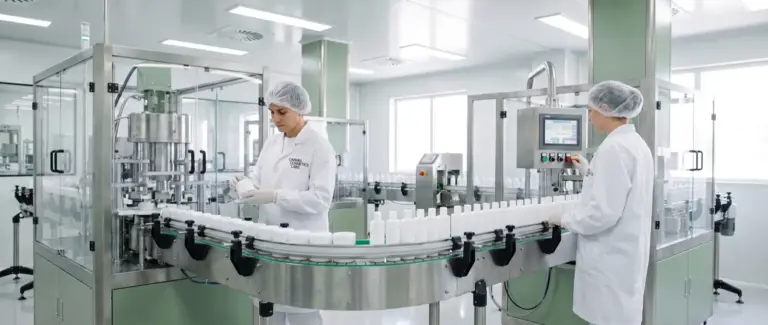
At Carmel Cosmetics Labs, in Agadir, in the heart of argan country, we work on both sides of the equation: we supply bulk cosmetic-grade argan oil and manufacture finished products under white label and contract manufacturing, to ISO 22716 and ISO 9001 standards, for more than 500 brands in 35 countries. Ours is an FDA-registered facility under MoCRA.
The most common mistake founders make when targeting the United States: leaving compliance for last. A formula designed for Europe or Morocco often needs adjusting before export. Set the target market, the likely HS code and the responsible person in the product brief from the start. That is the job of a cosmetics manufacturer based in Morocco: turning an origin ingredient into a compliant, ready-to-sell product.
Methodology and data limitations
Source. US Census Bureau import records (reporter: United States, code 842; partner: Morocco, code 504; flow: imports), extracted through the UN Comtrade API on October 8, 2026, in current US dollars.
Periods. 2025 = sum of the 12 published months, subject to revision. 2026 = January to July. For 2022, only 4-digit data exist (1515 = $13.31M, 3301 = $5.93M, 3303 = $2.34M); they are not mixed with the 6-digit series.
Codes. 1515.90, 3301.29 + 3301.90, 3303, 1302.19, 3304, 2508.10 + 2508.40 + 2530.90, 3305 and 3401. Excluded as non-beauty: food flavorings (HS 3302.10, about $10M a year), dried plants (HS 1211.90, about $5.8M) and locust bean gum (HS 1302.32, about $5.4M in 2024).
Limitations. Some codes group several products (1515.90 includes oils other than argan). Goods routed through the European Union may be declared as European (see the regulations for exporting cosmetics from Morocco to Europe). 2025/2024 changes are calculated on an identical set of codes.
Frequently asked questions
Which Moroccan cosmetic product does the US import the most?
Vegetable oil under code 1515.90, which includes argan oil: $6.23M imported by the United States in 2025, according to the US Census Bureau. It ranks ahead of essential oils ($4.62M) and fragrances ($1.27M). The code also covers other oils, but the average price of about $36/kg observed in 2024 is consistent with a large share of argan.
Are Moroccan cosmetics exempt from US tariffs?
Not entirely. The 2006 free trade agreement grants preferential duties to goods of Moroccan origin. But additional tariffs have followed one another: 10% in 2025, a temporary duty in early 2026, then new Section 301 tariffs since July 24, 2026, with rates that depend on the product and its exemptions. Always have a customs broker confirm the rate for your HS code.
Do you need FDA registration to sell cosmetics in the US?
Yes. Since July 1, 2024, MoCRA has required facilities that manufacture cosmetics for the US market to register with the FDA, and every product to be listed with its ingredients. This is not an approval: the FDA does not authorize cosmetics before they go on the market, and the brand remains responsible for their safety.
What is M-Beauty?
M-Beauty (Moroccan Beauty) is the term Carmel Cosmetics Labs proposes for Moroccan beauty sold as brands and finished products, modeled on Korea’s K-Beauty. It is a vision, not an official category. It draws on origin ingredients such as argan, ghassoul, rose and orange blossom, and on hammam rituals.
Do these figures underestimate Moroccan beauty in the US?
Probably. They only count goods declared as Moroccan when they enter the United States. A bottle made in France with Moroccan argan oil shows up under another country of origin, and products routed through Europe may slip through the count. The figures measure direct exports, not the total presence of Moroccan ingredients.
Conclusion: from bulk to brand
In 2025, Morocco mainly sold ingredients to the United States: $6.23M of oils including argan and $4.62M of essential oils, against $0.74M of finished skincare. The 38% rise in skincare in early 2026 shows another model is possible, within a framework (free trade agreement, MoCRA) that is favorable despite tariffs worth watching.
Looking to launch a line built on Moroccan ingredients for the US market? We work with you on the formula, MoCRA compliance and packaging to develop your white label range. Book your free consultation on WhatsApp, at +212 808 504 500 or at [email protected].
Cite this study: Carmel Cosmetics Labs (2026), “Moroccan Beauty Exports to the US: The 2025-2026 Product Ranking”, https://carmelcosmeticslabs.com/en/moroccan-beauty-exports-usa/, October 8, 2026.