

















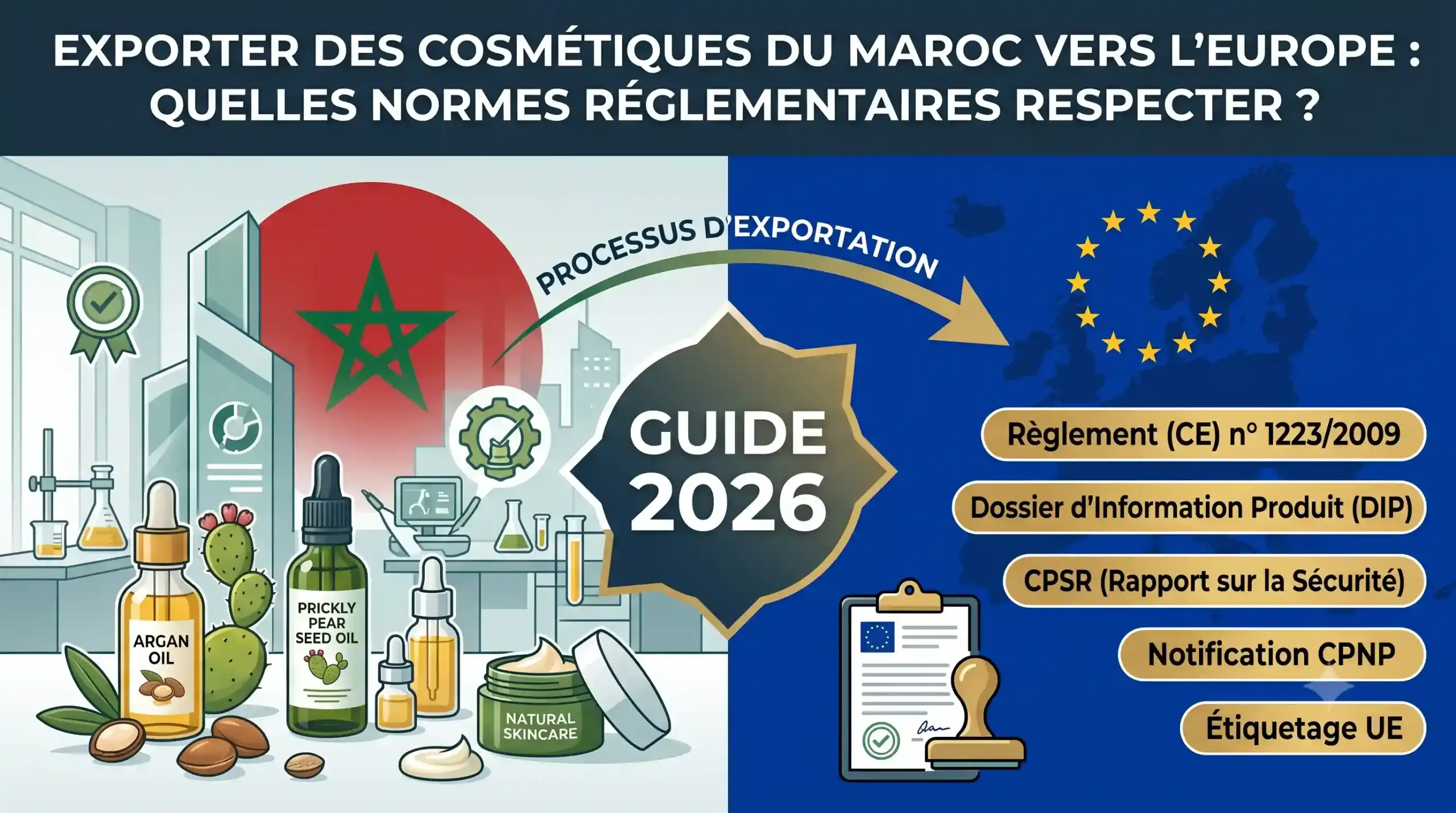
The essentials. To export cosmetics from Morocco to the European Union, the product must comply with Regulation (EC) No 1223/2009, wherever it is made. In practice, eight European checkpoints govern market access: appoint a Responsible Person established in the EU, notify the product on the CPNP portal, build a Product Information File (PIF) with a safety report, manufacture under Good Manufacturing Practices (ISO 22716), use only ingredients that comply with the annexes, follow the labeling rules (including the new allergens), respect the ban on animal testing, and make only substantiated claims. On the Moroccan side, you must comply with local regulations and gather the export documents (certificate of free sale, certificate of origin, customs codes).
Here is the complete roadmap, step by step.
Contents
- Exporting to Europe: the principle to understand first
- The 8 European regulatory requirements to meet
- On the Moroccan side: export formalities not to overlook
- The roadmap in practice, step by step
- Summary table: who does what?
- How a Moroccan laboratory secures your export
- FAQ — Exporting cosmetics from Morocco to Europe
Exporting to Europe: the principle to understand first
First misconception to correct: you do not need to manufacture in Europe to sell in Europe. Regulation (EC) No 1223/2009 does not regulate a place of production, but the act of placing a product on the market. As soon as a product is sold in the EU, it must meet the regulation in full — whether it is made in Lyon, Milan or Agadir. Brands in northern Morocco already make this choice: see our cosmetics laboratory for brands in Tangier and Tetouan.
So a Moroccan laboratory can perfectly well produce for the European market; we covered this in detail in our article Can a cosmetics laboratory in Morocco make products that meet EU standards?. This roadmap starts from there and describes how exporting works in practice.

The 8 European regulatory requirements to meet
1. Regulation (EC) No 1223/2009, the reference text
This is the foundation. It governs the safety, composition, labeling and monitoring of every cosmetic product sold in the EU. The full text is available on EUR-Lex.
2. A Responsible Person established in the EU
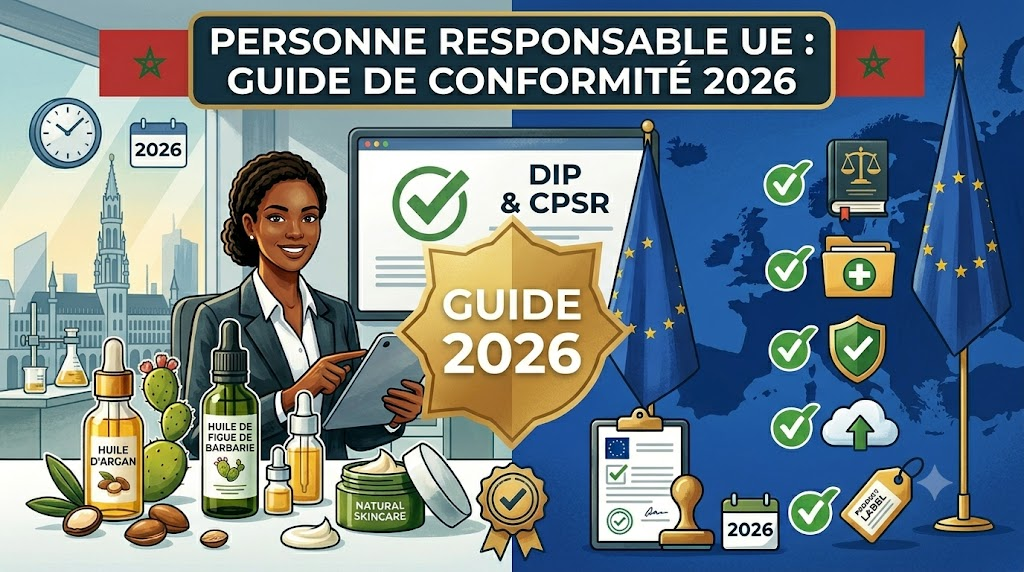
This is the most far-reaching obligation for a non-EU exporter. The product must have a Responsible Person (RP) established in the Union: the RP takes on legal responsibility for compliance, notifies the product and keeps the file. The RP cannot be in Morocco — it is the importer or an agent appointed by written contract.
3. CPNP notification before placing on the market
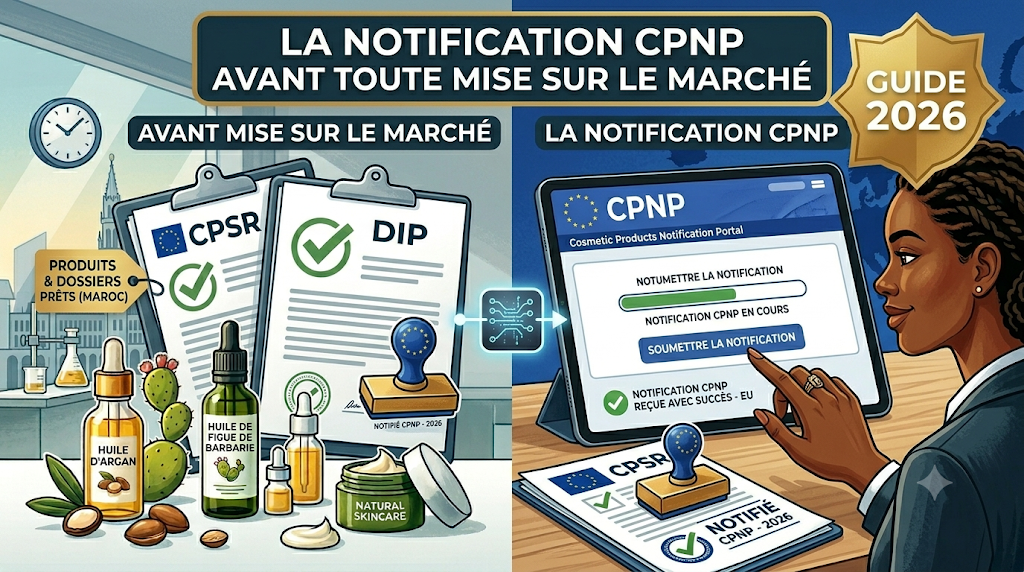
Every product must be notified on the Cosmetic Products Notification Portal (CPNP) before it is first sold. The notification includes the category, the frame formulation, the RP and the country of origin (“Morocco” for an imported product). Only the RP can do this. Details on the official CPNP page.
4. The Product Information File (PIF) and the safety report
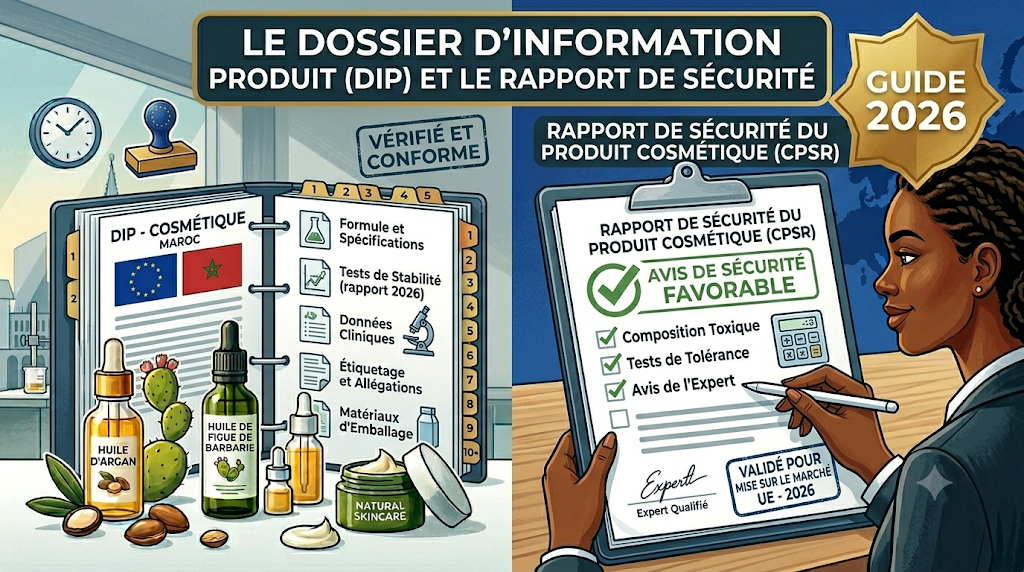
The RP keeps a PIF available to the authorities for ten years after the last batch. At its heart is the safety report (CPSR), assessed by a qualified expert. Building a solid PIF is a profession in its own right — it is the focus of our regulatory and PIF support.
5. Good Manufacturing Practices (ISO 22716)
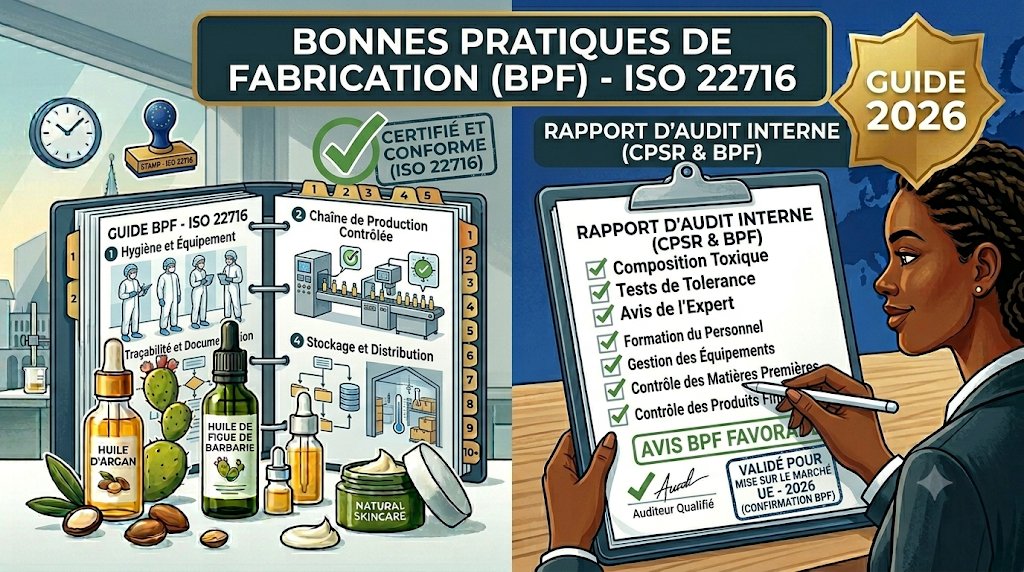
Article 8 of the regulation requires manufacturing in line with GMP. The EN ISO 22716 standard gives a presumption of conformity with this requirement: an ISO 22716-certified Moroccan laboratory therefore meets the manufacturing pillar just like a European manufacturer. To understand this standard, see our complete guide to ISO 22716 certification in Morocco.
6. Ingredients that comply with the annexes
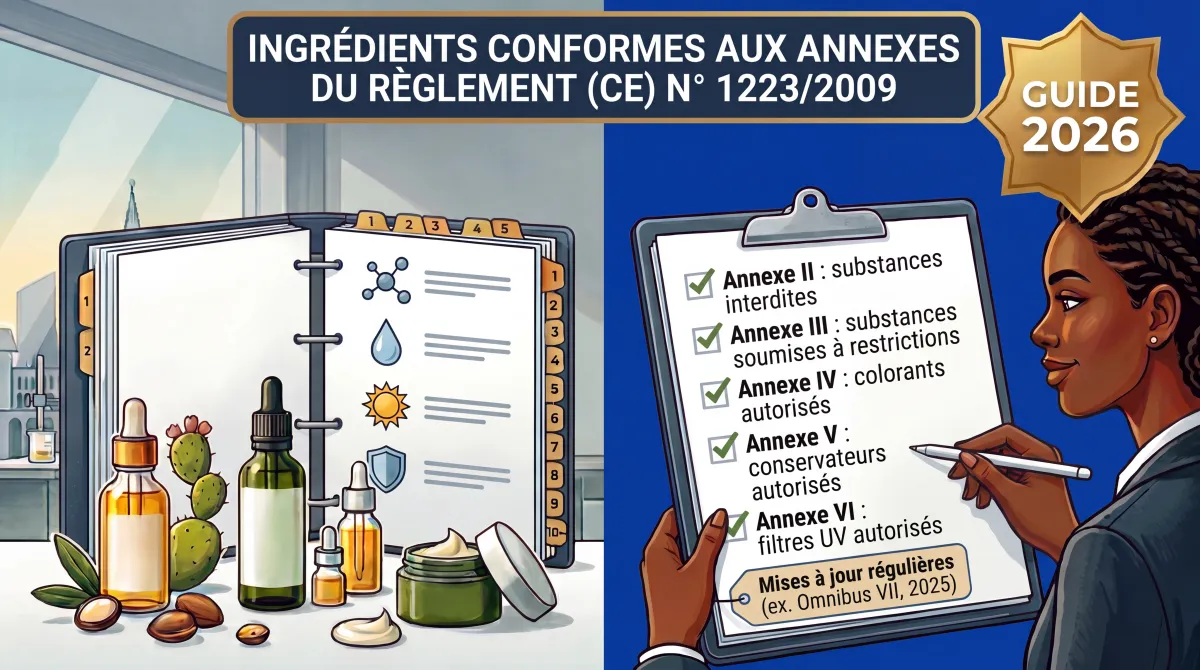
No banned substances (Annex II), compliance with restrictions and concentrations (Annex III), and use of authorized preservatives, colorants and UV filters only (Annexes V, IV and VI). These annexes change several times a year as CMR substances are reclassified and new restrictions are added (for example Omnibus VII, Regulation (EU) 2025/877, which has banned 22 CMR substances, including TPO, since September 1, 2025) — as the case of PFAS and their 2026 ban shows.
7. Labeling that complies with Article 19
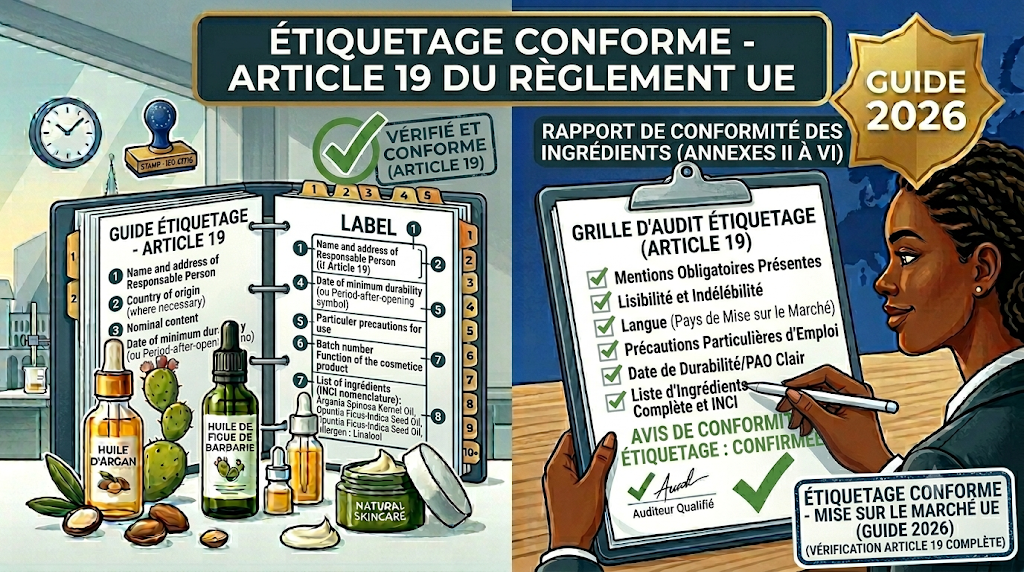
INCI list, nominal content, date of minimum durability or PAO, function, precautions, batch number, the RP’s name and EU address, and the country of origin. On top of this comes the new obligation to declare fragrance allergens: Regulation (EU) 2023/1545 expands the list from 26 to more than 80 substances, mandatory since July 31, 2026 for products placed on the market, and from July 31, 2028 for those already on sale.
8. The animal testing ban and substantiated claims
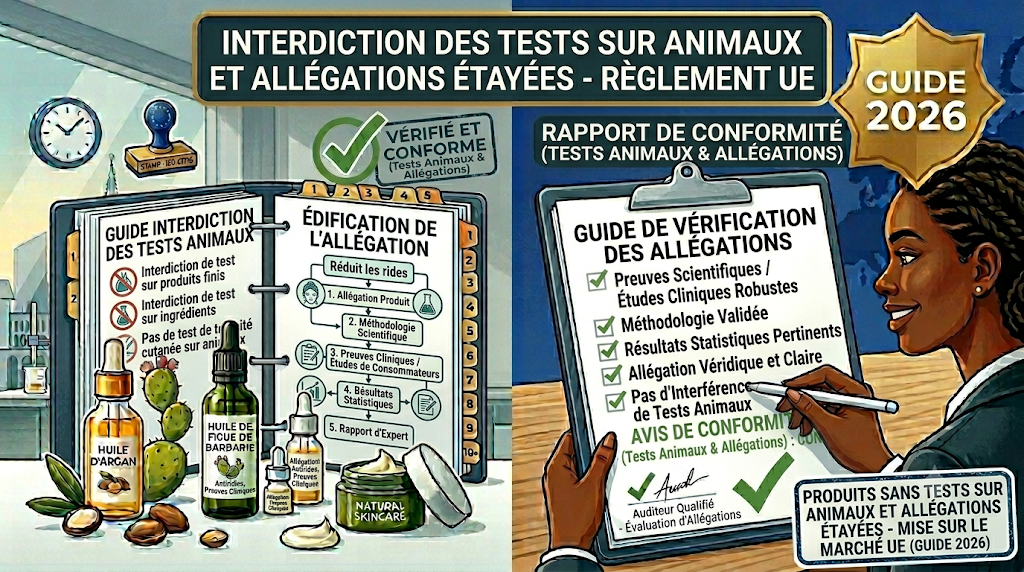
The EU bans the sale of products and ingredients tested on animals (Article 18): alternative methods are mandatory. Finally, every claim must be substantiated according to the common criteria of Regulation No 655/2013 — a topic we cover in detail in How are cosmetic claims regulated in the EU?.
On the Moroccan side: export formalities not to overlook
European standards are only one side of the operation. On the Moroccan side, the exporter must also:
- Comply with Moroccan cosmetics regulations, supervised by the AMMPS (Moroccan Agency for Medicines and Health Products), which oversees manufacturing and placing on the local market, including the prior declaration of the facility to the AMMPS. To sell the same product in Morocco, see how to register a cosmetic product in Morocco.
- Plan ahead for the certificate of free sale, often requested by importers.
- Prepare a certificate of origin (EUR.1 movement certificate issued by Moroccan customs – ADII – to benefit from the EU-Morocco preferential regime) for customs clearance.
- Identify the right customs codes (HS) for cosmetic products (Chapter 33, and heading 3401 for soaps) and plan export formalities and logistics (transport, storage conditions, durability dates).
These steps work hand in hand with EU obligations: a product can be fully compliant with Regulation 1223/2009 and still be blocked at export for lack of proper Moroccan documentation.
The roadmap in practice, step by step
- Validate the formula’s compliance with the regulation’s annexes (substances, concentrations, filters, preservatives).
- Appoint a Responsible Person established in the EU (importer or agent).
- Build the PIF and have the safety report produced by a qualified assessor.
- Manufacture under GMP (ISO 22716), with the matching document traceability.
- Bring labeling into compliance: language of the destination country, mandatory information, new allergens, country of origin.
- Notify the product on the CPNP — an essential prerequisite for the first sale.
- Gather the Moroccan export documents: certificate of free sale, certificate of origin, customs codes.
- Ship, then handle cosmetovigilance and update the file and notifications with every regulatory or formula change.
Summary table: who does what?
| Requirement | Who is responsible | Proof / deliverable |
|---|---|---|
| Formula compliance (annexes) | Laboratory / formulator | Technical data sheets, SDS |
| Responsible Person | EU importer or agent | Written mandate, EU contact details |
| CPNP notification | Responsible Person | Notification number |
| PIF + safety report | RP (file built with the lab’s help) | PIF, CPSR |
| GMP manufacturing | Laboratory | ISO 22716 certificate |
| Compliant labeling | Responsible Person + lab | Approved label artwork |
| Export documents | Exporter (Morocco) | Certificate of free sale, certificate of origin, HS codes |
How a Moroccan laboratory secures your export
The complexity of this chain is why choosing the right laboratory is decisive. A partner that masters formulation that complies with the annexes, PIF preparation, the clinical efficacy studies that substantiate claims and GMP manufacturing (ISO 22716) all at once drastically reduces regulatory risk.
That is the approach of Carmel Cosmetics Labs, which has supported more than 500 brands — including many based in Europe (France, Belgium, Luxembourg, Switzerland, Italy, Spain, the Netherlands, Germany) — with their PIF preparation, clinical studies and product notification. The laboratory does not replace the Responsible Person, but provides all the technical material that makes notification and market launch possible. To discuss your export project, contact the laboratory. See our pages for brands from France, Belgium and Luxembourg and Switzerland.
FAQ — Exporting cosmetics from Morocco to Europe
Do you need a factory in Europe to export cosmetics to the EU?
No. Regulation (EC) No 1223/2009 applies to the product placed on the EU market, not to where it is made. A product made in Morocco can be exported to the EU as long as it meets all the regulation’s obligations and a Responsible Person established in the EU has been appointed.
Who can be the Responsible Person for a product made in Morocco?
The Responsible Person must be established in the European Union: usually the importer or an agent appointed by written contract. The RP cannot be based in Morocco, and only the RP can notify the product on the CPNP.
What is a certificate of free sale, and is it mandatory?
A certificate of free sale confirms that a product is legally sold in its country of origin. Regulation 1223/2009 itself does not require it, but importers or customs authorities frequently ask for it, so it is wise to plan ahead.
How long does it take to make a product ready for export to the EU?
It all depends on how mature the file is. Building the PIF and safety report, bringing labeling into compliance and CPNP notification come on top of formulation and stability testing; the schedule is defined with you in the quote.
Do the new allergen rules apply to Moroccan exporters?
Yes, as soon as the products are sold in the EU. Regulation (EU) 2023/1545 requires the individual declaration of more than 80 fragrance allergens, with compliance required since July 31, 2026 for new products and by July 31, 2028 for existing stock.
Can a Moroccan laboratory notify products on the CPNP on my behalf?
No: only the Responsible Person established in the EU can notify. However, a laboratory can prepare the entire file needed (formula, PIF, safety report, labeling) so the notification goes smoothly.
Preparing to export a cosmetics brand from Morocco to Europe? Carmel Cosmetics Labs manufactures under GMP (ISO 22716) and supports you across the entire regulatory chain. Request a call with the laboratory. Also worth reading: Manufacturing in Morocco and exporting to the USA.