


































“Made in Morocco” and “compliant with EU standards” are not opposites. In fact, the opposite of a stubborn misconception is true: in the cosmetics industry, regulatory compliance is not measured by the factory’s latitude but by the rigor of a file. Here is why.
Key takeaway. Yes, a Moroccan cosmetics lab can manufacture products that fully comply with EU standards. Regulation (EC) No 1223/2009, the reference text for the EU market, applies to every product placed on the EU market, whatever its country of manufacture. Compliance rests on six pillars: a Responsible Person established in the EU, a CPNP notification, a Product Information File with a safety report, manufacturing under Good Manufacturing Practices (ISO 22716), ingredients that comply with the annexes, and regulatory labeling. The place of production is never the obstacle; a weak compliance architecture is.
Why the country of manufacture does not determine compliance
The reflex is understandable. For many emerging brands, “EU standards” suggests a geographic seal: a factory somewhere between Lyon and Milan. The regulatory reality is plainer, and more demanding: Regulation (EC) No 1223/2009 does not regulate a place, it regulates placing on the market.
In other words, as soon as a product is sold in the European Union, it must fully meet the regulation, whether it was formulated in Paris, Seoul or Agadir. Conversely, a product made on European soil but poorly documented is not compliant either. Geography is neutral. What separates a compliant product from an illegal one is the chain of responsibilities and evidence that comes with it.
This logic has a direct consequence for a Moroccan lab: there is no barrier in principle to exporting to the EU. There is, however, a regulatory discipline to master from end to end.
What exactly does Regulation (EC) No 1223/2009 say?
Fully applicable since 2013, the EU Cosmetics Regulation governs the product’s entire life cycle: formulation, manufacturing, safety, labeling and market surveillance. Its goal is explicit: to ensure a high level of protection of human health and the traceability of every product sold in the Union.
For a manufacturer based outside the EU, six obligations shape market access. Here they are, in order of importance.
1. The Responsible Person: the keystone
This is the point that surprises new exporters most. Every non-EU brand or manufacturer must appoint a Responsible Person (RP) established in the Union. Only the RP can notify the product; it holds legal responsibility for compliance, keeps the product file and deals with the authorities. The RP cannot be in Morocco: the importer, or a representative appointed by written mandate, takes on this role within the EU.
2. CPNP notification, before any sale
Before it is first placed on the market, the product must be notified on the Cosmetic Products Notification Portal (CPNP), the European Commission’s central portal. The notification includes the product category and name, the RP’s identity and address, the country of origin for imported products, and any nanomaterials or CMR substances. A product that has not been notified simply cannot be sold legally.
3. The Product Information File and the safety report
The RP keeps a Product Information File (PIF) available to the authorities for ten years after the last batch is placed on the market. At its core is the Cosmetic Product Safety Report (CPSR), in two parts: safety data on one side, and an assessment by a qualified expert (toxicologist, pharmacist or equivalent) on the other. The PIF also includes a description of the manufacturing method showing GMP compliance, and proof of the claimed effects.
4. Good Manufacturing Practices (ISO 22716)
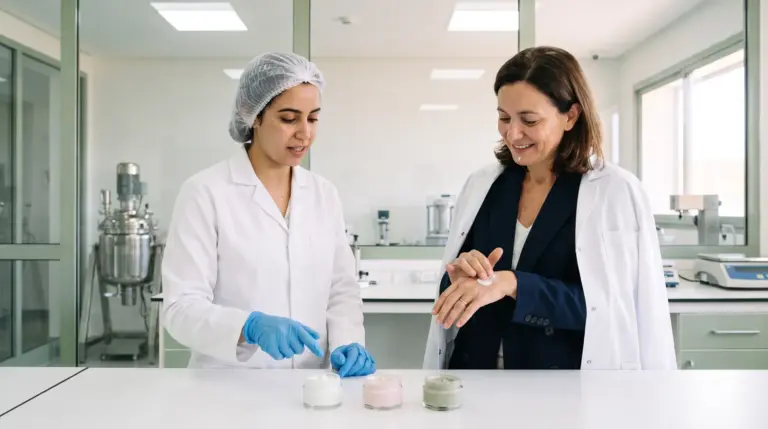
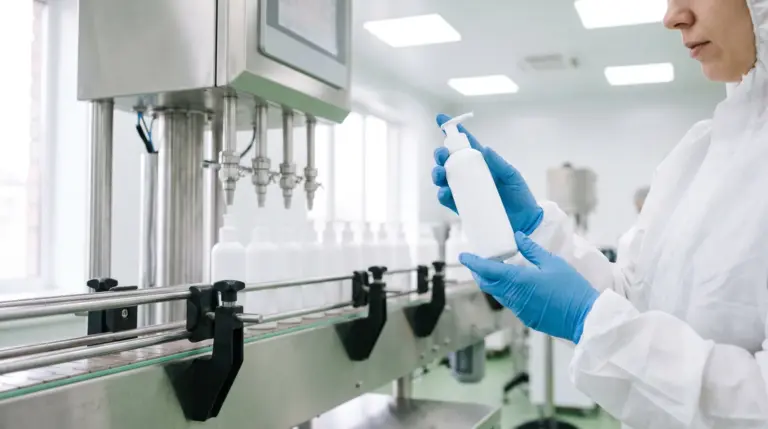
This is where, and only where, the Moroccan lab’s industrial quality comes into play. Article 8 of the regulation requires manufacturing in line with Good Manufacturing Practices (GMP). The EN ISO 22716 standard gives a presumption of conformity with this requirement. An ISO 22716 certified Moroccan lab therefore meets, by design, the “manufacturing” pillar of EU standards: the same standard as its European counterparts.
5. Ingredient compliance
No prohibited substances (Annex II), compliance with restrictions and maximum concentrations (Annex III), and only authorized preservatives, colorants and UV filters (Annexes V, IV and VI). These annexes are not fixed: they are revised several times a year. A compliant formula is one that is monitored over time, wherever it is made.
6. Labeling (Article 19)
INCI list, nominal content, date of minimum durability or PAO, product function, precautions for use, batch number, EU name and address of the Responsible Person, and, for an imported product, the country of origin (“Made in Morocco”). Labeling must be in the official language of the country where the product is sold.
On top of this comes a cross-cutting requirement, Article 18: the EU bans the sale of products, and ingredients, tested on animals. Alternative methods are therefore mandatory, regardless of the rules in force in Morocco.
What the place of manufacture changes, and what it does not
| Regulatory aspect | Impact of manufacturing in Morocco |
|---|---|
| Applicability of Regulation 1223/2009 | None: it applies as soon as the product is sold in the EU. |
| Responsible Person | Must be established in the EU (importer or representative), never in Morocco. |
| Country of origin statement | Mandatory: “Made in Morocco” appears on the label of the imported product. |
| Manufacturing quality (GMP) | This is the Moroccan factory’s role: ISO 22716 certification. |
| Ingredient compliance | Identical: no prohibited substances, limits respected, everywhere. |
| Animal testing | Product and ingredients must comply with the EU ban, whatever the local rule. |
The table is clear: of six rows, only one really depends on the Moroccan production lab, namely manufacturing quality. The other five belong to the compliance architecture, which is built regardless of borders.
A moving target: why “up to date” matters as much as “compliant”
Compliance is not a one-off achievement; it needs maintenance. Three regulatory developments illustrate this in 2026.
Fragrance allergens (Regulation (EU) 2023/1545). The list of fragrance allergens that must be declared individually on the label grows from 26 to more than 80 substances and groups. The declaration threshold remains 0.001% in leave-on products and 0.01% in rinse-off products. The deadlines are now close: July 31, 2026 for products newly placed on the market, and July 31, 2028 for selling through existing stock. For an exporter, this means revising formulas, CPSRs, CPNP notifications and label artwork: a coordination effort to plan ahead.
Annexes under constant revision. The regulation’s annexes are updated roughly every quarter (reclassified CMR substances, adjusted restrictions). Regulatory monitoring is not optional; it is a permanent function.
The EU no longer includes the UK. Since Brexit, the United Kingdom has applied its own regime: a UK-based Responsible Person, a separate notification and, to date, the old list of 26 allergens. Targeting “Europe” therefore means distinguishing the EU market from the UK market, with two sets of obligations.
The real role of a Moroccan lab: manufacturing excellence
Once you separate the regulatory architecture from the production site, the Moroccan lab’s role becomes clear, and valuable: it is the guarantor of the industrial pillar.
A lab that operates under ISO 22716 (GMP), masters formula compliance with the EU annexes and knows how to build the technical documentation of a product file is structurally able to manufacture for the European market. On the Moroccan side there is also Circular 771, which governs placing products on the local market: a dual regulatory culture (EU and Morocco) that becomes an asset for a brand targeting both shores of the Mediterranean.
This is exactly the positioning of Carmel Cosmetics Labs, a dermocosmetics lab based in Agadir: a new 2,500 m² production unit designed to GMP (ISO 22716), expertise in actives and annexes, and regulatory support built for export. The lab also develops its own dermocosmetic brand, Sublime: concrete proof of R&D capability beyond contract manufacturing alone. The differentiator, here as elsewhere, is not the factory’s address: it is the compliance infrastructure.
From theory to practice: know-how already proven in Europe
And this capability is far from theoretical. The regulatory argument only counts if it holds up in practice, and ours has for years.
Of the 500+ brands supported by Carmel Cosmetics Labs, most are based not in Morocco but in Europe: in France, Belgium, Luxembourg, Switzerland, Italy, Spain, the Netherlands and Germany. These are among the most demanding markets in the world for safety and transparency, and yet these brands chose a Moroccan lab to develop and manufacture their products.
For each one, our support went well beyond production. We built their Product Information Files (PIF) to the most rigorous standards, making sure every safety report was robust. We ran clinical efficacy studies with them: controlled tests that turn a marketing promise into a substantiated claim and feed the “proof of claimed effects” section of the file. And we supported them through to the decisive step: the notification of their products, an essential prerequisite for placing them on the EU market.
In other words, for this lab, EU compliance is not an ambition. It is a proven practice, validated by dozens of brands already on their markets, from Paris to Milan and from Amsterdam to Geneva.
FAQ: cosmetics labs in Morocco and EU compliance
Can a cosmetics lab in Morocco manufacture products that comply with EU standards?
Yes. Regulation (EC) No 1223/2009 applies to every product sold in the EU, whatever its country of manufacture. A Moroccan lab that complies with Good Manufacturing Practices (ISO 22716) and the regulation’s annexes can produce for the European market, provided the brand works with a Responsible Person established in the EU.
Do you need a factory in Europe to sell cosmetics in the EU?
No. EU regulation covers the product and its compliance file, not the place of manufacture. Production in Morocco is fully compatible with selling in the EU, provided all the regulation’s obligations are met.
Who can be the Responsible Person for a product made in Morocco?
The Responsible Person must be established in the European Union. This is usually the importer, or a representative appointed by written mandate. The RP cannot be based in Morocco.
Is ISO 22716 certification enough to sell in the EU?
It covers the “manufacturing” pillar: ISO 22716 gives a presumption of conformity with the Good Manufacturing Practices required by the regulation. But it does not replace the other obligations: CPNP notification, product file, safety report, labeling and ingredient compliance.
Do you have to state “Made in Morocco” on the label?
Yes. For a product imported into the EU, the country of origin must appear on the label, alongside the name and EU address of the Responsible Person.
Do the new allergen rules apply to products made in Morocco?
Yes, as soon as they are sold in the EU. Regulation (EU) 2023/1545 requires the individual declaration of more than 80 fragrance allergens, with compliance due by July 31, 2026 for new products and by July 31, 2028 for existing stock.
Has Carmel already worked with European brands?
Yes. Most of the 500+ brands supported by Carmel Cosmetics Labs are based in Europe, including France, Belgium, Luxembourg, Switzerland, Italy, Spain, the Netherlands and Germany. The lab supported them in building their Product Information File (PIF), running clinical efficacy studies and notifying their products.
Preparing to export a cosmetics brand to Europe? Carmel Cosmetics Labs manufactures to GMP (ISO 22716) and supports the compliance of your formulas. Contact the lab.