









To get ISO 22716 certification, a cosmetics manufacturer puts in place the good manufacturing practices (GMP) described in the standard, then is audited by an independent certification body. If the audit is successful, the certificate is issued for a three-year cycle, with surveillance audits during the cycle.
This guide covers the steps, what the auditor checks and how long the process takes. Are you a brand having your products manufactured? You do not need to be certified yourself: it is your manufacturer that must be. See our ISO 22716 and ISO 9001 certifications.
What is ISO 22716 certification?
ISO 22716 is the international standard for good manufacturing practices for cosmetic products. Published in 2007, it covers the production, control, storage and shipment of cosmetics. Certification confirms, after an independent audit, that a manufacturing site actually applies these good practices.
In Europe, Regulation (EC) No 1223/2009 requires cosmetics to be manufactured according to GMP (Article 8). ISO 22716 is the harmonized standard that gives a presumption of this compliance. Third-party certification is not mandatory in itself, but it is the strongest proof you can show a brand, a distributor or an authority.
Who needs ISO 22716 certification?
- Cosmetics manufacturers and contract manufacturers that produce for themselves or for brands.
- Packaging and filling sites that fill and label cosmetic products.
- Exporting companies: many buyers, distributors and markets ask for proof of GMP.
A brand that outsources all of its manufacturing does not need to be certified: it must choose a certified manufacturer and keep the GMP compliance statement in its product information file (PIF).
The 7 steps to get ISO 22716 certification
1. Run a baseline assessment
The site’s current practices are compared with the requirements of the standard, chapter by chapter: personnel, premises, equipment, raw materials, production, quality control, complaints, documentation. This gap analysis gives you the list of gaps to close.
2. Write the documentation system
The standard is built on written records: procedures, work instructions, specifications, batch records and logs. Every operation that affects product quality must be described, then traced.
3. Bring premises and equipment into compliance
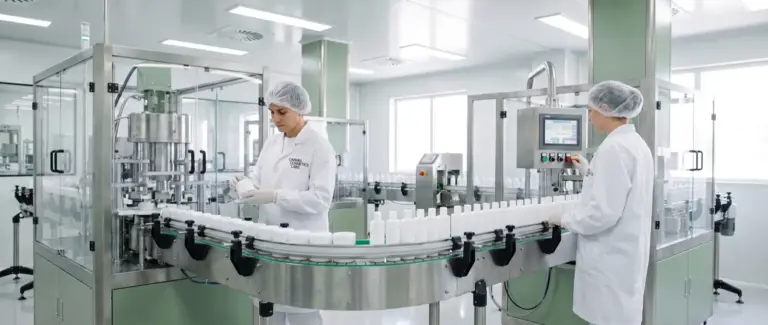
Controlled flows of materials and people, suitable areas, cleaning plans, equipment maintenance and calibration: the standard does not set a list of equipment, but it requires everything to be suitable, clean and under control.
4. Train your staff
Every employee must know their role, the hygiene rules and the procedures that apply to them. Training is recorded.
5. Carry out an internal audit
Before the official audit, an internal audit checks that practices really follow the written procedures. Any gaps found are corrected and documented.
6. Choose a certification body
Several recognized certification bodies audit against ISO 22716. They operate in Morocco as well as in Europe. Carmel Cosmetics Labs, for example, is certified by Bureau Veritas Certification.
7. Pass the certification audit
The auditor visits the site, interviews the teams and checks the records. Any nonconformities must be corrected within a set deadline. The certificate is then issued, maintained through surveillance audits and renewed at the end of the cycle.
How long does it take to get certified?
It mainly depends on your starting point: a site that already applies structured practices has fewer gaps to close than a site starting from scratch. You should generally allow several months between the baseline assessment and the audit. Once obtained, the certificate covers a three-year cycle, with surveillance audits.
What the auditor checks
The audit follows the 17 chapters of the standard. The points most closely examined in practice:
- traceability of a batch, from raw material to finished product;
- the batch record and manufacturing records;
- quality control before release and retention of samples;
- handling of out-of-specification products, deviations and complaints;
- change control and internal audits.
We explain the 17 chapters of the ISO 22716 standard and the journey of a batch on our certifications page.
How to check a manufacturer’s certificate
Before entrusting your production, check five points on the certificate: the body that issued it, the exact standard (ISO 22716:2007), the scope (it must include manufacturing), the address of the certified site and the validity dates.
Are you a brand? Work with a certified manufacturer
Rather than certifying your own site, entrust your production to a manufacturer that is already certified. Our factory in Aït Melloul (Greater Agadir) has been certified ISO 22716 since 2022 and ISO 9001 since 2023 by Bureau Veritas, with certifications valid until 2028. We provide the GMP compliance statement for your PIF.