Services

Torn between two services?A project manager will guide you

Catalog

Explore the full catalog1,000+ formulas ready to carry your brand

Face careFull range

Serums, creams and targeted care, formulated with your actives.

Body careFull range

Moisturizing, nourishing and shower care: cream, butter or oil.

Specialty careFull range

Sun care, lips, intimate care and oral care.

Men, baby, makeupFull range

Shaving and beard, baby and mom, makeup.

Industries

All solutions by industryFormulas and formats for your business

Our brands

Our own brands, developed and made in our laboratory.

Become a distributor of our brandsPharmacies, spas, shops and wholesalers

Laboratory

Cosmetics manufacturing room with a row of stainless-steel mixers and an operator in white workwearOur factory in Aït MelloulISO 22716 and ISO 9001, visits by appointmentDiscover the factory

Resources

Hydrolyzed keratin

Hydrolyzed keratin is a material made mostly of partially hydrolyzed keratin, used as a hair conditioner and film former1. Depending on the size of its fragments, it penetrates the hair cortex or stays on the surface3. The CIR panel judges it safe in current uses2. "Keratin" smoothing products, on the other hand, have contained formaldehyde7, which is banned in cosmetics in the EU9.

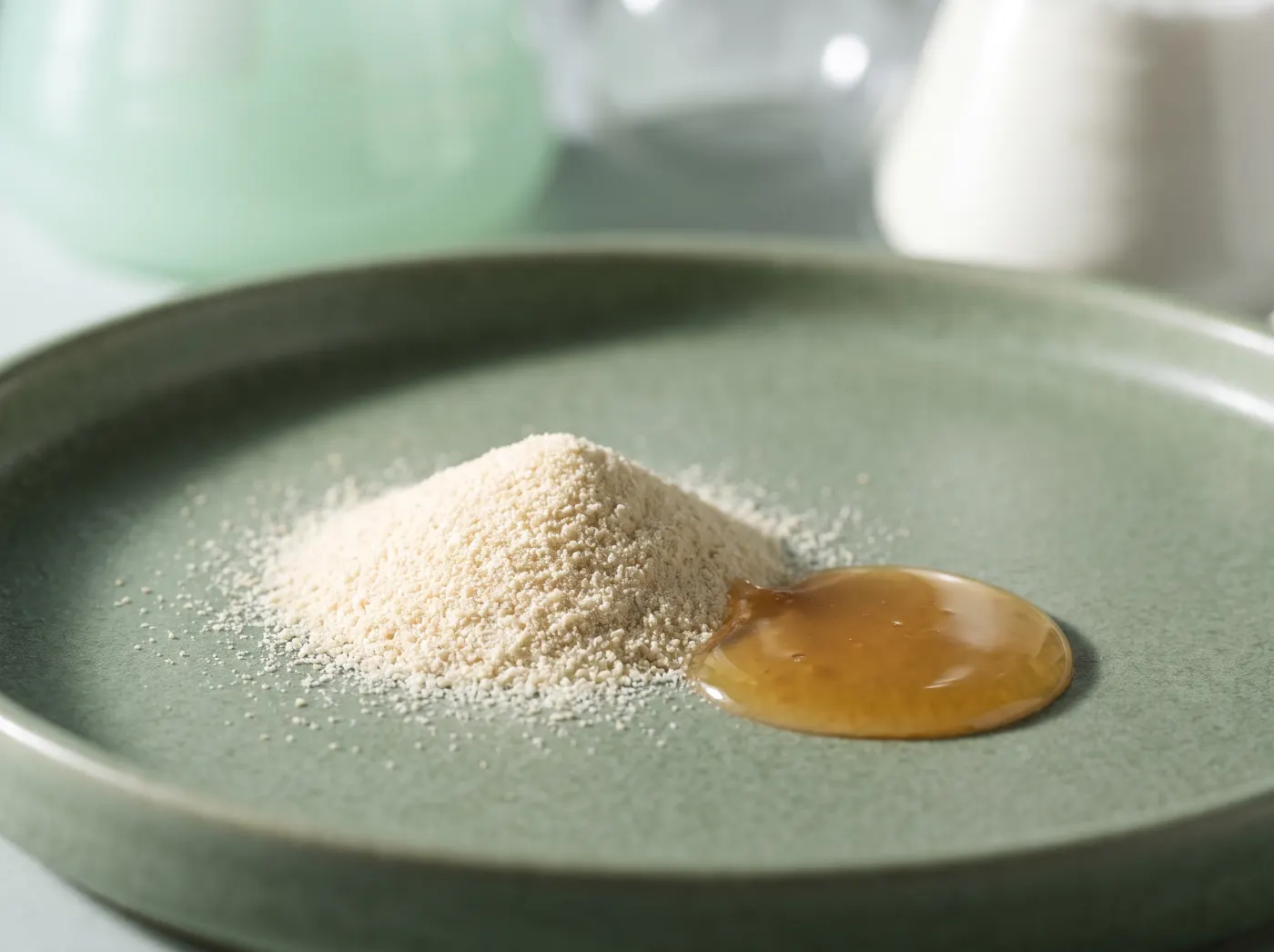
Fine hydrolyzed keratin powder in macro view on a sage green ceramic surface, raking light

Hydrolyzed keratin at a glance

Entry from our cosmetic ingredient glossary. Regulatory data from the European Commission's CosIng database1, safety according to the CIR expert panel2. Copy the identifiers in one click for your files.

INCI name
HYDROLYZED KERATIN
Other names
Keratin hydrolysate"Keratins, hydrolyzates" in CosIng1
CAS number
69430-36-0
EC number
274-001-1
Nature
Partially hydrolyzed keratinBiological material made mostly of keratin hydrolyzed into fragments1
Origin
AnimalWool in the studies cited35; to be specified in the specification sheet
Fragment size
Varies by processStudied: 221 Da, about 2,577 Da and about 75,440 Da3, or under 1,000 Da5
CosIng functions
Hair conditioning, film forming, humectant, antistaticAlso skin conditioning1
EU status
No restrictionNot listed in the annexes of Regulation (EC) 1223/20091. Formaldehyde, however, is banned: Annex II, entry 1577910
Glyoxylic acid
Not in the annexes to dateCosIng function "hair waving or straightening"13. SCCS opinion requested on May 4, 202614
Allergen to declare
No
Safety
Judged safe in cosmeticsThe CIR panel concludes that the 8 keratin-derived ingredients assessed are safe in current uses2

What the research says

Each result shows the protocol and the level of evidence. The higher the level, the better the result carries over to a finished formula.

Clinical trialReview or consensusLaboratory

HairHaircare

Fragment size decides penetration

Laboratory
Wool keratin at 221, 2,577 and 75,440 DaRelaxed tightly curled hairIsolated fibers, tensile tests

Small and medium fragments penetrate deep into the cortex; the largest mostly deposit on the surface. Medium and high molecular weight peptides increase Young's modulus (fiber stiffness) and reduce breakage at 20% and 80% relative humidity. Laboratory study, co-author from a manufacturer3.

Protein-based cosmetics that protect the fiber

Review
2022 review

The authors report positive effects of protein-based cosmetics on hair protection and on properties such as strength, shape and volume. They highlight the potential of keratin particles4.

SkinSkincare

Wool keratin peptide: hydration and elasticity

Clinical trial
Peptide under 1,000 DaLong-term in vivo studiesAqueous solution or with wool lipids

Treated areas show higher hydration and elasticity, a stronger skin barrier and better water retention. The combination with wool lipids gives the best results. The abstract does not give the number of participants5.

Keratin smoothing products: what the studies saySafety

"Keratin" smoothing products containing formaldehyde or its derivatives

Review
2013 review

The authors note that many salon products contain formaldehyde or its derivatives, yet are marketed as safe6.

6 products out of 7 above 0.96% formaldehyde

Product analysis
7 brands sold in South Africa in 2012Liquid chromatography

Six brands contain 0.96 to 1.4% formaldehyde, 5 times the 0.2% limit retained by the CIR. Five of them were labeled "formaldehyde free"7.

Exposure that can exceed salon limits

Salon simulation
4 products on mannequin hair88 air samples

Formaldehyde content of the products: 11.5%, 8.3%, 3% and 0%. Mean air concentrations of 0.08 to 3.47 ppm during drying. Even products labeled "formaldehyde free" can produce concentrations equal to or above occupational exposure limits8.

Glyoxylic acid: crystalline nephropathy in mice

Mice and clinical case
Cream with 10% glyoxylic acidSmoothing product testedSkin application

Glyoxylic acid, absorbed through the skin and converted to oxalate, caused calcium oxalate crystal nephropathy in mice. The authors recommend stopping cosmetic products that contain it11.

34 people with acute kidney injury after a smoothing product

Systematic review
8 publications36 episodes

For 20 episodes, the product was labeled "formaldehyde free"; for 16, its composition was unknown. Everyone recovered. The authors call for caution with smoothing products12.


Ingredient safetyDermatology

8 keratin derivatives judged safe

Expert opinion
CIR panel, 2021 report

The panel concludes that the 8 keratin-derived ingredients assessed are safe in the uses and concentrations described. They mostly serve as skin and hair conditioning agents2.

This page summarizes published literature on a cosmetic ingredient. It does not describe the effect of a finished product, which depends on its formula, and it is not medical advice. The level of evidence for hydrolyzed keratin is modest: laboratory tests on fibers and one skin study, few clinical trials. The studies on smoothing products concern the safety of those products, not keratin itself. Studies affiliated with a manufacturer are flagged in the sources.

Which products use hydrolyzed keratin?

Our white label catalog includes 8 formulas with keratin: the key active in 6 of them, a supporting ingredient in the others. Every category can be customized (formula, fragrance, packaging).

8Hair

Signature active in the masks, shampoo, serum and conditioners; also found in the styling wax, the smoothing product and the heat protectant spray.

In our formulas, it is most often paired with

Argan oil 4Shea butter 3Coconut oil 2Castor oil 2

Frequently asked questions about hydrolyzed keratin

What is hydrolyzed keratin?
It is a biological material made mostly of keratin, a fibrous protein, cut into fragments by hydrolysis1. It appears on labels under the INCI name HYDROLYZED KERATIN and works as a hair conditioner, film former, humectant and antistatic agent1.
What does keratin do in hair care?
It depends on the size of the fragments. On relaxed afro-textured hair, fragments of 221 and 2,577 Da penetrate the cortex while those of 75,440 Da stay mostly on the surface; medium and high molecular weight peptides reduce breakage3. A review concludes that protein-based cosmetics protect the fiber4.
Does hydrolyzed keratin smooth hair for good?
The studies cited show no lasting smoothing effect of hydrolyzed keratin: they measure penetration, strength and breakage34. "Brazilian" smoothing products, which hold a straight shape even on wet hair, have been linked to formaldehyde or its derivatives67. The smoothing effect of a product must therefore be justified by its complete formula, not by keratin alone.
Does a Brazilian keratin smoothing product contain formaldehyde?
It has: out of 7 brands tested, 6 contained 0.96 to 1.4%, including 5 labeled "formaldehyde free"7. In the EU, formaldehyde is banned in cosmetics (Annex II, entry 1577, along with paraformaldehyde and methanediol, entries 1578 and 1579)910. Preservatives in Annex V that release it require the statement "Releases formaldehyde" above 0.001%9. The smoothing formula in our catalog is presented as formaldehyde free; the complete INCI list is provided with the quote.
What about glyoxylic acid, used instead of formaldehyde?
Glyoxylic acid (CAS 298-12-4) has the CosIng function "hair waving or straightening"13. It is not listed in any annex of the regulation, but kidney damage after smoothing products has been reported: crystalline nephropathy in mice11 and 34 people in a 2025 review12. On May 4, 2026, the Commission asked the SCCS to assess its safety in cosmetic products14. Until its opinion is published, check the INCI list of any smoothing product.

Is hydrolyzed keratin of animal origin?
The studies cited use wool keratin35. It is a biological material: its origin and hydrolysis process must be specified in the specification sheet, especially for any ethical or plant-based claim.
Is hydrolyzed keratin safe?
The CIR panel judges the 8 keratin-derived ingredients it assessed to be safe2. Protein hydrolysates can rarely cause contact urticaria: in a Finnish study, the people who reacted, all atopic, reacted to at least one collagen derivative15. A tolerance test of the final formula is still advised.


Can you manufacture a keratin mask for my brand?
Yes. Our ISO 22716 certified lab offers 8 keratin formulas (mask, shampoo, conditioners, serum, styling wax, smoothing product) that you can customize, or a custom formula. Samples are free.

Sources

Peer-reviewed studies and official regulatory sources, checked on November 3, 2026.

  1. European Commission. CosIng, entry HYDROLYZED KERATIN (CAS 69430-36-0, EC 274-001-1). ec.europa.eu/growth/tools-databases/cosing
  2. Burnett CL, Bergfeld WF, Belsito DV, et al. Safety assessment of keratin and keratin-derived ingredients as used in cosmetics. Int J Toxicol. 2021;40(2_suppl):36S-51S. doi:10.1177/10915818211013019
  3. Malinauskyte E, Shrestha R, Cornwell PA, et al. Penetration of different molecular weight hydrolysed keratins into hair fibres and their effects on the physical properties of textured hair. Int J Cosmet Sci. 2021;43(1):26-37. doi:10.1111/ics.12663Croda (co-author)
  4. Tinoco A, Martins M, Cavaco-Paulo A, Ribeiro A. Biotechnology of functional proteins and peptides for hair cosmetic formulations. Trends Biotechnol. 2022;40(5):591-605. doi:10.1016/j.tibtech.2021.09.010
  5. Barba C, Méndez S, Roddick-Lanzilotta A, et al. Cosmetic effectiveness of topically applied hydrolysed keratin peptides and lipids derived from wool. Skin Res Technol. 2008;14(2):243-248. doi:10.1111/j.1600-0846.2007.00280.x
  6. Weathersby C, McMichael A. Brazilian keratin hair treatment: a review. J Cosmet Dermatol. 2013;12(2):144-148. doi:10.1111/jocd.12030
  7. Maneli MH, Smith P, Khumalo NP. Elevated formaldehyde concentration in « Brazilian keratin type » hair-straightening products: a cross-sectional study. J Am Acad Dermatol. 2014;70(2):276-280. doi:10.1016/j.jaad.2013.10.023
  8. Pierce JS, Abelmann A, Spicer LJ, et al. Characterization of formaldehyde exposure resulting from the use of four professional hair straightening products. J Occup Environ Hyg. 2011;8(11):686-699. doi:10.1080/15459624.2011.626259
  9. European Parliament and Council. Regulation (EC) No 1223/2009 on cosmetic products, consolidated version of 1 May 2025: Annex II, entries 1577 to 1579; Annex V, preamble, point 2. eur-lex.europa.eu
  10. European Commission. CosIng, entry FORMALDEHYDE (CAS 50-00-0, EC 200-001-8; Annex II, entry 1577). ec.europa.eu/growth/tools-databases/cosing
  11. Robert T, Tang E, Kervadec J, et al. Hair-straightening cosmetics containing glyoxylic acid induce crystalline nephropathy. Kidney Int. 2024;106(6):1117-1123. doi:10.1016/j.kint.2024.07.032
  12. Aamir AB, Latif R, Sorath F, et al. Acute kidney injury induced by topical hair straightening products: a systematic review. World J Nephrol. 2025;14(4):112796. doi:10.5527/wjn.v14.i4.112796
  13. European Commission. CosIng, entry GLYOXYLIC ACID (CAS 298-12-4, EC 206-058-5). ec.europa.eu/growth/tools-databases/cosing
  14. European Commission, DG SANTE. SCCS - Request for a scientific opinion on the safety of glyoxylic acid when used in cosmetic products. Published May 4, 2026. health.ec.europa.eu
  15. Niinimäki A, Niinimäki M, Mäkinen-Kiljunen S, Hannuksela M. Contact urticaria from protein hydrolysates in hair conditioners. Allergy. 1998;53(11):1078-1082. doi:10.1111/j.1398-9995.1998.tb03818.x
Carmel Cosmetics Labs product specialist with a brand founder

Tell us about your project

A product specialist reviews your request and gets back to you on the channel you prefer.

Lead EN – Demande de devis
Tell us about your project. A product specialist will get back to you shortly.
CONTACT INFORMATION
Name
PROJECT INFORMATION
Which cosmetics category interests you most?

By submitting this form, you agree to our terms of service and privacy policy.

No obligation. Your information stays confidential and is used only to prepare your quote.