











































Services

Torn between two services?A project manager will guide you

Catalog

Explore the full catalog1,000+ formulas ready to carry your brand

Face careFull range

Serums, creams and targeted care, formulated with your actives.

Body careFull range

Moisturizing, nourishing and shower care: cream, butter or oil.

Specialty careFull range

Sun care, lips, intimate care and oral care.

Men, baby, makeupFull range

Shaving and beard, baby and mom, makeup.

Industries

All solutions by industryFormulas and formats for your business

Laboratory

Cosmetics manufacturing room with a row of stainless-steel mixers and an operator in white workwearOur factory in Aït MelloulISO 22716 and ISO 9001, visits by appointmentDiscover the factory

Resources

Shea butter

Shea butter is the fat extracted from the nuts of the shea tree (Vitellaria paradoxa), a tree of sub-Saharan Africa. It is mostly made of stearic and oleic acids12, with an unsaponifiable fraction rich in triterpenes1. CosIng classifies it as a skin conditioning agent9. Its composition varies with origin2.
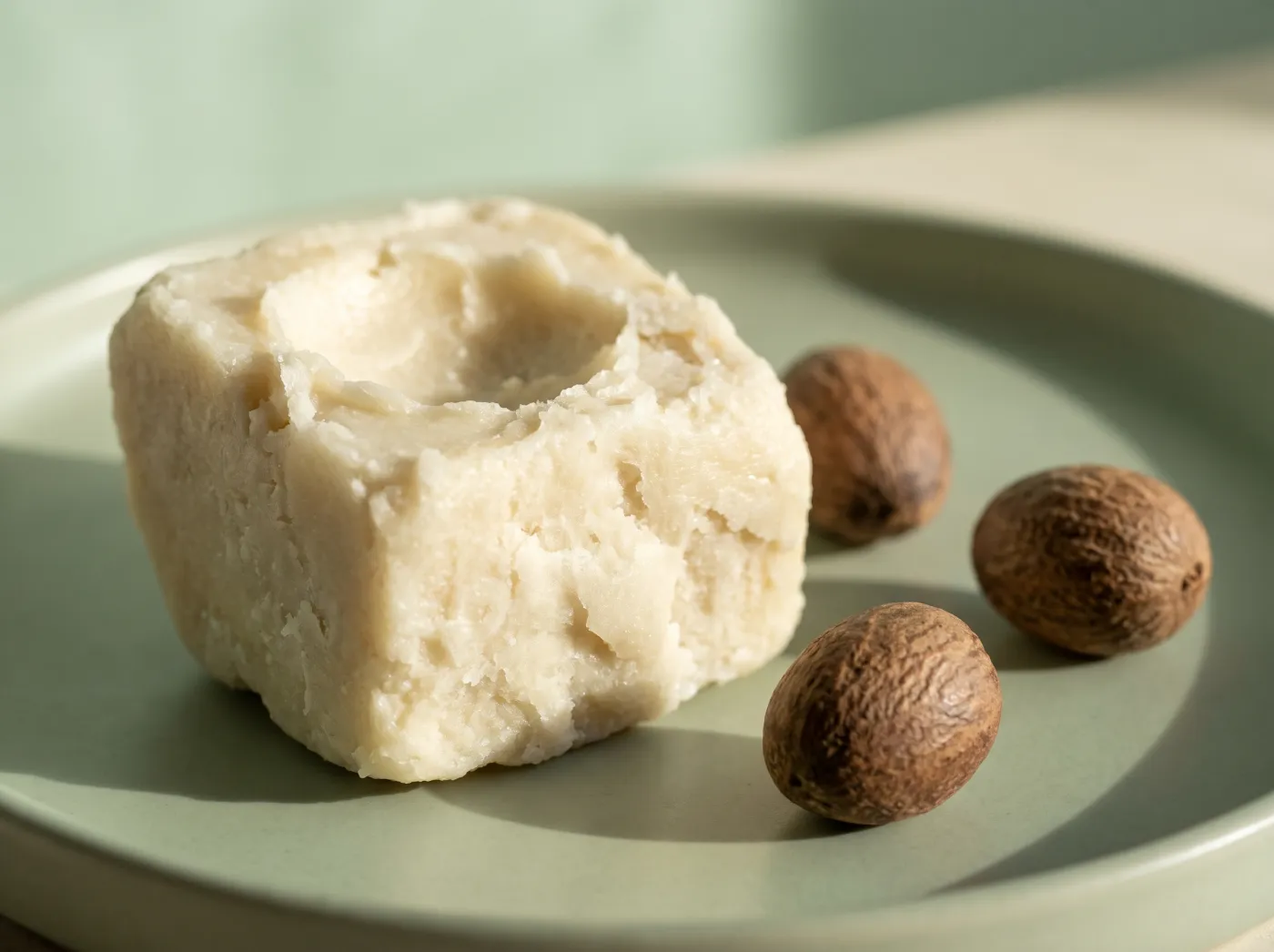
Raw shea butter in macro view, creamy texture and fine grain, on a sage green ceramic surface

Shea butter at a glance

Entry from our cosmetic ingredient glossary. Regulatory data from the European Commission's CosIng database9, safety according to the CIR expert panel8. Copy the identifiers in one click for your files.

INCI name
BUTYROSPERMUM PARKII BUTTER
Other names
Shea butterShea butter; Vitellaria paradoxa (botanical name used in the literature)
CAS number
194043-92-0CosIng also lists 91080-23-89
EC number
293-515-7
Botanical origin
Shea tree (Sapotaceae)Fat obtained from the fruit, INCI name based on Butyrospermum parkii9
Producing countries studied
Sub-Saharan AfricaMali, Burkina Faso, Nigeria, Uganda2; Ivory Coast, Ghana, Cameroon, Chad, Sudan1
Main fatty acids
Stearic and oleicStearic 28 to 56%, oleic 34 to 61% depending on origin1
Unsaponifiable matter
2 to 12% of the fatOf which 22 to 72% triterpene alcohols: alpha-amyrin, beta-amyrin, lupeol, butyrospermol1
CosIng functions
Skin conditioning, viscosity controlling"Skin conditioning" and "viscosity controlling" in the European nomenclature9
EU status
No restrictionNot listed in the annexes of Regulation (EC) 1223/20099
Allergen to declare
No
Safety
Judged safe in cosmeticsCIR panel, provided it is formulated to be non-sensitizing8

What the research says

Each result shows the protocol and the level of evidence. The higher the level, the better the result carries over to a finished formula.

Clinical trialReview or consensusLaboratory

Composition and materialChemistry

A butter rich in stearic and oleic acids

Laboratory
36 samples7 sub-Saharan African countries

Stearic acid makes up 28 to 56% of the fatty acids and oleic acid 34 to 61%. West African shea is generally richer in stearic acid and triterpenes than East African shea1.

A composition that varies with origin

Laboratory
150 samplesMali, Burkina Faso, Nigeria, Uganda

Triglycerides, fatty acids and triterpenes vary strongly from one batch to another. Oleic acid dominates in Ugandan provenances, stearic acid in West African ones2. Fixing an origin and a specification with the supplier is therefore useful.

Refining changes the minor compounds

Laboratory
Crude butter, refined stearin and olein

Stearic and oleic remain the two main fatty acids. Refined stearin contains fewer tocopherols, sterols and phenolic compounds than crude butter. Refined olein keeps similar levels4.

Published values vary widely

Review
2014 reviewNut, pulp and butter

The authors note large variations in the reported compositions and recommend more precise analyses to make the quality and shelf life of the butter more reliable3.

Skin and bodySkincare, bodycare

No effect on SPF in lipsticks

Laboratory
12 formulasDesign of experimentsIn vitro SPF

Titanium dioxide and the chemical filter changed the in vitro SPF; shea butter had no influence. It mainly affected the texture and melting point of the formulas5.

Few dedicated cosmetic clinical trials

Review
2022 review27 clinical studies17 oils and butters

Shea is one of the 17 vegetable materials examined, but the clinical studies mostly cover other oils. On healthy skin, oils rich in oleic acid do not seem to have a negative effect; frequency and duration of use matter6.

Safety and expert viewsToxicology

Thirteen shea-derived ingredients judged safe

Expert assessment
2024 CIR panel13 shea-derived ingredients

Used mainly as skin and hair conditioning agents, they are judged safe in current uses and concentrations, provided they are formulated to be non-sensitizing8.

No IgE-binding soluble protein

Laboratory
Laboratory analysis of shea butter

The analysis detected no IgE-binding soluble proteins in shea butter7. This is a useful point for the safety file; INCI labeling remains mandatory.

This page summarizes published literature on a cosmetic ingredient. It does not describe the effect of a finished product, which depends on its formula, and it is not medical advice. Several of the studies cited were run or funded by industry; this is indicated in the sources.

Which products use shea butter?

Our white label catalog includes 65 formulas with shea butter: the key active in 20 of them, a supporting ingredient in the others. Every category can be customized (formula, fragrance, packaging).

Shea butter, coconut oil, jojoba oil or castor oil?

Four vegetable fats often compared when choosing the base of a care product. Their chemistry differs, so their behavior in a formula does too.

Shea butterCoconut oilJojoba oilCastor oil
Chemical natureButter: stearic (28 to 56%) and oleic (34 to 61%) acids1Oil: 92.1% saturated fatty acids, of which 47.7% lauric acid10Liquid wax: about 98% wax esters12Oil: about 90% ricinoleic acid11
EU regulationNo restrictionNo restrictionNo restrictionNo restriction
Carmel catalog formulas65 formulas65 formulas25 formulas25 formulas

Frequently asked questions about shea butter

What is shea butter?
It is the fat extracted from the nuts of the shea tree, a tree of sub-Saharan Africa. It is mostly made of stearic and oleic acids1 and contains an unsaponifiable fraction rich in triterpenes. Its INCI name is BUTYROSPERMUM PARKII BUTTER.
What are the benefits of shea butter in cosmetics?
CosIng classifies it as a skin conditioning and viscosity controlling agent9. Dedicated cosmetic clinical trials on shea alone remain few6: this page therefore gives it no quantified effect. In a formula, it is valued for its texture and its supply of fat.
Is shea butter good for hair?
It is very common in hair care, notably for textured hair, and our catalog includes shea masks and styling creams. We found no published controlled study measuring its effect alone on hair: we talk about a formulation use, not a demonstrated effect.
Pure, raw or refined shea butter?
Refining changes the minor compounds: refined stearin contains fewer tocopherols, sterols and phenolic compounds than crude butter4. The choice depends on the color, odor and stability you want. Composition also varies with origin2, hence the value of a supplier specification.
Does shea butter protect from the sun?
Not in a measurable way in the study cited: in lipsticks, shea butter had no influence on in vitro SPF, unlike titanium dioxide and the chemical filter5. Sun protection relies on approved filters.
Is shea butter safe, and what about pregnancy?
The CIR panel judges shea-derived ingredients safe in current uses, provided they are formulated to be non-sensitizing8, and they are not restricted in the EU9. One analysis detected no IgE-binding soluble proteins7. During pregnancy, as with any skincare product, a healthcare professional's advice remains the rule.
Can you manufacture a shea butter balm or body butter for my brand?
Yes. Our ISO 22716 certified lab offers 65 shea formulas (body butters and balms, creams, hair masks, lip balms, scrubs) that you can customize, or a custom formula. Samples are free.

Sources

Peer-reviewed studies and official regulatory sources, checked on November 2, 2026.

  1. Akihisa T, Kojima N, Katoh N, et al. Triterpene alcohol and fatty acid composition of shea nuts from seven African countries J Oleo Sci. 2010;59(7):351-360. doi:10.5650/jos.59.351
  2. Di Vincenzo D, Maranz S, Serraiocco A, et al. Regional variation in shea butter lipid and triterpene composition in four African countries J Agric Food Chem. 2005;53(19):7473-7479. doi:10.1021/jf0509759
  3. Honfo FG, Akissoe N, Linnemann AR, et al. Nutritional composition of shea products and chemical properties of shea butter: a review Crit Rev Food Sci Nutr. 2014;54(5):673-686. doi:10.1080/10408398.2011.604142
  4. Abdel-Razek AG, Abo-Elwafa GA, Al-Amrousi EF, et al. Effect of refining and fractionation processes on minor components, fatty acids, antioxidant and antimicrobial activities of shea butter Foods. 2023;12(8):1626. doi:10.3390/foods12081626
  5. Sarruf FD, Cândido TM, de Oliveira CA, et al. Influence of Shea (Butyrospermum parkii) butter, TiO2 and ethylhexyl methoxycinnamate on physical parameters and in vitro photoprotective efficacy J Cosmet Dermatol. 2020;19(8):2076-2085. doi:10.1111/jocd.13238
  6. Poljšak N, Kočevar Glavač N. Vegetable butters and oils as therapeutically and cosmetically active ingredients for dermal use: a review of clinical studies Front Pharmacol. 2022;13:868461. doi:10.3389/fphar.2022.868461
  7. Chawla KK, Bencharitiwong R, Ayuso R, et al. Shea butter contains no IgE-binding soluble proteins J Allergy Clin Immunol. 2011;127(3):680-682. doi:10.1016/j.jaci.2010.10.022
  8. Burnett CL, Bergfeld WF, Belsito DV, et al. Safety assessment of Butyrospermum parkii (shea)-derived ingredients as used in cosmetics Int J Toxicol. 2024;43(1_suppl):82S-95S. doi:10.1177/10915818231224230
  9. European Commission. CosIng, entry BUTYROSPERMUM PARKII BUTTER (CAS 194043-92-0 / 91080-23-8, CE 293-515-7). ec.europa.eu/growth/tools-databases/cosing
  10. Orsavova J, Misurcova L, Ambrozova JV, et al. Fatty acids composition of vegetable oils and its contribution to dietary energy intake and dependence of cardiovascular mortality on dietary intake of fatty acids Int J Mol Sci. 2015;16(6):12871-12890. doi:10.3390/ijms160612871
  11. Girdler K, Cabatu A, Olds H, Potts GA. Use of castor oil in dermatology: a narrative review Cureus. 2026;18(2):e103289. doi:10.7759/cureus.103289
  12. Gad HA, Roberts A, Hamzi SH, et al. Jojoba oil: an updated comprehensive review on chemistry, pharmaceutical uses, and toxicity Polymers (Basel). 2021;13(11):1711. doi:10.3390/polym13111711
Carmel Cosmetics Labs product specialist with a brand founder

Tell us about your project

A product specialist reviews your request and gets back to you on the channel you prefer.

Lead EN – Demande de devis
Tell us about your project. A product specialist will get back to you shortly.
CONTACT INFORMATION
Name
PROJECT INFORMATION
Which cosmetics category interests you most?

By submitting this form, you agree to our terms of service and privacy policy.

No obligation. Your information stays confidential and is used only to prepare your quote.
