











































Services

Torn between two services?A project manager will guide you

Catalog

Explore the full catalog1,000+ formulas ready to carry your brand

Face careFull range

Serums, creams and targeted care, formulated with your actives.

Body careFull range

Moisturizing, nourishing and shower care: cream, butter or oil.

Specialty careFull range

Sun care, lips, intimate care and oral care.

Men, baby, makeupFull range

Shaving and beard, baby and mom, makeup.

Industries

All solutions by industryFormulas and formats for your business

Laboratory

Cosmetics manufacturing room with a row of stainless-steel mixers and an operator in white workwearOur factory in Aït MelloulISO 22716 and ISO 9001, visits by appointmentDiscover the factory

Resources

Castor oil

Castor oil is the fixed oil extracted from the seeds of Ricinus communis4. It is made of about 90% ricinoleic acid1 and contains no ricin2. The CIR panel judges it safe in cosmetics3. On hair, the evidence is weak and shows no growth5.
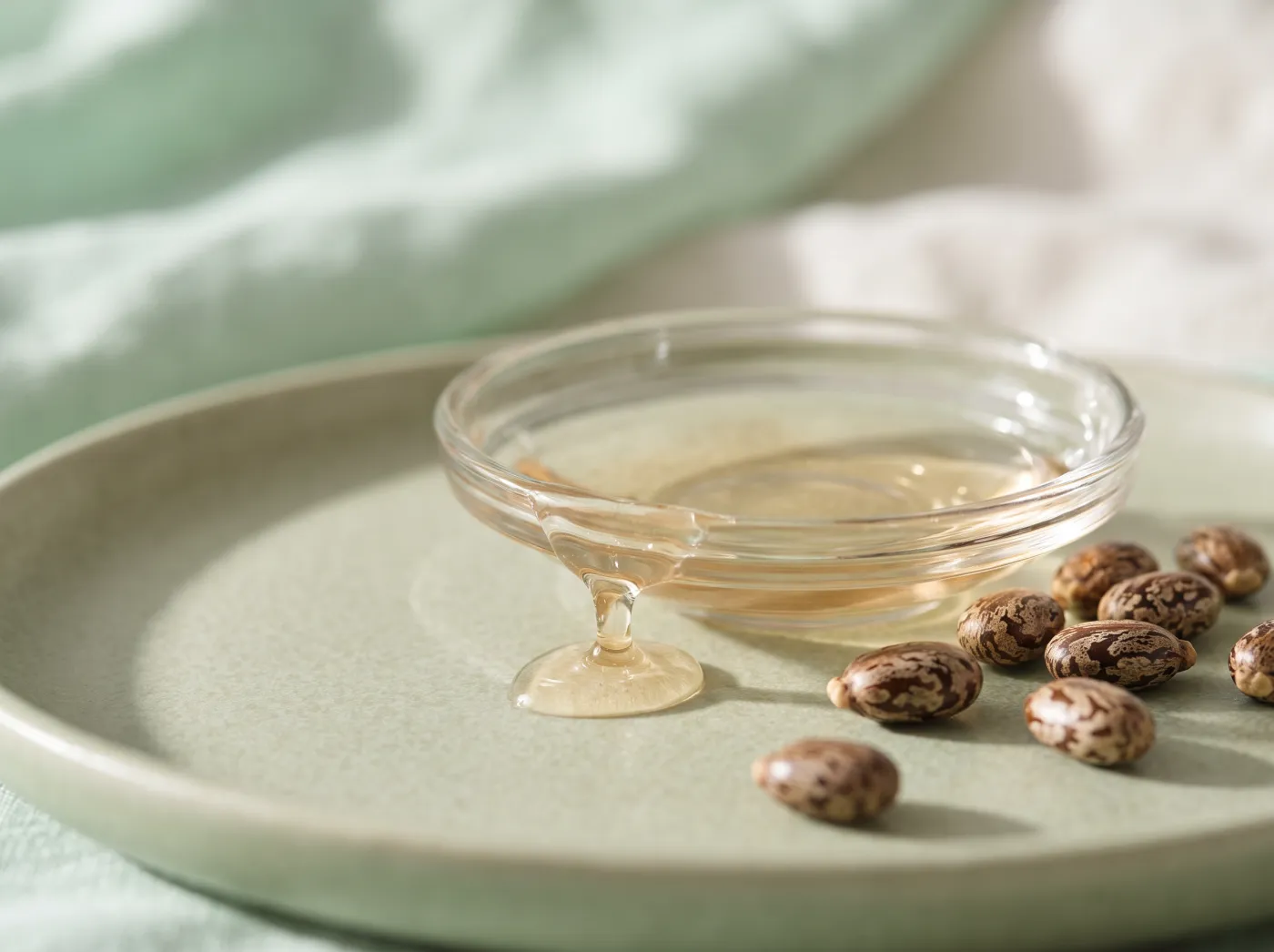
Amber castor oil in macro view, a thick glossy drop on a sage green ceramic surface

Castor oil at a glance

Entry from our cosmetic ingredient glossary. Regulatory data from the European Commission's CosIng database4, safety according to the CIR expert panel3. Copy the identifiers in one click for your files.

INCI name
RICINUS COMMUNIS SEED OIL
Other names
Castor oilCastor oil; ricini oleum (European Pharmacopoeia)4
CAS number
8001-79-4
EC number
232-293-8
Botanical origin
Castor plant (Euphorbiaceae)Fixed oil from the seeds of Ricinus communis4; plant native to northeastern Africa and India1
Main fatty acid
Ricinoleic acidAbout 90% of the fatty acids1
CosIng functions
Skin conditioningAlso listed as a perfuming agent4
EU status
No restrictionNot listed in the annexes of Regulation (EC) 1223/20094
Allergen to declare
NoRicin, the seed toxin, does not pass into the oil2
Safety
Judged safe in cosmeticsCIR panel: conclusion in 2007, confirmed at the 2025 re-review23

What the research says

Each result shows the protocol and the level of evidence. The higher the level, the better the result carries over to a finished formula.

Clinical trialReview or consensusLaboratory

Composition and qualityChemistry

About 90% ricinoleic acid

Review
2026 narrative review

Ricinoleic acid, a hydroxylated monounsaturated fatty acid, makes up about 90% of the fatty acids in the oil1.

Cosmetic castor oils sometimes cut with other oils

Laboratory
9 commercial cosmetic castor oilsChromatography and mass spectrometry

Three of the nine samples contained little ricinoleic acid, a sign of blending with other vegetable oils. Measuring the fatty acid profile is a useful quality check at purchase10.

Scalp and hairHaircare

Shine: weak evidence. Growth: no solid evidence

Review
2022 systematic review22 articles includedCoconut, castor, argan

The evidence for improved hair shine is weaker than for coconut oil, and there is no solid evidence of an effect on growth5.

Growth hypothesis: computer modeling only

Laboratory
In silico study389 constituents from 12 plantsMolecular docking

Computer modeling predicts that ricinoleic acid could bind to an enzyme linked to hair shedding. This is a prediction, not a measurement: the authors describe leads for future studies7. No human trial is cited here.

Studies on hair oils remain scarce and animal-based

Review
2023 narrative reviewCastor oil, pumpkin seed oil, essential oils

The authors note that most studies on hair oils were run on mice and that more research is needed6.

A rare risk: tangled hair

Case report
Reported caseCoconut and castor oils

A case of acute, irreversible felting of long hair was described after both oils were applied after washing. The authors point to the viscosity of castor oil9.

Skin and bodySkincare

Dark circle shade: an exploratory trial without a control group

Clinical trial
Castor oil cream2 applications a day, 2 months25 enrolled, 22 analyzedNo control group

Instrumental measurements of under-eye color went down, as did melanin, wrinkles and sagging. Without a control group, the effect of the oil itself is not established: the authors call for a randomized trial8.

Safety and expert viewsToxicology

Judged safe in 2007, confirmed in 2025

Expert assessment
2007 CIR panel and 2025 re-review

Castor oil, ricinoleic acid and several ricinoleates are judged safe in the uses and concentrations described3. The highest use concentration reported in 2007 is 81%, in lipsticks2.

No ricin in the oil

Review
2007 CIR assessment

Ricin does not pass into the oil. The oil and ricinoleic acid may also increase the penetration of other substances through the skin2, a point to keep in mind for formulas that combine actives.

This page summarizes published literature on a cosmetic ingredient. It does not describe the effect of a finished product, which depends on its formula, and it is not medical advice. Several of the studies cited were run or funded by industry; this is indicated in the sources.

Which products use castor oil?

Our white label catalog includes 25 formulas with castor oil: the key active in 10 of them, a supporting ingredient in the others. Every category can be customized (formula, fragrance, packaging).

Castor oil, shea butter, coconut oil or jojoba oil?

Four vegetable fats often compared when choosing the base of a care product. Their chemistry differs, so their behavior in a formula does too.

Castor oilShea butterCoconut oilJojoba oil
Chemical natureOil: about 90% ricinoleic acid1Butter: stearic (28 to 56%) and oleic (34 to 61%) acids11Oil: 92.1% saturated fatty acids, of which 47.7% lauric acid12Liquid wax: about 98% wax esters13
EU regulationNo restrictionNo restrictionNo restrictionNo restriction
Carmel catalog formulas25 formulas65 formulas65 formulas25 formulas

Frequently asked questions about castor oil

What is castor oil?
It is the oil extracted from the seeds of the castor plant, Ricinus communis4. It contains about 90% ricinoleic acid1. Its INCI name is RICINUS COMMUNIS SEED OIL. The oil contains no ricin2.
What are the benefits of castor oil in cosmetics?
CosIng classifies it as a skin conditioning agent4. It goes into balms and lipsticks, up to 81% in the latter2. Evidence for specific effects is limited: hair shine is less well documented than for coconut oil5, and one exploratory trial without a control group looked at dark circle shade8.
Does castor oil make hair grow?
No solid evidence shows it. A systematic review finds no strong evidence of an effect on growth5, and the ricinoleic acid lead rests only on computer modeling7. A brand therefore cannot promise growth on this basis.
What about castor oil for eyelashes and eyebrows?
We found no peer-reviewed study measuring an effect of castor oil alone on lashes or brows. Demand is high, but in formulation we talk about care and conditioning, not lengthening or regrowth.
Are there risks with castor oil?
The CIR panel judges it safe in current cosmetic uses3 and it is not restricted in the EU4. One case of tangled hair has been reported on long hair, with viscosity blamed9. During pregnancy, as with any skincare product, a healthcare professional's advice remains the rule.
How do you check the quality of a castor oil?
Through the fatty acid profile: in one study, three of nine cosmetic castor oils contained little ricinoleic acid, a sign of blending with other oils10. Ask for a certificate of analysis with the ricinoleic acid content.
Can you manufacture a castor oil product for my brand?
Yes. Our ISO 22716 certified lab offers 25 castor oil formulas (hair oils and serums, lip balms, body balms, beard care) that you can customize, or a custom formula. Samples are free.

Sources

Peer-reviewed studies and official regulatory sources, checked on November 2, 2026.

  1. Girdler K, Cabatu A, Olds H, Potts GA. Use of castor oil in dermatology: a narrative review Cureus. 2026;18(2):e103289. doi:10.7759/cureus.103289
  2. Cosmetic Ingredient Review Expert Panel. Final report on the safety assessment of Ricinus communis (castor) seed oil, hydrogenated castor oil, glyceryl ricinoleate, ricinoleic acid and related ricinoleates Int J Toxicol. 2007;26 Suppl 3:31-77. doi:10.1080/10915810701663150
  3. Fiume MM, Bergfeld WF, Belsito DV, et al. Re-review summary of Ricinus communis (castor) seed oil and ricinoleates as used in cosmetics Int J Toxicol. 2025;44(3_suppl):117S-122S. doi:10.1177/10915818251361102
  4. European Commission. CosIng, entry RICINUS COMMUNIS SEED OIL (CAS 8001-79-4, CE 232-293-8). ec.europa.eu/growth/tools-databases/cosing
  5. Phong C, Lee V, Yale K, et al. Coconut, castor, and argan oil for hair in skin of color patients: a systematic review J Drugs Dermatol. 2022;21(7):751-757. doi:10.36849/JDD.6972
  6. Dinkins J, Iwuala C, Akintilo L, et al. Commonly used hair oils in the Black community: a narrative review in their use to treat androgenetic alopecia Int J Dermatol. 2023;62(8):980-985. doi:10.1111/ijd.16657
  7. Fong P, Tong HH, Ng KH, et al. In silico prediction of prostaglandin D2 synthase inhibitors from herbal constituents for the treatment of hair loss J Ethnopharmacol. 2015;175:470-480. doi:10.1016/j.jep.2015.10.005
  8. Parvizi MM, Saki N, Samimi S, et al. Efficacy of castor oil cream in treating infraorbital hyperpigmentation: an exploratory single-arm clinical trial J Cosmet Dermatol. 2024;23(3):911-917. doi:10.1111/jocd.16056
  9. Maduri VR, Vedachalam A, Kiruthika S. "Castor oil" - the culprit of acute hair felting Int J Trichology. 2017;9(3):116-118. doi:10.4103/ijt.ijt_22_17
  10. Arroyo Negrete MA, Wrobel K, Acevedo Aguilar FJ, et al. Determination of fatty acid methyl esters in cosmetic castor oils by flow injection - electrospray ionization - high resolution mass spectrometry Int J Cosmet Sci. 2018 (publication en ligne). doi:10.1111/ics.12465
  11. Akihisa T, Kojima N, Katoh N, et al. Triterpene alcohol and fatty acid composition of shea nuts from seven African countries J Oleo Sci. 2010;59(7):351-360. doi:10.5650/jos.59.351
  12. Orsavova J, Misurcova L, Ambrozova JV, et al. Fatty acids composition of vegetable oils and its contribution to dietary energy intake and dependence of cardiovascular mortality on dietary intake of fatty acids Int J Mol Sci. 2015;16(6):12871-12890. doi:10.3390/ijms160612871
  13. Gad HA, Roberts A, Hamzi SH, et al. Jojoba oil: an updated comprehensive review on chemistry, pharmaceutical uses, and toxicity Polymers (Basel). 2021;13(11):1711. doi:10.3390/polym13111711
Carmel Cosmetics Labs product specialist with a brand founder

Tell us about your project

A product specialist reviews your request and gets back to you on the channel you prefer.

Lead EN – Demande de devis
Tell us about your project. A product specialist will get back to you shortly.
CONTACT INFORMATION
Name
PROJECT INFORMATION
Which cosmetics category interests you most?

By submitting this form, you agree to our terms of service and privacy policy.

No obligation. Your information stays confidential and is used only to prepare your quote.
