


















































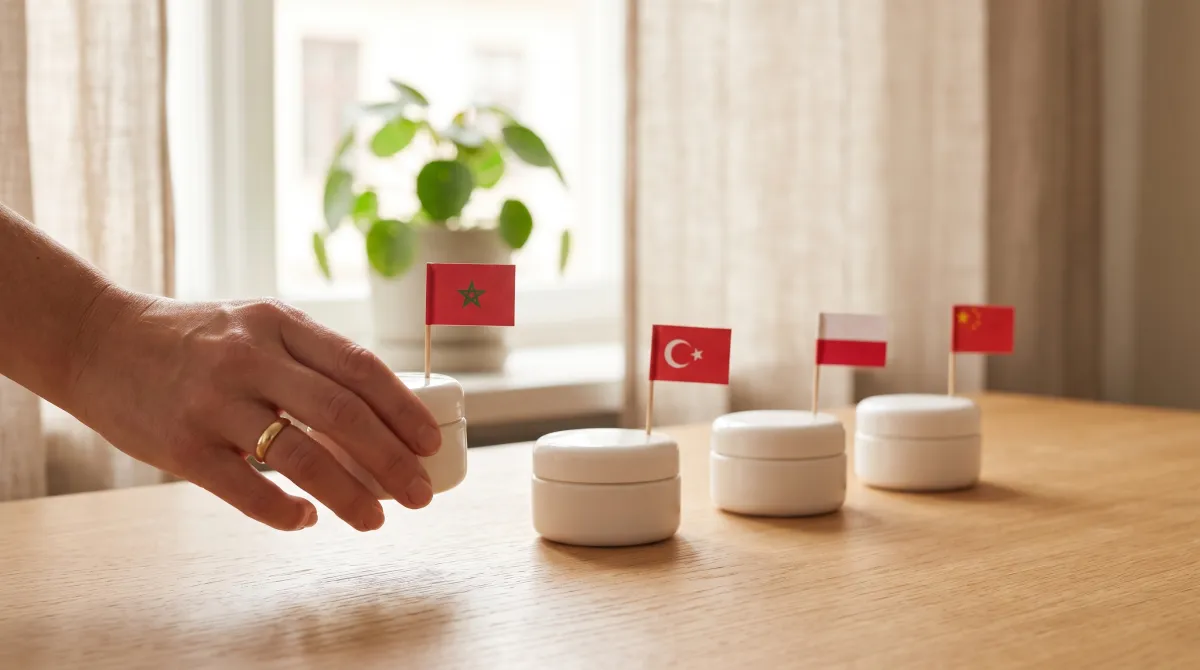
Where should you manufacture cosmetics for the European market? No country is the best choice in every situation. Morocco offers proximity, a convenient time zone and local ingredients; Turkey offers an industrial base; Poland offers a border-free market; China offers scale. The right choice depends on your volumes, range and need for regulatory support.
Morocco itself imports a lot of what it could manufacture: our study of cosmetics imports into Morocco puts the substitution potential at 3.5 billion dirhams.
Key takeaways
- Every cosmetic sold in the EU must comply with Regulation (EC) no. 1223/2009, regardless of where it is manufactured. A country’s reputation never replaces manufacturer due diligence.
- For skincare and makeup (customs code 3304), the EU customs duty is 0 %, including for Chinese products. Customs duty is therefore not a decisive argument against China.
- The real differences involve transport, time zones, language, import formalities and technical documentation.
- Manufacturing outside the EU (Morocco, Turkey or China) requires a Responsible Person established in the EU and the country of origin on the label.
- For a European or French-speaking brand, Morocco offers the strongest combination of practical advantages outside the EU: a 0 to 1 hour time difference with Paris, French as a working language, a short crossing to Europe, an EU free trade agreement and local ingredients such as argan oil.
- Whatever the country, audit the factory: ISO 22716 certificate, batch records, tests, confidentiality and formula ownership.
What should you compare before choosing where to manufacture cosmetics?
Compare regulatory compliance and technical documentation first, then logistics and costs. A cheaper manufacturer that cannot provide the documents your Responsible Person needs can put your launch at risk.
- Compliance: formulas and labeling that comply with Regulation (EC) no. 1223/2009, and production in accordance with good manufacturing practices (GMP).
- Responsible Person: who will hold this role in the EU, and what will the manufacturer supply for the PIF?
- Transport: shipping method, freight cost and ease of replenishment.
- Time zone and language: can you speak with the formulator during your working day, in your language?
- Flexibility: MOQ, the number of products you can launch together and the capacity to support your growth.
- Intellectual property: confidentiality agreement, formula ownership and disclosure of the complete composition.
GMP (good manufacturing practices) provides rules for controlled, traceable production. Article 8 of the regulation makes GMP mandatory and presumes compliance where manufacturing follows ISO 22716, explained in our guide to ISO 22716 certification and audits.
Comparison table: Morocco, Turkey, Poland, China, Spain and France
To decide where to manufacture cosmetics, compare these six options using the criteria that affect a brand selling in the EU. Time differences are relative to Paris (Central European Time). Duties vary by exact product: have your freight forwarder confirm the customs classification.
| Criterion | Morocco | Turkey | Poland | China | Spain / France |
|---|---|---|---|---|---|
| EU relationship | Outside the EU, association agreement (free trade area since 2000) | Outside the EU, customs union for industrial products (1995) | Member state | Outside the EU, standard tariff | Member states |
| EU duty on skincare and makeup (3304) and shampoos (3305 10) | 0 % | 0 % | None (single market) | 0 % | None (single market) |
| EU duty on deodorants (3307 20) | 0 % with proof of origin | 0 % for goods in free circulation, with an A.TR certificate | None | 6,5 % | None |
| Import formalities (customs clearance, import VAT) | Oui | Oui | Non | Oui | Non |
| Responsible Person in the EU | Importer or designated representative | Importer or designated representative | The manufacturer can hold this role | Importer or designated representative | The manufacturer can hold this role |
| Country of origin on the label | Mandatory | Mandatory | Not required | Mandatory | Not required |
| Time difference with Paris | 0 to 1 hour | 1 to 2 hours | None | 6 to 7 hours | None |
| Transport to the EU | Short sea crossing or road | Road or sea | Road | Mainly sea freight | Road |
| Common working languages | French, Arabic, English | Turkish, English | Polish, English | Mandarin, English | Spanish or French, English |
| Main strength | Proximity, French-speaking partners, Moroccan ingredients | Large export-oriented industrial base | Large export industry, no customs border | Scale, packaging supply chain, development capabilities | Dense ecosystem, a ‘made in Europe’ positioning |
| Watch point | Arrange imports and request proof of origin | Arrange imports and verify EU documentation | Check whether French-language support is available | Distance, time zone and documentation requirements | Production costs are often higher |
The rates cited come from the European Commission’s Access2Markets database (skincare 3304 99 from China), the tariff information for shampoos 3305 10 and that for deodorants 3307 20. Import VAT remains payable whenever goods are imported.
Our reading of the table: among the non-EU countries compared, Morocco alone combines an almost identical time zone to Paris, French as a working language, a short crossing to Europe, an EU free trade agreement and sought-after local raw materials. Poland, Spain and France retain the single-market advantage; China and Turkey offer industrial scale.
Do customs duties really make a difference compared with China?
For most cosmetics, no: the EU applies 0 % customs duty to skincare, makeup and shampoos, regardless of origin. Describing Morocco or Turkey as ‘less taxed’ than China would be inaccurate for most ranges.
There is a difference for some categories, such as deodorants and antiperspirants, which face a 6,5 % duty without preferential treatment. In these cases, the EU-Morocco association agreement, effective March 1st, 2000, or the EU-Turkey customs union can reduce the duty to zero, subject to the applicable origin or free-circulation requirements and supporting documentation. Proof of origin is a document (certificate or origin declaration) confirming that a product meets a trade agreement’s rules of origin.
The real cost of a distant country lies elsewhere: freight, inventory tied up in transit, sample logistics and documentation that needs revising. When comparing where to manufacture cosmetics at a lower cost, quantify these items.
What are each country’s real strengths?
Every country has genuine strengths, and an honest comparison should acknowledge them.
Morocco: a practical choice for European or French-speaking brands
Morocco combines an EU free trade area, a time zone close to Paris, French as a working language and ingredients such as argan oil, prickly pear seed oil, rhassoul (ghassoul) clay and rose water. In practice, this affects day-to-day project management:
- Communication during Paris working hours: calls, sample approvals and formula adjustments can be discussed in French during the working day.
- A short logistics route: the Strait of Gibraltar separates Morocco from Spain, and shipments to Europe travel by sea or road without crossing several oceans.
- A stable trade framework: the association agreement with the EU, in force since 2000, provides preferential access for goods of Moroccan origin with the appropriate proof of origin.
- Ingredients at source: the argan tree is endemic to southwestern Morocco; local manufacturing facilitates traceability for these distinctive ingredients.
- Manufacturers working to European standards: ISO 22716 certified factories produce cosmetics compliant with Regulation (EC) no. 1223/2009, with the documentation your Responsible Person expects.
As with Turkey and China, EU imports require planning (customs clearance, Responsible Person and origin labeling). Our article on the requirements for exporting cosmetics from Morocco to Europe explains these steps.
Poland: an export-oriented cosmetics industry within the EU
Poland exported a record 6,0 billion euros of cosmetics in 2024, according to the Polish cosmetics industry association report shared by Trade.gov.pl, ranking it 9th among global exporters. Its domestic market grew by 16,8 % that year. Its decisive advantage is the absence of an EU customs border: no import clearance or mandatory origin labeling, and the manufacturer can be the Responsible Person.
Turkey: an export-oriented industrial base
Turkey’s cosmetics sector ended 2024 with around 3 billion dollars in exports to nearly 200 countries, according to the deputy chairman of the Turkish Exporters Assembly (TİM), quoted by Anadolu Agency. The customs union facilitates trade, but Turkey remains outside the EU: an importer or designated representative must act as Responsible Person.
China: scale and the packaging supply chain
China remains strong in large-scale capacity, packaging choice and development capabilities for high volumes. Its limitations are distance, time zones and technical documentation that needs close scrutiny.
France and Spain: European benchmarks
France exported 22,5 billion euros of cosmetics in 2024, and the sector is the second-largest contributor to its trade balance, according to FEBEA. Spain exported nearly 7,4 billion euros in the first ten months of 2024, up 23 %, according to Stanpa. Both offer a dense ecosystem and European manufacturing credentials, generally at higher costs.
Which country suits which brand profile?
Where you manufacture cosmetics depends less on a country’s reputation than on your business model: volumes, products, support and brand positioning.
| Brand profile | Often-suitable options | Why |
|---|---|---|
| Brand seeking a ‘made in Europe’ positioning | France, Spain, Poland | EU origin is part of the marketing promise. |
| French-speaking brand launching several products and seeking a nearby contact | Morocco, France | Shared language, similar time zones and straightforward sample discussions. |
| Brand focused on Moroccan ingredients (argan oil, rhassoul clay, prickly pear seed oil) | Morocco | Raw materials available near the production site. |
| High-volume brand with standardized products | China, Turkey, Poland | Substantial industrial capacity. |
| Brand bringing production closer to Europe (nearshoring) | Morocco, Turkey | Geographic proximity outside the EU, with trade agreements. |
| European brand seeking cost control without moving far from its market | Morocco | Competitive costs, proximity, French-speaking partners and preferential EU access. |
Nearshoring means moving production closer to its market, to a neighboring rather than a distant country. For established brands, our analysis of manufacturing in Morocco for the European market develops this argument.
How do you audit a cosmetics manufacturer abroad?
Auditing an overseas manufacturer means checking documents and the factory to establish whether it can produce and document compliant cosmetics. The approach is the same in every country:
- Request the certificates for ISO 22716 (and ISO 9001, where applicable), including the certification body and validity date.
- Clarify the documentation supplied to the Responsible Person: quantitative formula, manufacturing method and test results.
- Verify the tests: stability, packaging compatibility, challenge testing and microbiological controls. Our article on cosmetic quality testing explains them.
- Check traceability: a finished batch must be linked to its raw materials, controls and release records.
- Define intellectual property rights: confidentiality agreement, ownership of the custom formula and disclosure of the complete composition.
- Visit the factory or commission an independent audit, then approve a pilot batch before the first order.
The PIF (Product Information File) is the documentation the Responsible Person keeps available to authorities for each cosmetic placed on the EU market. To prepare your first discussion, use our checklist before contacting a cosmetics lab.
The manufacturer’s perspective
At Carmel Cosmetics Labs, based in Agadir, we offer white label, private label and contract manufacturing for over 500 brands in 35 countries. The mistakes we most often see when brands compare countries are not really about the country.
- Choosing on unit price alone, without factoring in freight, inventory tied up in transit or documentation revisions.
- Overlooking the Responsible Person: when the manufacturer is outside the EU, establish from the outset who will hold this role and maintain the PIF.
- Failing to request the complete composition of a custom formula, leaving the brand dependent on its manufacturer.
Our factory follows ISO 22716 and ISO 9001, in accordance with Regulation (EC) no. 1223/2009. For details, read our article on manufacturing cosmetics to European standards in Morocco. If you are new to contract manufacturing, our complete guide to cosmetic contract manufacturing covers contracts and specifications.
Frequently asked questions
Are cosmetics manufactured outside the EU less safe?
Not inherently. Every cosmetic sold in the EU must comply with the same regulation, wherever it is manufactured: safety assessment, PIF, GMP and CPNP notification. Safety depends on the manufacturer and Responsible Person, not the country. That is why an audit matters before your first order. For the full process, see our guide to CPNP notification.
Must the label state ‘made in Morocco’ or ‘made in China’?
Yes. Article 19 of Regulation (EC) no. 1223/2009 requires the country of origin on the label of cosmetics imported into the EU. A product manufactured in Poland, Spain or France is not subject to this requirement. Include this wording in your packaging design and brand messaging.
Who can be the Responsible Person for a product manufactured abroad?
The Responsible Person is the individual or legal entity established in the EU that ensures compliance for each cosmetic placed on the market. For an imported product, this is the importer by default. The importer may appoint another person established in the EU through a written mandate, such as your own company or a specialist service provider.
How do you compare quotes from two different countries?
Compare the landed cost at your warehouse: product price, packaging, freight, insurance, import formalities, import VAT cash outlay and inventory tied up in transit. A lower quote can become more expensive if your team has to redo part of the documentation.
Conclusion: choose a country, but above all a manufacturer
To decide where to manufacture cosmetics, assess compliance and technical documentation first, transport, time zones and language next, then total costs. Customs duty rarely drives the decision for skincare and makeup: the real difference is the manufacturer you choose.
Our recommendation: for a European or French-speaking brand seeking a nearby, responsive and competitive partner, Morocco ticks the most boxes. Consider Poland, Spain or France if ‘made in Europe’ is central to your positioning, and China for very large volumes of standardized products.
Considering Morocco for your range? Explore how our cosmetics manufacturing lab in Agadir works and book a Free consultation. We review your project, markets and volumes, then provide a detailed quote. You can also contact us on WhatsApp at +212 761 511 711.