







































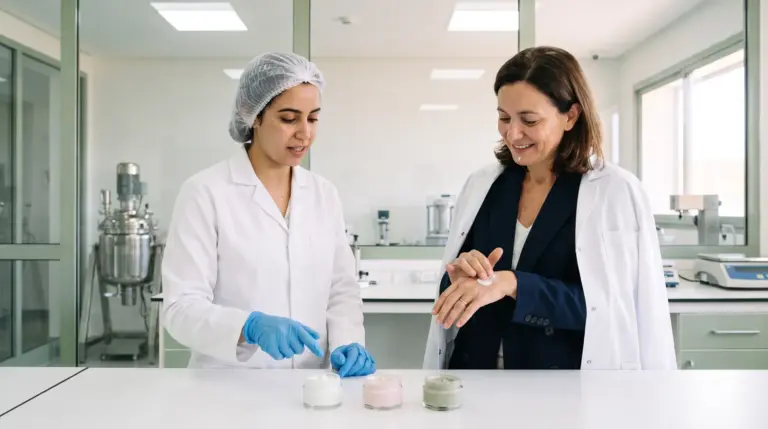




Cosmetovigilance is the monitoring of undesirable effects caused by cosmetic products after they are placed on the market. In the European Union, the Responsible Person and distributors must notify any serious undesirable effect to the competent authority without delay. In France, that authority has been ANSES since January 1, 2024, no longer ANSM.
Key takeaways
- Legal basis: Article 23 of Regulation (EC) No 1223/2009. A serious undesirable effect (SUE) must be notified “without delay”, meaning 20 calendar days under the European guidelines.
- In France, reports have gone to ANSES since 2024: by email for professionals, and through the national reporting portal for consumers and healthcare providers.
- In 2024, ANSES accepted 366 cosmetovigilance reports, 34% of which involved serious effects.
- Every SUE must be added to the cosmetic product safety report, in the PIF.
- Batch traceability under ISO 22716 GMP is what makes the investigation possible.
What is cosmetovigilance?
Cosmetovigilance is the system that collects, assesses and manages reports of undesirable effects linked to the use of a cosmetic product once it is on sale. It complements the safety assessment carried out before launch, because no test can reproduce thousands of real users.
In Article 2(1), Regulation (EC) No 1223/2009 defines an undesirable effect as “an adverse reaction for human health attributable to the normal or reasonably foreseeable use of a cosmetic product”. Irritation after a hair color or a cosmetic allergy to a fragrance both fall within this definition.
For a brand, cosmetovigilance starts at the formulation stage. It extends the six compliance pillars to have in place before market launch: a robust safety report, traced batches and an up-to-date complaints log.
What is a serious undesirable effect (SUE)?
A serious undesirable effect is an undesirable effect with a severe health consequence, from an exhaustive list set by the regulation. Article 2(1)(p) defines it as “an undesirable effect which results in temporary or permanent functional incapacity, disability, hospitalisation, congenital anomalies or an immediate vital risk or death”.
The most common criterion is temporary functional incapacity. According to the ANSES 2024 activity report, it accounts for 88% of the SUEs analyzed, versus 9% for hospitalization and 3% for an immediate vital risk. A burn that keeps someone off work for a few days is therefore an SUE, even without a hospital visit.
| Type of effect | Example | Classification | Reporting by the Responsible Person |
|---|---|---|---|
| Mild, short-lived irritation | Tingling after a cleanser, gone within a few hours | Non-serious undesirable effect | Optional; record and analyze |
| Temporary functional incapacity | Burn after a hair removal product, time off work | Serious undesirable effect | Mandatory, without delay |
| Hospitalization or vital risk | Severe allergic reaction after a hair color | Serious undesirable effect | Mandatory, without delay |
Who handles cosmetovigilance in France since 2024?
Since January 1, 2024, ANSES (the French Agency for Food, Environmental and Occupational Health & Safety) has run the national cosmetovigilance system, replacing ANSM. Vidal reported on this transfer in April 2024. If your internal documents still mention ANSM, update them.
ANSES assesses severity and causality (the likelihood of a link between the product and the effect) using a European grid, then notifies SUEs to the Responsible Person and on the European ICSMS portal. If it spots a breach of the regulation (banned substance, product not notified on the CPNP, non-compliant labeling), it reports it to the DGCCRF, which inspects products and can order their withdrawal.
In 2024, ANSES accepted 366 cosmetovigilance reports: 50.5% came from consumers, 30.9% from healthcare professionals and 18.1% from Responsible Persons or distributors. In total, 34% were classified as SUEs, and Responsible Persons reported half of them. Skincare accounted for 54% of reports and hair products for 21% (ANSES, 2024 report, figures presented at the Cosmed congress on April 1, 2026).
Who must report a cosmetic undesirable effect, to whom and within what deadline?
The Responsible Person and distributors are required to report SUEs; healthcare professionals, consumers and beauty professionals may report any effect. Article 23(1) of the regulation is explicit: “In the event of serious undesirable effects, the responsible person and distributors shall notify without delay the following information to the competent authority of the Member State where the serious undesirable effect occurred”.
Three items follow: “(a) all serious undesirable effects which are known to him or which may reasonably be expected to be known to him; (b) the name of the cosmetic product concerned, enabling its specific identification; (c) the corrective measures taken by him, if any”. The European guidelines for SUE reporting interpret “without delay” as 20 calendar days from the moment any employee of the company becomes aware of it.
The Responsible Person is the natural or legal person established in the EU who answers for the compliance of each cosmetic product placed on the European market. For a Moroccan brand exporting to France, this is often an importer or a representative appointed in writing.
| Party | Obligation | Recipient in France | Deadline |
|---|---|---|---|
| Responsible Person | Report every SUE, with the product name and corrective measures | ANSES ([email protected]), SUE Form A recommended | Without delay (20 calendar days) |
| Distributor | Report every SUE observed | ANSES ([email protected]) | Without delay (20 calendar days) |
| Healthcare professional | Report SUEs; report non-serious effects if they wish | signalement.social-sante.gouv.fr portal | Without delay for SUEs |
| Consumer, hairdresser, beautician | May report any effect | signalement.social-sante.gouv.fr portal | No set deadline |
| ANSES | Forward to the other Member States and the Responsible Person | EU authorities, ICSMS portal | Immediately |
In France, this obligation is set out in Article L5131-5 of the Public Health Code. The procedures are detailed on the ANSES cosmetovigilance page. Consumers and healthcare providers use the national reporting portal.
How to report a cosmetic undesirable effect: the brand’s procedure
For a brand, reporting a cosmetic undesirable effect follows six steps, which should be written down before the first launch rather than improvised on the day of the first complaint.
- Receive and record. Every complaint (email, social media, customer review, distributor) is logged in a register, with the date you became aware of it: this is when the 20 days start.
- Collect the facts. Exact product name, batch number, how it was used, description and photos of the reaction, allergy history, any medical consultation.
- Assess severity. Check the facts against the six criteria of Article 2. If in doubt, have your safety assessor confirm.
- Report the SUE. Send SUE Form A to ANSES (or to the authority of the Member State where the effect occurred) without waiting for the investigation to end.
- Investigate the batch. Compare the returned sample with the retained sample, review the batch record and check whether other complaints involve the same batch.
- Act and update. Decide on corrective measures (reformulation, warning, withdrawal or recall), then add the case to the safety report.
Do not confuse withdrawal and recall. A withdrawal prevents a product in the supply chain from being made available; a recall aims to get back a product already in the hands of the end user (Article 2, points q and r).
Cosmetovigilance and the PIF: what to update after a report
After a report, cosmetovigilance requires you to update the cosmetic product safety report, the core document of the PIF. Article 10 requires this report to be “kept up to date in view of additional relevant information generated subsequent to placing the product on the market”. Annex I, Part A, point 9 provides a dedicated section: “All available data on the undesirable effects and serious undesirable effects to the cosmetic product or, where relevant, other cosmetic products. This includes statistical data.”
The PIF (product information file) is the technical file the Responsible Person keeps available to the authorities for ten years after the last batch is placed on the market. Article 21 adds that existing data on undesirable effects must be made easily accessible to the public.
Inspections show this remains a weak point. The DGCCRF investigation published in February 2026 covered 147 recently established operators, 90% of them micro-businesses, and more than 200 PIFs, most of which were incomplete, inconsistent or out of date. The safety report was missing in almost half of the companies inspected.
Some signals justify reviewing the formula or the label, especially reactions to allergens, now that fragrance allergen labeling is being extended in 2026. Repeated complaints may require new warnings, in line with the transparency and labeling rules.
How does cosmetovigilance work in Morocco?
In Morocco, cosmetovigilance is one of the health vigilance systems of the Moroccan Agency for Medicines and Health Products (AMMPS). Its official page defines it as “a system for monitoring undesirable effects linked to the use of cosmetic and personal hygiene products after they are placed on the market”. The site also offers a “Report an undesirable effect” service.
However, we have not found any published official text specifying, for cosmetics, who must report, within what deadline and with which form. Have AMMPS confirm these details before you set your procedure, alongside the registration of your cosmetic products with AMMPS.
The manufacturer’s perspective
On the lab side, we see cosmetovigilance being decided long before the first complaint. Carmel Cosmetics Labs manufactures white label and contract products under ISO 22716 GMP for more than 500 brands in 35 countries. Difficult situations almost always share the same cause: the brand cannot trace the product in question back to the batch produced.
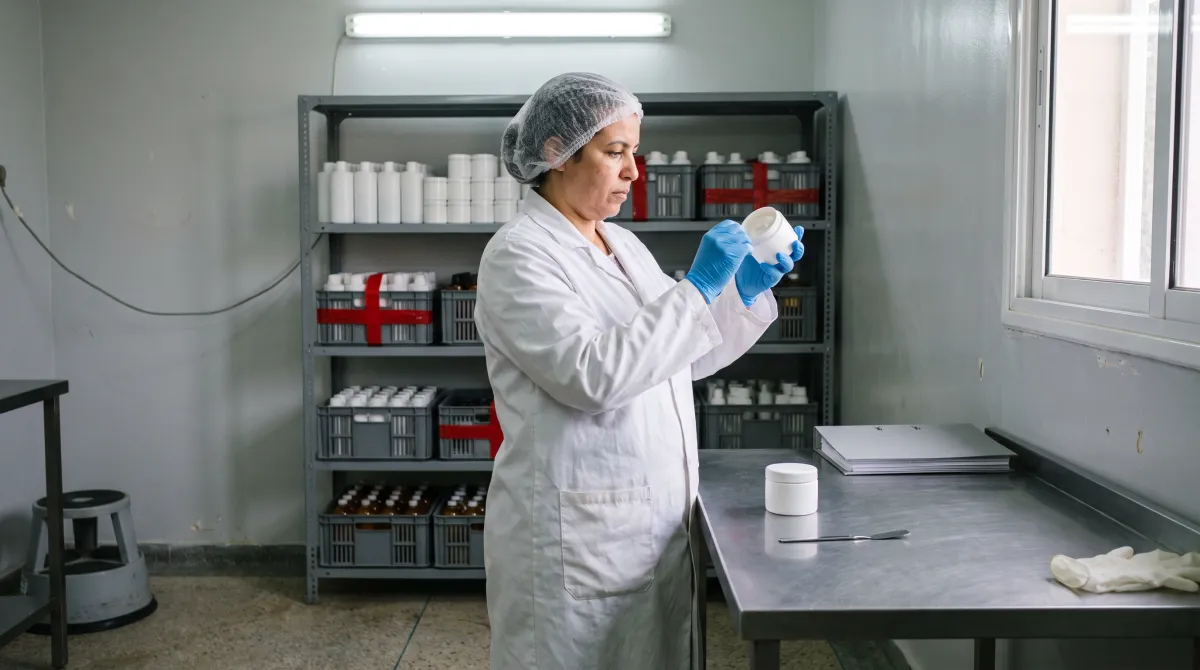
- The batch number is your best ally. It must appear on every unit and in every customer exchange. The ISO 22716 GMP traceability requirements exist precisely for this.
- Retention samples. Keeping units from every batch lets you tell a manufacturing defect apart from contamination after opening or misuse.
- Pre-launch testing reduces reports. Stability, packaging compatibility and challenge testing are part of the quality checks to run on your cosmetic products.
- One designated contact. The 20-day clock starts as soon as any team member is informed, including your community manager. Decide who receives complaints and who makes the reporting call, and build this workflow into your manufacturing contract.
Frequently asked questions
Is cosmetovigilance mandatory for a small brand?
Yes. The obligation to notify serious undesirable effects applies to every Responsible Person, whatever the size of the company or the volume sold. A micro-business selling a few hundred units online has the same obligations as a large group: keep a complaints log, classify SUEs, report them and add them to the safety report.
Do non-serious undesirable effects have to be reported?
Reporting non-serious effects is not mandatory for the Responsible Person, but it must record and analyze them. This data feeds the “undesirable effects” section of the safety report, including in statistical form. A build-up of mild reactions to the same product is often the first sign of a formula, preservation or labeling problem.
Can a brand report an SUE before finishing its investigation?
Yes, and it is actually recommended. The European guidelines provide for an initial notification, followed by additional information as the investigation progresses. Waiting for test results risks missing the 20 calendar days. In the first report, state what you know, what still needs checking and the measures already taken.
Who reports when the product is made by a contract manufacturer?
The reporting obligation lies with the Responsible Person, not the contract manufacturer. In practice, the manufacturer provides the investigation material: batch record, test results, retention samples. The manufacturing contract should set out this workflow. If the manufacturer receives a complaint directly, it passes it on promptly to the Responsible Person.
Conclusion: build your cosmetovigilance in from manufacturing
Cosmetovigilance relies on three reflexes: recognize a serious undesirable effect, report it without delay (to ANSES in France) and reflect every case in the safety report. These reflexes only work if batch traceability is solid from manufacturing onward.
Preparing a launch or want to check that your file holds up? We can review your PIF, your safety report and your complaints procedure, then manufacture your products with batch-by-batch traceability at an ISO 22716 certified cosmetics manufacturer. Book your free consultation or book a meeting with our team.