

























From April 2026, fragrance allergen labeling rules are changing radically in Canada, in Europe and soon in the United States. For any cosmetics brand — especially white label and private label brands — this regulatory shift means: an immediate audit of formulas, an audit of supplied fragrances, and updated labels before the deadlines.
This article helps you navigate these complex changes with a practical compliance checklist to secure your cosmetics ranges in key markets.
Summary: critical 2026 and 2028 deadlines
Three dates you must remember:
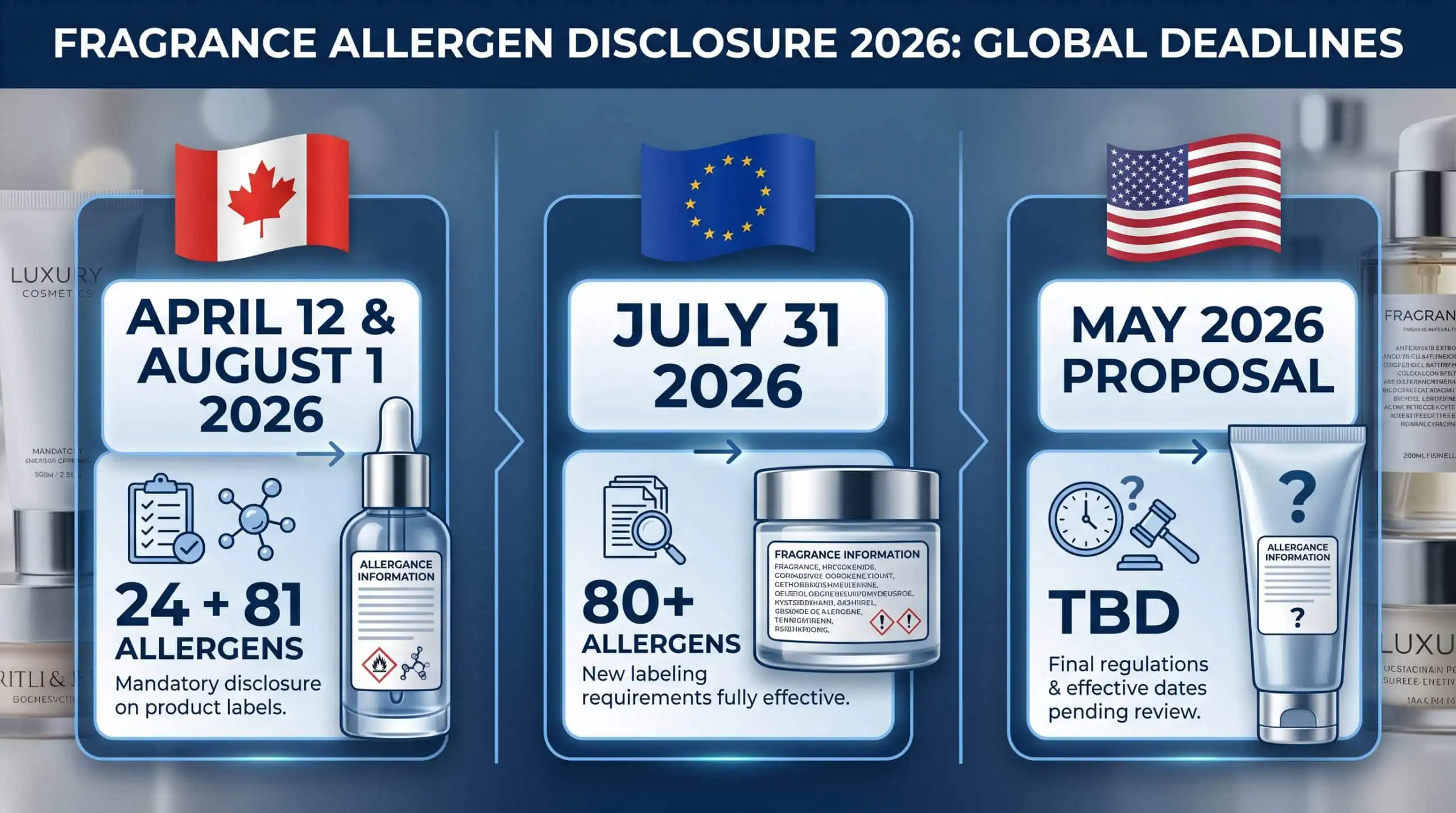
- April 12, 2026 (Canada, already passed!) — All new and existing cosmetic products in Canada must declare a minimum of 24 fragrance allergens .
- July 31, 2026 (European Union) — All new products placed on the EU market must declare 80+ fragrance allergens (a massive expansion from the previous 26).
- August 1, 2026 (Canada) — All new products sold in Canada must comply with the full list of 81 allergens (aligned with the EU).
United States: The FDA is expected to publish its proposal in May 2026, with enforcement expected in 2027 or later.
Why this sudden expansion?
For 25 years, the European list contained 26 fragrance allergens : amyl cinnamal, benzyl alcohol, citral, eugenol, limonene, linalool, etc. These molecules are well documented as triggers of contact allergies.
In 2023, the European Union adopted a much more conservative approach, expanding to more than 80 substances — now including menthol, citronella oil, lavender oil, anethole, benzaldehyde, vanillin… essentially every aromatic component that can potentially pose an allergy risk, including those found naturally in essential oils.
Direct consequence: if your fragrance contains lavender oil, lemon oil or rose essence above 0.001% (leave-on), you must now list each identified allergen molecule — not just the word “fragrance”.
The three 2026 regulatory regimes: Canada, EU, USA
1. Canada — Phased approach (already under way)
Phase 1 (April 12, 2026) ✓ CURRENT
- All products, new and existing, must declare a minimum of 24 fragrance allergens in the INCI list.
- Disclosure thresholds: 0.001% for leave-on (creams, makeup), 0.01% for rinse-off (shampoos, cleansers).
- Reporting exact concentrations is optional (not mandatory, unless the ingredient is on the restricted list).
Immediate issue: your inventory of supplier fragrances must be audited now. Health Canada requires every product declaring fragrance to explicitly list the allergens present. For Québec brands, see our page cosmetics manufacturer for Québec and Canada.
Phase 2 (August 1, 2026)
- All new products sold in Canada must declare the full list of 81 allergens.
- Existing products have until August 1, 2028 to comply.
2. European Union — Hard deadline July 2026
- July 31, 2026: all new products launched after this date must declare 80+ allergens.
- July 31, 2028: all existing products must comply (2-year transition period).
- Same thresholds: 0.001% leave-on, 0.01% rinse-off.
Critical impact: if you export to the EU or sell through European distributors, there is no flexibility. Any new product formulated after July 2026 must be 100% compliant with the new list.
3. United States — Being drafted (MoCRA)
- May 2026: the FDA is expected to publish a Notice of Proposed Rulemaking (NPRM) — essentially a draft version of the rule open to public comment.
- 2027 or later: estimated final enforcement date.
- Likely: the FDA will align its list with the EU (80+ allergens) or a modified version for the US market.
Note: California has already independently adopted the EU list — so any brand selling in California must already display the 26+ allergens.
The full list of 81 EU allergens: highlights
The 26 original ones (amyl cinnamal, benzyl alcohol, citral, eugenol, geraniol, limonene, linalool, etc.) remain mandatory.
The ~55 new additions include in particular:
- Menthol — found in peppermint oil and cooling products.
- Natural essential oils — citronella, lavender, rose, eucalyptus, jasmine.
- Botanical components — anethole (fennel, anise), vanillin (vanilla), benzaldehyde (almond).
- Synthetic molecules — hexyl salicylate, hexyl cinnamal, hexene 1-ol.
- Modern isolates — iso E super, galaxolide, odor precursors.
Consequence: a “natural” fragrance containing lavender oil + vanilla absolute + rose oil can have 10–15 declarable allergens on its own.
What this means for your white label or private label brand
Scenario 1: You buy ready-made fragrances from a supplier
IMMEDIATE ACTION:
- ✅ Ask your supplier for the detailed composition of each fragrance — not just “fragrance blend” but molecule by molecule.
- ✅ Check which ones match the list of 81 EU + 24 Canadian allergens.
- ✅ Get a signed Certificate of Analysis (CoA) listing all the allergens present.
- ✅ Add this information to your product technical sheets and labels.
Common pitfalls:
- Low-end suppliers say “natural fragrance oil” — vague and non-compliant. Demand the detailed formula.
- “100% pure” essential oils often contain declarable allergens — there is no shortcut.
- Complex synthetic fragrances (“fruity floral” types) can hide 20+ allergen molecules.
Scenario 2: You formulate your own fragrances (with a perfumer)
IMMEDIATE ACTION:
- ✅ Work with an IFRA-certified perfumer who knows the EU + Canadian allergen lists.
- ✅ Ask for a full INCI composition with concentrations (% of each allergen).
- ✅ Confirm that every supplier raw material (essences, isolates, synthetics) is pre-audited for allergens.
Opportunity: “hypoallergenic” or “clean” fragrances (free from the 81+ common allergens) are becoming a strong marketing argument — rare, premium, healthy.
2026 compliance checklist: 7 steps to secure your brand
- ☐ Step 1 — Formula audit
- List all products containing “parfum” or “fragrance”.
- For each product, get the supplier technical sheet listing the INCI allergens.
- ☐ Step 2 — Threshold check
- Leave-on (creams, serums, makeup) > 0.001% = must declare.
- Rinse-off (shampoo, cleanser) > 0.01% = must declare.
- In doubt? Declare as a precaution (better to over-declare than under-declare → legal risk).
- ☐ Step 3 — Supplier communication
- Send each supplier a written request: “List all EU 81 + CA 24 allergens present in this fragrance”.
- Ask for a signed statement or CoA.
- ☐ Step 4 — Label update
- For Canada: a minimum of 24 allergens from April 12.
- For the EU: 80+ from July 31 (for new products).
- Include the declaration in the INCI list.
- ☐ Step 5 — Internal documentation
- Create a spreadsheet: product | supplier fragrance | declared allergens | threshold | market (CA/EU/US).
- File supplier CoAs (evidence in case of a regulatory audit).
- ☐ Step 6 — Internal training
- The marketing / packaging team must know that “fragrance” alone no longer works — individual allergens must be listed.
- ☐ Step 7 — US compliance plan
- Wait for the FDA NPRM in May 2026, but start preparing now for an EU-like list (81+).
- If you have customers in California: you are already required.
Choose “compliant” fragrances now
If you are launching a new range or reformulating, choose:
- “Hypoallergenic” certified fragrances — some manufacturers sell pre-audited blends without the 81 common EU allergens.
- Modern synthetic fragrances — easier to document than complex essential oils.
- Major suppliers (Givaudan, Symrise, IFF, Firmenich) — already provide complete allergen lists and CoAs.
- Full transparency — avoid “mystery fragrance blends”; demand a detailed INCI.
How Carmel Cosmetics Labs supports you
At Carmel Cosmetics Labs, we understand that this new regulatory complexity can be overwhelming. That is why:
- ✅ We work exclusively with audited fragrance suppliers — all our partners provide complete allergen lists + CoAs.
- ✅ Every white label formula we develop automatically audits fragrance allergens against the CA/EU deadlines.
- ✅ We handle full INCI labeling — you receive a ready-to-sell product, legally compliant in all key markets.
- ✅ We offer regulatory support — our team stays up to date on MoCRA, EU Reg 2023/1545, etc.
If you are launching a cosmetics brand in 2026, a fragrance allergen audit is no longer a “nice-to-have” — it is a legal obligation. Choosing a lab partner like Carmel means this audit is already built into every formula.
Next steps: act now
The deadlines are close. Here is what to do this week:
- Monday: Audit your fragrance inventory (list all products with “fragrance” + supplier origin).
- Tuesday–Wednesday: Ask each supplier for detailed allergen lists + CoAs.
- Thursday–Friday: Compile the compliance spreadsheet and identify at-risk products.
- Next week: Revise your labels and launch the print corrections.
Would you rather hand this audit to an expert? Talk to our regulatory team. We can audit your current formulas, suggest 100% compliant fragrances and spare you the legal risks.
This article is part of our Regulation and compliance series — see also our 2026 guide to new cosmetics rules by market.