











































Services

Torn between two services?A project manager will guide you

Catalog

Explore the full catalog1,000+ formulas ready to carry your brand

Face careFull range

Serums, creams and targeted care, formulated with your actives.

Body careFull range

Moisturizing, nourishing and shower care: cream, butter or oil.

Specialty careFull range

Sun care, lips, intimate care and oral care.

Men, baby, makeupFull range

Shaving and beard, baby and mom, makeup.

Industries

All solutions by industryFormulas and formats for your business

Laboratory

Cosmetics manufacturing room with a row of stainless-steel mixers and an operator in white workwearOur factory in Aït MelloulISO 22716 and ISO 9001, visits by appointmentDiscover the factory

Resources

Apricot kernel oil

Apricot kernel oil is the fixed oil pressed from the kernels of the Prunus armeniaca stone9. It is a triglyceride rich in oleic acid, about 70% of the fatty acids, with 22% linoleic acid12. CosIng classifies it as skin conditioning and fragrance9. Dedicated clinical evidence on skin is absent from our selection.
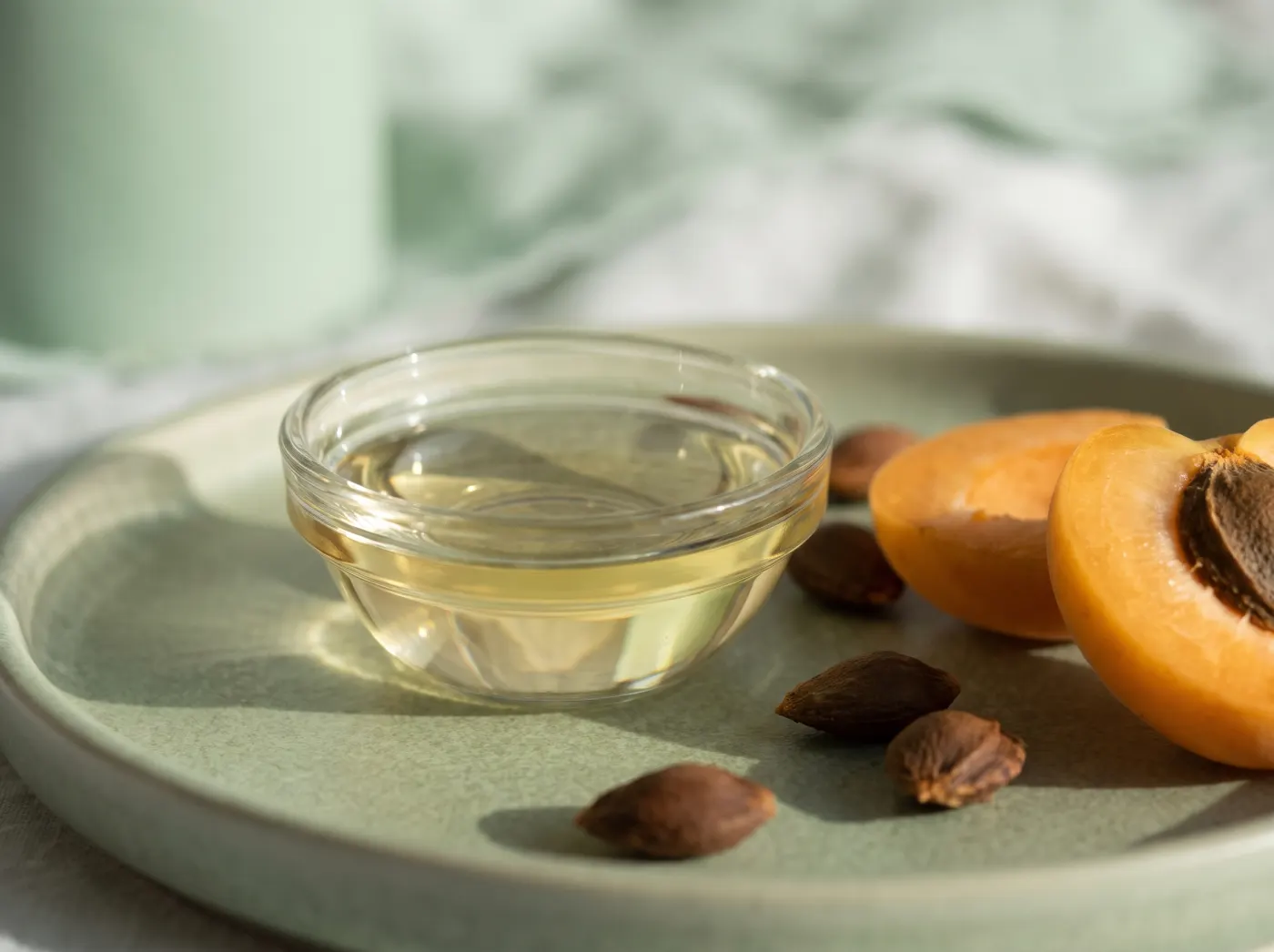
Amber apricot kernel oil in macro view, a clear drop on a sage green ceramic surface

Apricot kernel oil at a glance

Entry from our cosmetic ingredient glossary. Regulatory data from the European Commission's CosIng database9. Copy the identifiers in one click for your files.

INCI name
PRUNUS ARMENIACA KERNEL OIL
Other names
Apricot kernel oilApricot oil; PRUNUS ARMENIACA (APRICOT) KERNEL OIL (US INCI name)
CAS number
68650-44-2 / 72869-69-3Two CAS numbers for the same CosIng entry9
EC number
272-046-1
Botanical origin
Apricot tree (Rosaceae)Fixed oil pressed from the kernels of the stone of Prunus armeniaca L.9
Composition
Triglycerides, mostly oleic acidOleic 70.70%, linoleic 22.41%, palmitic 3.14%, stearic 1.4%, linolenic 0.90%, palmitoleic 0.70% (5 cultivars)2
Tocopherols and sterols
γ-tocopherol and β-sitosterol predominantγ-tocopherol 475.11 mg/kg of oil and β-sitosterol 273.67 mg/100 g of oil in nine Turkish varieties1
CosIng functions
Skin conditioning, fragrance"Skin conditioning" and "fragrance"9
Do not confuse with
Apricot kernel powderAnother glossary ingredient (PRUNUS ARMENIACA SHELL POWDER), a mechanical exfoliant, unrelated to the oil
EU status
No restriction specific to the ingredientNo annex indicated in CosIng9; Prunus armeniaca does not appear in Regulation (EC) 1223/2009 consolidated as of May 1, 2025 (Annex II only cites Prunus laurocerasus)
Allergen to declare
NoNot in the list of fragrance allergens of Regulation (EU) 2023/1545
Safety (CIR)
Report on 244 vegetable oilsCosmetic Ingredient Review (CIR) report on 244 vegetable oils: judged safe under cosmetic conditions of use. We could not check here whether this INCI is on the list of 244 oils; to be verified in the report8

What the research says

Each result shows the protocol and the level of evidence. The higher the level, the better the result carries over to a finished formula.

Clinical trialReview or consensusLaboratory

Composition and materialChemistry

An oleic triglyceride, with 22% linoleic

Laboratory
5 Polish cultivarsChemical analysis of the oils

Oleic acid makes up 70.70% of the fatty acids, ahead of linoleic (22.41%), palmitic (3.14%), stearic (1.4%), linolenic (0.90%) and palmitoleic (0.70%). The unsaponifiable matter reaches 0.68%2.

A similar composition across nine Turkish varieties

Laboratory
9 Malatya varietiesFatty acids, sterols, tocopherols

The oil content of the kernels ranges from 40.23 to 53.19%. Oleic acid makes up 70.83% of the fatty acids, linoleic 21.96%, palmitic 4.92% and stearic 1.21%1.

Tocopherols: mostly γ-tocopherol

Laboratory
Polish and Turkish cultivars

The oils contain 19.6 to 40.0 mg/kg of α-tocopherol, 315.4 to 502.3 mg/kg of γ-tocopherol and 28.3 to 58.5 mg/kg of δ-tocopherol2. β-Sitosterol dominates among the sterols1.

Skin and bodySkincare, bodycare

An oleic-profile oil: the benchmark from the reviews

Review
2018 and 2022 reviewsOleic acid and the skin barrier

The reviews link a high content of oleic acid, an irritant, to a risk for the barrier when the skin is already weakened; on unaffected skin, an oleic-rich oil does not necessarily react negatively, and frequency and duration of use matter34. These reviews did not study apricot kernel oil itself.

A single result cited, on cells and outside cosmetics

Laboratory
2017 reviewBitter apricot kernel oil

For bitter apricot oil, the review reports only one study in cultured keratinocytes on cell death, oriented toward a medical condition. It is not a cosmetic result and we do not retain it as one5.

What reviews and experts saySafety, uses

Safety: a report on 244 vegetable oils

Review
2017 CIR report244 oils

The expert panel concludes that the 244 vegetable oils assessed are safe under cosmetic conditions of use. The review focused mostly on skin effects8.

This page summarizes published literature on a cosmetic ingredient. It does not describe the effect of a finished product, which depends on its formula, and it is not medical advice. Several of the studies cited were run or funded by industry; this is indicated in the sources.

Which products use apricot kernel oil?

Our white label catalog includes 11 formulas with apricot kernel oil: the key active in 1 of them, a supporting ingredient in the others. Every category can be customized (formula, fragrance, packaging).

1Face

Supporting oil in the argan oil serum.

8Body

Oil in massage and bath oils, modeling butters and balms, shower gels and intimate foams.

In our formulas, it is most often paired with

Vitamin E 8Argan oil 6Coconut 4Arnica extracts 4Horse chestnut 4

Apricot kernel, macadamia, sweet almond or olive oil?

Four oils dominated by oleic acid. Their linoleic acid and saturated fat content makes the difference in a formula.

Apricot kernel oilMacadamia oilSweet almond oilOlive oil
Oleic acid70.70%261.74 to 66.47%767.2%666.4%6
Linoleic acid22.41%2Not quantified in our sources22.8%616.4%6
Saturated fatty acidsNot quantified in our sourcesNot quantified in our sources9.3%619.4%6
EU regulationNo restrictionNo restrictionNo restrictionNo restriction
Carmel catalog formulas11 formulas9 formulas74 formulas13 formulas

Frequently asked questions about apricot kernel oil

What is apricot kernel oil?
It is the fixed oil pressed from the kernels inside the apricot stone, Prunus armeniaca9. Its INCI name is PRUNUS ARMENIACA KERNEL OIL. It is rich in oleic acid, about 70% of the fatty acids12.
What are the benefits of apricot kernel oil in cosmetics?
CosIng classifies it as skin conditioning and fragrance9. We retained no published controlled trial on skin with this oil: the only result cited by a review concerns cells and is not cosmetic5. Its value remains an oleic fatty acid profile with a rich feel, to be chosen according to the product.
Is apricot kernel oil good for hair?
We found no study on hair with this oil, and our catalog does not offer it for hair.
Is apricot kernel oil comedogenic, and is it suitable for the face?
We retained no official or peer-reviewed source giving a comedogenicity rating, so this page gives no figure. The reviews point out that oils very rich in oleic acid can disturb the barrier of weakened skin34; tolerance is verified with tests on the finished formula.
What is the difference between apricot kernel oil and apricot kernel powder?
The oil (PRUNUS ARMENIACA KERNEL OIL) is a pressed fat9. Apricot kernel powder (PRUNUS ARMENIACA SHELL POWDER) is a mechanical exfoliant made from the shell: they are two distinct ingredients, with different uses in our scrubs.
Are there risks with apricot kernel oil?
No restriction applies to the ingredient in the EU9 and it is not on the list of fragrance allergens. The CIR judged the 244 vegetable oils of its report safe8, although we could not check here whether this INCI is on the list. We retained no source on possible residues specific to the kernel: a supplier certificate of analysis remains necessary. During pregnancy, as with any skincare, the advice of a healthcare professional remains the rule.
Can you manufacture an apricot kernel oil or an apricot kernel product for my brand?
Yes. Our ISO 22716 certified lab offers 11 formulas containing apricot kernel oil (massage and bath oils, balms, shower gels) that you can customize, or a custom formula. Samples are free.

Sources

Peer-reviewed studies and official regulatory sources, checked on November 3, 2026.

  1. Turan S, Topcu A, Karabulut I, et al. Fatty acid, triacylglycerol, phytosterol, and tocopherol variations in kernel oil of Malatya apricots from Turkey J Agric Food Chem. 2007;55(26):10787-10794. doi:10.1021/jf071801p
  2. Stryjecka M, Kiełtyka-Dadasiewicz A, Michalak M, et al. Chemical composition and antioxidant properties of oils from the seeds of five apricot (Prunus armeniaca L.) cultivars J Oleo Sci. 2019;68(8):729-738. doi:10.5650/jos.ess19121
  3. Poljšak N, Kočevar Glavač N. Vegetable butters and oils as therapeutically and cosmetically active ingredients for dermal use: a review of clinical studies Front Pharmacol. 2022;13:868461. doi:10.3389/fphar.2022.868461
  4. Vaughn AR, Clark AK, Sivamani RK, Shi VY. Natural oils for skin-barrier repair: ancient compounds now backed by modern science Am J Clin Dermatol. 2018;19(1):103-117. doi:10.1007/s40257-017-0301-1
  5. Lin TK, Zhong L, Santiago JL. Anti-inflammatory and skin barrier repair effects of topical application of some plant oils Int J Mol Sci. 2017;19(1):70. doi:10.3390/ijms19010070
  6. Orsavova J, Misurcova L, Ambrozova JV, et al. Fatty acids composition of vegetable oils and its contribution to dietary energy intake and dependence of cardiovascular mortality on dietary intake of fatty acids Int J Mol Sci. 2015;16(6):12871-12890. doi:10.3390/ijms160612871
  7. Shuai X, Dai T, Chen M, et al. Comparative study of chemical compositions and antioxidant capacities of oils obtained from 15 macadamia (Macadamia integrifolia) cultivars in China Foods. 2021;10(5):1031. doi:10.3390/foods10051031
  8. Burnett CL, Fiume MM, Bergfeld WF, et al. Safety assessment of plant-derived fatty acid oils Int J Toxicol. 2017;36(3_suppl):51S-129S. doi:10.1177/1091581817740569
  9. European Commission. CosIng, entry PRUNUS ARMENIACA KERNEL OIL (CAS 68650-44-2 / 72869-69-3, CE 272-046-1). ec.europa.eu/growth/tools-databases/cosing
Carmel Cosmetics Labs product specialist with a brand founder

Tell us about your project

A product specialist reviews your request and gets back to you on the channel you prefer.

Lead EN – Demande de devis
Tell us about your project. A product specialist will get back to you shortly.
CONTACT INFORMATION
Name
PROJECT INFORMATION
Which cosmetics category interests you most?

By submitting this form, you agree to our terms of service and privacy policy.

No obligation. Your information stays confidential and is used only to prepare your quote.
