












































Services

Torn between two services?A project manager will guide you

Catalog

Explore the full catalog1,000+ formulas ready to carry your brand

Face careFull range

Serums, creams and targeted care, formulated with your actives.

Body careFull range

Moisturizing, nourishing and shower care: cream, butter or oil.

Specialty careFull range

Sun care, lips, intimate care and oral care.

Men, baby, makeupFull range

Shaving and beard, baby and mom, makeup.

Industries

All solutions by industryFormulas and formats for your business

Laboratory

Cosmetics manufacturing room with a row of stainless-steel mixers and an operator in white workwearOur factory in Aït MelloulISO 22716 and ISO 9001, visits by appointmentDiscover the factory

Resources

Horse chestnut extract (Aesculus hippocastanum)

Horse chestnut (Aesculus hippocastanum) provides extracts declared in cosmetics as astringent, tonic and skin conditioning agents1. Its saponin, escin, comes from the seeds5. In cosmetics, only one trial on an extract is retained, around the eyes2; the other data concern combinations or medical use.

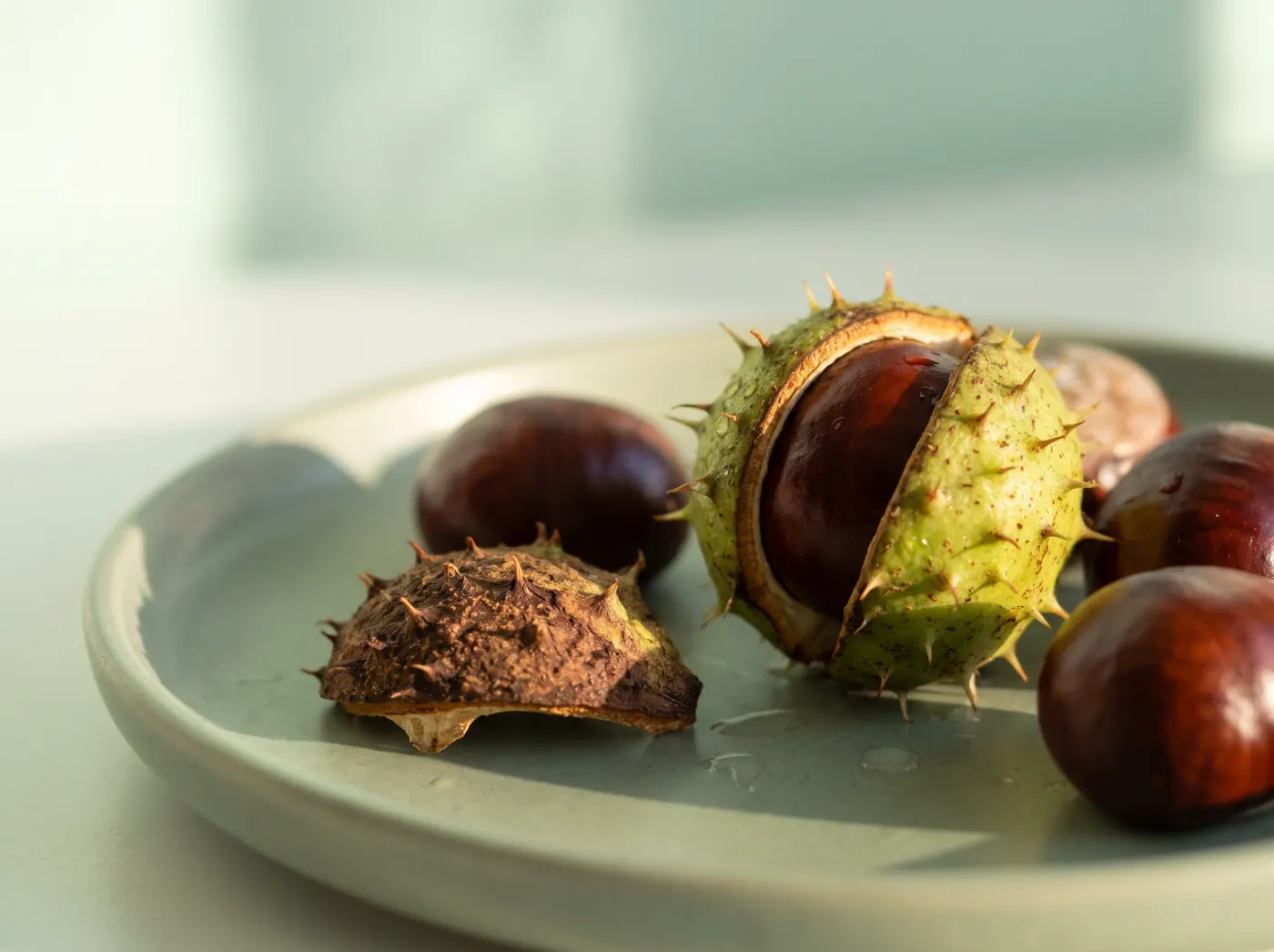
Glossy horse chestnuts and their husk in macro view on a sage green ceramic surface

Horse chestnut at a glance

Entry from our cosmetic ingredient glossary. Regulatory data from the European Commission's CosIng database1 and Regulation (EC) 1223/20097. Copy the identifiers in one click for your files.

INCI name
AESCULUS HIPPOCASTANUM BARK EXTRACTBark extract according to CosIng1. Escin is extracted from the seeds5: the plant part of the material used is confirmed on its technical data sheet
Other names
Horse chestnut tree, horse chestnut
CAS number
8053-39-2
EC number
232-497-7
Botanical origin
Aesculus hippocastanum L., HippocastanaceaeCosIng entry: extract of the bark of the horse chestnut tree1
Compounds of interest
Escin (triterpenoid saponin)β-escin is extracted from the seeds5. It is a natural surfactant, used in pharmacy and in cosmetics4
CosIng functions
Astringent, tonic, skin conditioningFunctions declared for the bark extract1
Standardization
Varies by extractThe escin content depends on the plant part and the extraction: it is set in the raw material specification
EU status
No restrictionNo annex listed in CosIng1; no mention of Aesculus in Annexes II and III of the consolidated text of 1 May 20257
Allergen to declare
Not listedAbsent from the fragrance allergen list of Regulation (EU) 2023/15458
Safety
No CIR or SCCS assessment foundNo CIR or SCCS opinion on the extract was found: a tolerance test on the final formula is essential

What the research says

Each result shows the protocol and the level of evidence. The higher the level, the better the result carries over to a finished formula.

Clinical trialReview or consensusLaboratory

FaceEye area

Fewer eye area wrinkles with a 3% extract

Clinical trial
Gel with 3% horse chestnut extract9 weeks, 3 applications a day40 women, eye area, versus control

After 6 weeks, the wrinkle scores at the corners of the eyes and on the lower eyelid are significantly lower than those of the control; the result is similar at 9 weeks. The extract also makes fibroblasts contract in vitro. Study by a cosmetics manufacturer, the extract tested is not described more precisely2.

BodySilhouette

Cellulite: a cream with escin, caffeine and hypertonic salt

Clinical trial
Cream with 13% NaCl, escin, caffeine and beta-sitosterol60 days, 20 womenGrade I to III cellulite, no control group

Thigh circumference decreases by 1.8 and 2.1 cm (right, left) after 60 days (p = 0.001) and skin dimples by 56% on 3D analysis. The trial tests a combination of actives, with no control group: it does not isolate the effect of escin3.

Formulation and safetyReviews

A natural surfactant, whose effect depends on concentration

Laboratory
2019 reviewβ-escin, model lipid bilayers

Escin is strongly surface-active. Below its critical micelle concentration, it changes the membrane parameters; above it, it fully solubilizes the lipid bilayers. The dose therefore matters in formulation4.

A molecule studied mostly for pharmacology

Review
2023 reviewIsolated β-escin, extracted from the seeds

The review describes a significant cytotoxicity of β-escin in the pharmacology work listed. It concerns the isolated molecule, not a cosmetic extract: it does not replace a tolerance test of the final formula5.

Clinical uses outside the cosmetic field

Review
2019 reviewEscin tablets and transdermal gel

Most of the clinical data on escin concern medical uses. This page does not cover them: they cannot be transferred to a cosmetic6.

This page summarizes published literature on a cosmetic ingredient. It does not describe the effect of a finished product, which depends on its formula, and it is not medical advice. Escin is mostly studied as a molecule for medical use: that work is not covered here. Only cosmetic results are cited, and the level of evidence is modest.

Which products use horse chestnut?

Our white label catalog includes 5 formulas with horse chestnut, always as a supporting ingredient. Every category can be customized (formula, fragrance, packaging).

5Body

Supporting active in five massage and post-scrub oils of the catalog (cypress light legs, cinnamon cedar, peppermint, lavender, verbena), always combined with arnica and butcher's broom.

In our formulas, it is most often paired with

Arnica extracts 5Argan oil 5Butcher's broom 5Vitamin E 5Coconut 4

Frequently asked questions about horse chestnut

What is horse chestnut extract in cosmetics?
It is an extract of the horse chestnut tree (Aesculus hippocastanum). The INCI in our glossary, AESCULUS HIPPOCASTANUM BARK EXTRACT, refers to the bark1, while escin, its best-known molecule, is extracted from the seeds5. CosIng gives it the astringent, tonic and skin conditioning functions1.
What are the benefits of horse chestnut for skin?
Cosmetic evidence is limited: a trial on a 3% gel reduced eye area wrinkles in 40 women2, and a cream combining escin, caffeine and hypertonic salt reduced thigh circumference in a trial without a control3. This page does not cover medical use.
Is horse chestnut useful for heavy legs?
This page covers cosmetic use only. We retained no cosmetic study on the feeling of heavy legs. Our light legs massage oil combines several extracts (arnica, butcher's broom, horse chestnut) with oils and essential oils: it is a massage care product, not a health product.
Is horse chestnut suitable for the eye area?
A trial on 40 women tested a gel with 3% extract around the eyes, three times a day, for 9 weeks: wrinkle scores dropped versus the control2. The study comes from a manufacturer and concerns neither dark circles nor puffiness.
What percentage of horse chestnut extract should you use?
The only cosmetic trial retained uses a 3% extract in a gel2. The escin content varies by extract, and escin is a surfactant whose effect depends on concentration4: the dose is set with the formulator.
What can you pair horse chestnut with?
In our formulas, it is always paired with arnica and butcher's broom, along with argan oil, coconut oil and vitamin E, in massage oils. The stability of the final formula is checked with lab tests.
Is horse chestnut extract safe?
No European restriction is listed in CosIng1, but we found no CIR or SCCS assessment of the extract. Isolated β-escin shows significant cytotoxicity in pharmacology work5: the extract's content and a tolerance test on the final formula matter.
Can you manufacture a horse chestnut massage oil for my brand?
Yes. Our ISO 22716 certified lab offers 5 horse chestnut formulas (massage and post-scrub oils) that you can customize, or a custom formula. Samples are free.

Sources

Peer-reviewed studies and official regulatory sources, checked on November 3, 2026.

  1. European Commission. CosIng, entry AESCULUS HIPPOCASTANUM BARK EXTRACT (CAS 8053-39-2, EC 232-497-7). ec.europa.eu/growth/tools-databases/cosing
  2. Fujimura T, Tsukahara K, Moriwaki S, Hotta M, Kitahara T, Takema Y. A horse chestnut extract, which induces contraction forces in fibroblasts, is a potent anti-aging ingredient. J Cosmet Sci. 2006;57(5):369-376. doi:10.1111/j.1467-2494.2007.00369_3.xKao
  3. Puviani M, Tovecci F, Milani M. A two-center, assessor-blinded, prospective trial evaluating the efficacy of a novel hypertonic draining cream for cellulite reduction: A Clinical and instrumental (Antera 3D CS) assessment. J Cosmet Dermatol. 2018;17(3):448-453. doi:10.1111/jocd.12467
  4. Geisler R, Dargel C, Hellweg T. The Biosurfactant β-Aescin: A Review on the Physico-Chemical Properties and Its Interaction with Lipid Model Membranes and Langmuir Monolayers. Molecules. 2019;25(1):E117. doi:10.3390/molecules25010117
  5. Wang Y, Han X, Wan X, Niu F, Zhou C. β-Escin: An Updated Review of Its Analysis, Pharmacology, Pharmacokinetics, and Toxicity. Am J Chin Med. 2023;51(8):2095-2120. doi:10.1142/s0192415x23500908
  6. Gallelli L. Escin: a review of its anti-edematous, anti-inflammatory, and venotonic properties. Drug Des Devel Ther. 2019;13:3425-3437. doi:10.2147/dddt.s207720
  7. European Parliament and Council. Regulation (EC) No 1223/2009 on cosmetic products, Annexes II and III, consolidated text of 1 May 2025. eur-lex.europa.eu
  8. European Commission. Règlement (UE) 2023/1545 amending Regulation (EC) 1223/2009 as regards the labeling of fragrance allergens. eur-lex.europa.eu
Carmel Cosmetics Labs product specialist with a brand founder

Tell us about your project

A product specialist reviews your request and gets back to you on the channel you prefer.

Lead EN – Demande de devis
Tell us about your project. A product specialist will get back to you shortly.
CONTACT INFORMATION
Name
PROJECT INFORMATION
Which cosmetics category interests you most?

By submitting this form, you agree to our terms of service and privacy policy.

No obligation. Your information stays confidential and is used only to prepare your quote.