Services

Torn between two services?A project manager will guide you

Catalog

Explore the full catalog1,000+ formulas ready to carry your brand

Face careFull range

Serums, creams and targeted care, formulated with your actives.

Body careFull range

Moisturizing, nourishing and shower care: cream, butter or oil.

Specialty careFull range

Sun care, lips, intimate care and oral care.

Men, baby, makeupFull range

Shaving and beard, baby and mom, makeup.

Industries

All solutions by industryFormulas and formats for your business

Our brands

Our own brands, developed and made in our laboratory.
Become a distributor of our brandsPharmacies, spas, shops and wholesalers

Laboratory

Cosmetics manufacturing room with a row of stainless-steel mixers and an operator in white workwearOur factory in Aït MelloulISO 22716 and ISO 9001, visits by appointmentDiscover the factory

Resources

Lemon essential oil

Lemon essential oil is the volatile oil obtained from the fruit of Citrus limon1. It is rich in limonene9 and contains furocoumarins, responsible for its phototoxicity4. It is named in Annex III of Regulation (EU) 2023/1545 (line 353)2 and, for its furocoumarins, falls under Annex II (line 358)3.
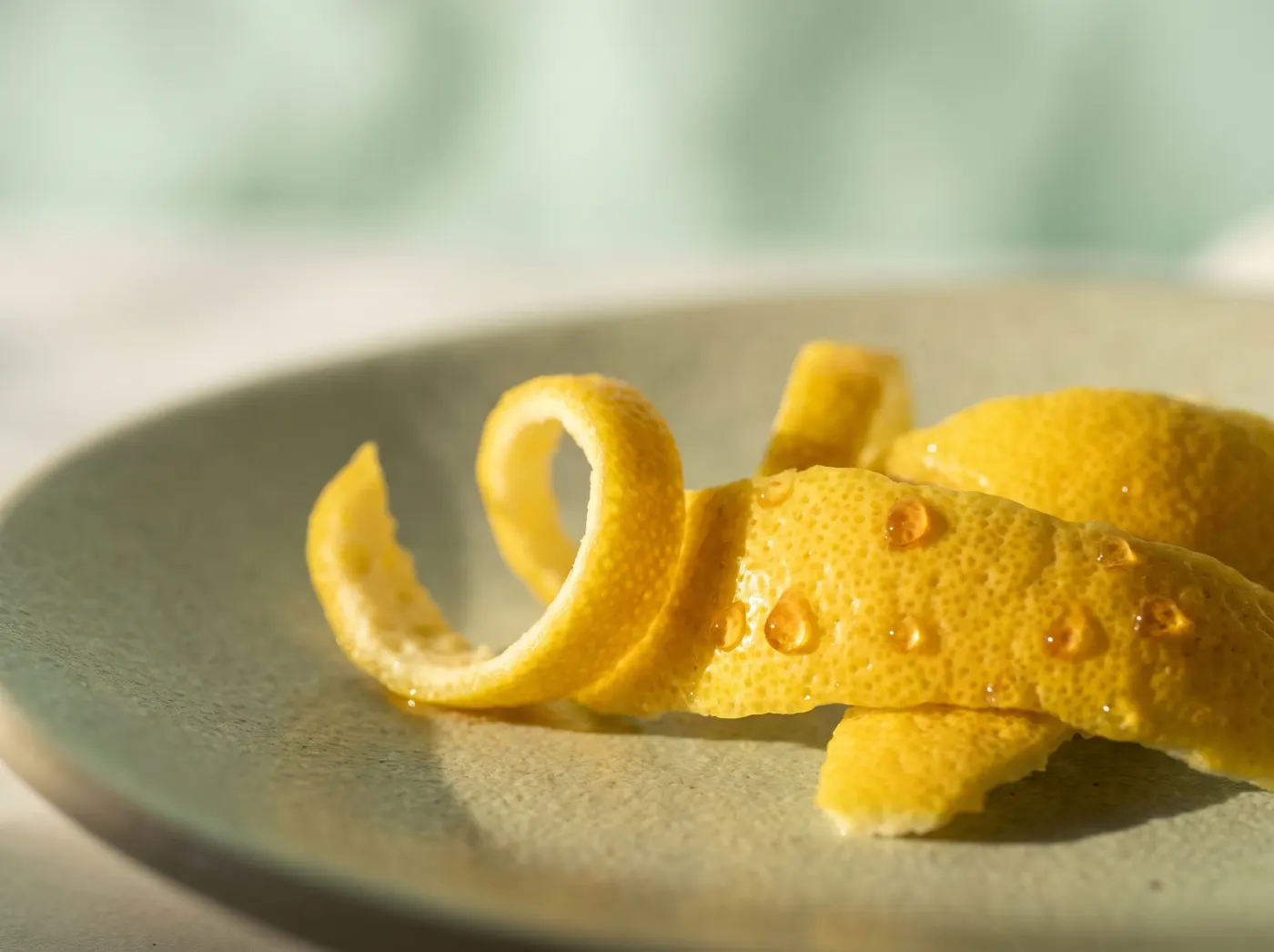
Lemon essential oil in macro view, clear drops on a sage green ceramic surface, raking light

Lemon essential oil at a glance

Entry from our cosmetic ingredient glossary. Regulatory data from the European Commission's CosIng database1 and from Regulations (EU) 2023/15452 and 1223/2009 consolidated3. Copy the identifiers in one click for your files.

INCI name
CITRUS LIMON FRUIT OILUS INCI name: CITRUS LIMON (LEMON) FRUIT OIL1
Other names
Lemon essential oilLemon oil. Not to be confused with lemon fruit extract (CITRUS LIMON FRUIT EXTRACT), a different ingredient1
CAS number
8008-56-8Regulation (EU) 2023/1545 cites this CAS at line 353, together with CAS 84929-31-72
EC number
Not assignedCosIng gives no EC number for this entry1
Botanical origin
Lemon (Citrus limon, Rutaceae)CosIng: volatile oil obtained from the fruit1
Composition
Limonene, β-pinene, γ-terpineneLimonene 60.7%, β-pinene 12.6% and γ-terpinene 10.3% in one analyzed oil9; limonene 39.7% and β-pinene 25.4% in another10. Composition varies from one oil to another
CosIng functions
Astringent, tonic"Astringent" and "Tonic"1
EU status
Named in Annex III, line 353Citrus limon oil, line added by Regulation (EU) 2023/15452. The regulation names it "Citrus Limon Peel Oil" (CAS 84929-31-7 / 8008-56-8), whereas CosIng registers it under CITRUS LIMON FRUIT OIL and refers to line II/3581
Allergen to declare
Yes, as an oil and through its constituentsAbove 0.001% in a leave-on product and 0.01% in a rinse-off product2. Limonene (line 88, peroxide value below 20 mmol/L) and β-pinene (line 371) are also named3. Non-compliant products could be placed on the market until 31 July 2026 and may be made available until 31 July 20282
Photosensitization
Furocoumarins: Annex II, line 358Prohibited "except for normal content in the natural essences used"; below 1 mg/kg in sun protection and tanning products3. Bergapten from 4 to 87 ppm and oxypeucedanin from 26 to 728 ppm depending on the origin of the lemon oil4
Safety
CIR assessment of citrus peel oilsSafe if the finished leave-on product contains at most 0.0015% (15 ppm) of 5-methoxypsoralen and if the formula is non-sensitizing and non-irritating8. The EFSA opinion on the pressed oil considers it irritating to skin and eyes, sensitizing and phototoxic5

What the research says

Each result shows the protocol and the level of evidence. The higher the level, the better the result carries over to a finished formula.

Clinical trialReview or consensusLaboratory

Oil compositionChemistry

Limonene leads, but proportions vary

Laboratory
2 Citrus limon oils analyzedGC-MS analysis

In one, limonene reaches 60.7%, ahead of β-pinene (12.6%) and γ-terpinene (10.3%)9. In the other, it is 39.7% and β-pinene 25.4%, with 21 components identified10.

Measuring furocoumarins in cold-pressed oils

Laboratory
HPLC method15 main furocoumarinsCold-pressed oils of several citrus fruits

A method separates and measures 15 furocoumarins of citrus oils; it can be run in a quality control lab equipped with an HPLC7.

PhotosensitizationSafety

Two furocoumarins explain the phototoxicity

Laboratory
Fractionation of lemon oils from several regionsBiological and HPLC analysis

Oxypeucedanin and bergapten explain almost all of the phototoxic activity. Their content varies more than 20-fold by origin (bergapten from 4 to 87 ppm, oxypeucedanin from 26 to 728 ppm) and their ratio is not constant. Oxypeucedanin is four times less potent than bergapten4.

Irritating, sensitizing, phototoxic

Review
2021 EFSA scientific opinionPressed lemon oil and its fractions

The EFSA panel classifies pressed lemon oil and its fractions as irritating to skin, eyes and airways, and as sensitizing. They contain furocoumarins and may cause phototoxicity. The opinion concerns animal feed5.

Different furocoumarin profiles from one citrus to another

Laboratory
UPLC-MS/MS analysis14 coumarins and furocoumarins12 Citrus species

Notable differences appear between varieties and between origins of the same species. The abstract gives no content specific to lemon6.

Oxidation and contact allergiesToxicology

CIR assessment of citrus peel oils

Review
14 citrus peel oils2019 report

The panel concludes the oils are safe if finished leave-on products do not exceed 0.0015% (15 ppm) of 5-methoxypsoralen and are formulated to be non-sensitizing and non-irritating8.

Oxidized limonene is far more sensitizing

Review
2019 review

Exposed to air, limonene forms hydroperoxides that are far more sensitizing than the pure compound. Some of the positive tests may be irritant false positives11.

Limonene hydroperoxides: 3.1% positive tests

Clinical study
5,511 consecutively tested peopleIVDK network, 2018 to 2020Clinic population

Tests with limonene hydroperoxides (0.3%) were positive in 170 people (3.1%), with many weak, doubtful or irritant reactions12.

Use on skinEvidence

No cosmetic clinical trial retained

Review
2018 review of citrus oils

The 2018 review summarizes the biological activities and safety of the oils of twelve citrus fruits, including lemon13. We retained no robust cosmetic clinical trial on skin. CosIng classifies the oil as astringent and tonic1.

This page summarizes published literature on a cosmetic ingredient. It does not describe the effect of a finished product, which depends on its formula, and it is not medical advice. Evidence is flagged by level: clinical trial, review or laboratory.

Which products use lemon essential oil?

Our white label catalog includes 1 formula with lemon essential oil: the key active in 1 of them, a supporting ingredient in the others. Every category can be customized (formula, fragrance, packaging).

1Body

Fragrance of the cypress and lemon massage oil in the catalog, which combines the two essential oils.

In our formulas, it is most often paired with

Coconut oil 1Arnica extracts 1Argan oil 1Apricot kernel oil 1Horse chestnut 1

Lemon, sweet orange, petitgrain bigarade or litsea cubeba?

Four citrus-scented oils often compared. Their chemistry differs, so do their labeling and their photosensitizing risk.

LemonSweet orangePetitgrain bigaradeLitsea cubeba
Dominant constituentsLimonene, β-pinene, γ-terpinene9LimoneneLinalool and linalyl acetateCitral (neral and geranial)
Regulation (EU) 2023/1545Oil named (line 353)2Oil named (line 351)2Oil not named under its INCI2Oil not named; citral named (line 70)3
Carmel catalog formulas1 formula1 formulaNoneNone

Frequently asked questions about lemon essential oil

What is lemon essential oil?
It is the volatile oil obtained from the fruit of the lemon, Citrus limon1. Its INCI name is CITRUS LIMON FRUIT OIL. It is rich in limonene (60.7% in one analyzed oil)9. It is not lemon fruit extract, which has its own page.
What are the benefits of lemon essential oil for skin?
CosIng classifies it as astringent and tonic1. We retained no robust cosmetic clinical trial on skin13. It is mostly used as a fresh fragrance, with precautions related to light.
Is lemon essential oil photosensitizing?
It contains furocoumarins, including bergapten and oxypeucedanin, which explain almost all of its phototoxicity4. Their content varies more than 20-fold by origin of the oil. Annex II (line 358) allows them at "normal content in the natural essences" and requires below 1 mg/kg in sun protection and tanning products3. For a leave-on product, the CIR retains at most 0.0015% (15 ppm) of 5-methoxypsoralen8. Ask for the oil's certificate of analysis.
Do I have to declare lemon oil in the ingredient list?
Yes. Since Regulation (EU) 2023/1545, Citrus limon oil is named in Annex III (line 353) and must be declared above 0.001% in a leave-on product and 0.01% in a rinse-off product2. The limonene and β-pinene it contains are also named3. Non-compliant products may be made available on the market until 31 July 2028.
Is lemon oil allergenic?
It can be: limonene oxidizes in air and its hydroperoxides are far more sensitizing than the pure compound11. In a study of 5,511 tested people, 3.1% reacted to limonene hydroperoxides, with a risk of false positives12. Air-protected packaging, an antioxidant and tolerance tests on the finished product limit the risk.
What is the difference between lemon extract and lemon essential oil?
The essential oil is the volatile fraction of the fruit, rich in limonene1. Lemon fruit extract (CITRUS LIMON FRUIT EXTRACT) is a different ingredient, with a composition that varies with the process: see our "Lemon extract" page. CosIng refers both to Annex II, line 3581.
Can you manufacture a lemon product for my brand?
Yes. Our ISO 22716 certified lab can add lemon essential oil to a catalog formula that you customize (the catalog includes a cypress and lemon massage oil) or to a custom formula, with furocoumarin control. Samples are free.

Sources

Peer-reviewed studies and official regulatory sources, checked on November 3, 2026.

  1. European Commission. CosIng, entry CITRUS LIMON FRUIT OIL (CAS 8008-56-8, EC -). ec.europa.eu/growth/tools-databases/cosing
  2. Commission Regulation (EU) 2023/1545 of 26 July 2023 amending Regulation (EC) No 1223/2009 of the European Parliament and of the Council as regards labelling of fragrance allergens in cosmetic products (Annex III). eur-lex.europa.eu
  3. Regulation (EC) No 1223/2009 of the European Parliament and of the Council on cosmetic products, consolidated version of 1 May 2025 (Annexes II and III). eur-lex.europa.eu
  4. Naganuma M, Hirose S, Nakayama Y, Nakajima K, Someya T. A study of the phototoxicity of lemon oil. Arch Dermatol Res. 1985;278(1):31-36. doi:10.1007/bf00412492
  5. EFSA Panel on Additives and Products or Substances used in Animal Feed (FEEDAP), Bampidis V, Azimonti G, Bastos ML, Christensen H, Kouba M, et al. Safety and efficacy of feed additives consisting of expressed lemon oil and its fractions from Citrus limon (L.) Osbeck and of lime oil from Citrus aurantiifolia (Christm.) Swingle for use in all animal species (FEFANA asbl). EFSA J. 2021;19(4):e06548. doi:10.2903/j.efsa.2021.6548
  6. Dosoky NS, Satyal P, Setzer WN. Authentication of Citrus spp. Cold-Pressed Essential Oils by Their Oxygenated Heterocyclic Components. Molecules. 2022;27(19):6277. doi:10.3390/molecules27196277
  7. Frérot E, Decorzant E. Quantification of total furocoumarins in citrus oils by HPLC coupled with UV, fluorescence, and mass detection. J Agric Food Chem. 2004;52(23):6879-6886. doi:10.1021/jf040164pFirmenich
  8. Burnett CL, Fiume MM, Bergfeld WF, Belsito DV, Hill RA, Klaassen CD, et al. Safety Assessment of Citrus-Derived Peel Oils as Used in Cosmetics. Int J Toxicol. 2019;38:33S-59S. doi:10.1177/1091581819862504
  9. Kačániová M, Čmiková N, Vukovic NL, Verešová A, Bianchi A, Garzoli S, et al. Citrus limon Essential Oil: Chemical Composition and Selected Biological Properties Focusing on the Antimicrobial (In Vitro, In Situ), Antibiofilm, Insecticidal Activity and Preservative Effect against Salmonella enterica Inoculated in Carrot. Plants (Basel). 2024;13(4):524. doi:10.3390/plants13040524
  10. Ben Hsouna A, Ben Halima N, Smaoui S, Hamdi N. Citrus lemon essential oil: chemical composition, antioxidant and antimicrobial activities with its preservative effect against Listeria monocytogenes inoculated in minced beef meat. Lipids Health Dis. 2017;16(1):146. doi:10.1186/s12944-017-0487-5
  11. de Groot A. Limonene Hydroperoxides. Dermatitis. 2019;30(6):331-335. doi:10.1097/der.0000000000000465
  12. Schubert S, Geier J, Brans R, Heratizadeh A, Kränke B, Schnuch A, et al. Patch testing hydroperoxides of limonene and linalool in consecutive patients-Results of the IVDK 2018-2020. Contact Dermatitis. 2023;89(2):85-94. doi:10.1111/cod.14332
  13. Dosoky NS, Setzer WN. Biological Activities and Safety of Citrus spp. Essential Oils. Int J Mol Sci. 2018;19(7):E1966. doi:10.3390/ijms19071966
Carmel Cosmetics Labs product specialist with a brand founder

Tell us about your project

A product specialist reviews your request and gets back to you on the channel you prefer.

Lead EN – Demande de devis
Tell us about your project. A product specialist will get back to you shortly.
CONTACT INFORMATION
Name
PROJECT INFORMATION
Which cosmetics category interests you most?

By submitting this form, you agree to our terms of service and privacy policy.

No obligation. Your information stays confidential and is used only to prepare your quote.