Services

Torn between two services?A project manager will guide you

Catalog

Explore the full catalog1,000+ formulas ready to carry your brand

Face careFull range

Serums, creams and targeted care, formulated with your actives.

Body careFull range

Moisturizing, nourishing and shower care: cream, butter or oil.

Specialty careFull range

Sun care, lips, intimate care and oral care.

Men, baby, makeupFull range

Shaving and beard, baby and mom, makeup.

Industries

All solutions by industryFormulas and formats for your business

Our brands

Our own brands, developed and made in our laboratory.

Become a distributor of our brandsPharmacies, spas, shops and wholesalers

Laboratory

Cosmetics manufacturing room with a row of stainless-steel mixers and an operator in white workwearOur factory in Aït MelloulISO 22716 and ISO 9001, visits by appointmentDiscover the factory

Resources

Arnica (Arnica montana)

Arnica (Arnica montana), an Asteraceae, provides flower extracts declared in cosmetics as skin conditioning agents1. Its sesquiterpene lactones are recognized contact allergens367. The CIR panel judges its data insufficient to conclude on the safety of the extract2, and cosmetic evidence of efficacy is thin9.

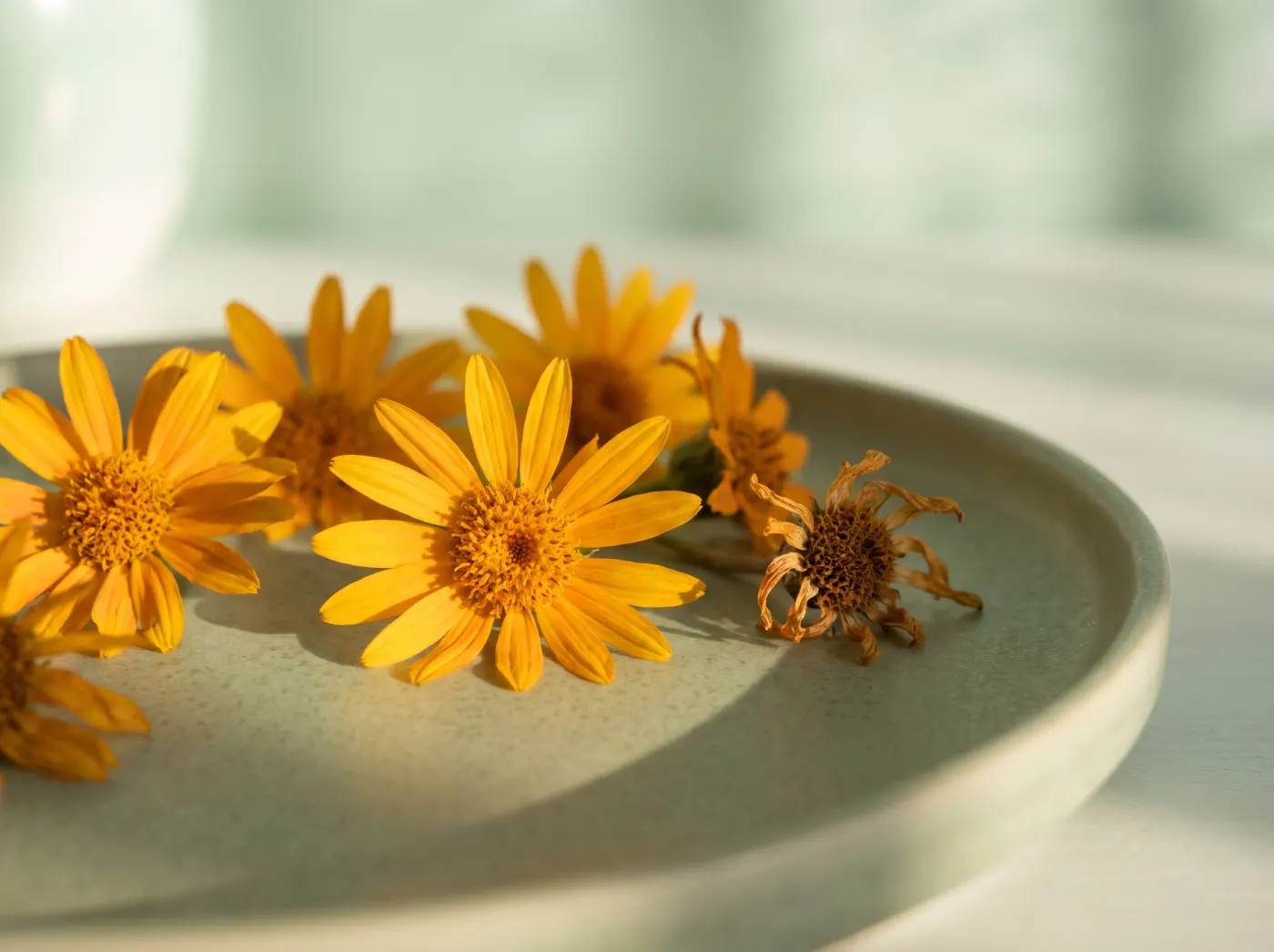
Dried orange-yellow arnica flowers in macro view on a sage green ceramic surface

Arnica at a glance

Entry from our cosmetic ingredient glossary. Regulatory data from the European Commission's CosIng database1 and Regulation (EC) 1223/200910, opinion of the CIR expert panel2. Copy the identifiers in one click for your files.

INCI name
ARNICA MONTANA FLOWER EXTRACTExtract of dried flower heads1. It is prepared by hydroalcoholic maceration, by maceration in soybean oil, or with glycols2
Other names
Mountain arnica, arnica extract, arnica macerate (depending on the form)
CAS number
68990-11-4
EC number
273-579-2
Botanical origin
Arnica montana L., AsteraceaeFlowers, roots or rhizomes for Arnica montana2; the CosIng entry covers the extract of dried flower heads1
Compounds of interest
Sesquiterpene lactones (helenalin and derivatives)Helenalin derivatives are the active compounds of an extract tested in cosmetics9; they are also the main allergens of the family37. The extract also contains fatty acids, flavonoids, tannins and carotenoids2
CosIng functions
Skin conditioning, perfumingFunctions declared for the flower extract1
Standardization
Varies by extract and growing siteThe composition depends on the origin of the plant2. The sesquiterpene lactone content can be measured by spectrophotometry and correlates with clinical allergy results7: a check to plan in the specification
EU status
No restrictionNo annex listed in CosIng1; no mention of Arnica in Annexes II and III of the consolidated text of 1 May 202510
Allergen to declare
Not listedAbsent from the fragrance allergen list of Regulation (EU) 2023/154511. This does not remove the allergy risk specific to the Asteraceae family
Safety
Data judged insufficient by the CIRThe CIR panel (2001) could not conclude on the safety of the extract for lack of sufficient data, with listed needs (use concentrations, photosensitization, repeated-dose toxicity)2

What the research says

Each result shows the protocol and the level of evidence. The higher the level, the better the result carries over to a finished formula.

Clinical trialReview or consensusLaboratory

FaceCosmetic efficacy

A gel with 1% flower extract increases lip and face volume

Clinical trial
Gel with 1% arnica flower extractHuman clinical study (sample size not given in the abstract)Human preadipocytes in culture

In culture, the extract speeds up the growth and differentiation of human preadipocytes, thanks to two helenalin derivatives. In the clinical study, the 1% gel increases lip and face volume and reduces wrinkles, with no adverse effect. Study by a cosmetic ingredient manufacturer9.

A sesquiterpene lactone barely found in the blood after application

Laboratory
Arnica tincture applied to rat skinChromatography coupled with mass spectrometry

84% of the sesquiterpene lactones applied (1.0 mg) are absorbed, but their concentrations stay below the detection limit (0.3 ng/mL) in plasma, urine and feces. They probably accumulate in the skin. No toxicity expected, apart from the known sensitizing potential. Study designed for medical use, only the skin data are retained8.

Safety and allergyReviews and cases

Insufficient data according to the CIR panel

Expert assessment
CIR panel 2001Arnica montana and its extract

About 100 cosmetic formulas contained the extract. Clinical tests showed neither irritation nor sensitization, but a delayed allergy (type IV) is described in people who handle the flowers. For lack of sufficient data, the panel does not conclude. Ingesting arnica has caused serious poisonings2.

1.13% of people sensitized to arnica in a test series

Clinical trial
443 consecutive people testedCompositae mix, lactone mix, arnica, calendula

5 people (about 1.13%) reacted to arnica, 9 (2.03%) to calendula. The Compositae mix was positive in 3 of the 5 people sensitized to arnica: it is not enough to detect this allergy. The authors recommend testing with plant extracts5.

People sensitized to arnica react to arnica products

Case series
6 people sensitized to arnicaTests with arnica products

5 of 6 reacted to arnica-based products. The authors advise against topical use of Asteraceae-based cosmetics by people allergic to this family4.

Among the Asteraceae, arnica is one of the most sensitizing

Review
2002 reviewAsteraceae (Compositae)

Of at least 15 suspected species, only arnica and German chamomile have epidemiological data. Sensitization seems relatively common with arnica and elecampane, rare with German chamomile. Sesquiterpene lactones are the main allergens3.

A measurable allergen, used in screening tests

Laboratory
Compositae screening mixArnica, tansy, yarrow, chamomile, feverfew

The extracts of this mix, including arnica, have a variable sesquiterpene lactone content. A spectrophotometric measurement method matches the clinical results well and is used for quality control of extracts with allergenic potential7.

In mice, arnica allergy appears only without immune defenses

Laboratory
Mouse contact hypersensitivity modelArnica tinctures and lactones

In immunocompetent mice, contact hypersensitivity to arnica could not be induced, even with a pure tincture applied to inflamed skin. In mice lacking CD4 lymphocytes and MHC II molecules, it appears. Animal model result, not transferable to humans6.


This page summarizes published literature on a cosmetic ingredient. It does not describe the effect of a finished product, which depends on its formula, and it is not medical advice. Arnica is also a traditional remedy: only the cosmetic and safety aspects are covered here. Evidence of cosmetic efficacy is thin; the safety data, especially on allergy, are the best documented.

Which products use arnica?

Our white label catalog includes 5 formulas with arnica, always as a supporting ingredient. Every category can be customized (formula, fragrance, packaging).

5Body

Supporting active in five massage and post-scrub oils of the catalog (cypress light legs, cinnamon cedar, peppermint, lavender, verbena), always combined with horse chestnut and butcher's broom.

In our formulas, it is most often paired with

Argan oil 5Horse chestnut 5Butcher's broom 5Vitamin E 5Coconut 4

Arnica, chamomile, calendula or centella asiatica?

Three Asteraceae and one Apiaceae, often combined in comfort care. The first three share the same allergy caution.

ArnicaChamomileCalendulaCentella asiatica
Botanical familyAsteraceae1AsteraceaeAsteraceaeApiaceae
Main roleSkin conditioning (flower extract)1Skin conditioning (flower extract)Skin conditioning (flower extract)Soothing, hydration, comfort
Formulation watch pointKnown allergen; insufficient CIR data25Caution for people sensitized to AsteraceaeSame family, same cautionTriterpene content varies by extract
EU regulationNo restriction110No restrictionNo restrictionNo restriction

Frequently asked questions about arnica

What is arnica in cosmetics?
It is an extract of the flower heads of Arnica montana, a mountain Asteraceae, declared as ARNICA MONTANA FLOWER EXTRACT1. It is prepared by hydroalcoholic maceration, in soybean oil or with glycols2, which gives materials of different composition.
What are the benefits of arnica for skin?
CosIng recognizes a skin conditioning role1. Cosmetic evidence is thin: a gel with 1% extract increased lip and face volume and reduced wrinkles in a study by an ingredient manufacturer9, and no other cosmetic trial is retained. This page does not cover medical use.
Can arnica cause allergies?
Yes, it is its main watch point. Arnica's sesquiterpene lactones are recognized contact allergens37. In a series of 443 people tested, about 1.13% reacted to arnica5, and 5 of 6 sensitized people reacted to arnica-based products4. People allergic to Asteraceae should avoid it.
Is arnica regulated in cosmetics?
It appears neither in Annexes II and III of Regulation (EC) 1223/2009 consolidated on 1 May 202510, nor in an annex listed by CosIng1. It is not on the fragrance allergen list either11. However, the CIR panel judges the data insufficient to conclude on the safety of the extract2: the safety file of the final formula is therefore essential.
What percentage of arnica should you use?
The only cosmetic trial retained uses a gel with 1% flower extract9. The CIR asked for use concentration data2. The dose is set with the formulator, based on the sesquiterpene lactone content7 and the tolerance test.
What can you pair arnica with?
In our formulas, it is always paired with horse chestnut and butcher's broom, along with argan oil, coconut oil and vitamin E, in massage oils. The stability of the final formula is checked with lab tests.
Is arnica safe?
The main risk is contact allergy in people sensitized to Asteraceae345. The CIR panel could not conclude on the safety of the extract and notes that ingesting arnica products has caused serious poisonings2: an arnica cosmetic is not to be swallowed. A tolerance test and a clear label mention are recommended.
Can you manufacture an arnica massage oil for my brand?
Yes. Our ISO 22716 certified lab offers 5 arnica formulas (massage and post-scrub oils) that you can customize, or a custom formula. Samples are free.

Sources

Peer-reviewed studies and official regulatory sources, checked on November 3, 2026.

  1. European Commission. CosIng, entry ARNICA MONTANA FLOWER EXTRACT (CAS 68990-11-4, EC 273-579-2). ec.europa.eu/growth/tools-databases/cosing

  2. Cosmetic Ingredient Review. Final report on the safety assessment of Arnica montana extract and Arnica montana. Int J Toxicol. 2001;20 Suppl 2:1-11. doi:10.1080/10915810160233712
  3. Paulsen E. Contact sensitization from Compositae-containing herbal remedies and cosmetics. Contact Dermatitis. 2002;47(4):189-198. doi:10.1034/j.1600-0536.2002.470401.x
  4. Paulsen E, Christensen LP, Andersen KE. Cosmetics and herbal remedies with Compositae plant extracts - are they tolerated by Compositae-allergic patients? Contact Dermatitis. 2008;58(1):15-23. doi:10.1111/j.1600-0536.2007.01250.x
  5. Reider N, Komericki P, Hausen BM, Fritsch P, Aberer W. The seamy side of natural medicines: contact sensitization to arnica (Arnica montana L.) and marigold (Calendula officinalis L.). Contact Dermatitis. 2001;45(5):269-272. doi:10.1034/j.1600-0536.2001.450503.x
  6. Lass C, Vocanson M, Wagner S, et al. Anti-inflammatory and immune-regulatory mechanisms prevent contact hypersensitivity to Arnica montana L. Exp Dermatol. 2008;17(10):849-857. doi:10.1111/j.1600-0625.2008.00717.x
  7. Salapovic H, Geier J, Reznicek G. Quantification of Sesquiterpene Lactones in Asteraceae Plant Extracts: Evaluation of their Allergenic Potential. Sci Pharm. 2013;81(3):807-818. doi:10.3797/scipharm.1306-17
  8. Jürgens FM, Robledo SM, Schmidt TJ. Evaluation of Pharmacokinetic and Toxicological Parameters of Arnica Tincture after Dermal Application In Vivo. Pharmaceutics. 2022;14(11):2379. doi:10.3390/pharmaceutics14112379
  9. Sakamoto K, Watanabe C, Masutani T, et al. Arnica montana L. extract containing 6-O-methacryloylhelenalin and 6-O-isobutyrylhelenalin accelerates growth and differentiation of human subcutaneous preadipocytes and leads volumizing of skin. Int J Cosmet Sci. 2023;45(1):1-13. doi:10.1111/ics.12815Ichimaru Pharcos
  10. European Parliament and Council. Regulation (EC) No 1223/2009 on cosmetic products, Annexes II and III, consolidated text of 1 May 2025. eur-lex.europa.eu
  11. European Commission. Règlement (UE) 2023/1545 amending Regulation (EC) 1223/2009 as regards the labeling of fragrance allergens. eur-lex.europa.eu
Carmel Cosmetics Labs product specialist with a brand founder

Tell us about your project

A product specialist reviews your request and gets back to you on the channel you prefer.

Lead EN – Demande de devis
Tell us about your project. A product specialist will get back to you shortly.
CONTACT INFORMATION
Name
PROJECT INFORMATION
Which cosmetics category interests you most?

By submitting this form, you agree to our terms of service and privacy policy.

No obligation. Your information stays confidential and is used only to prepare your quote.