


















































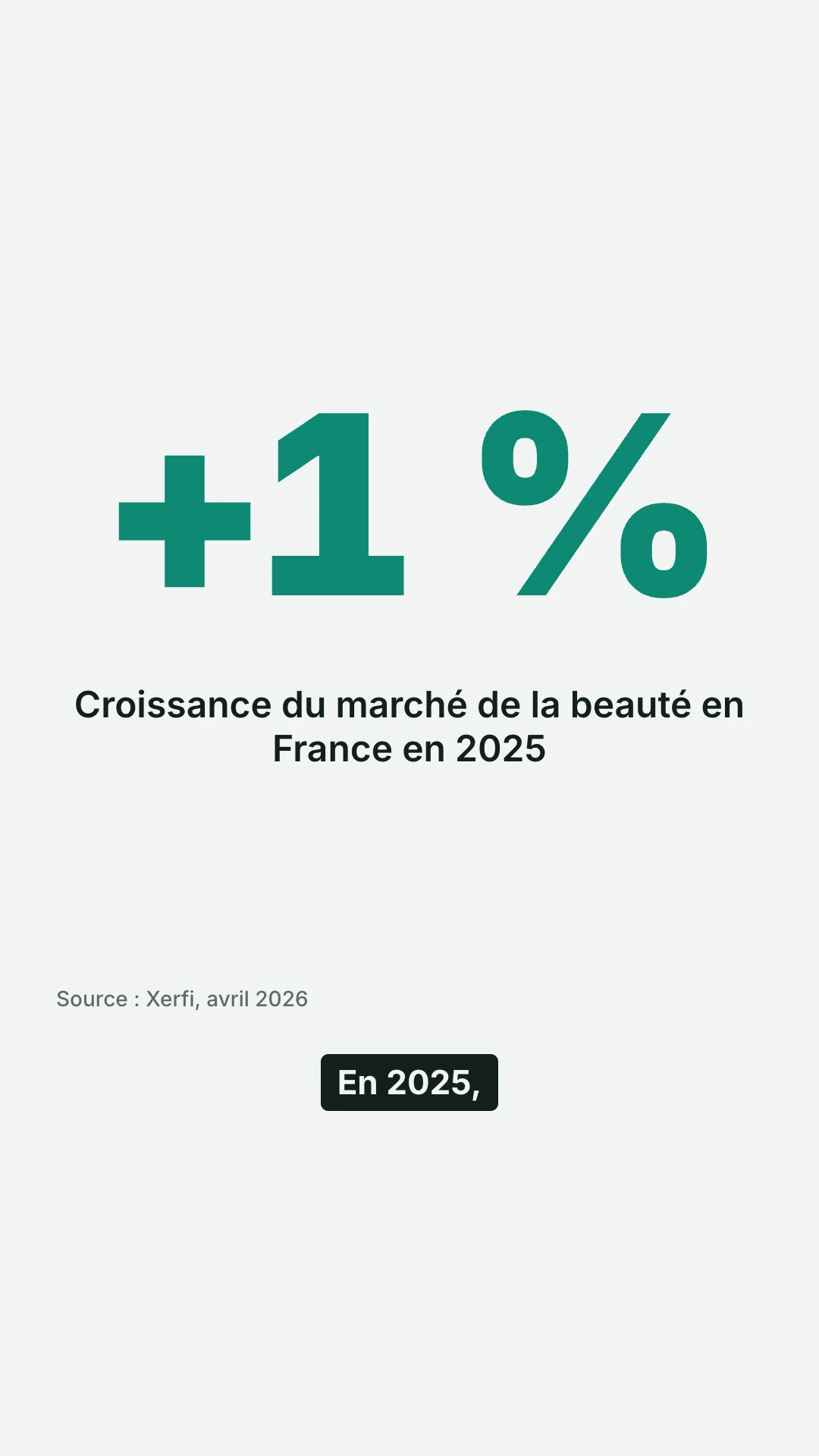
The French perfume and cosmetics market is worth €10.7bn in 2025, across all distribution channels. It grew 1% in value, its slowest pace since the 2020 crisis (Source: Xerfi, April 2026). Selective distribution (prestige perfumeries and department stores) remains the leading channel with 55% of the market, but sales there fell 1%. Pharmacies grew 8%. For 2026 and 2027, Xerfi forecasts growth of +0.5% and then +2%.
This page gathers the key figures for the cosmetics market in France: size, growth, channels, segments, prices and tourism. It combines the Xerfi study “La fabrication de parfums et cosmétiques” (April 2026) with public data from Circana, GERS, Fevad, FEBEA, French Customs, Cosmetics Europe and Insee, as well as our own calculations. Every figure is dated and sourced. Last updated: 8 November 2026. To reuse a figure, see How to cite this page.
The essentials in 12 figures
- €10.7bn: French perfume and cosmetics market in 2025, all channels combined, up from €7.6bn in 2011 (Xerfi).
- +1% in value in 2025, after +3% in 2024 and +6.5% in 2023 (Xerfi).
- +0.5% in 2026, +2% in 2027: market growth forecasts (Xerfi).
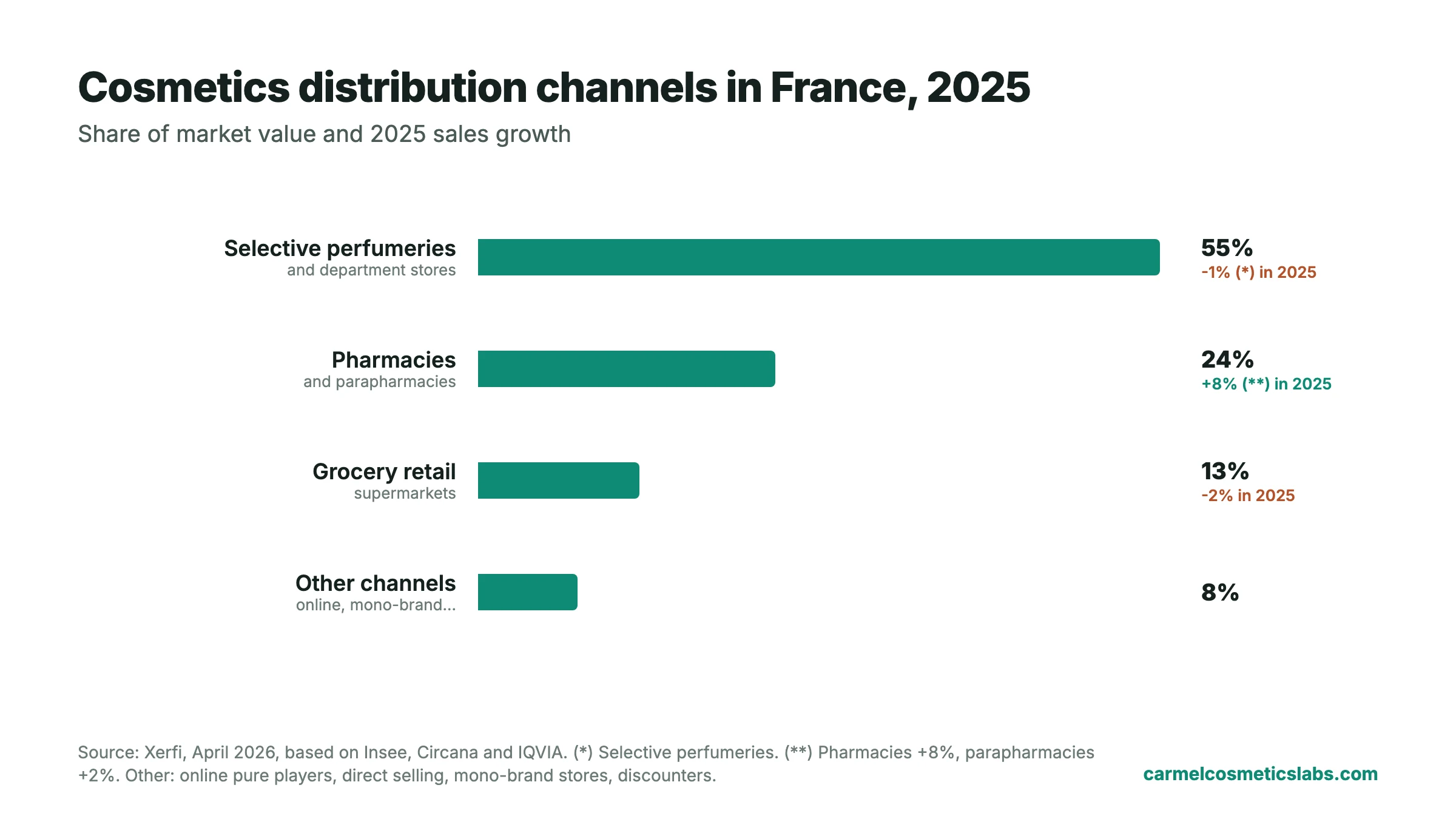
- 55% of the market goes through selective perfumeries and department stores, 24% through pharmacies and drugstore-pharmacies (parapharmacies), 13% through grocery retail and supermarkets, and 8% through other channels (Xerfi).
- +8% for pharmacy sales in 2025, against -1% in selective perfumeries and -2% in grocery retail and supermarkets (Xerfi).
- +20.4% for sun care in pharmacies and +5.9% for dermocosmetics (Xerfi, based on CosmétiqueMag and Gers).
- +29% for prestige haircare, the only selective category with strong growth; skincare fell 4% (Xerfi, based on Circana).
- -5.9% for make-up in grocery retail and supermarkets; only sun care grew there (+8%) (Xerfi, based on CosmétiqueMag and Circana).
- +1.4% for perfume prices and +0.4% for make-up and skincare prices in 2025 (Xerfi).
- One cosmetic product in five sold in France is bought by a foreign tourist (Xerfi).
- +62% for cosmetics imports from South Korea in 2025, +16% for those from China (Xerfi).
- +52% for Aroma-Zone sales in 2025, a sign of the rise of mono-brand stores (Premium Beauty News/AFP).
How big is the French cosmetics market?
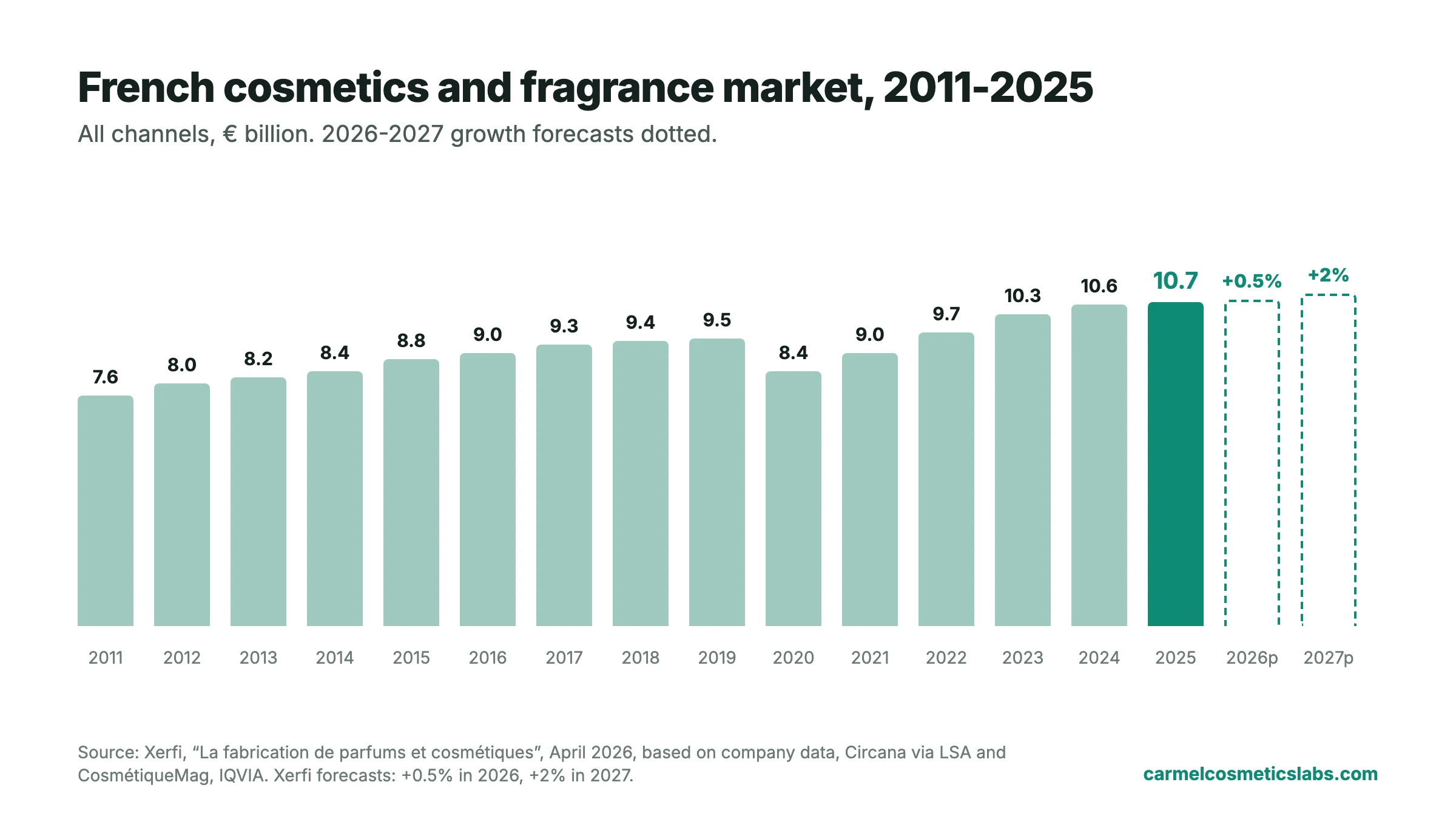
The French perfume and cosmetics market is worth €10.7bn in 2025, across all channels (Source: Xerfi, April 2026). It has gained €3.1bn since 2011 (€7.6bn). After the 2020 drop (-12%), it rebounded from 2021 to 2023 before slowing sharply.
| Year | Market (€bn) | Change in value |
|---|---|---|
| 2019 | 9.5 | +1.5% |
| 2020 | 8.4 | -12.0% |
| 2021 | 9.0 | +7.5% |
| 2022 | 9.7 | +7.0% |
| 2023 | 10.3 | +6.5% |
| 2024 | 10.6 | +3.0% |
| 2025 | 10.7 | +1.0% |
| 2026 (forecast) | – | +0.5% |
| 2027 (forecast) | – | +2.0% |
Why do other sources give different amounts?
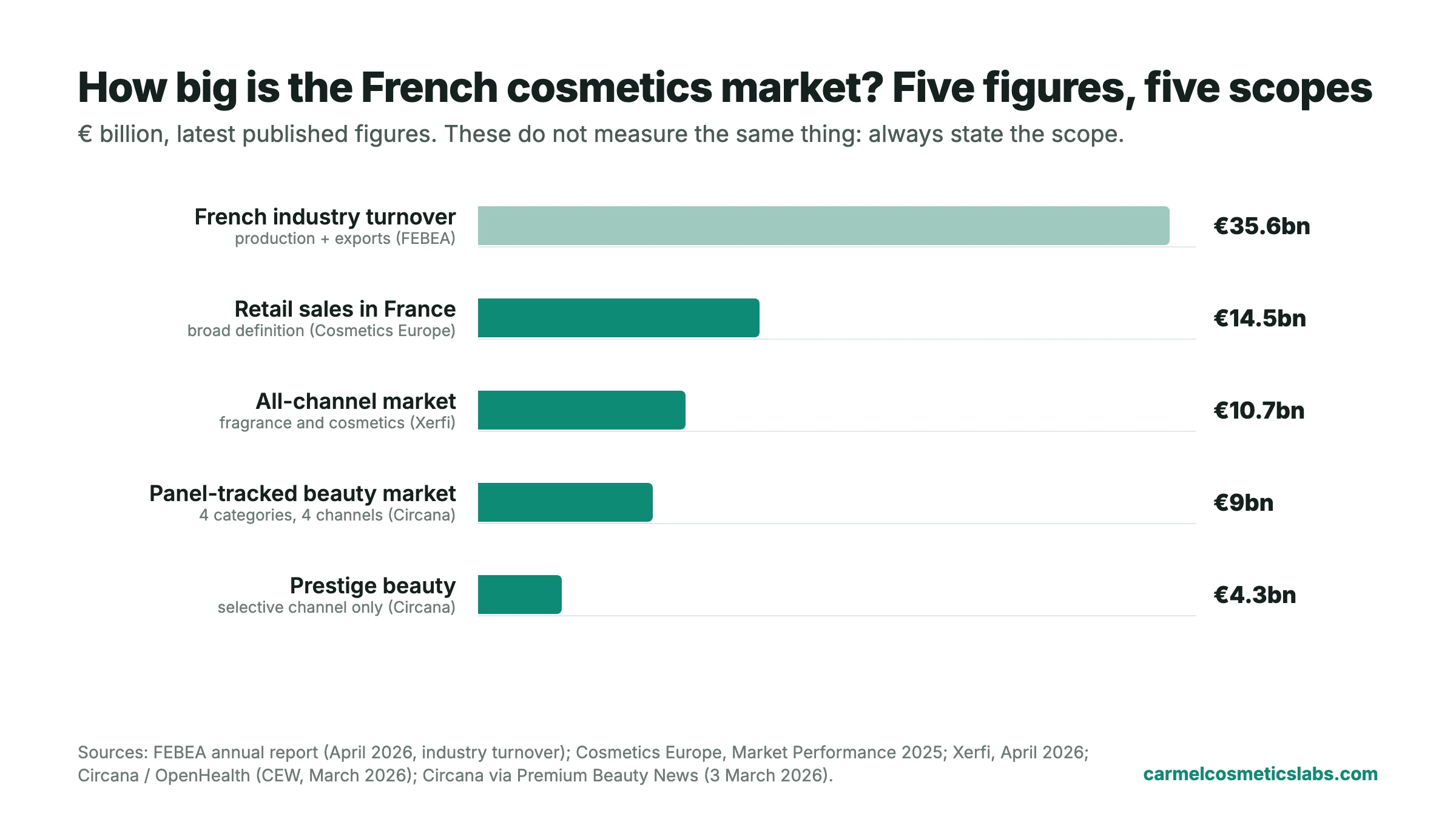
Depending on the source, the size of the market ranges from €4.3bn to €35.6bn. These figures do not contradict each other: they do not measure the same thing. Articles on the subject often mix these scopes.
| Figure | What it measures | Source |
|---|---|---|
| About €35.6bn | Turnover of the French cosmetics industry, exports included (€22.4bn of exports in 2025). This is not sales in France. | FEBEA, annual report published in April 2026 |
| €14.5bn | Retail sales in France, at the price paid by the consumer, under a broad definition that includes hygiene, toiletries and oral care. | Cosmetics Europe, 2025 |
| €10.7bn | Perfume and cosmetics market across all channels, within the scope of the study. | Xerfi, April 2026 |
| About €9bn | Skincare, haircare, perfume and make-up in four channels tracked by panel: selective distribution, supermarkets, supermarket-based drugstores and pharmacies. Flat in 2025 (0%). | Circana / OpenHealth, CEW Beauty Business, March 2026 |
| €4.3bn | Prestige beauty sold through selective distribution, online sales included. | Circana via Premium Beauty News, March 2026 |
Xerfi’s scope includes the fastest-growing channels (mono-brand stores, pure online sales, discount retailers). This is why it shows +1% in 2025, while the Circana panel, limited to four channels, is flat.
Our reading of the figures: 5 calculations
Using these series, we calculated five indicators that sum up the situation. The calculations are by Carmel Cosmetics Labs; the method is given for each one.
- +2.5% a year on average since 2011. This is the compound annual growth rate of the market between 2011 (€7.6bn) and 2025 (€10.7bn), based on the Xerfi series.
- +2.0% a year since 2019, against +2.8% before. Despite the rebound from 2021 to 2023, average growth since 2019 (€9.5bn) remains below that of 2011-2019.
- About €5.9bn in selective distribution, €2.6bn in pharmacies and drugstore-pharmacies, €1.4bn in grocery retail. These are Xerfi’s channel shares (55%, 24%, 13%) applied to the €10.7bn market.
- About €2.1bn bought by tourists. One cosmetic product in five, applied to the €10.7bn market (order of magnitude).
- About €10.8bn in 2026 and €11.0bn in 2027. These are Xerfi’s growth forecasts (+0.5%, then +2%) applied to the 2025 market.
What growth should be expected in 2026 and 2027?
Xerfi forecasts near-stagnation: +0.5% in 2026, then +2% in 2027 (Source: Xerfi, April 2026). According to the study, households will stay cautious as their purchasing power erodes, will turn to cheaper products, sometimes imported, and price pressure will limit growth of the market in value.
Public figures point the same way. In 2025, household consumption grew only 0.4% in volume, with a savings rate of 17.9% (Insee). Consumer purchase intentions, detailed below, also lean towards caution.
How does France compare with the rest of Europe?
France is the third-largest European beauty market, with €14.5bn of retail sales in 2025, behind Germany (€18.0bn) and the United Kingdom (€14.7bn), in a European market of €110bn (Cosmetics Europe). It is also the only large European market where prestige beauty fell in 2025. For pharmacy brands, see also the best-selling dermocosmetics in Europe.
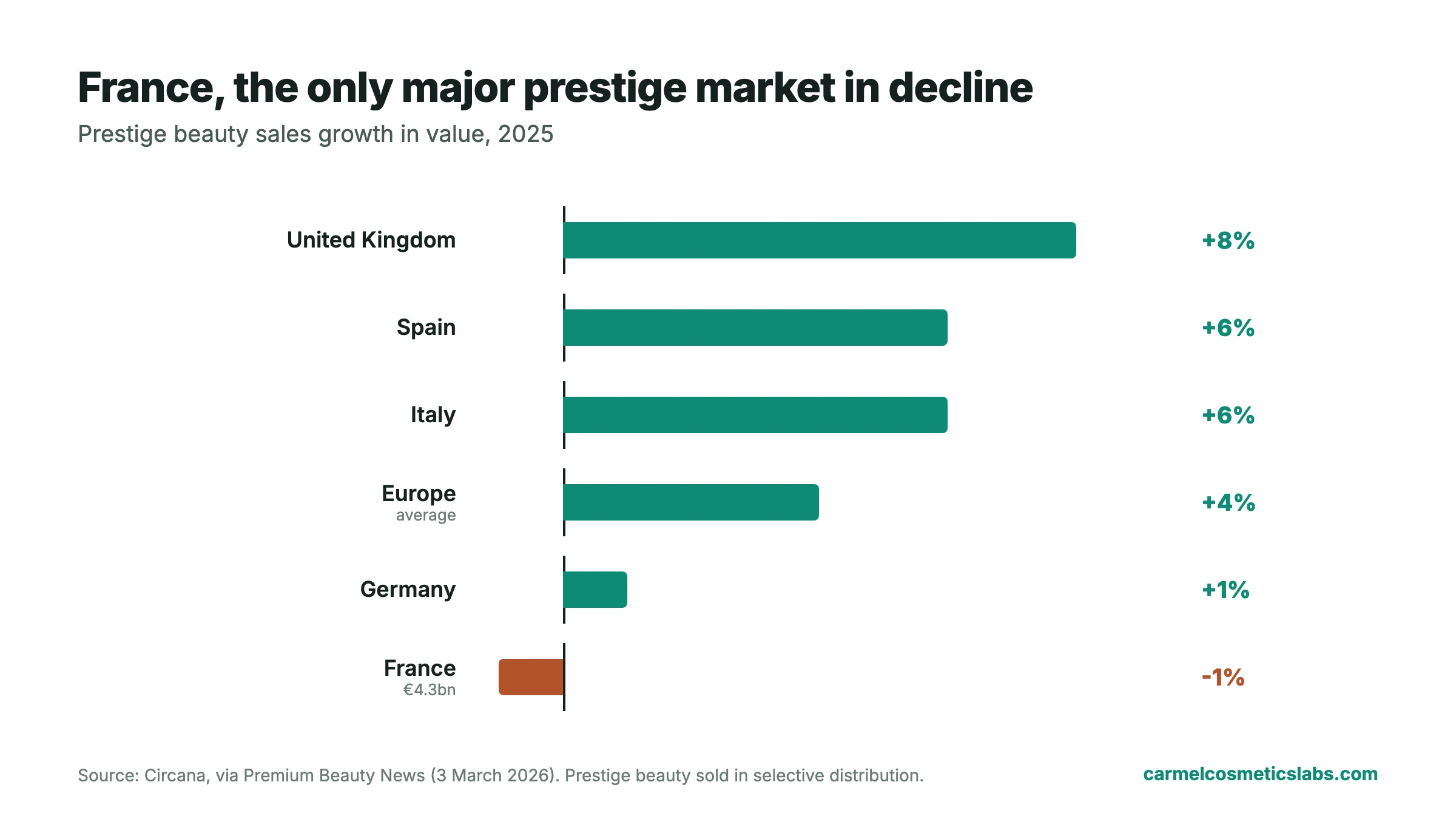
- In 2025, prestige beauty grew 8% in the United Kingdom, 6% in Spain and Italy, and 1% in Germany. It fell 1% in France, to €4.3bn of sales, while Europe grew 4% (Circana via Premium Beauty News).
- Online sales account for 18% of selective distribution sales in France, against more than 50% in the United Kingdom and 46% in Germany (Circana).
- According to Circana, France is the only European country where beauty prices were still rising in 2025.
What share does each distribution channel hold?
Selective perfumeries and department stores account for 55% of the French market in 2025, ahead of pharmacies and drugstore-pharmacies (24%), grocery retail and supermarkets (13%) and other channels (8%) (Source: Xerfi, April 2026, based on Insee, Circana and IQVIA).
| Channel | Market share 2025 | Change in sales 2025 |
|---|---|---|
| Selective perfumeries and department stores | 55% | -1% (selective perfumeries) |
| Pharmacies and drugstore-pharmacies (parapharmacies) | 24% | pharmacies +8%, parapharmacies +2% |
| Grocery retail and supermarkets | 13% | -2% |
| Other channels (pure online sales, direct selling, mono-brand stores, discount retailers…) | 8% | – |
Which segments are growing and which are declining?
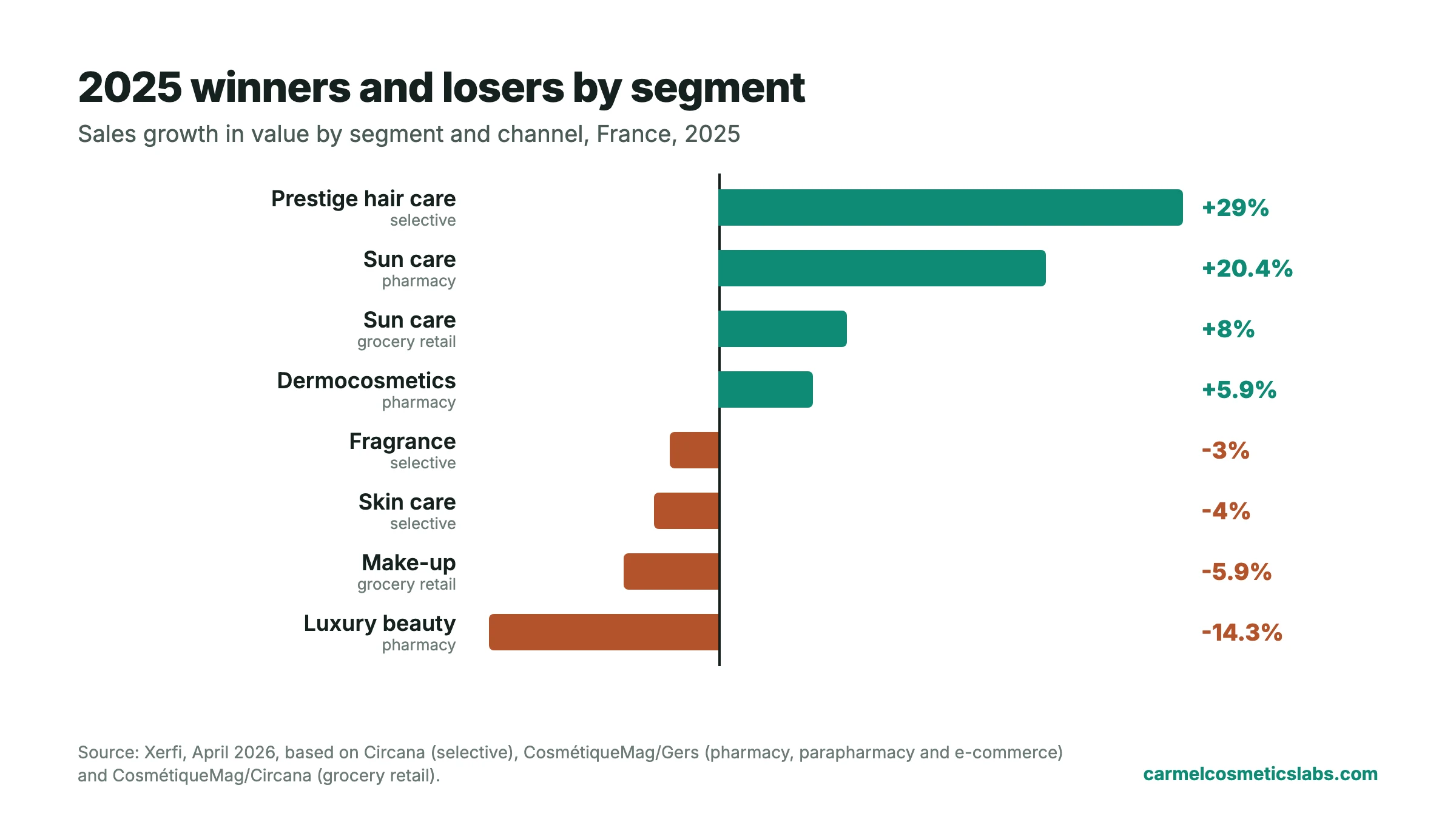
In 2025, the strongest increases come from sun care in pharmacies (+20.4%) and prestige haircare (+29%). The steepest declines hit luxury beauty in pharmacies (-14.3%) and make-up in grocery retail and supermarkets (-5.9%) (Source: Xerfi, April 2026).
Pharmacies: sun care and dermocosmetics lead
In pharmacies, drugstore-pharmacies and their associated online sales, sun care sales grow 20.4%, dermocosmetics 5.9% and make-up 5.2%. Organic beauty falls 2.7% and luxury beauty 14.3% (Source: Xerfi, April 2026, based on CosmétiqueMag and Gers). According to Xerfi, dermocosmetics benefits from lasting drivers linked to health and an ageing population.
GERS data confirm the trend: health and beauty sales in pharmacies reach €2.5bn in 2025, up 7.5%, or about €175m more than in 2024 (GERS Data, Revue Pharma). Avène, La Roche-Posay and Caudalie are the top three brands. K-beauty there rises from €10m in 2023 to €32m in 2025. These sales go through 19,434 pharmacies, 242 fewer than a year earlier (GERS, Le Moniteur des pharmacies).
Selective distribution: perfume weighs on the total, haircare takes off
In selective perfumeries, perfume, the largest segment, falls 3% in value and 5% in volume. Skincare falls 4% in value and 8% in volume, and make-up is flat. Prestige haircare grows 29% in value (Source: Xerfi, April 2026, based on Circana). Fragrances sold for more than €185 and body mists also grow.
Grocery retail and supermarkets: everything falls except sun care
In grocery retail and supermarkets, perfume and cosmetics sales fall 1.6% in 2025. Sun care grows 8%, while skincare (-1.3%), perfumes (-1.7%) and make-up (-5.9%) decline (Source: Xerfi, April 2026, based on CosmétiqueMag and Circana). Xerfi points to competition from mono-brand stores (Adopt, Aroma-Zone, Rituals) and above all from discount stores (Action, Normal).
The new channels
Aroma-Zone sales grow 52% in 2025, after +56% in 2024. The retailer has 4.5 million customers (Premium Beauty News/AFP, March 2026). According to Circana, mono-brand stores grow 21% and discount stores 12% (reported by Spa-A).
How are cosmetics prices changing?
Prices rose little in 2025: +1.4% for perfumes and eaux de toilette, +0.4% for make-up and skincare (Source: Xerfi, April 2026). After the sharp increases of previous years, retailers moderated their prices and ran more promotions to protect volumes.
Over a longer period, the average price in selective distribution rose 20% between 2019 and 2025 (Circana, reported by Spa-A). Across 30 women’s perfumes, the average increase over the same period is 15% (UFC-Que Choisir, May 2025).
Who buys, and where?
Cosmetics purchases in France depend heavily on tourists, who buy one product in five (Xerfi), and on online shopping, used by 44.8% of online shoppers for beauty (Fevad). Products imported from Korea and China, dupes and AI recommendations also carry growing weight.
- Tourists: foreign tourists buy one in five cosmetic products sold in France, mostly in selective distribution, department stores and tax-free shopping (Source: Xerfi, April 2026). France received 102 million international tourists in 2025 (Atout France).
- Imported products: cosmetics imports from South Korea grow 62% in 2025, those from China 16% (Source: Xerfi, April 2026).
- Online: 44.8% of online shoppers bought a beauty or hygiene product online in 2025. Amazon (31.8%), Sephora (22.9%), Yves Rocher (20.2%) and Aroma-Zone (12.9%) are the most used sites (Fevad).
- Dupes: 31% of French consumers bought a cosmetic “dupe” in the past 12 months (C-Ways for FEBEA, Premium Beauty News, June 2025).
- AI and platforms: 49% of consumers have already received a product recommendation from a generative AI. 42% of beauty buyers have bought on Amazon, and Vinted is the fourth most cited site, at 11% (NielsenIQ, reported by Spa-A).
- Consumer sentiment: 42% of consumers plan to cut their spending on beauty and personal care (Circana), and only 17% feel “free to spend” (NielsenIQ, CEW).
What about French industry?
French manufacturers make about half of their turnover abroad (Xerfi). In 2025, exports of perfumes and cosmetics reach €22.4bn, down slightly (-0.1%): this is their first decline outside Covid since 2008 (FEBEA, February 2026).
- Sales to the United States fall 19%, to €2.4bn, after the introduction of 15% customs duties in August 2025 (FEBEA; French Customs).
- The European Union grows 4%, to €12.1bn, and now accounts for 54% of exports (FEBEA).
- Cosmetics generate a trade surplus of about €17bn, the second largest in the French economy after aerospace. Imports grow 6%, to €5.4bn, driven by South Korea and China (FEBEA).
- The sector directly employs more than 58,000 people, 80% of them outside the Paris region (FEBEA).
What these figures mean for a new brand
- Growth comes from channels, not from the market. With +0.5% forecast for 2026, a brand gains share where sales are growing: pharmacies (+8%) and mono-brand stores.
- Sun care, dermocosmetics and haircare drive demand. These are the segments that grew in 2025, across several channels.
- A fair price becomes decisive. Households are shifting to cheaper products: an original formula at an accessible price has a place next to the big brands.
To go further, see where to sell cosmetics in France, the best first product to launch, how to create a private label brand in France and how to compare manufacturer quotes and budget your first batch. Read our guide on how to start a cosmetics brand and see our page on cosmetics manufacturing for French brands. Carmel Cosmetics Labs, an ISO 22716 certified laboratory, formulates and manufactures cosmetics from Agadir, Morocco, under white label and private label arrangements, for French and European brands, in compliance with Regulation (EC) No 1223/2009.
Methodology and sources
- Main source: Xerfi, “La fabrication de parfums et cosmétiques. Conjoncture et prévisions 2027”, April 2026. Figures marked “Xerfi” are taken from it, with the original sources the study cites (Insee, Circana, IQVIA, CosmétiqueMag, Gers). Only excerpts of the study are quoted here; the full study is available from Xerfi.
- Additional sources: FEBEA, French Customs, Cosmetics Europe, Circana, GERS and NielsenIQ (via the trade press and CEW), Fevad, Insee, Atout France, UFC-Que Choisir. Each figure was re-checked on 8 November 2026 on the page cited.
- Carmel calculations: average growth rates, euro amounts by channel, the tourist share in euros and the 2026-2027 projections are calculated by Carmel Cosmetics Labs from the series cited. They are orders of magnitude, not published data.
- Scopes: amounts and rates vary by source (see the scope table). Use the same series from one year to the next; do not compare a Xerfi figure with a Circana figure.
- Years: 2025 is the latest full year available. The 2026 and 2027 figures are forecasts.
How to cite this page
You may cite these figures in an article, a thesis or a presentation, crediting the original source (for example “Xerfi, April 2026”) and this page. The data remain the property of their authors. Example citation:
Carmel Cosmetics Labs, “French cosmetics market: key figures 2025-2026”, based on Xerfi (April 2026), updated 8 November 2026, https://carmelcosmeticslabs.com/en/french-cosmetics-market-statistics/
To reuse a chart, add a link to this page under the image, along with the source of the data.
Frequently asked questions
How big is the French cosmetics market?
The French perfume and cosmetics market reaches €10.7bn in 2025, across all channels, according to Xerfi (April 2026). Other sources give other amounts because they do not measure the same scope: €14.5bn of retail sales under a broad definition (Cosmetics Europe), and about €9bn for four channels tracked by panel (Circana).
Is the beauty market growing in France?
Only slightly. It grew 1% in value in 2025, after +3% in 2024, and Xerfi forecasts +0.5% in 2026 and then +2% in 2027 (Source: Xerfi, April 2026).
What is the leading sales channel for cosmetics in France?
Selective perfumeries and department stores, with 55% of the market in 2025. Next come pharmacies and drugstore-pharmacies (24%), grocery retail and supermarkets (13%) and other channels (8%) (Source: Xerfi, April 2026).
Which channel grew the most in 2025?
Among the large channels, pharmacies, with +8% (Source: Xerfi, April 2026). Mono-brand stores grow even faster: +21% according to Circana, and +52% for Aroma-Zone.
Which cosmetics products grew the most in 2025?
Prestige haircare (+29% in selective perfumeries), sun care (+20.4% in pharmacies, +8% in grocery retail and supermarkets) and dermocosmetics (+5.9% in pharmacies) (Source: Xerfi, April 2026).
What share of cosmetics is bought by tourists?
Foreign tourists buy one in five cosmetic products sold in France, mostly in selective perfumeries, department stores and tax-free shopping (Source: Xerfi, April 2026).
Are cosmetics prices rising in France?
Only a little in 2025: +1.4% for perfumes and +0.4% for make-up and skincare (Source: Xerfi, April 2026). Over six years, the average price in selective distribution rose 20% (Circana).
Is K-beauty growing in France?
Yes. Cosmetics imports from South Korea rise 62% in value in 2025 (Source: Xerfi, April 2026). In pharmacies, K-beauty goes from €10m in 2023 to €32m in 2025 (GERS).
Is France the largest beauty market in Europe?
No. With €14.5bn of retail sales in 2025, France is the third-largest European market, behind Germany (€18.0bn) and the United Kingdom (€14.7bn) (Cosmetics Europe). It is also the only large European market where prestige beauty fell in 2025 (-1%, Circana).