




To create a private label cosmetics brand in France, you need to define your positioning, choose an ISO 22716-certified contract manufacturer, develop and approve your formulas, then bring the products into compliance with Regulation (EC) No 1223/2009 (Responsible Person, Product Information File, CPNP notification) before selling them. Your timeline depends on the model you choose (catalogue white label or custom private label) and is defined with you in the quote; plan a starting budget of €3,000 to €15,000 depending on how complex your range is.
Contents
- Private label, white label, store brand: what’s the difference?
- The 7 steps to create a private label cosmetics brand
- How much does it cost to create a private label cosmetics brand?
- How long does it take to launch your brand?
- Do your cosmetics have to be made in France?
- How do you choose the right manufacturing partner?
- Frequently asked questions (FAQ)
- Conclusion
Launching your own cosmetics brand has never been more within reach. The private label model (also called white label) lets an entrepreneur, a pharmacy, a beauty salon or an e-commerce brand sell products under its own name without owning a factory or an R&D team. What remains is knowing the steps, the French and European regulatory framework and, above all, choosing the right manufacturing partner. This guide walks you through the whole process.
Key takeaways:
- Private label means selling products made by a third-party laboratory under your own brand.
- In France, no qualification is required, but compliance with Regulation (EC) No 1223/2009 is mandatory.
- You do not have to manufacture in France: what matters is EU compliance and Good Manufacturing Practice (ISO 22716).
- Choosing your contract manufacturer is the most decisive decision of the project.
- Your real entry cost depends mainly on minimum order quantities (MOQ) and the level of customization.
Private label, white label, store brand: what’s the difference?
These three terms are often confused. Here is a clear definition of each.
Private label refers to a product made by a laboratory and then sold under the client’s exclusive brand. The formula can be customized and commercially belongs to the brand that sells it.
White label, in everyday cosmetics-industry language, is almost a synonym for private label. The technical nuance: in “pure” white label, the client usually starts from an existing formula in the manufacturer’s catalogue, simply dressed in the brand’s colors. In private label, the level of customization (formula, texture, actives) generally goes further.
A store brand (retailer own brand) is a special case: these are products sold under the brand of a retail chain (a supermarket, a drugstore chain, etc.).
| Model | Formula source | Customization | Who is it for? |
|---|---|---|---|
| White label | Manufacturer’s catalogue | Low to medium (packaging, fragrance) | Fast start, controlled budget |
| Private label | Dedicated or adapted formula | Medium to high (actives, texture) | Brands seeking a distinctive positioning |
| Full custom | Developed from scratch in R&D | Maximum | Premium brands, differentiating claims |
In practice, the line is blurry: a good cosmetics contract manufacturing laboratory offers all three levels and steers you toward the one that fits your budget and ambitions.
The 7 steps to create a private label cosmetics brand
1. Define your positioning and target market
Before talking products, clarify your value proposition. Who are you targeting (sensitive skin, men’s care, organic cosmetics, the dermo-cosmetic segment)? Which channel will you sell through (e-commerce, pharmacy, beauty salon, marketplace)? At what price, and against which competitors? This positioning will drive everything else: the choice of actives, the packaging, the regulatory claims and even the country of manufacture.
2. Choose your product category and model
Select a coherent range rather than spreading yourself thin. A well-controlled launch often rests on 2 to 5 complementary products (for example: a cleanser, a serum, a cream). This is also the time to decide between white label (catalogue) and private label (dedicated formula). Browsing a catalogue of customizable cosmetic products lets you quickly assess what is feasible and at what cost.
3. Select your contract manufacturer
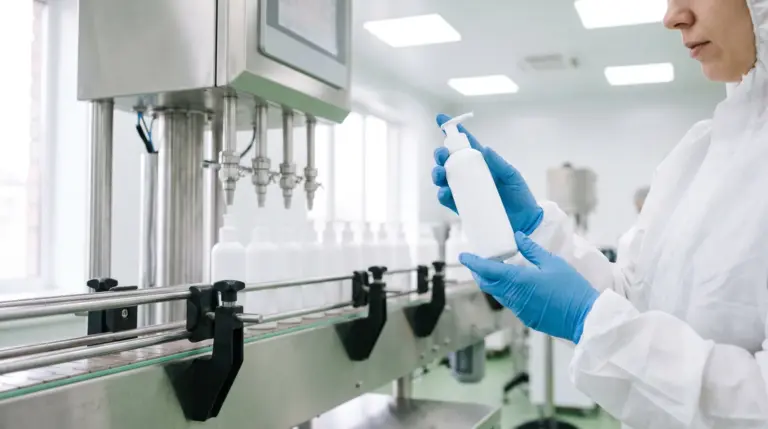
This is the most strategic step. The contract manufacturer designs, produces and fills your products. A serious laboratory should be ISO 22716 certified (cosmetic Good Manufacturing Practice), have an R&D team, offer an accessible MOQ and support you on regulatory matters. Depending on your project, the manufacturer will offer white label, custom private label or bulk cosmetics for you to fill yourself.
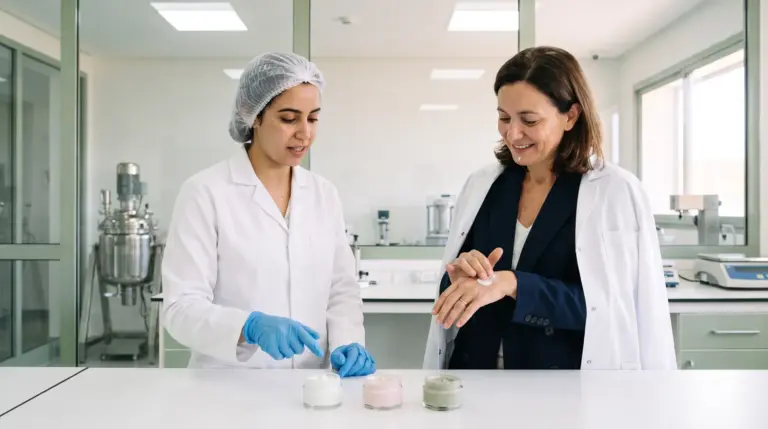
4. Develop the formula and approve samples
Now comes R&D. The laboratory formulates (or adapts) the product, then sends you samples to test (texture, fragrance, performance, stability). This phase includes stability and packaging compatibility tests, which are essential for setting the shelf life. Plan ahead for MOQ (Minimum Order Quantity) here: the minimum quantity per product strongly shapes your initial investment.

5. Achieve regulatory compliance (EC 1223/2009)
Every cosmetic sold in France and the European Union must comply with Regulation (EC) No 1223/2009. The main obligations are:
- Appoint a Responsible Person (RP) established in the EU, who guarantees compliance.
- Compile a Product Information File (PIF), kept and made available to the authorities.
- Have a safety assessment carried out by a qualified assessor (toxicologist, pharmacist).
- Notify each product on the European CPNP portal before placing it on the market.
- Follow the labeling rules (name and address of the Responsible Person, INCI list, nominal content, date of minimum durability, precautions, batch number, country of origin for imported products). Since July 31, 2026, every product newly placed on the market must also list the fragrance allergens on the list extended by Regulation (EU) 2023/1545 (above 0.001% in leave-on products and 0.01% in rinse-off products); products placed on the market before that date may be sold until July 31, 2028.
In France, since January 1, 2024, market surveillance of cosmetics falls solely under the DGCCRF, and cosmetovigilance under Anses. A manufacturer that offers regulatory support and PIF preparation saves you considerable time and legally secures your brand.

6. Design the packaging and brand identity
Packaging (primary and secondary) must be compliant, functional and true to your positioning. In parallel, build your brand identity: name, logo, brand guidelines, visual world. Remember to protect your brand by registering its name with INPI: registration is not mandatory but strongly recommended to secure your asset.
7. Launch, distribute and promote the brand
The home stretch: production of the first batch, logistics setup, opening sales channels (online store, retail outlets, distributors) and marketing activation (social media, SEO, press relations, sampling). Private label lets you restock quickly based on sales, provided you have a responsive manufacturing partner.
How much does it cost to create a private label cosmetics brand?
The cost varies with the model (white label vs custom), the number of products and the quantities. Here are indicative ranges for a first launch.
| Cost item | White label (catalogue) | Custom private label |
|---|---|---|
| Formula development / adaptation | Included or low | €500 – €3,000 per formula |
| First batch (depending on MOQ) | €1,000 – €5,000 | €3,000 – €10,000 |
| Packaging & design | €500 – €2,000 | €1,000 – €5,000 |
| Regulatory compliance (PIF, safety assessment, notification) | €300 – €1,200 per product | €300 – €1,200 per product |
| INPI trademark registration | From ~€190 (1 class) | From ~€190 (1 class) |
All told, a well-controlled launch often starts at around €3,000 to €5,000 in white label, and €8,000 to €15,000 for a differentiated private label range. MOQ remains the main lever: an accessible MOQ keeps your entry cost under control.
How long does it take to launch your brand?
A simple white label range moves faster than custom private label, which involves formula development and stability testing. Your exact schedule is defined with you in the quote. It depends on how quickly samples are approved, on packaging supply and on building the regulatory file, steps that can partly run in parallel.
Do your cosmetics have to be made in France?
No. The law does not require you to manufacture in France to sell a French brand. What is mandatory is that the product complies with Regulation (EC) No 1223/2009, is made according to Good Manufacturing Practice (ISO 22716), and that you have a Responsible Person established in the EU. A product made outside the EU and then imported is perfectly legal: the importer (or the appointed RP) then carries the regulatory responsibility. That is the case for the brands we manufacture in Morocco: see our page cosmetics manufacturer in Morocco for French brands.
The “Made in France” label is a marketing choice, subject to its own rules of origin, not a legal requirement for selling in France. Many brands therefore work with laboratories outside the EU that manufacture to European standards. That is exactly the model of Carmel Cosmetics Labs, an ISO 22716 (GMP) and ISO 9001 certified dermo-cosmetic laboratory that has supported more than 500 brands in 35 countries, with products ready for the European market.
How do you choose the right manufacturing partner?
Your brand’s success depends largely on your contract manufacturer. Always check the following:
- Certifications: ISO 22716 (GMP) at a minimum, ideally complemented by ISO 9001 and compliance with export requirements (EC Regulation, FDA registration).
- R&D capabilities: the ability to formulate custom products, incorporate specific actives and run stability tests.
- Flexible MOQ: an accessible MOQ at launch, with room to scale up volumes.
- Regulatory support: handling of the PIF, the safety assessment and CPNP notification.
- References and traceability: a portfolio of client brands, customer reviews, transparency across the production chain.
- Range of services: from formula to filling, including bulk, so the partnership grows with your needs.
A full-service laboratory saves you from juggling multiple suppliers and makes every step more reliable, from concept to finished product.
Frequently asked questions (FAQ)
What is the difference between white label and private label? White label usually starts from an existing formula in the manufacturer’s catalogue, dressed in the client’s colors. Private label involves a deeper level of customization, with a dedicated or heavily adapted formula. In the cosmetics industry, the two terms are often used as synonyms.
What budget do you need to create a cosmetics brand? A white label launch generally starts at around €3,000 to €5,000, while a custom private label range is more likely to fall between €8,000 and €15,000. The main cost driver is the minimum order quantity (MOQ).
Can you create a cosmetics brand without a laboratory? Not without compliant facilities. Manufacturing must follow Good Manufacturing Practice (ISO 22716) and the product must comply with Regulation (EC) No 1223/2009. Working with a contract manufacturer is the standard route to launching a compliant brand.
Do you need a qualification to create a cosmetics brand in France? No qualification is required to create the brand. However, the product safety assessment must be carried out by a qualified assessor (toxicologist or pharmacist), usually provided by the laboratory or a regulatory consultant.
What are the regulatory obligations for selling a cosmetic in France? You must appoint a Responsible Person established in the EU, compile a Product Information File (PIF), have a safety assessment carried out, notify the product on the CPNP portal and follow the labeling rules of Regulation (EC) No 1223/2009.
What is the minimum order quantity (MOQ) to get started? It varies by laboratory and product type. Look for a manufacturer with an accessible MOQ in white label, so your entry cost stays under control as you launch.
Conclusion
Creating a private label cosmetics brand in France is an achievable project, provided you master three pillars: a clear positioning, rigorous regulatory compliance and a reliable laboratory partner. The white label / private label model lets you focus on your brand and your market, while entrusting the industrial and regulatory complexity to an expert.
Got a brand project? Book a free consultation from Carmel Cosmetics Labs: we support you from formula to finished product, in line with international standards.