


















































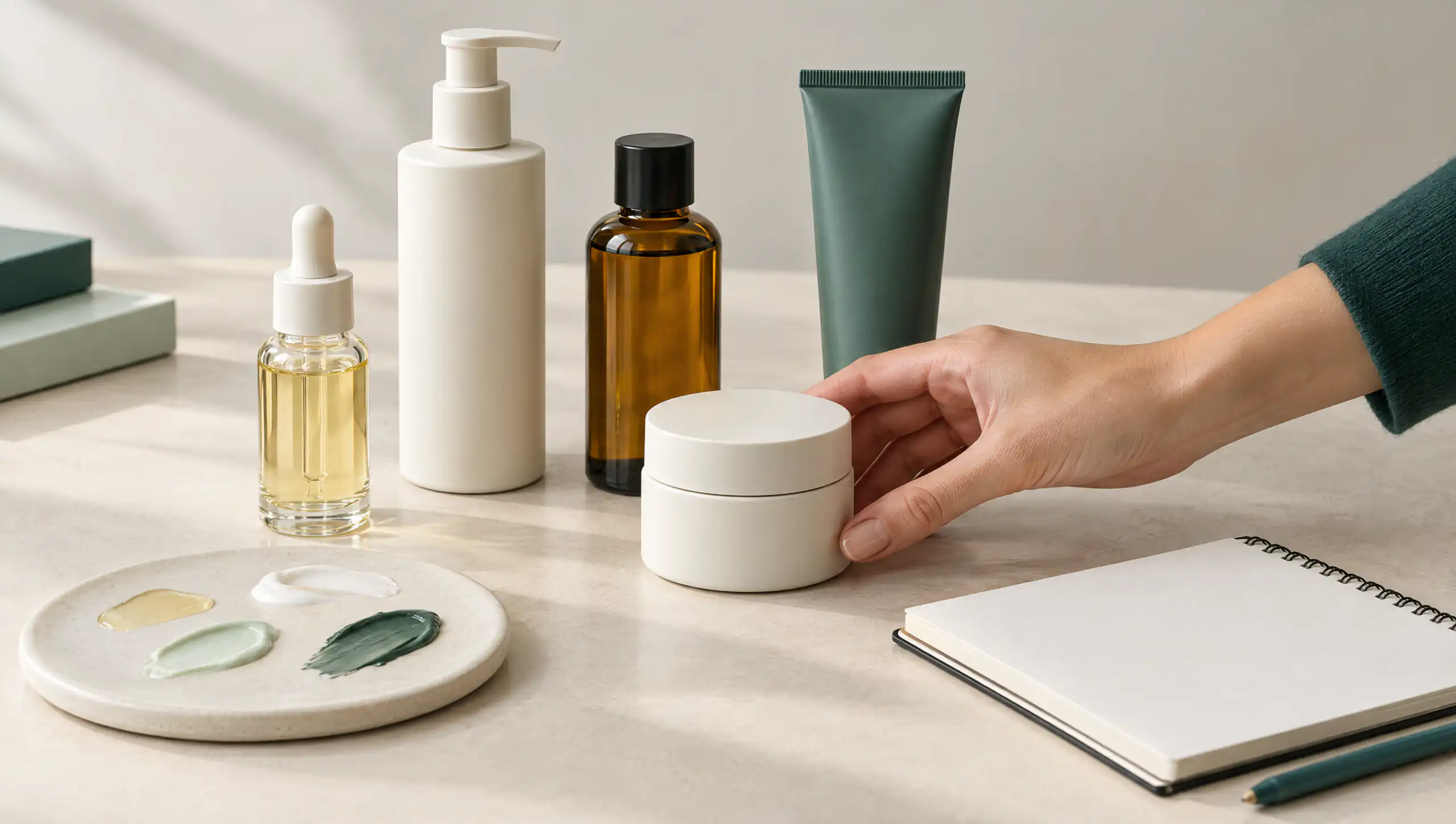
What is the best product to start a skincare line? Choose one product that meets a specific need for customers you can already reach, then check its full cost. A hair treatment can suit a salon, a massage oil a spa, a cream or serum an audience focused on facial care. The choice depends on your access to the customer as much as on the product.
Torn between a serum, a cream and an oil because all three seem to sell? Before you ask for samples, ask a more useful question: who will you offer this first product to, and why would that person switch from the one they already use?
Our rankings of the best-selling cosmetic products in France and the best-selling products in Morocco (both in French) give you market leads. This guide helps you turn those leads into a launch decision. The product and channel pairings below are starting points to validate, not sales forecasts.
Compare five possible products to start with
To choose between your ideas, keep the same target customer and the same sales channel. A product that looks promising in a store may need a different price, a different size or more explanation on an e-commerce site.
| Product to consider | A consistent option if… | To validate before choosing it |
|---|---|---|
| Face serum | Your audience expresses a specific skincare need and you can explain its place in a routine. | Justifiable claim, texture, packaging compatibility, accepted price and difference from the serum already in use. |
| Face cream | Your customers look for a daily care product whose use and expected comfort you can describe. | Skin feel, ease of application, possible fragrance, size and real preference over their current cream. |
| Face cleanser | You have identified a dissatisfaction with a step already in their routine. | Rinsing method, sensory feel, packaging and the economics of selling single units after shipping. |
| Body or massage oil | Your business lets you demonstrate the gesture, notably in a spa, a beauty salon or a body care setting. | Touch, glide, fragrance, dosage, leak-proofing and consistency of the size with the chosen use. |
| Hair mask or hair treatment | You know the habits of a specific hair care audience, for example through a salon or a community. | Rinse-off or leave-in use, amount applied, desired finish and fit with the existing routine. |
The Carmel formula catalog then lets you spot products to discuss with the laboratory. Start with a use and a size, then compare the formulas that match your brief.
Start from your first sales channel
The best first product is the one whose value you can explain in your real selling situation. Does the customer discover the texture during a treatment? Do they already follow you for your advice? Will a partner store present your product? These situations do not call for the same launch.
You run a beauty salon or a spa
Start from a request that keeps coming up during your treatments. A body oil used in a massage or a cream that extends a treatment routine can be a lead. The link between the treatment and the product must be easy to understand: when to use it at home, how much, and for what use.
Also separate the professional size from the size sold to the customer. The quantities used, the packaging and the acceptable price are not necessarily the same. Choose first the size that fits your launch goal.
You have a hair salon or a hair care audience
Customers who regularly ask about detangling, texture or hair finish give you a starting point. Compare a rinse-off mask with a leave-in treatment based on the habits you observe. Their place in the routine and their directions for use differ.
Your possible advantage comes from your knowledge of these uses. You still need to check that customers want to buy your offer, rather than simply listening to your advice or keeping their usual product.
You sell online to an existing community
Choose a need your community already voices. A cream and a serum can both meet a skincare expectation, but they do not tell the same story. Your product page must make the use, the expected texture, the amount and the price clear without relying on a face-to-face demonstration.
Do not confuse interest in content with purchase intent. A much-commented video may reveal curiosity about an ingredient without showing that a finished product, at your price, will find its customers.
You are starting with no audience and no point of sale
Before choosing a formula, work out how you will meet your first buyers. Interviewing a targeted customer group or talking with potential distributors will give you more useful input than a range designed for “everyone”.
A store buyer can talk to you about their assortment, the expected retail price and listing conditions. A person buying for themselves will talk about their routine, their hesitations and the product they would replace. Keep these two points of view separate.
Which product should you choose on a limited budget?
No product family is systematically the cheapest to launch. Volume, formula, container, decoration, services and the quantities requested all change the budget. An oil in specific packaging can tie up more cash than a cream in standard packaging.
To limit your initial commitments, have an existing formula, a standard container and a single clearly defined product reviewed. Ask for the cost of each customization separately. You will see what you save by simplifying an option, without assuming that a short ingredient list or a small bottle means a small budget.
Then compare products on full cost: manufacturing, packaging, launch-specific costs and delivery. In your sales scenario, add the expenses of the chosen channel. A distributor’s commission or the cost of shipping an order changes what you keep.
The cosmetics price calculator helps you test a selling price or a maximum purchase price. Use the same country, the same channel and the same assumptions for both candidate products. Enter the real costs you have; fixed launch costs must be budgeted separately. The simulated margin is not your net profit.
Two products, the same channel, the same margin target and every cost item filled in. You are then comparing two sales projects, not just two bottle prices.
Test my maximum purchase priceA single first product or a full range?
A single product is a reasonable starting point if it fulfills a clear use on its own. You can focus your work on its formula, packaging, messaging and sales. This choice removes neither fixed costs nor quality requirements.
A small routine can make sense when the products play complementary roles that your customers understand. But each product adds decisions and commitments: stock, packaging, supporting evidence and content. A gift set does not guarantee that all its products will be wanted.
Before adding a second product, write down its exact role. If its only justification is “it will look more serious on the website”, keep it for a later stage. If customers regularly ask for a complementary step and the budget allows, you have a concrete reason to study it.
Validate demand before committing to production
Start by testing your idea with future customers. Bpifrance Création recommends meeting your potential customers (in French) and adapting the project to the feedback you gather. For your first product, separate the evaluation of the commercial concept from that of the formulated product.
Check the problem and the price first
- Which product does the person use today, and in what situation?
- What doesn’t suit them: texture, size, directions, price or another specific point?
- What would your offer need to bring for them to consider switching?
- At your price and in your sales channel, what would make them hesitate?
Present two concepts with the same level of detail: use, size, intended price and expected benefit. Note the objections, not just the number of preferences. If a concept gets positive opinions but nobody can explain when they would use it, the need still has to be clarified.
A waiting list or an information request is a signal of interest, not a secured sale. This feedback helps you decide what to explore further; it does not replace observing real purchases after launch.
Then evaluate samples in a defined setting
With the laboratory, specify what must be evaluated on the samples and under what conditions: application, texture, scent, dosage or packaging behavior. Do not hand out a prototype for improvised trials without validating the conditions of use.
The feedback you collect does not replace safety assessments or the evidence needed for the claimed effects. Before choosing a formula, have the tests and documents suited to the product and the target market specified.
Choose a claim you can substantiate
A precise claim makes the brief easier: an application gesture, a use and an expected result clearly described. It also lets you ask the laboratory what must be verified before using it in your communication.
For the European Union, the DGCCRF reminds us that cosmetic claims must rest on adequate and verifiable evidence (in French). The presence of a well-known ingredient does not, on its own, allow you to reuse every claim associated with that ingredient for your finished product.
If your project relies on sun protection, use on babies or a very specific claim, have these requirements reviewed from the brief stage. The product choice must factor in the intended use and the evidence to gather, not just its marketing appeal. For another market, have the applicable local rules confirmed.
Your decision sheet before contacting the laboratory
Keep your two best options and fill in these five lines for each. An unknown answer becomes a question to resolve, rather than an assumption quietly added to the budget.
| Decision | What you should be able to write |
|---|---|
| Customer and use | A specific customer group, their current routine and the situation in which the product will be used. |
| Product and size | A product family, an expected texture, a volume and a type of packaging to study. |
| Channel and price | Where the first sale will take place, who will present the product and what retail price you want to test. |
| Budget and feasibility | Your launch budget, your purchase target and the points the quote must confirm. |
| Evidence of demand | The customer feedback obtained, the remaining objections and the reason this option comes ahead of the other. |
You can then turn this sheet into a cosmetic product brief. At this stage, the goal is to arrive with a reasoned choice and precise questions, even if the final formula is still to be selected.
Frequently asked questions about the first product to launch
Which cosmetic product is the most profitable to start with?
Profitability cannot be deduced from the category. It depends on the price actually collected, the full cost, selling expenses, fixed costs and the volumes sold. Compare two products in the same commercial scenario, then check what remains unknown before concluding.
Is it better to start with a serum or a cream?
Pick the product whose use, and difference from their current product, your customers understand. Then compare samples, packaging, the evidence needed and the full cost. A serum is not automatically more profitable, nor a cream automatically simpler to launch.
Can you launch a brand with a single product?
Yes, if that product has a standalone use and a clear proposition. A single product does not exempt you from the requirements that apply to the product and its market. Mainly, it lets you focus your decisions and budget on one defined first project.
Should you pick the best-selling product on the market?
A ranking helps you spot existing demand. It does not tell you whether you can reach the same buyers, at what cost, or why they would choose your brand. Use it to build a list of options, then separate them by your customers, your channel and your budget.
Have your two best options reviewed
Send Carmel Cosmetics Labs your target customers, your sales channel, your two candidate products, the intended size and your launch budget. We can then review suitable formulas and packaging options, as part of our white label manufacturing offer with an accessible MOQ. Quantities and services will be specified in the quote.
The expected outcome of this first exchange: a selection to evaluate, a scope to cost and points to confirm so you can choose your first product.