


















































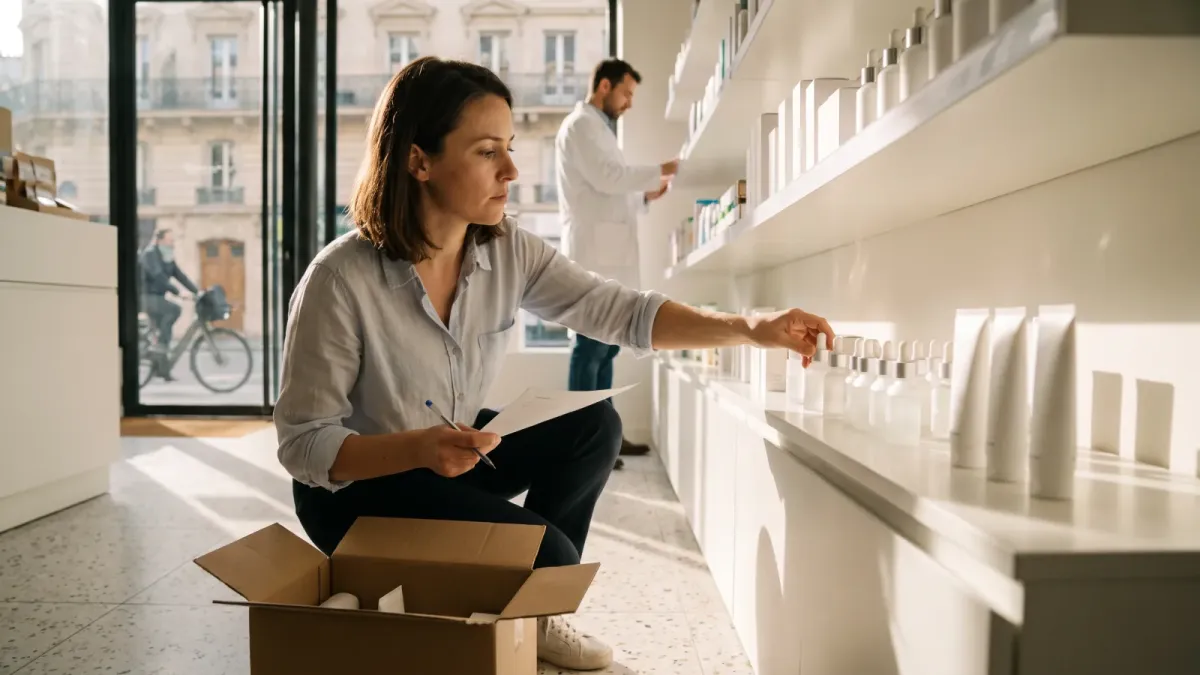
Where to sell cosmetics in France? Online to start, in pharmacies for a proven skincare product, in selective distribution (perfumeries and department stores) for a brand with a strong identity, and in mass retail for a product built on price and volume. According to Xerfi (April 2026), selective distribution accounts for 55% of the perfume and cosmetics market, pharmacy and parapharmacy for 24% and mass retail for 13%. Channel shares and 2025 growth figures are in our French cosmetics market statistics.
Key takeaways
- Selective distribution is still the largest channel by value, but it declined in 2025 (-1% in value according to Circana).
- Pharmacy is the most dynamic channel: health and beauty grew 7.5% there in 2025 according to GERS, driven by dermocosmetics.
- Mass retail is declining and has to deal with discounters and single-brand chains.
- Online, a brand website, Amazon and TikTok Shop let you test a product at lower risk.
- Each channel calls for a different formula, packaging and level of proof.
What are the cosmetics distribution channels in France?
Cosmetics distribution in France splits into four very unequal groups: selective distribution, pharmacy and parapharmacy, mass retail, and other channels (8%), which include pure players. Digital runs across all channels: it makes up 18% of selective sales (in French). Here is each channel’s share in 2025.
| Channel | Share of the 2025 perfume and cosmetics market (value) | 2025 trend | What drives sales |
|---|---|---|---|
| Selective perfumeries and department stores | 55% | -1% in value (prestige beauty, Circana) | Image, fragrance, novelty, in-store advice |
| Pharmacies and parapharmacies | 24% | +7.5% (health and beauty in pharmacies, GERS) | Health-and-beauty credibility, tolerance, pharmacist advice |
| Mass retail | 13% | Declining (-2%, Xerfi) | Price, promotion, turnover, brand awareness |
| Other: direct online sales, brand stores, discounters | 8% | Not measured overall | Community, content, price or exclusivity |
On the selective side, Circana puts the market at EUR 4.3 billion in 2025, down 1% in value and 3% in units (in French). These figures do not match exactly: GERS measures health and beauty sales in pharmacies, Circana measures prestige beauty, and Xerfi measures perfumes and cosmetics across all channels.
To see which categories drive each aisle, read our ranking of the best-selling cosmetic products in France (in French).
Selling cosmetics in pharmacies: the channel that is growing
Selling cosmetics in pharmacies means targeting the fastest-growing channel, provided you bring proof. According to GERS sell-out data reported by Revue Pharma, health and beauty in pharmacies is worth EUR 2.5 billion in 2025, up 7.5% (in French), with dermocosmetics the top contributor to that growth (+EUR 87.3 million), ahead of sun care.
Dermocosmetics is a category of cosmetic products designed for sensitive or problem-prone skin, sold with the advice of a healthcare professional. It remains legally a cosmetic product, subject to Regulation (EC) No 1223/2009: no therapeutic claim is allowed, even in a pharmacy.
What pharmacies expect from you:
- a short, well-tolerated formula, often fragrance-free or with limited allergens;
- use and tolerance tests that support every claim, in line with the common criteria of Regulation (EU) No 655/2013;
- simple, protective packaging (airless, tube);
- training and in-store activation for pharmacy teams.
See also our analysis of the best-selling dermocosmetics in Europe. For a range designed for pharmacies, discover our dermocosmetic skincare manufacturing for pharmacies.
Selective distribution: perfumeries and department stores
Selective distribution is the largest channel by value, but also the hardest to enter for an emerging brand. The supplier chooses its retailers on qualitative criteria (location, advice, presentation), as in perfumeries and department stores.
The channel is dominated by fragrance: EUR 2.3 billion out of the EUR 4.3 billion of selective (in French), according to Circana. Skincare is more fragile there, with EUR 0.8 billion in sales and a 4% decline in value in 2025, under pressure from pharmacies according to the same source. Online sales make up 18% of the channel, against 8% in 2019.
You need a strong identity, premium packaging and visibility budgets; a premium brand often enters this channel after an online test.
Selling cosmetics in mass retail: volume, price and turnover
Selling cosmetics in mass retail gives you access to the largest number of buyers, but it demands a logic of volume, price and promotion. Mass retail represents 13% of the perfume and cosmetics market in value and fell 2% in 2025, according to Xerfi (April 2026).
Listings go through the retailers’ central buying offices, in annual commercial negotiations. Plan for production that follows orders, a price that fits the aisle and promotion budgets.
Another way in: produce for the retailer’s private label rather than selling your own. Our guide on how buyers choose a store brand cosmetics manufacturer details these requirements; our page on retailer private label cosmetics manufacturing presents our offer.
Sidebar: single-brand chains and discounters, the new competitors
Two shifts are changing the picture. On one side, single-brand chains (Aroma-Zone, Adopt, Typology) are gaining ground and competing with both selective and mass retail. Circana lists them among the causes of the decline in selective distribution (analysis published by Premium Beauty News, in French).
On the other, discounters are capturing a growing share of purchases. According to NielsenIQ, cited by Olivier Dauvers in October 2025 (in French), Action’s market share exceeds 12% by volume in beauty. This very-low-price, high-volume channel rarely suits a launch.
Online sales: where to sell cosmetics without a store?
Online is the most accessible channel to start with: no listing and no central buying office. You keep control of price and image, and the reviews you collect will help convince a buyer.
Three options, to combine:
- Your brand website: more margin and customer data, but traffic to build.
- Amazon: instant audience, strict listing rules and heavy price competition. See our guide to selling cosmetics on Amazon (in French).
- TikTok Shop: selling through video and creators, effective for products that demonstrate well. Our article explains how to sell cosmetics on TikTok Shop (in French).
Selling online does not exempt you from any obligation: a product placed on the European market must have a Responsible Person in the EU, a Product Information File (PIF) and a notification on the CPNP portal, as required by Regulation 1223/2009. See our guide to notifying a cosmetic product in the EU.
Which niche channels can you start with?
Niche channels let you launch a range without going through a central buying office, with a controlled number of points of sale. They require a product suited to the professional who recommends it.
- Beauty salons and spas: treatment-room sizes and retail sizes. See our cosmetic brand for beauty salons offer and our ranges for spas and hammams.
- Hair salons: treatments used at the basin and then resold, see our hair care products for salons.
- Concept stores: a strong brand universe and packaging that stands out.
- Organic stores: formulas consistent with what this network expects.
- Independent pharmacies: direct outreach, before aiming for a buying group.
- B2B and hospitality: guest amenities and signature ranges for hotels and venues.
- Export: foreign distributors, with labeling and a file adapted to the country.
What does each channel require? The comparison table
Access, proof, packaging, price: each criterion shapes your formula.
| Criterion | Pharmacy | Selective | Mass retail | Online |
|---|---|---|---|---|
| Access | Buying groups, wholesalers, direct pharmacy outreach | Retail chain buyers, very selective | Central buying offices, annual negotiation | Direct, no intermediary |
| Proof expected | Tolerance, use tests, technical sales pitch | Desirability, image, sensory performance | Price, turnover, brand awareness | Customer reviews, content, demonstration |
| Typical formula | Short, sensitive skin, fragrance-free or lightly fragranced | Sensoriality, fragrance, signature textures | Effective, simple, controlled cost | Differentiating, easy to explain on video |
| Packaging | Simple, protective (airless, tube) | Premium, glass, refined carton | Sturdy, readable on shelf, family size | Shipping-resistant, photogenic |
| Brand profile that succeeds | Expert skincare, dermocosmetics | Fragrance, makeup, premium skincare | Mass-market brand or private label | Niche brand or community-driven brand |
How do you choose where to sell your cosmetics brand?
To choose where to sell cosmetics, start from your positioning and your means, not from the size of the channel. Here is the approach we recommend:
- Define your end customer: skin, budget, place of purchase.
- Set your target retail price, then work back to the acceptable cost price once each intermediary’s margin is deducted.
- List the proof you have (tests, active ingredients, certifications) and compare it with the channel’s requirements.
- Estimate your commercial budget: promotions in mass retail, in-store activation in pharmacies, online advertising. Our tool to calculate your cosmetics budget and compare quotes helps you cost out manufacturing.
- Test on a controlled channel (website, marketplace, a few points of sale) before investing in a national listing.
- Adjust the range (sizes, containers, sales pitch) to the chosen channel before series production.
Many brands combine an online channel with a physical channel consistent with their image, avoiding contradictory signals. The channel is only one step: our guide to creating a cosmetics brand covers the others, from formula to compliance.
The manufacturer’s perspective
At Carmel Cosmetics Labs, an ISO 22716 and ISO 9001 certified laboratory that has supported more than 500 brands in more than 35 countries, we make skincare for pharmacies and parapharmacies as well as retailer private label products for mass retail. The same product idea is therefore not made the same way depending on the channel you target.
The most frequent mistakes we see:
- glass packaging for a product aimed at mass retail, which makes the price unsustainable;
- targeting pharmacies with a heavily fragranced formula and no tolerance tests;
- forgetting that a product sold online must be as compliant as one sold on a shelf.
Our advice: decide on the channel before validating the formula, and tell your laboratory from the first conversation. In practice, we send you free samples to compare textures, we offer packaging adapted to the channel (airless for pharmacies, glass for selective, family size for mass retail) and optional tolerance or use tests to support your claims. With our white label manufacturing service and an accessible MOQ, we adapt the formula and packaging to the channel you are targeting, and our regulatory support (PIF, compliance) secures your market launch.
Frequently asked questions
What is the largest cosmetics distribution channel in France?
By value, it is selective distribution, with 55% of the perfume and cosmetics market according to Xerfi (April 2026), as the table above shows; it is driven by fragrance, which accounts for EUR 2.3 billion of the EUR 4.3 billion of selective according to Circana, while pharmacy is the fastest-growing channel.
How much do intermediaries take from the selling price?
There is no single public scale: wholesalers, buying groups, distributors and retailers each take their own margin between your selling price and the shelf price, depending on the channel and the negotiation. Start from the target shelf price, remove VAT and the stated margins, and check that the manufacturing cost remains compatible.
How do you find a distributor for your cosmetics brand?
First prove that the product sells (online sales, reviews, first points of sale), then target distributors specialized in your channel, in particular at trade shows. Prepare a clear file: range, selling price, logistics, compliance and marketing support.
How do you sell in the professional channel (salons, spas, hair salons)?
The professional channel needs treatment-room or basin sizes and retail sizes for customers. Managers expect training on your protocols and simple sales materials. Approach a few venues, measure resale, then expand through specialized distributors.
Can you switch channels after launch?
Yes, but it often requires adapting the formula, packaging and price. Moving from mass retail to pharmacy means tolerance tests; the reverse path means cutting costs. Anticipating this shift at the design stage avoids a full reformulation.
Conclusion: choose the channel before the formula
Where to sell cosmetics in France? Pharmacy is growing, selective weighs the most in value, mass retail offers volume and digital lets you test at lower risk. The right channel is the one that matches your price, your proof and your commercial budget.
Not sure which channel to choose? Book a free consultation or schedule a meeting with our team: we help you design a range suited to your sales channel with our white label cosmetics offer.