













































The best-selling dermocosmetics in Europe are a few pharmacy hero formats: micellar water, soothing balm with panthenol, barrier-support cream, SPF 50+ sunscreen, dark-spot serum and moisturizer with ceramides. Our 2026 editorial selection includes ten, each supported by a dated public source, with lessons for launching your range.
Key takeaways
- Dermocosmetics is not a legal category: these products are cosmetics under Regulation (EC) no. 1223/2009, just like all others.
- Europe’s cosmetics market was worth 110 billion euros at retail prices in 2025, including 32,3 billion for skincare (Cosmetics Europe).
- The three major groups all grew in 2025: +5,5 % like-for-like for L’Oréal’s Dermatological Beauty division, +3,9 % for Pierre Fabre dermocosmetics and +11,7 % for Beiersdorf’s Derma business.
- Best-sellers share simple formats, clear cosmetic benefits, a focus on tolerance and familiar ingredients: thermal spring water, panthenol, ceramides, niacinamide, hyaluronic acid and UV filters.
- A brand can develop these formats through white label without copying anyone, provided it prioritizes testing (tolerance, stability and SPF) and carefully worded claims.
What is a dermocosmetics product?
A dermocosmetics product is a cosmetic designed for sensitive or blemish-prone skin, generally sold in pharmacies or health-and-beauty stores and recommended by healthcare professionals. The term describes marketing and distribution, not a legal status: Regulation (EC) no. 1223/2009 recognizes only ‘cosmetic products’.
As Céline Couteau and Laurence Coiffard explain in The Conversation, dermocosmetics has no legal definition. These products follow the same rules as other cosmetics: safety assessment, Product Information File (PIF), CPNP notification and a Responsible Person in the EU.
What distinguishes dermocosmetics is its approach: concise formulas, often fragrance-free, testing under dermatological supervision and pharmacist advice. A product claiming an effect on a skin disease falls outside cosmetic scope and into medicines regulation.
Europe’s dermocosmetics market: key figures
No public body publishes a single figure for Europe’s dermocosmetics market, and research firms’ estimates differ. We therefore compare three verifiable sources: the overall cosmetics market, group results and pharmacy panels quoted by the trade press.
| Indicator | Value | Source |
|---|---|---|
| European cosmetics market (retail prices, 2025) | €110 billion, including €32,3 billion in skincare | Cosmetics Europe |
| Leading national markets (2025) | Germany €18,0 billion, UK €14,7 billion, France €14,5 billion, Italy €12,8 billion, Spain €11,8 billion | Cosmetics Europe |
| L’Oréal, Dermatological Beauty (2025) | €7,2 billion, +5,5 % like-for-like, 25,8 % share of the global dermocosmetics market | L’Oréal, February 12, 2026, annual report |
| Pierre Fabre, Dermocosmetics and Personal Care (2025) | €1,7 billion, +3,9 %; Avène exceeds €1 billion | Pierre Fabre, March 19, 2026 |
| Beiersdorf, Derma business: Eucerin and Aquaphor (2025) | €1,5 billion, +11,7 % organic growth | Beiersdorf, March 2, 2026 |
| Pharmacy beauty category, France (2025) | +7,6 % by value (Gers Data) | Le Moniteur des pharmacies, January 21, 2026 |
According to L’Oréal, the global dermocosmetics market slowed in 2025 but remained stronger than beauty overall. In France, IQVIA estimates non-prescription pharmacy sales at nearly 17 billion euros in 2025, with growth driven mainly by beauty, personal care and supplements (IQVIA, February 2026). For comparisons, see our analysis of France’s best-selling cosmetics categories and figures on Morocco’s dermocosmetics market.
Methodology: how we built this selection
There is no official public ranking of Europe’s best-selling dermocosmetics products across all countries and retailers. This selection is therefore editorial, based solely on public sources: groups’ 2025 annual results (L’Oréal, Pierre Fabre, Beiersdorf), brand-published claims citing panels (IQVIA, Gers Data, HMR) and trade publications.
Scope: pharmacies and health-and-beauty retail in Europe. Limitations: figures are often national (France, Spain or Belgium), some come from brands’ internal sales, and no Europe-wide product sales figures are published. The order reflects evidence strength and reach, not measured sales volume. Brands are cited for market information only. For a country focus, see the best-selling cosmetics in Belgium.
The selection: 10 best-selling dermocosmetics products in Europe
These ten dermocosmetics products or hero ranges recur in public sources, with their category, ingredients and evidence supporting their best-seller status.
| # | Product (brand) | Category | Featured ingredients | Public evidence (date) |
|---|---|---|---|---|
| 1 | Cicaplast Baume B5+ (La Roche-Posay) | Soothing balm | Panthenol, madecassoside | Growth driver cited by L’Oréal (February 2026) |
| 2 | Sensibio H2O (Bioderma) | Micellar water | Gentle micelles, fragrance-free | 1 bottle sold per second, according to Bioderma |
| 3 | Cicalfate+ cream (Eau Thermale Avène) | Barrier-support cream | Thermal spring water, copper-zinc | Avène, Europe’s 2nd-largest brand (Pierre Fabre, March 2026) |
| 4 | Huile Prodigieuse (Nuxe) | Dry oil | Vegetable oils | No. 1 oil in 5 countries (Gers, IQVIA 2024) |
| 5 | Vinoperfect radiance serum (Caudalie) | Dark-spot serum | Viniferine, squalane | No. 1 dark-spot skincare in France (Gers, January 2026) |
| 6 | Fusion Water Magic SPF 50 (ISDIN) | Facial sunscreen | UV filters, hyaluronic acid | ‘Best-selling in pharmacies’, Spain (ISDIN) |
| 7 | Anthelios (La Roche-Posay) | SPF 50+ sunscreen | Broad-spectrum UV filters | Launches cited by L’Oréal (2026) |
| 8 | CeraVe moisturizers | Moisturizing cream and lotion | Ceramides, hyaluronic acid | Billion-euro brand (L’Oréal, February 2026) |
| 9 | Anti-Pigment with Thiamidol (Eucerin) | Dark-spot skincare | Thiamidol | Double-digit growth (Beiersdorf, March 2026) |
| 10 | Sebiaclear range (SVR) | Blemish-care skincare | Gluconolactone, niacinamide | SVR, leading contributor to growth in France (Gers Data, 2025) |
1. La Roche-Posay Cicaplast Baume B5+: a multipurpose soothing balm
In its 2025 annual results, L’Oréal states that La Roche-Posay remains the largest contributor to its dermatological division’s growth, ‘driven by the Cicaplast franchise’. The balm combines a family-use tube, a formula focused on panthenol (provitamin B5) and a soothing benefit that is easy to understand.
2. Bioderma Sensibio H2O: the pioneering micellar water
Bioderma describes Sensibio H2O as the first micellar water, created in 1995, and says one bottle is sold every second worldwide (brand data, without a published panel source). Micellar water is a cleansing lotion whose gentle surfactants form micelles to lift makeup and sebum without rinsing. Daily use and frequent repurchase make it a classic entry product.
3. Eau Thermale Avène Cicalfate+: a barrier-support cream
According to Pierre Fabre, Eau Thermale Avène exceeded one billion euros in revenue in 2025 and ranked second in the European market. The brand presents its Cicalfate+ cream as recommended by dermatologists, citing French IQVIA 2023 data. Its formula combines Avène thermal spring water, a copper-zinc complex and an in-house postbiotic ingredient.
4. Nuxe Huile Prodigieuse: a multipurpose dry oil
Nuxe claims its Huile Prodigieuse is the no. 1 oil in France (Gers Data, pharmacies and health-and-beauty retail, annual total to June 2024), as well as Belgium, Germany, Spain and Italy (IQVIA 2024), and Portugal (HMR 2024). More sensorial than dermatological, it shows how a multipurpose format can lead a category.
5. Caudalie Vinoperfect radiance serum: dark-spot skincare
Caudalie presents its Vinoperfect dark-spot radiance serum as France’s no. 1 dark-spot skincare product (Gers Data, pharmacy and health-and-beauty revenue, cumulative to January 2026), and reports one serum sold every 15 seconds (internal sales, 2024). Its patented ingredient, viniferine from grapevine sap, has a story that can be explained in one sentence.
6. ISDIN Fusion Water Magic SPF 50: a water-light facial sunscreen
In Spain, ISDIN describes Fusion Water Magic SPF 50 as ‘the best-selling in pharmacies’ and the no. 1 facial sunscreen recommended by dermatologists; the page does not show the precise source. Its strength is a very light fluid with a matte finish, designed for daily use under makeup.
7. La Roche-Posay Anthelios: a benchmark sunscreen range
The L’Oréal 2025 annual report highlights Anthelios UVMUNE 400 and Anthelios UVAIR SPF 50+ launches as division growth drivers. In Belgium, La Roche-Posay cites IQVIA NPA data (pharmacies, cumulative to August 2025) on dermatologist-recommended products.
8. CeraVe moisturizers: ceramides for everyday care
CeraVe is one of L’Oréal Dermatological Beauty’s three billion-euro brands. Its recovery in 2025 was supported by an intensive moisturizing lotion launch (L’Oréal). Ceramides are lipids naturally present in the stratum corneum, contributing to skin barrier function. CeraVe has made them its signature through educational messaging.
9. Eucerin Anti-Pigment with Thiamidol: a proprietary ingredient
According to Beiersdorf, the Derma business (Eucerin and Aquaphor) grew by 11,7 % in 2025, its fifth consecutive year of double-digit growth, supported in part by Thiamidol range extensions. The group’s annual report states that Thiamidol’s efficacy is supported by over 120 clinical studies involving more than 9 000 participants.
10. SVR Sebiaclear: the rise of blemish-prone skincare
According to Le Moniteur des pharmacies (Gers Data), SVR contributed most to growth in France’s pharmacy beauty category in 2025: +32,6 million euros, or +37 %. Sebiaclear, for blemish-prone skin, is its most visible range, although product-level sales are not published.
What these dermocosmetics products have in common
Best-selling dermocosmetics combine broadly useful formats, an easily stated benefit and a short, recognizable list of key ingredients. They succeed through tolerance, texture and consistency, not a ‘miracle’ formula.
- Thermal spring water: a distinctive origin that supports the brand story as well as the formula.
- Panthenol: provitamin B5 is a moisturizing ingredient that helps soothe the feel of skin, central to multipurpose balms.
- Ceramides: skin-barrier lipids that have become a mainstream skincare message.
- Niacinamide: versatile vitamin B3 for the appearance of blemishes, skin tone and barrier support.
- Hyaluronic acid: a humectant that retains water at the skin’s surface.
- UV filters: SPF 50+ has become an everyday step, not just a summer one.
Five formats recur: micellar water, soothing balm or cream, moisturizer, targeted serum and facial sunscreen. They also provide established starting points for a new range, from white label facial cleansers to facial skincare creams.
How do you launch a white label dermocosmetics range?
Launching white label dermocosmetics means starting with established formats, adapting them to your positioning with a lab, then ensuring compliance. The aim is never to copy a best-seller, but to address the same need with your own formula.
- Choose one or two hero formats: a gentle cleanser or micellar water for repeat purchases, a targeted serum or balm for perceived value.
- Define the target skin type: sensitive, dry, blemish-prone or uneven-toned. This determines ingredients, texture and tests.
- Develop or adapt an existing base with a cosmetic formulation lab: ingredients, fragrance or fragrance-free, preservation and compatible packaging.
- Test: stability and packaging compatibility, preservative efficacy (challenge test), skin tolerance under dermatological supervision and measured SPF for sunscreen.
- Assemble regulatory documentation: safety assessment, PIF, CPNP notification and compliant labeling. Regulatory and PIF support helps avoid reworking earlier steps.
- Prepare for the pharmacy channel: pharmacist-facing product guidance, claims evidence and retail pricing consistent with the category. To compare pharmacy with other channels, see where to sell your cosmetics brand in France.
Claims need particular care. Regulation (EU) no. 655/2013 sets six common criteria (legal compliance, truthfulness, evidential support, honesty, fairness and informed decision-making). Therapeutic claims are excluded. For more, see our guide to EU cosmetic claims regulation.
| Acceptable if substantiated | Claims to avoid |
|---|---|
| ‘Tested under dermatological supervision’ | Prohibited therapeutic claim examples: ‘treats eczema’, ‘treats acne’ |
| ‘Soothes feelings of discomfort’ | Prohibited therapeutic claim examples: ‘healing’, ‘anti-inflammatory’ |
| ‘Formula for sensitive skin’ | Unsubstantiated claim to avoid: ‘hypoallergenic’ without a supporting protocol |
| ‘SPF 50+’, ‘very high protection’ | Prohibited sunscreen claim examples: ‘sunblock’, ‘total protection’ |
| ‘Reduces the appearance of dark spots’ | Unsubstantiated claim to avoid: ‘eliminates dark spots’ without a study |
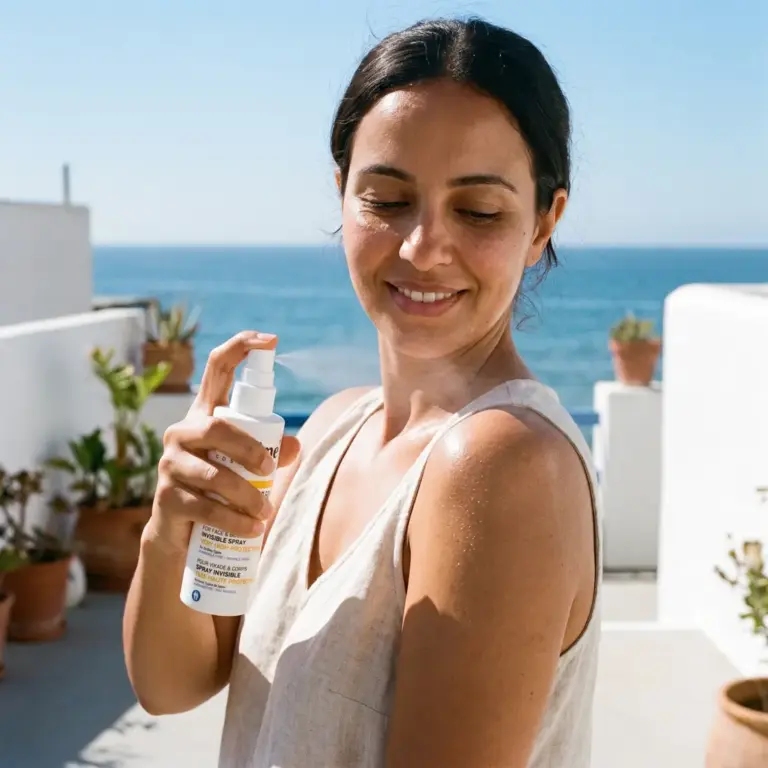
For sunscreen, Recommendation 2006/647/EC sets protection categories, requires UVA protection of at least one-third of the SPF and prohibits ‘sunblock’ claims. Our white label sun protection page details available formats. The same principles apply to cosmetic skincare around aesthetic procedures, discussed in our article on a post-procedure dermocosmetics range.
Manufacturing in Morocco does not prevent sales in Europe: a product made outside the EU can enter its market if it complies with Regulation 1223/2009 and has an EU-established Responsible Person. We explain the requirements for manufacturing cosmetics to European standards in Morocco.
The manufacturer’s perspective
At Carmel Cosmetics Labs, an ISO 22716 and ISO 9001 certified lab in Agadir, we have supported over 500 brands in more than 35 countries. Successful dermocosmetics projects begin with a precise focus: one or two formats and a clear target skin type, rather than ten products at once.
The most common mistake is writing claims before testing, then discovering that the promise cannot be substantiated. We recommend the reverse: define the intended benefit, plan a protocol to demonstrate it, then write the packaging copy. Another pitfall is asking for ‘the same thing as’ a pharmacy benchmark. Start instead with the need (soothing the feel of skin, moisturizing or protecting) and an ingredient that differentiates your brand, such as Moroccan argan oil or rose water.
Frequently asked questions
What is the world’s best-selling dermocosmetics brand?
L’Oréal describes La Roche-Posay as the world’s leading dermatological skincare brand, without publishing the measurement details. In Europe, Pierre Fabre states that Eau Thermale Avène is the market’s second-largest brand, with revenue exceeding one billion euros in 2025. These rankings come from the groups themselves.
Is a dermocosmetic product safer than a conventional cosmetic?
Not inherently. Every cosmetic sold in the European Union must undergo a safety assessment by a qualified assessor before entering the market. Dermocosmetics differ in their formulation choices and additional, voluntary tolerance testing.
Can a white label brand be sold in pharmacies?
Yes. No specific authorization is required for a cosmetic to be stocked in pharmacies: the pharmacist or pharmacy group selects the products. In practice, pharmacies expect evidence of efficacy and tolerance, a complete regulatory file and clear guidance for customer consultations.
How is a sunscreen’s SPF measured?
SPF is measured under ISO 24444, an in vivo method involving a panel of volunteers, while UVA protection is generally assessed in vitro under ISO 24443. The label must reflect the results and follow the European protection categories, from low to very high.
Do you need a dermatologist to launch a dermocosmetics range?
It is not mandatory, but it is a valuable asset. A dermatologist can oversee tolerance testing, help identify the target skin needs and strengthen credibility with pharmacists. A qualified assessor still signs the safety assessment, and the Responsible Person ensures compliance.
Conclusion: learn from best-sellers without copying them
Europe’s dermocosmetics best-sellers succeed through simplicity: a broadly useful format, a few carefully chosen ingredients, demonstrated tolerance and a clear benefit. The lesson for a new brand is straightforward: one or two hero formats, backed by evidence rather than superlatives.
Want to launch your own dermocosmetics range (micellar water, balm, SPF, serum or cleanser)? Explore our white label cosmetics manufacturing, with an accessible MOQ, then book your Free consultation to discuss it with our team.