Services

Torn between two services?A project manager will guide you

Catalog

Explore the full catalog1,000+ formulas ready to carry your brand

Face careFull range

Serums, creams and targeted care, formulated with your actives.

Body careFull range

Moisturizing, nourishing and shower care: cream, butter or oil.

Specialty careFull range

Sun care, lips, intimate care and oral care.

Men, baby, makeupFull range

Shaving and beard, baby and mom, makeup.

Industries

All solutions by industryFormulas and formats for your business

Our brands

Our own brands, developed and made in our laboratory.

Become a distributor of our brandsPharmacies, spas, shops and wholesalers

Laboratory

Cosmetics manufacturing room with a row of stainless-steel mixers and an operator in white workwearOur factory in Aït MelloulISO 22716 and ISO 9001, visits by appointmentDiscover the factory

Resources

Cinnamon (Cinnamomum zeylanicum)

Cinnamon powder is the dried, ground bark of Cinnamomum zeylanicum, Ceylon cinnamon (Lauraceae)1. CosIng classifies it as skin conditioning1. Its oils contain cinnamaldehyde, linalool and eugenol5: cinnamal and eugenol are fragrance allergens to declare2. No cosmetic trial on the powder was retained.

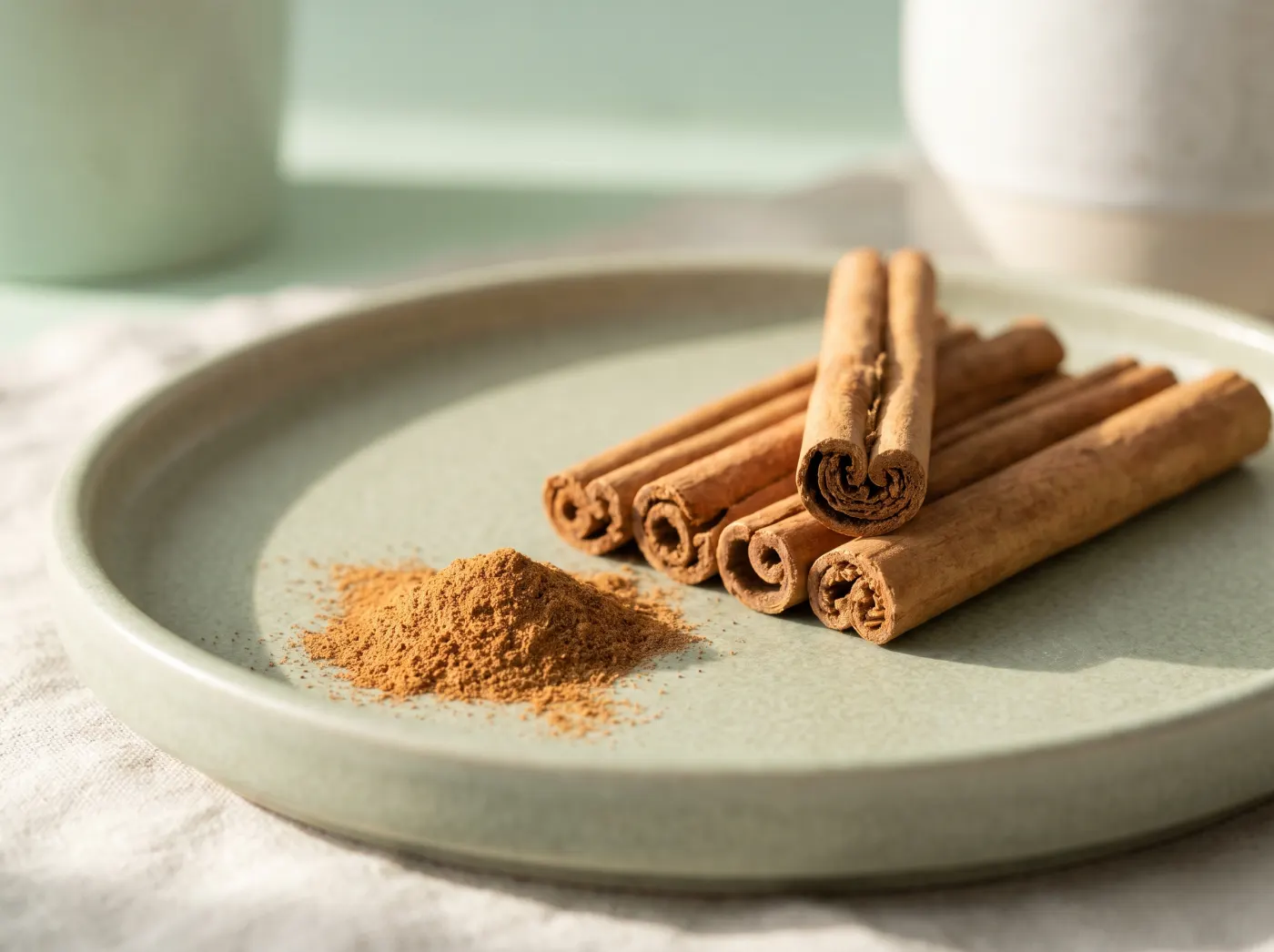
Cinnamon in macro view, raw material on a sage green ceramic surface, raking light

Cinnamon at a glance

Entry from our cosmetic ingredient glossary. Data from the European Commission's CosIng database1, consolidated Regulation (EC) No 1223/20092 and Regulation (EU) 2023/15453. Copy the identifiers in one click for your files.

INCI name
CINNAMOMUM ZEYLANICUM BARK POWDERBark: the name specifies the part of the plant1
Other names
Ceylon cinnamon, cinnamon powderTrue cinnamon; cassia (Cinnamomum cassia) is a different species6
CAS number
84649-98-9Same number as the C. zeylanicum bark oil, cited in the regulation12
EC number
283-479-0
Botanical origin
Ceylon cinnamon (Cinnamomum zeylanicum, Lauraceae)CosIng: powder obtained from dried, ground bark1. The tree is native to Sri Lanka4
Composition
Powder: not documented. Bark oil: cinnamaldehyde, linalool, β-caryophyllene, eucalyptol, eugenolBark essential oil: (E)-cinnamaldehyde 71.50%, linalool 7.00%, β-caryophyllene 6.40%, eucalyptol 5.40%, eugenol 4.60%5. The leaf oil is dominated by eugenol4
CosIng functions
Skin conditioning"Skin conditioning"1
EU status
No dedicated line for the powderCosIng mentions only the general rule on ozone-depleting substances1. C. zeylanicum bark oil is named at line 349 of Annex III, C. cassia leaf oil at line 34823
Allergen to declare
Cinnamal, eugenol and bark oil namedAnnex III names cinnamal (line 76), eugenol (71), linalool (84), coumarin (77), β-caryophyllene (332) and C. zeylanicum bark oil (349): mention mandatory above 0.001% in a leave-on product and 0.01% in a rinse-off product. For line 349, non-compliant products may be placed on the market until 31 July 2026 and made available until 31 July 202823. For the powder, batch analysis tells which apply
Safety
No CIR or SCCS assessment retainedTolerance is judged on the finished formula and on the batch certificate of analysis

What the research says

Each result shows the protocol and the level of evidence. The higher the level, the better the result carries over to a finished formula.

Clinical trialReview or consensusLaboratory

Composition and qualityChemistry

More than 80 compounds, depending on the part of the tree

Review
2011 reviewLeaf, bark and fruit oils

Leaf oil is dominated by eugenol, stem bark oil by cinnamaldehyde, root bark oil by camphor, and cinnamyl acetate dominates in the fruit. The oils are described as antioxidant and antimicrobial4.

A bark oil rich in cinnamaldehyde

Laboratory
C. zeylanicum bark essential oilGC-MS

Cinnamaldehyde makes up 71.50% of the oil, ahead of linalool (7.00%), β-caryophyllene (6.40%), eucalyptol (5.40%) and eugenol (4.60%). The oil scavenges free radicals and mostly inhibits Gram-positive bacteria. The study targets food preservation uses5.

More than half of the "cinnamon" sold was cassia

Laboratory
34 cinnamon samples, Italian marketCoumarin and cinnamaldehyde measured by HPLC

About 51% of the samples were cassia, 10% probably a mix, and only 39% true Ceylon cinnamon. Several European agencies have warned about the high coumarin content of cassia6. For a brand, the species must appear on the batch certificate.

Tolerance and contact allergiesSafety

Cinnamaldehyde and eugenol among the most reactive fragrance constituents

Clinical trial
1,323 participants, 11 European centersFragrance mix at 8% and its 8 constituents

The mix is positive in 89 of the 1,072 participants tested (8.3%). Among the constituents, reactions are most frequent with oakmoss (24), isoeugenol (20), eugenol (13) and cinnamic aldehyde (10). In the series of 48 fragrances tested separately, no clinical relevance is proven7.

Cinnamon among the spices patch tested

Clinical trial
55 people suspected of contact allergySpices at 10 and 25% in petrolatum

At 25% only, three participants react to cinnamon. According to the authors, these isolated responses may mark the detection threshold of a true allergy or a marginal irritation8.

A mud bath with cinnamon essential oil in question

Case report
74-year-old womanPatch tests 5 years later

Tests are positive to the fragrance mix, to cinnamon essence, to eugenol, to cinnamic alcohol and to cinnamic aldehyde9.

A cinnamon-flavored toothpaste

Case report
Cassia cinnamon oilContact allergy

The case shows that a person allergic to cinnamon can be exposed through many sources, cinnamic aldehyde and its derivatives being very widespread10.


This page summarizes published literature on a cosmetic ingredient. It does not describe the effect of a finished product, which depends on its formula, and it is not medical advice. Evidence is flagged by level: clinical trial, review or laboratory.

Which products can use cinnamon?

Our white label catalog includes 1 formula with cinnamon: the key active in 1 of them, a supporting ingredient in the others. Every category can be customized (formula, fragrance, packaging).

1Body

Massage oil with cedar and cinnamon essential oils from the catalog (essential oil, not bark powder); as a powder, a common use in plant soaps and scrubs.

In our formulas, it is most often paired with

Coconut 1Arnica extracts 1Argan oil 1Horse chestnut 1Apricot kernel 1

Frequently asked questions about cinnamon

What is cinnamon in cosmetics?
It is the bark of Cinnamomum zeylanicum, Ceylon cinnamon, dried and ground into powder, or distilled into essential oil14. Its INCI name for the powder is CINNAMOMUM ZEYLANICUM BARK POWDER.
What are the benefits of cinnamon for the skin?
CosIng classifies the powder as a skin conditioning agent1. No cosmetic clinical trial on the powder was retained: work covers the composition and laboratory activity of the oils45. A brand should therefore stay cautious with its claims.
Are the cinnamal and eugenol in cinnamon allergens to declare?
Yes, the regulation names cinnamal (line 76) and eugenol (line 71): they appear in the ingredient list above 0.001% in leave-on products or 0.01% in rinse-off products2. C. zeylanicum bark oil is also named (line 349)3. The calculation is done on the finished product, from the analysis of the powder or oil batch.
What is the difference between cinnamon powder and cinnamon essential oil?
The powder is the ground bark; the essential oil is the distilled volatile fraction, rich in cinnamaldehyde5. They are not labeled the same way: the bark oil is named in the regulation3, the powder is not. Our catalog contains a massage oil with cinnamon essential oil, no product with the powder.
Ceylon cinnamon or cassia: what is the difference?
They are two species. In a study of 34 samples sold in Italy, about 51% were cassia and 39% true Ceylon cinnamon6. Coumarin is an allergen to declare (line 77)2, and several European agencies have warned about the coumarin in cassia6.
Can cinnamon cause an allergy or irritation?
Yes, contact allergies are described with cinnamon and its constituents: cinnamaldehyde and eugenol react in people tested7, and cases exist after a mud bath with cinnamon oil9 or a toothpaste10. Tolerance is checked on the finished formula, and a healthcare professional's advice comes first for reactive skin.

Can you make a cinnamon product for my brand?
Yes. Our ISO 22716 certified lab can add cinnamon to one of its catalog formulas to customize, or to a custom formula. Free samples are offered.

Sources

Peer-reviewed studies and official regulatory sources, checked on November 3, 2026.

  1. European Commission. CosIng, entry CINNAMOMUM ZEYLANICUM BARK POWDER (CAS 84649-98-9, EC 283-479-0). ec.europa.eu/growth/tools-databases/cosing
  2. European Parliament and Council. Regulation (EC) No 1223/2009 on cosmetic products, consolidated version of 1 May 2025: Annex III, lines 71 (eugenol), 76 (cinnamal), 77 (coumarin), 84 (linalool), 332, 348 and 349. eur-lex.europa.eu
  3. Commission Regulation (EU) 2023/1545 of 26 July 2023 amending Regulation (EC) No 1223/2009 of the European Parliament and of the Council as regards labelling of fragrance allergens in cosmetic products (Annex III). Lines 348 (Cinnamomum Cassia leaf oil) and 349 (Cinnamomum Zeylanicum bark oil). eur-lex.europa.eu
  4. Jayaprakasha GK, Rao LJ. Chemistry, biogenesis, and biological activities of Cinnamomum zeylanicum. Crit Rev Food Sci Nutr. 2011;51(6):547-562. PMID 21929331
  5. Alizadeh Behbahani B, Falah F, Lavi Arab F, et al. Chemical Composition and Antioxidant, Antimicrobial, and Antiproliferative Activities of Cinnamomum zeylanicum Bark Essential Oil. Evid Based Complement Alternat Med. 2020;2020:5190603. PMID 32419807
  6. Lungarini S, Aureli F, Coni E. Coumarin and cinnamaldehyde in cinnamon marketed in Italy: a natural chemical hazard? Food Addit Contam Part A. 2008;25(11):1297-1305. PMID 19680836
  7. Frosch PJ, Pilz B, Andersen KE, et al. Patch testing with fragrances: results of a multicenter study of the European Environmental and Contact Dermatitis Research Group with 48 frequently used constituents of perfumes. Contact Dermatitis. 1995;33(5):333-342. PMID 8565489
  8. Futrell JM, Rietschel RL. Spice allergy evaluated by results of patch tests. Cutis. 1993;52(5):288-290. PMID 8299390

  9. García-Abujeta JL, de Larramendi CH, Berna JP, et al. Mud bath dermatitis due to cinnamon oil. Contact Dermatitis. 2005;52(4):234. PMID 15860002

  10. Drake TE, Maibach HI. Allergic contact dermatitis and stomatitis caused by a cinnamic aldehyde-flavored toothpaste. Arch Dermatol. 1976;112(2):202-203. PMID 962353
Carmel Cosmetics Labs product specialist with a brand founder

Tell us about your project

A product specialist reviews your request and gets back to you on the channel you prefer.

Lead EN – Demande de devis
Tell us about your project. A product specialist will get back to you shortly.
CONTACT INFORMATION
Name
PROJECT INFORMATION
Which cosmetics category interests you most?

By submitting this form, you agree to our terms of service and privacy policy.

No obligation. Your information stays confidential and is used only to prepare your quote.