











































Services

Torn between two services?A project manager will guide you

Catalog

Explore the full catalog1,000+ formulas ready to carry your brand

Face careFull range

Serums, creams and targeted care, formulated with your actives.

Body careFull range

Moisturizing, nourishing and shower care: cream, butter or oil.

Specialty careFull range

Sun care, lips, intimate care and oral care.

Men, baby, makeupFull range

Shaving and beard, baby and mom, makeup.

Industries

All solutions by industryFormulas and formats for your business

Laboratory

Cosmetics manufacturing room with a row of stainless-steel mixers and an operator in white workwearOur factory in Aït MelloulISO 22716 and ISO 9001, visits by appointmentDiscover the factory

Resources

Tea tree oil (essential oil)

Tea tree essential oil is distilled from the leaves of Melaleuca alternifolia5. Terpinen-4-ol is its main constituent7. It is not named in the annexes of the European cosmetics regulation, but it oxidizes in air and becomes more sensitizing2. The 2026 CIR assessment finds it safe if the formula is non-sensitizing4.
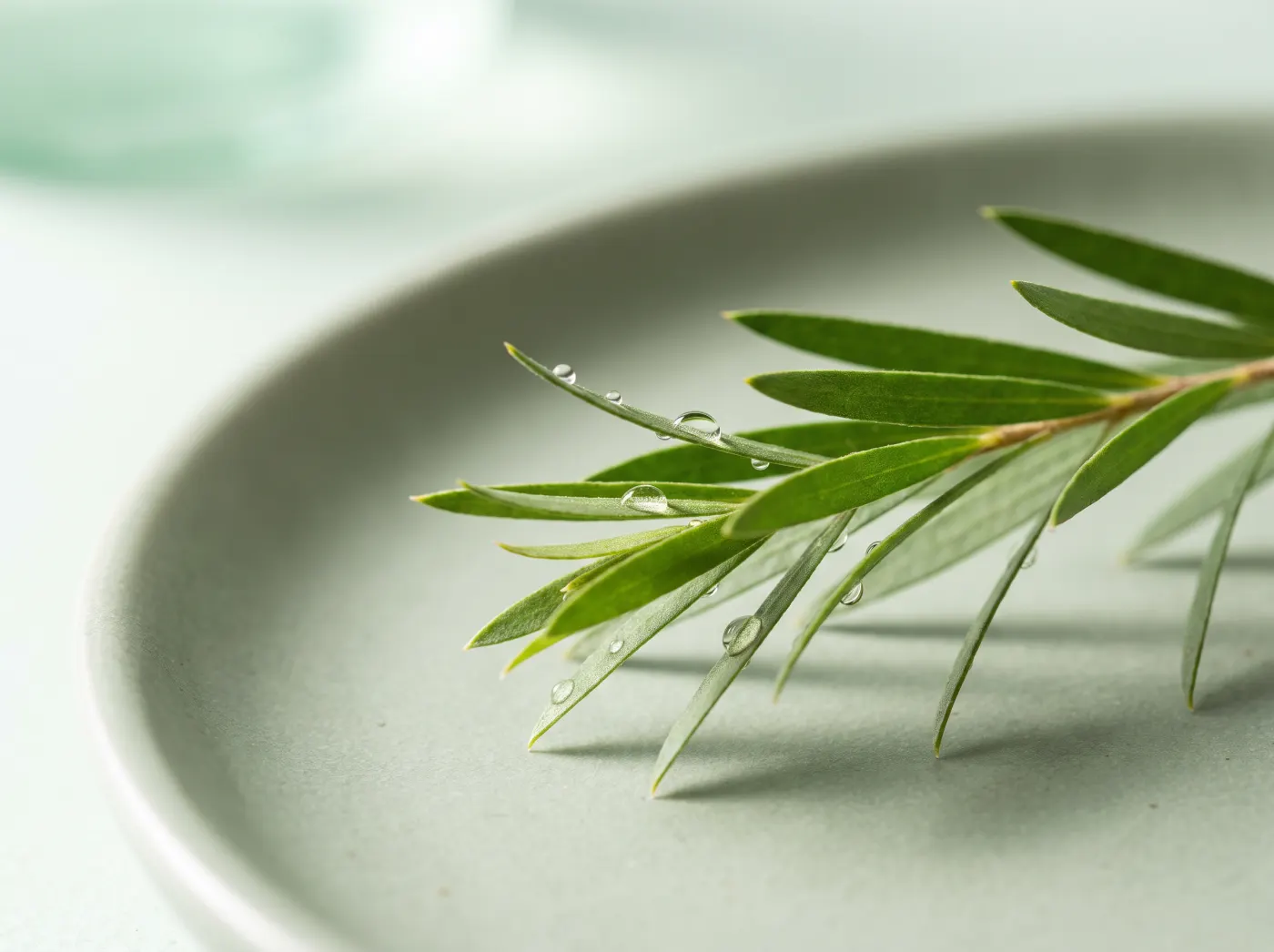
Tea tree essential oil in macro view, clear drops on a sage green ceramic surface, raking light

Tea tree oil at a glance

Entry from our cosmetic ingredient glossary. Regulatory data from the European Commission's CosIng database10, from Regulation (EU) 2023/154511 and from the opinions of the SCCP scientific committee, the predecessor of the SCCS56. Copy the identifiers in one click for your files.

INCI name
MELALEUCA ALTERNIFOLIA LEAF OILCosIng also lists MELALEUCA ALTERNIFOLIA FLOWER/LEAF/STEM OIL, the oil of flowers, leaves and stems (CAS 85085-48-9)10
Other names
Tea tree essential oilTea tree oil; Melaleuca oil. "Tea tree" refers to the Australian tree Melaleuca alternifolia5
CAS number
8022-72-8 / 68647-73-4
EC number
Not provided for this INCICosIng gives "- / -" for MELALEUCA ALTERNIFOLIA LEAF OIL10. The 2008 SCCP opinion cites EINECS 285-377-1 for CAS 68647-73-46
Botanical origin
Melaleuca alternifolia (Myrtaceae)CosIng: oil distilled from the leaves. The SCCP specifies that other Melaleuca species may be sold under this name, provided they meet standard ISO 473056
Composition
Terpinen-4-ol, γ-terpinene, 1,8-cineoleMain constituents of the commercial oil: terpinen-4-ol, γ-terpinene, 1,8-cineole, α-terpinene, α-terpineol, p-cymene, α-pinene1. In a Slovak oil, terpinen-4-ol reaches 40.3%7
CosIng functions
Antioxidant, fragrance, skin protecting, skin conditioning"Antioxidant", "Fragrance", "Skin protecting", "Skin conditioning - miscellaneous" and "Perfuming"10
EU status
No line in Annexes II to VINeither the oil nor its INCI names appear in Regulation (EC) No 1223/2009 consolidated as of 1 May 2025, and CosIng refers to no restriction1012. The SCCP had already noted in 2004 that the oil was regulated in no annex5
Allergen to declare
No mention specific to the oil; constituents namedRegulation (EU) 2023/1545 names constituents of tea tree: α-terpinene (line 131), terpinolene (133), limonene (88), pinene (371) and terpineol (343). Each is declared above 0.001% in leave-on products and 0.01% in rinse-off products in the finished product, and several lines require a peroxide value of the substance below 10 mmol/L (20 for limonene)11
Safety
2026 CIR: safe if the formula is non-sensitizingThe CIR panel assessed 8 ingredients derived from Melaleuca alternifolia and asks to limit the oxidation of the oil in the finished product4. In 2008 the SCCP judged that safety could not be assessed for lack of skin absorption data6

What the research says

Each result shows the protocol and the level of evidence. The higher the level, the better the result carries over to a finished formula.

Clinical trialReview or consensusLaboratory

Oil compositionChemistry

Terpinen-4-ol leads

Laboratory
GC-MS analysisOil grown in Slovakia2022 study

Terpinen-4-ol reaches 40.3% of the oil, ahead of γ-terpinene (11.7%), 1,8-cineole (7.0%) and p-cymene (6.2%)7. The composition varies with the origin of the oil.

About ten monoterpenes make up most of the oil

Committee opinion
2004 SCCP opinion

The SCCP counts about 100 terpenes in the oil, of which more than 60 are identified. About ten monoterpenes account for 80 to 90% of it, and their content varies strongly with the plant population and the climate5.

Oxidation and contact allergiesToxicology

The oil oxidizes within a few days

Laboratory
Guinea pigs (experimental sensitization)Patch tests in 11 sensitized peopleOil exposed to light, air and heat

Fresh oil is a very weak sensitizer, oxidized oil about 3 times more potent. In 4 days, peroxides rise from under 50 to over 500 ppm and p-cymene from 2 to 11.5%. All 11 people reacted to α-terpinene, terpinolene and ascaridole2.

The oil that has caused the most published allergies

Review
2016 review

Of all essential oils, tea tree has caused the most published allergic reactions since 1991. Routine patch tests are positive in 0.1 to 3.5% of the people tested. Almost all reactions come from the pure oil; cosmetics are involved in a minority of cases1.

The 2008 SCCP opinion

Committee opinion
SCCP/1155/08Adopted on 16 December 2008

The SCCP considers tea tree a skin sensitizer. The pure oil and some formulas at 5% or more can irritate the skin and eyes. For lack of sufficient absorption data, no margin of safety was calculated and safety could not be assessed6. In 2004, it already noted that oxidized oil is 3 times more potent than fresh oil5.

A favorable CIR assessment, with a condition

Review
2026 assessment8 ingredients derived from Melaleuca alternifolia

The panel concludes that these ingredients are safe in the present uses and concentrations, provided the formula is non-sensitizing. It notes that oxidized oil can be sensitizing and asks to limit oxidation in the finished product4.

Toxic when swallowed at high dose, irritating when concentrated

Review
2006 review

The oil is toxic if ingested at high dose and can irritate the skin at high concentration. The authors advise avoiding ingestion, applying the oil only diluted and storing it properly3.

ScalpHaircare

5% shampoo and dandruff

Clinical trial
Randomized, single-blind trial, 126 people aged 14 and over5% shampoo vs placeboDaily use, 4 weeksMild to moderate dandruff

The dandruff severity and area score improved by 41% with the tea tree shampoo, against 11% with placebo. The oil is tested in a rinse-off product, at 5%. The abstract does not specify the funding8.

SkinHydration

A blend of oils including tea tree, over 90 days

Clinical trial
Randomized trial, 40 participants, 3 groupsLavender, eucalyptus, mandarin with or without tea tree vs placebo90 days

The blend improved the skin barrier and hydration and lowered sebum, with no reported adverse effect. Since tea tree was in only one of the two treated groups, the study does not allow these effects to be attributed to it9.

This page summarizes published literature on a cosmetic ingredient. It does not describe the effect of a finished product, which depends on its formula, and it is not medical advice. Evidence is flagged by level: clinical trial, review or laboratory.

Which products use tea tree oil?

Our white label catalog includes 3 formulas with tea tree oil: the key active in 1 of them, a supporting ingredient in the others. Every category can be customized (formula, fragrance, packaging).

1Body

Essential oil paired with lavender, avocado oil and aloe vera in a salt and licorice body scrub.

1Hair

Essential oil paired with rosemary, clove and eucalyptus in the rosemary and black seed hair oil.

In our formulas, it is most often paired with

Aloe vera 1Clove 1Eucalyptus 1Argan oil 1Avocado oil 1

Tea tree, eucalyptus or cypress oil?

Three essential oils often compared when choosing a fragrance. Their chemistry differs, so does their labeling.

Tea treeEucalyptusCypress
Dominant constituentsTerpinen-4-ol, γ-terpinene, 1,8-cineole, α-terpinene, α-terpineol, p-cymene, α-pinene11,8-cineole, more than 50% of Eucalyptus globulus oil13α-pinene (38.47%) and δ-3-carene (25.14%) in one studied oil14
Regulation (EU) 2023/1545Oil not named; α-terpinene, terpinolene, limonene and pinene named11Eucalyptus globulus oil named (line 355)11Oil not named in this text; limonene and pinene named11
Carmel catalog formulas3 formulas2 formulas1 formula

Frequently asked questions about tea tree oil

What is tea tree essential oil?
It is the oil distilled from the leaves of Melaleuca alternifolia, the Australian tea tree, which is unrelated to the tea plant510. Its INCI name is MELALEUCA ALTERNIFOLIA LEAF OIL. Its main constituent is terpinen-4-ol17.
What are the benefits of tea tree oil in cosmetics?
CosIng classes it as an antioxidant, fragrance, skin protecting and skin conditioning agent10. Two cosmetic results were kept: a dandruff trial with a 5% shampoo, 126 people, 4 weeks8, and a 40-person trial on a blend of oils, whose tea tree-specific effect cannot be isolated9. We do not reuse other claims.
Is tea tree oil an allergen to declare?
Like any ingredient, the oil appears in the list under its INCI name. But unlike eucalyptus or lavender, it is not named in Annex III1112. Some of its constituents are: α-terpinene, terpinolene, limonene, pinene, terpineol. They are declared above 0.001% in leave-on products and 0.01% in rinse-off products in the finished product11. Check with the technical data sheet of the oil used.
What percentage of tea tree oil should I use?
The texts consulted set no maximum concentration. Published reference points: the pure oil and some formulas at 5% or more can irritate6, the 2004 opinion noted that only products at 2% or more seemed to cause reactions5, and the dandruff trial used a 5% shampoo8. The concentration is validated on the finished product through tolerance tests.
Is tea tree oil dangerous?
It is a sensitizer: fresh, it is weakly active; oxidized, about 3 times more26. The oil is also toxic if swallowed at high dose3. Hence the value of packaging protected from air and light and a stabilized formula: the CIR panel asks to limit oxidation in the finished product4.
What is the difference between tea tree oil and melaleuca oil?
None: both names designate the oil of Melaleuca alternifolia5. The commercial oil is standardized by ISO 4730, cited by the SCCP6.
Can you manufacture a tea tree product for my brand?
Yes. Our ISO 22716 certified lab offers 3 tea tree formulas (essential oil, mouth spray, body scrub, hair oil) that you can customize, or a custom formula. Samples are free.

Sources

Peer-reviewed studies and official regulatory sources, checked on November 3, 2026.

  1. de Groot AC, Schmidt E. Tea tree oil: contact allergy and chemical composition. Contact Dermatitis. 2016;75(3):129-143. doi:10.1111/cod.12591
  2. Hausen BM, Reichling J, Harkenthal M. Degradation products of monoterpenes are the sensitizing agents in tea tree oil. Am J Contact Dermat. 1999;10(2):68-77. doi:10.1016/s1046-199x(99)90002-7
  3. Hammer KA, Carson CF, Riley TV, Nielsen JB. A review of the toxicity of Melaleuca alternifolia (tea tree) oil. Food Chem Toxicol. 2006;44(5):616-625. doi:10.1016/j.fct.2005.09.001
  4. Fiume MM, Bergfeld WF, Belsito DV, et al. Safety assessment of Melaleuca alternifolia (tea tree)-derived ingredients as used in cosmetics. Int J Toxicol. 2026;45(3_suppl):5S-64S. doi:10.1177/10915818261460875
  5. Scientific Committee on Consumer Products (SCCP). Opinion on tea tree oil. Adopted at the 2nd plenary meeting of 7 December 2004. ec.europa.eu, SCCP opinion 2004
  6. Scientific Committee on Consumer Products (SCCP). Opinion on tea tree oil (SCCP/1155/08). Adopted at the 18th plenary meeting of 16 December 2008. ec.europa.eu, SCCP opinion 2008
  7. Borotová P, Galovičová L, Vukovic NL, et al. Chemical and biological characterization of Melaleuca alternifolia essential oil. Plants (Basel). 2022;11(4):558. doi:10.3390/plants11040558
  8. Satchell AC, Saurajen A, Bell C, Barnetson RS. Treatment of dandruff with 5% tea tree oil shampoo. J Am Acad Dermatol. 2002;47(6):852-855. doi:10.1067/mjd.2002.122734
  9. Infante VHP, Maia Campos PMBG, Gaspar LR, et al. Safety and efficacy of combined essential oils for the skin barrier properties: in vitro, ex vivo and clinical studies. Int J Cosmet Sci. 2022;44(1):118-130. doi:10.1111/ics.12761
  10. European Commission. CosIng, entry MELALEUCA ALTERNIFOLIA LEAF OIL (CAS 8022-72-8 / 68647-73-4, EC -). ec.europa.eu/growth/tools-databases/cosing
  11. Commission Regulation (EU) 2023/1545 of 26 July 2023 amending Regulation (EC) No 1223/2009 of the European Parliament and of the Council as regards labelling of fragrance allergens in cosmetic products (Annex III). eur-lex.europa.eu
  12. Regulation (EC) No 1223/2009 of the European Parliament and of the Council on cosmetic products, consolidated version of 1 May 2025 (Annex III). eur-lex.europa.eu
  13. de Groot AC, Schmidt E. Essential oils, part III: chemical composition. Dermatitis. 2016;27(4):161-169. doi:10.1097/DER.0000000000000193
  14. Akermi S, Smaoui S, Elhadef K, et al. Cupressus sempervirens essential oil: exploring the […] multitarget mechanisms, chemcomputational toxicity prediction, and safety assessment in zebrafish embryos. Molecules. 2022;27(9):2630. doi:10.3390/molecules27092630
Carmel Cosmetics Labs product specialist with a brand founder

Tell us about your project

A product specialist reviews your request and gets back to you on the channel you prefer.

Lead EN – Demande de devis
Tell us about your project. A product specialist will get back to you shortly.
CONTACT INFORMATION
Name
PROJECT INFORMATION
Which cosmetics category interests you most?

By submitting this form, you agree to our terms of service and privacy policy.

No obligation. Your information stays confidential and is used only to prepare your quote.
