Services

Torn between two services?A project manager will guide you

Catalog

Explore the full catalog1,000+ formulas ready to carry your brand

Face careFull range

Serums, creams and targeted care, formulated with your actives.

Body careFull range

Moisturizing, nourishing and shower care: cream, butter or oil.

Specialty careFull range

Sun care, lips, intimate care and oral care.

Men, baby, makeupFull range

Shaving and beard, baby and mom, makeup.

Industries

All solutions by industryFormulas and formats for your business

Laboratory

Cosmetics manufacturing room with a row of stainless-steel mixers and an operator in white workwearOur factory in Aït MelloulISO 22716 and ISO 9001, visits by appointmentDiscover the factory

Resources

Rosemary oil (essential oil)

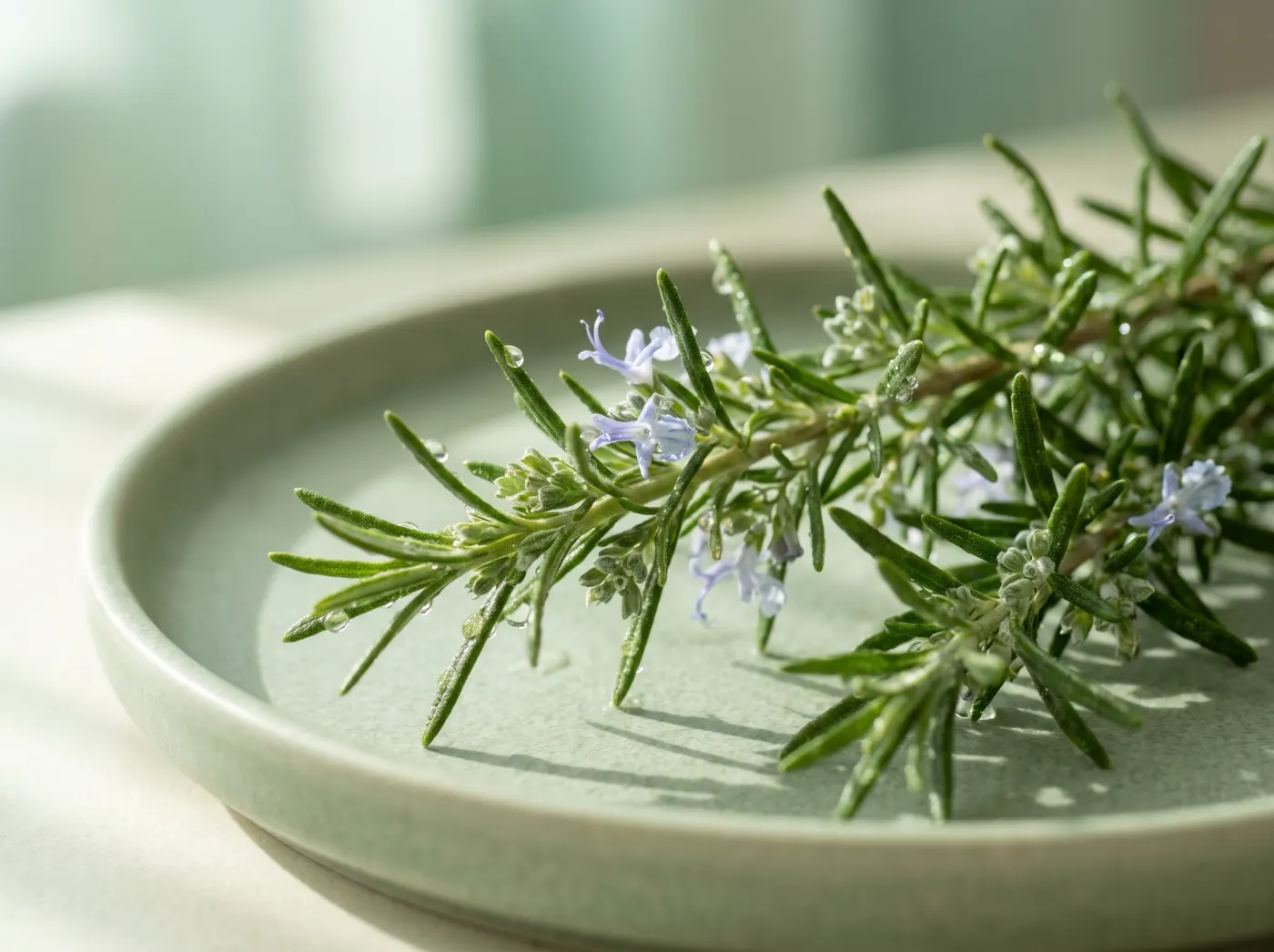
Rosemary essential oil is obtained from the flowering tops and leaves of Rosmarinus officinalis8. Its composition varies with origin: α-pinene, 1,8-cineole and camphor are the molecules most often reported56. CosIng classifies it as a fragrance and skin conditioning agent8. Cosmetic evidence, mostly on the scalp, remains limited3.

Rosemary essential oil in macro view, golden drops on a sage green ceramic surface, raking light

Rosemary oil at a glance

Entry from our cosmetic ingredient glossary. Regulatory data from the European Commission's CosIng database8 and from Regulation (EU) 2023/15459. Copy the identifiers in one click for your files.

INCI name
ROSMARINUS OFFICINALIS LEAF OILAlso exists as "LEAF/STEM OIL" (leaf and stem oil, CAS 84604-14-8)8
Other names
Rosemary essential oilRosemary oil; US INCI name ROSMARINUS OFFICINALIS (ROSEMARY) LEAF OIL8
CAS number
84604-14-8 / 8000-25-7
EC number
283-291-9
Botanical origin
Rosemary (Rosmarinus officinalis L., Lamiaceae)CosIng: essential oil from the flowering tops and leaves8. Botanical synonym: Salvia rosmarinus5
Composition
α-pinene, 1,8-cineole, camphorMost frequently reported molecules among about 150 identified compounds5. Across six origins: α-pinene 13.5 to 37.7%, 1,8-cineole 16.1 to 29.3%, camphor 0.7 to 7.0%. At least five chemotypes are described6
CosIng functions
Fragrance, skin conditioning"Fragrance" and "Skin conditioning"8
EU status
No dedicated line in Annex IIIRosemary oil is not named in Regulation (EU) 2023/15459. CosIng only mentions the general rule on ozone-depleting substances8
Allergen to declare
Not the oil, but some of its constituentsRegulation (EU) 2023/1545 requires separate labeling of, among others, Camphor (line 331), Pinene (371) and Limonene (88): above 0.001% in a leave-on product and 0.01% in a rinse-off product. 1,8-Cineole is not named in it. Non-compliant products may be placed on the market until 31 July 2026 and made available until 31 July 20289
Safety
No CIR assessment foundWe did not find a CIR panel report on this oil: tolerance is judged on the finished formula and on the batch certificate of analysis

What the research says

Each result shows the protocol and the level of evidence. The higher the level, the better the result carries over to a finished formula.

Clinical trialReview or consensusLaboratory

Oil compositionChemistry

A composition that changes with origin

Laboratory
Oils from six originsGas chromatography

The oils are dominated by α-pinene (13.5 to 37.7%), 1,8-cineole (16.1 to 29.3%), verbenone (0.8 to 16.9%), borneol (2.1 to 6.9%), camphor (0.7 to 7.0%) and limonene (1.6 to 4.4%). With 72 published compositions, the analysis distinguishes at least five chemotypes6.

About 150 compounds identified

Review
2019 review

The most frequently reported molecules are 1,8-cineole, α-pinene and camphor5.

Among the most complex oils

Review
2016 reviewOils that caused contact allergies

The number of identified constituents generally ranges from 100 to 250, but reaches 450 to 500 in some oils, including lavender, geranium and rosemary. Limonene, linalool and α-pinene are important constituents of more than 20 oils7.

Scalp and hairHaircare

Hair count up at 6 months, as with 2% minoxidil

Clinical trial
Rosemary oil vs 2% minoxidil6 months50 + 50 participantsRandomized, no placebo group

In people with androgenetic hair shedding, the hair count did not change significantly at 3 months. At 6 months it had increased in both groups, with no difference between them. Scalp itching increased in both groups, more with minoxidil. Without a placebo group, the trial cannot say how much is due to the oil1.

A place among seven non-conventional products

Review
2025 network meta-analysis24 trialsHair density at 24 weeks

Rosemary oil applied to the scalp is among the non-conventional products compared with reference products. The authors give relative efficacy benchmarks; the abstract does not quantify the one for rosemary2.

Limited evidence, according to the reviews

Review
2025 and 2026 reviews

The 2025 review notes small, short studies with no long follow-up and calls for larger randomized trials3. The 2026 review, focused on rosemary, calls for documenting its long-term efficacy and safety4.


This page summarizes published literature on a cosmetic ingredient. It does not describe the effect of a finished product, which depends on its formula, and it is not medical advice. Evidence is flagged by level: clinical trial, review or laboratory.

Which products use rosemary oil?

Our white label catalog includes 17 formulas with rosemary oil: the key active in 9 of them, a supporting ingredient in the others. Every category can be customized (formula, fragrance, packaging).

In our formulas, it is most often paired with

Vitamin E 9Panthenol 5Argan oil 4Mint 3

Rosemary, lavender, peppermint or eucalyptus?

Four essential oils often compared when choosing a fragrance or a sensation. Their chemistry differs, so does their labeling.

RosemaryLavenderPeppermintEucalyptus
Dominant constituentsα-pinene, 1,8-cineole, camphor6Linalool and linalyl acetate10Menthol and menthone111,8-cineole, more than 50% of Eucalyptus globulus oil7
Regulation (EU) 2023/1545Oil not named; Camphor, Pinene and Limonene named9Oil named (line 360)9Oil named (line 361), Menthol named (line 338)9Eucalyptus globulus oil named (line 355)9
Carmel catalog formulas17 formulas8 formulas8 formulas3 formulas

Frequently asked questions about rosemary oil

What is rosemary oil?
It is the essential oil obtained from the flowering tops and leaves of Rosmarinus officinalis8. Its INCI name is ROSMARINUS OFFICINALIS LEAF OIL. It contains mostly α-pinene, 1,8-cineole and camphor, in proportions that vary with origin56.
What are the benefits of rosemary oil in cosmetics?
CosIng classifies it as a fragrance and skin conditioning agent8. On the scalp, a 6-month randomized trial reports a higher hair count, but without a placebo group1. Reviews consider the evidence limited34. A brand should therefore stay cautious with its claims.


Is rosemary oil good for hair?
In the Panahi trial, 50 people with androgenetic hair shedding applied rosemary oil for 6 months, and the hair count had increased at the end, as in the 2% minoxidil group1. The trial had no placebo group. In our range, rosemary goes into scalp care as a formula ingredient, with no promise of results.
Do I need to declare allergens with rosemary oil?
The oil itself is not named in Regulation (EU) 2023/1545, but some of its constituents are, such as Camphor, Pinene and Limonene9. They must appear in the ingredient list above 0.001% in leave-on products or 0.01% in rinse-off products. The calculation is made on the finished product, from the analysis of the oil batch.
What is the difference between rosemary essential oil and rosemary hydrosol?
The essential oil is the volatile fraction obtained by distillation8; the hydrosol is the aromatic water collected during that distillation, far less concentrated. Our catalog offers both: the pure essential oil and the hydrosol, the latter with a validated preservative system.
Is rosemary oil safe?
No restriction specific to the oil appears in the regulation89. Like any essential oil, it contains fragrance molecules that can sensitize some people; tolerance is checked on the finished formula. During pregnancy, as with any skincare product, a healthcare professional's advice remains the rule.
Can you manufacture a rosemary product for my brand?
Yes. Our ISO 22716 certified lab offers 17 rosemary formulas (essential oil, hydrosol, scalp care, shampoos, scrubs) that you can customize, or a custom formula. Samples are free.

Sources

Peer-reviewed studies and official regulatory sources, checked on November 3, 2026.

  1. Panahi Y, Taghizadeh M, Marzony ET, Sahebkar A. Rosemary oil vs minoxidil 2% for […] of androgenetic […]: a randomized comparative trial. Skinmed. 2015;13(1):15-21. . PMID 25842469
  2. Gupta AK, Bamimore MA, Talukder M. Relative efficacy of conventional monotherapies and select nonconventional, over-the-counter products for male […]: a network meta-analysis study. J Cosmet Dermatol. 2025;24(10):e70483. . doi:10.1111/jocd.70483
  3. Ahmed A, Alali AM, Abdullah E, et al. Herbal remedies for hair loss: a review of efficacy and safety. Skin Appendage Disord. 2025;11(4):360-371. . doi:10.1159/000542876
  4. Almutairi AG, Altheyab FY, Alhawsawi W, et al. Review on natural remedies for hair growth promotion with a focus on rosemary. Dermatol Reports. 2026. . doi:10.4081/dr.2026.10368
  5. Borges RS, Ortiz BLS, Pereira ACM, et al. Rosmarinus officinalis essential oil: a review of its phytochemistry, anti-inflammatory activity, and mechanisms of action involved. J Ethnopharmacol. 2019;229:29-45. . doi:10.1016/j.jep.2018.09.038
  6. Satyal P, Jones TH, Lopez EM, et al. Chemotypic characterization and biological activity of Rosmarinus officinalis. Foods. 2017;6(3):20. . doi:10.3390/foods6030020
  7. de Groot AC, Schmidt E. Essential oils, part III: chemical composition. Dermatitis. 2016;27(4):161-169. doi:10.1097/DER.0000000000000193
  8. European Commission. CosIng, entry ROSMARINUS OFFICINALIS LEAF OIL (CAS 84604-14-8 / 8000-25-7, EC 283-291-9). ec.europa.eu/growth/tools-databases/cosing
  9. Commission Regulation (EU) 2023/1545 of 26 July 2023 amending Regulation (EC) No 1223/2009 of the European Parliament and of the Council as regards labelling of fragrance allergens in cosmetic products (Annex III). eur-lex.europa.eu
  10. Hagvall L, Sköld M, Bråred-Christensson J, et al. Lavender oil lacks natural protection against autoxidation, forming strong contact allergens on air exposure. Contact Dermatitis. 2008;59(3):143-150. . doi:10.1111/j.1600-0536.2008.01402.x
  11. Nair B. Final report on the safety assessment of Mentha piperita (peppermint) oil, Mentha piperita (peppermint) leaf extract, Mentha piperita (peppermint) leaf, and Mentha piperita (peppermint) leaf water. Int J Toxicol. 2001;20 Suppl 3:61-73. . PMID 11766133
Carmel Cosmetics Labs product specialist with a brand founder

Tell us about your project

A product specialist reviews your request and gets back to you on the channel you prefer.

Lead EN – Demande de devis
Tell us about your project. A product specialist will get back to you shortly.
CONTACT INFORMATION
Name
PROJECT INFORMATION
Which cosmetics category interests you most?

By submitting this form, you agree to our terms of service and privacy policy.

No obligation. Your information stays confidential and is used only to prepare your quote.