











































Services

Torn between two services?A project manager will guide you

Catalog

Explore the full catalog1,000+ formulas ready to carry your brand

Face careFull range

Serums, creams and targeted care, formulated with your actives.

Body careFull range

Moisturizing, nourishing and shower care: cream, butter or oil.

Specialty careFull range

Sun care, lips, intimate care and oral care.

Men, baby, makeupFull range

Shaving and beard, baby and mom, makeup.

Industries

All solutions by industryFormulas and formats for your business

Laboratory

Cosmetics manufacturing room with a row of stainless-steel mixers and an operator in white workwearOur factory in Aït MelloulISO 22716 and ISO 9001, visits by appointmentDiscover the factory

Resources

Avocado oil

Avocado oil is pressed from the pulp of the Persea gratissima fruit. CosIng describes it as an oil made mainly of fatty acid glycerides, with a "skin conditioning" function1. Oleic acid dominates2. Cosmetic evidence specific to the oil is limited: there is no controlled trial on the oil alone56.
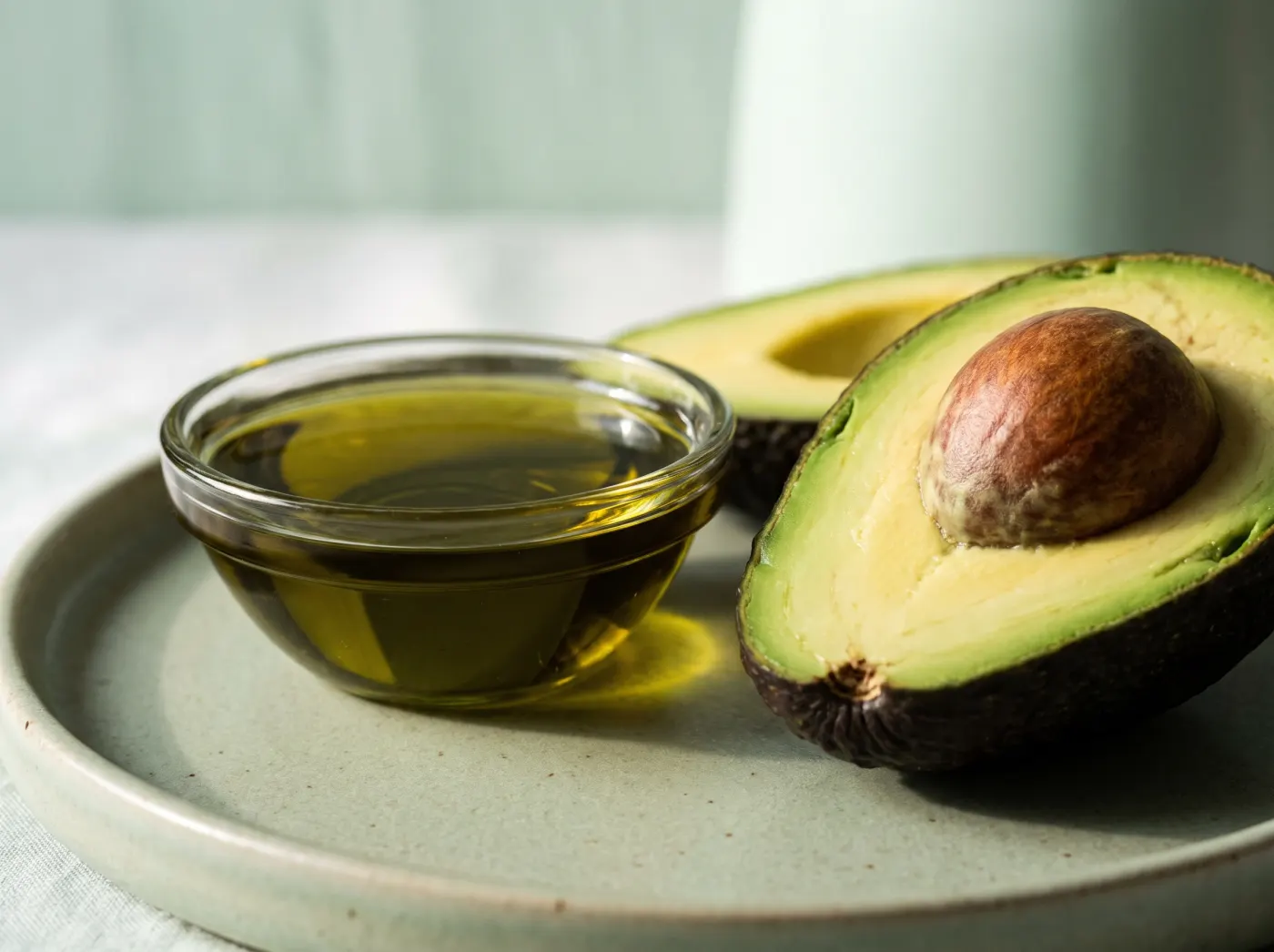
Green avocado oil in macro view, a thick drop on a sage green ceramic surface, raking light

Avocado oil at a glance

Entry from our cosmetic ingredient glossary. Regulatory data from the European Commission's CosIng database1. Copy the identifiers in one click for your files.

INCI name
PERSEA GRATISSIMA OIL
Other names
Avocado oilCurrent botanical name Persea americana2
CAS number
8024-32-6
EC number
232-428-0
Botanical origin
Avocado (Lauraceae)Fixed oil obtained by pressing the sliced and dehydrated pulp of the avocado1
Composition
Triglycerides, oleic acid dominantHass variety: oleic 52 to 67%, palmitic 13 to 19%, linoleic 11 to 15%, palmitoleic 3 to 8%2
Minor constituents
Sterols, tocopherols, squalene, carotenoids, chlorophyllThe content varies with the extraction and drying of the pulp2
CosIng function
Skin conditioning"Skin conditioning"1
EU status
No specific restrictionOnly the general mention on ozone-depleting substances appears in CosIng1
Allergen to declare
NoOne case of contact allergy to the oil in a sunscreen has been published8
Safety
No dedicated CIR assessment retainedThe CIR panel judged 244 vegetable oils used in cosmetics safe7

What the research says

Each result shows the protocol and the level of evidence. The higher the level, the better the result carries over to a finished formula.

Clinical trialReview or consensusLaboratory

Composition and qualityChemistry

No international quality standard

Review
2019 reviewCharacteristics and applications

There is no international regulation on avocado oil quality. The authors refer to olive oil parameters. Quality depends on fruit maturity, extraction and storage2.

A composition that varies by variety

Review
2019 reviewTables of several varieties and countries

Oleic acid ranges from about 41% to 74% depending on the variety. For the Hass variety, the oil contains up to 71% monounsaturated fatty acids, 13% polyunsaturated and 16% saturated23.

SkinSkincare

A semi-occlusive oil that stays on the surface

Clinical trial
Avocado, almond, soybean, jojoba and paraffin6 healthy volunteersIn vivo, laser microscopy and water loss

Vegetable oils penetrate only the first layers of the stratum corneum. Water loss decreases: the oils form a semi-occlusion of the surface, except jojoba4.

A saffron and avocado oil cream, 12 weeks

Clinical trial
Avocado oil and saffron creamDaily, 12 weeks20 healthy volunteersNo control group described

At least one grade of improvement on the global scale in 30% of volunteers at 6 weeks and 45% at 12 weeks. The area and volume of the nasolabial fold decrease, elasticity increases, hydration does not change. The effect of the oil is not isolated from that of saffron5.

Vegetable oils and the stratum corneum: a review of 27 studies

Review
2022 review17 oils including avocado

Avocado, almond and rapeseed have an oleic to linoleic ratio of 2 to 3 to 1, close to the physiological ratio. No significant skin benefit was linked to this ratio. On healthy skin, oils rich in oleic acid do not react negatively; frequency and duration of use matter6.

Tolerance and safetySafety

One reported case of contact allergy

Case report
Letter to the editor, 1987Avocado oil in a sunscreen

Contact allergy to avocado oil is documented. It is an isolated case, with no known frequency8.

244 vegetable oils assessed by the CIR panel

Expert assessment
CIR panel 2017Cosmetic vegetable oils

The panel concludes that these oils are safe in cosmetic use. Check the report list to confirm the exact ingredient of your formula7.

This page summarizes published literature on a cosmetic ingredient. It does not describe the effect of a finished product, which depends on its formula, and it is not medical advice. No controlled trial specific to avocado oil was retained: the page relies on reviews, a penetration study and a trial of a combined cream. No peer-reviewed study on hair was found.

Which products use avocado oil?

Our white label catalog includes 15 formulas with avocado oil: the key active in 4 of them, a supporting ingredient in the others. Every category can be customized (formula, fragrance, packaging).

2Face

Supporting oil in serums, notably argan oil and the eye and lash contour.

6Hair

Key active in the argan and avocado styling serum and the two-phase oil, supporting oil in hair oils and serums.

In our formulas, it is most often paired with

Vitamin E 11Sweet almond oil 5Argan oil 5Coconut oil 3

Avocado oil, shea butter, jojoba oil or coconut oil?

Four vegetable fats often compared when choosing the base of a care product. Their chemistry differs, so their behavior in a formula does too.

Avocado oilShea butterJojoba oilCoconut oil
Chemical natureOil: oleic 52 to 67% for the Hass variety2Butter: stearic (28 to 56%) and oleic (34 to 61%) acids10Liquid wax: about 98% wax esters9Oil: 92.1% saturated fatty acids, of which 47.7% lauric acid11
EU regulationNo specific restriction1No restrictionNo restrictionNo restriction
Carmel catalog formulas15 formulas65 formulas25 formulas69 formulas

Frequently asked questions about avocado oil

What is avocado oil?
It is the oil pressed from the pulp of the avocado, Persea gratissima. CosIng describes it as made mainly of fatty acid glycerides1. Oleic acid is its main constituent2. Its INCI name is PERSEA GRATISSIMA OIL, its CAS number 8024-32-6.
What are the benefits of avocado oil in cosmetics?
CosIng recognizes a skin conditioning function1. An in vivo study shows it as semi-occlusive, with reduced water loss4. We retained no controlled trial on the oil alone: it is mostly a formulation oil, comfortable in body and hair care.
Is avocado oil good for hair?
We found no peer-reviewed study measuring the effect of avocado oil alone on hair. Our catalog uses it as the key active of a styling serum and a two-phase hair oil, and as a supporting oil in several serums and oils: it is a formulation use.
Is avocado oil suitable for the face and oily skin?
We retained no official or peer-reviewed source giving a comedogenicity rating for avocado oil, so this page gives no figure. A 2022 review indicates that on healthy skin, oils rich in oleic acid do not react negatively, with frequency of use mattering6. The tolerance of a formula is checked with tests on the finished product.
What is the difference between avocado oil and shea butter?
Avocado oil is liquid, with oleic acid dominant2. Shea is a butter rich in stearic and oleic acids10. In a formula, shea brings consistency, avocado brings fluidity.
Is avocado oil safe?
No restriction applies to the ingredient in the EU1. One case of contact allergy to avocado oil in a sunscreen has been published8. The CIR panel judged 244 vegetable oils used in cosmetics safe7. During pregnancy, as with any skincare product, a healthcare professional's advice remains the rule.
Can you manufacture an avocado oil or care product for my brand?
Our ISO 22716 certified laboratory offers 15 avocado oil formulas (styling serums, hair oils, beard care, body care) to customize, or a custom formula. Free samples are included.

Sources

Peer-reviewed studies and official regulatory sources, checked on November 3, 2026.

  1. European Commission. CosIng, entry PERSEA GRATISSIMA OIL (CAS 8024-32-6, EC 232-428-0). ec.europa.eu/growth/tools-databases/cosing
  2. Flores M, Saravia C, Vergara CE, et al. Avocado oil: characteristics, properties, and applications Molecules. 2019;24(11):2172. doi:10.3390/molecules24112172
  3. Dreher ML, Davenport AJ. Hass avocado composition and potential health effects Crit Rev Food Sci Nutr. 2013;53(7):738-750. doi:10.1080/10408398.2011.556759
  4. Patzelt A, Lademann J, Richter H, et al. In vivo investigations on the penetration of various oils and their influence on the skin barrier Skin Res Technol. 2012;18(3):364-369. doi:10.1111/j.1600-0846.2011.00578.x
  5. Naeimifar A, Ahmad Nasrollahi S, Samadi A, et al. Preparation and evaluation of anti-wrinkle cream containing saffron extract and avocado oil J Cosmet Dermatol. 2020;19(9):2366-2373. doi:10.1111/jocd.13284
  6. Poljšak N, Kočevar Glavač N. Vegetable butters and oils as therapeutically and cosmetically active ingredients for dermal use: a review of clinical studies Front Pharmacol. 2022;13:868461. doi:10.3389/fphar.2022.868461
  7. Burnett CL, Fiume MM, Bergfeld WF, et al. Safety assessment of plant-derived fatty acid oils Int J Toxicol. 2017;36(3 Suppl):51S-129S. doi:10.1177/1091581817740569
  8. de Groot AC, van der Meeren HL, Weyland JW. Contact allergy to avocado oil in a sunscreen Contact Dermatitis. 1987;16(2):108-109. doi:10.1111/j.1600-0536.1987.tb01392.x
  9. Gad HA, Roberts A, Hamzi SH, et al. Jojoba oil: an updated comprehensive review on chemistry, pharmaceutical uses, and toxicity Polymers (Basel). 2021;13(11):1711. doi:10.3390/polym13111711
  10. Akihisa T, Kojima N, Katoh N, et al. Triterpene alcohol and fatty acid composition of shea nuts from seven African countries J Oleo Sci. 2010;59(7):351-360. doi:10.5650/jos.59.351
  11. Orsavova J, Misurcova L, Ambrozova JV, et al. Fatty acids composition of vegetable oils and its contribution to dietary energy intake and dependence of cardiovascular mortality on dietary intake of fatty acids Int J Mol Sci. 2015;16(6):12871-12890. doi:10.3390/ijms160612871
Carmel Cosmetics Labs product specialist with a brand founder

Tell us about your project

A product specialist reviews your request and gets back to you on the channel you prefer.

Lead EN – Demande de devis
Tell us about your project. A product specialist will get back to you shortly.
CONTACT INFORMATION
Name
PROJECT INFORMATION
Which cosmetics category interests you most?

By submitting this form, you agree to our terms of service and privacy policy.

No obligation. Your information stays confidential and is used only to prepare your quote.
