











































Services

Torn between two services?A project manager will guide you

Catalog

Explore the full catalog1,000+ formulas ready to carry your brand

Face careFull range

Serums, creams and targeted care, formulated with your actives.

Body careFull range

Moisturizing, nourishing and shower care: cream, butter or oil.

Specialty careFull range

Sun care, lips, intimate care and oral care.

Men, baby, makeupFull range

Shaving and beard, baby and mom, makeup.

Industries

All solutions by industryFormulas and formats for your business

Laboratory

Cosmetics manufacturing room with a row of stainless-steel mixers and an operator in white workwearOur factory in Aït MelloulISO 22716 and ISO 9001, visits by appointmentDiscover the factory

Resources

Jojoba oil

Jojoba oil is extracted from the seeds of Simmondsia chinensis, a shrub of the North American deserts1. It is not a triglyceride: it is made of about 98% wax esters1, hence its name liquid wax. CosIng classifies it as an emollient and a skin and hair conditioning agent9. Dedicated clinical evidence remains limited.
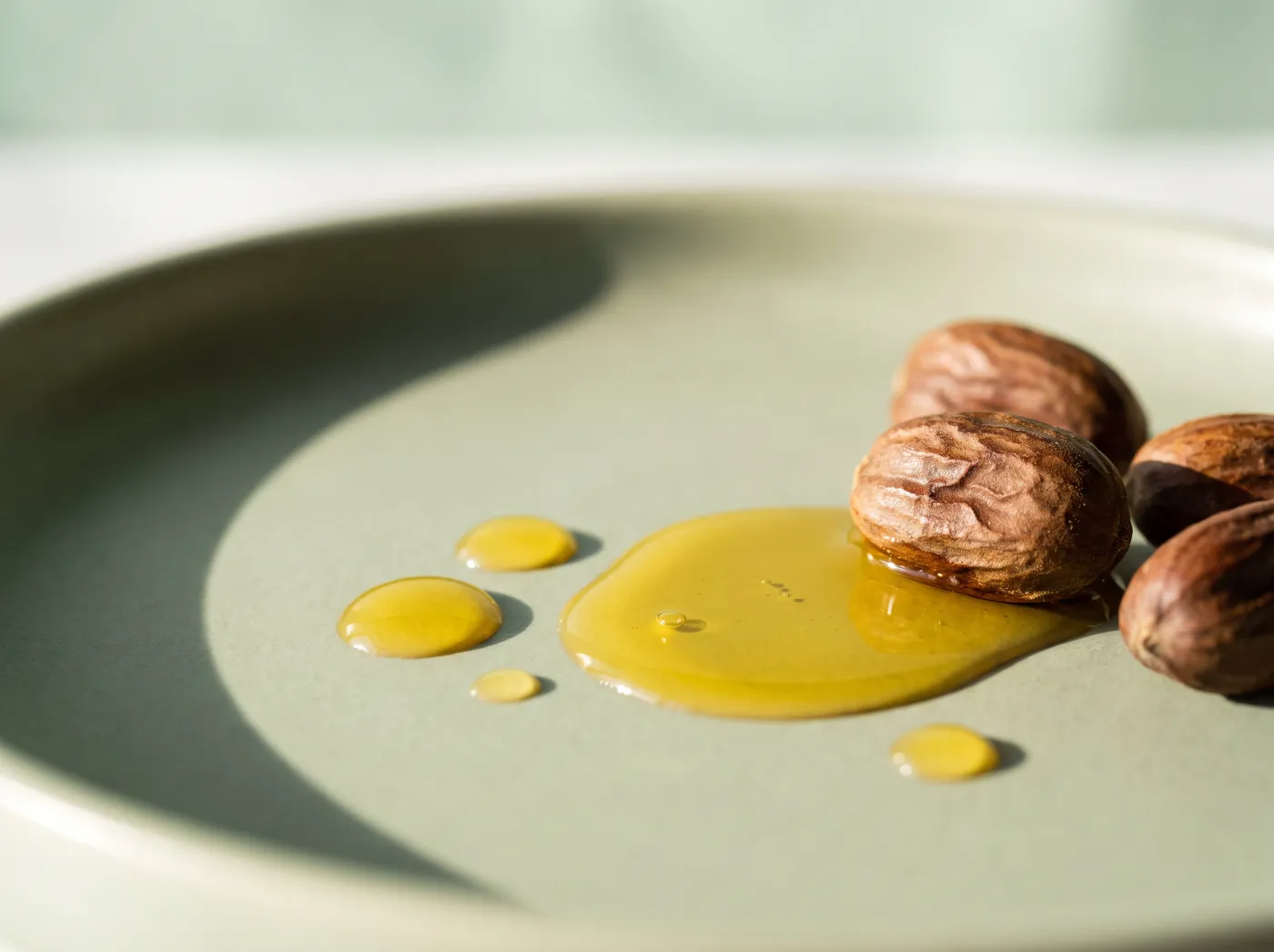
Golden jojoba oil in macro view, a clear drop on a sage green ceramic surface

Jojoba oil at a glance

Entry from our cosmetic ingredient glossary. Regulatory data from the European Commission's CosIng database9. Copy the identifiers in one click for your files.

INCI name
SIMMONDSIA CHINENSIS SEED OIL
Other names
Jojoba oilJojoba oil; jojoba liquid wax
CAS number
90045-98-0
EC number
289-964-3
Botanical origin
Jojoba (Buxaceae)Fixed oil pressed or extracted from the seeds of Simmondsia chinensis, a desert shrub9
Areas of origin and cultivation
North America, Chile, Egypt, ArgentinaNative to the deserts of North and Central America, grown in Chile, Egypt and Argentina1
Composition
About 98% wax estersPlus free fatty acids, alcohols, hydrocarbons, sterols and vitamins, very few triglycerides1
Structure
Long-chain monounsaturated estersFor example eicosenyl octadecenoate and docosenyl eicosenoate3
CosIng functions
Emollient, skin and hair conditioning"Skin conditioning - emollient" and "hair conditioning"9
EU status
No restriction specific to the ingredientNot listed in annexes II to VI of Regulation (EC) 1223/2009; only the general mention on ozone-depleting substances appears in CosIng9
Allergen to declare
No
Tolerance
Patch tests without allergic reactionExcept in hyperallergic people, according to a literature review1

What the research says

Each result shows the protocol and the level of evidence. The higher the level, the better the result carries over to a finished formula.

Clinical trialReview or consensusLaboratory

Composition and materialChemistry

A liquid wax, not a triglyceride

Review
2021 reviewChemistry, uses, toxicity

Jojoba is made of about 98% waxes, mostly wax esters, with sterols and vitamins. It is described as a liquid wax rather than an oil or fat1.

Long-chain monounsaturated esters

Laboratory
LC/MS/MS analysisJojoba wax

The main constituents are wax esters formed from monounsaturated alcohols and fatty acids with 18 to 24 carbons3. The double bonds are far apart from each other, unlike in most vegetable oils1.

High thermal and oxidation stability

Review
2021 review

The crude oil resists heat and rancidity well, in connection with its natural tocopherols (alpha, gamma, delta). Refined or bleached oil is less stable to oxidation1.

Skin and bodySkincare, bodycare

Documented cosmetic benefits, but heterogeneous studies

Review
2022 reviewSweet almond, evening primrose and jojoba

All three oils have skincare benefits, helping strengthen the integrity of the stratum corneum. The authors note discrepancies in the clinical data and questionable study designs; additional data on stratum corneum physiology are needed5.

Skin barrier: jojoba is among the oils studied

Review
2017 and 2018 reviewsOlive, sunflower, coconut, jojoba, argan and others

The reviews describe the ratio of linoleic to oleic acid as decisive for how useful an oil is for the barrier. They bring together data on several oils, including jojoba67.

Extracellular matrix in the lab: collagen III and hyaluronic acid

Laboratory
Ex vivo human skinJojoba wax, 4 preparations

Applied to human skin kept in culture, jojoba wax reduced by about 30% the secretion of the cytokines IL-6, IL-8 and TNFα induced by a stimulus, and increased the synthesis of collagen III and hyaluronic acid. A laboratory result, not verified in volunteers8.

What dermatology reviews sayDermatology

A general review of dermatological uses

Review
2013 review

Jojoba is presented as a source of liquid wax used in skin care, sunscreens and moisturizers, and as possibly promoting the absorption of substances applied to the skin4. The authors write a synthesis, with no trial protocol of their own.

A material studied beyond cosmetics

Review
2024 review

A review describes the oil as made of long-chain monounsaturated esters, distinct from classic triglyceride oils, with uses in cosmetics, chemistry and pharmacy2.

This page summarizes published literature on a cosmetic ingredient. It does not describe the effect of a finished product, which depends on its formula, and it is not medical advice. Several of the studies cited were run or funded by industry; this is indicated in the sources.

Which products use jojoba oil?

Our white label catalog includes 25 formulas with jojoba oil: the key active in 4 of them, a supporting ingredient in the others. Every category can be customized (formula, fragrance, packaging).

In our formulas, it is most often paired with

Vitamin E 16Argan oil 11Sweet almond oil 9

Jojoba oil, shea butter, coconut oil or castor oil?

Four vegetable fats often compared when choosing the base of a care product. Their chemistry differs, so their behavior in a formula does too.

Jojoba oilShea butterCoconut oilCastor oil
Chemical natureLiquid wax: about 98% wax esters1Butter: stearic (28 to 56%) and oleic (34 to 61%) acids10Oil: 92.1% saturated fatty acids, of which 47.7% lauric acid11Oil: about 90% ricinoleic acid12
EU regulationNo restrictionNo restrictionNo restrictionNo restriction
Carmel catalog formulas25 formulas65 formulas65 formulas25 formulas

Frequently asked questions about jojoba oil

What is jojoba oil?
It is the liquid wax extracted from the seeds of the jojoba, Simmondsia chinensis. It is made of about 98% wax esters1, unlike most vegetable oils, which are triglycerides. Its INCI name is SIMMONDSIA CHINENSIS SEED OIL.
What are the benefits of jojoba oil in cosmetics?
CosIng classifies it as an emollient and a skin and hair conditioning agent9. A 2022 review recognizes benefits for strengthening the integrity of the stratum corneum, while noting heterogeneous clinical data5.
Is jojoba oil good for hair?
CosIng lists it as a hair conditioning agent9. We found no published controlled trial measuring its effect alone on hair: it is a formulation use. Our catalog includes leave-in masks and shampoos that contain it.
Is jojoba oil comedogenic, and is it suitable for oily skin?
We found no official or peer-reviewed source giving a comedogenicity rating for jojoba oil, so this page gives no figure. It is not very sensitive to oxidation when crude1; its tolerance on a given skin is checked with tests on the finished formula.
What is the difference between jojoba oil and a regular vegetable oil?
Jojoba is a liquid wax, made of wax esters, whereas most vegetable oils are triglycerides1. This structure explains its good oxidation stability as long as it is not refined1.
Is jojoba oil safe?
No restriction applies to the ingredient in the EU9. According to a review, human patch tests showed no allergic reaction, except in hyperallergic people1. We did not use a CIR assessment for this page. During pregnancy, as with any skincare product, a healthcare professional's advice remains the rule.
Can you manufacture a jojoba oil or a jojoba product for my brand?
Yes. Our ISO 22716 certified lab offers 25 jojoba oil formulas (pure oil, massage oils, hair masks, shampoos, beard care) that you can customize, or a custom formula. Samples are free.

Sources

Peer-reviewed studies and official regulatory sources, checked on November 2, 2026.

  1. Gad HA, Roberts A, Hamzi SH, et al. Jojoba oil: an updated comprehensive review on chemistry, pharmaceutical uses, and toxicity Polymers (Basel). 2021;13(11):1711. doi:10.3390/polym13111711
  2. Chakrabarty S, Jigdrel K, Mukherjee P, et al. Bioactivities of jojoba oil beyond skincare J Med Food. 2024;27(7):579-588. doi:10.1089/jmf.2023.k.0062
  3. Tada A, Jin ZL, Sugimoto N, et al. Analysis of the constituents in jojoba wax used as a food additive by LC/MS/MS Shokuhin Eiseigaku Zasshi. 2005;46(5):198-204. doi:10.3358/shokueishi.46.198
  4. Pazyar N, Yaghoobi R, Ghassemi MR, et al. Jojoba in dermatology: a succinct review G Ital Dermatol Venereol. 2013;148(6):687-691. PMID 24442052
  5. Blaak J, Staib P. An updated review on efficacy and benefits of sweet almond, evening primrose and jojoba oils in skin care applications Int J Cosmet Sci. 2022;44(1):1-9. doi:10.1111/ics.12758Kneipp GmbH
  6. Vaughn AR, Clark AK, Sivamani RK, Shi VY. Natural oils for skin-barrier repair: ancient compounds now backed by modern science Am J Clin Dermatol. 2018;19(1):103-117. doi:10.1007/s40257-017-0301-1
  7. Lin TK, Zhong L, Santiago JL. Anti-inflammatory and skin barrier repair effects of topical application of some plant oils Int J Mol Sci. 2017;19(1):70. doi:10.3390/ijms19010070
  8. Tietel Z, Melamed S, Ogen-Shtern N, et al. Topical application of jojoba (Simmondsia chinensis L.) wax enhances the synthesis of pro-collagen III and hyaluronic acid and reduces inflammation in the ex-vivo human skin organ culture model Front Pharmacol. 2024;15:1333085. doi:10.3389/fphar.2024.1333085
  9. European Commission. CosIng, entry SIMMONDSIA CHINENSIS SEED OIL (CAS 90045-98-0, CE 289-964-3). ec.europa.eu/growth/tools-databases/cosing
  10. Akihisa T, Kojima N, Katoh N, et al. Triterpene alcohol and fatty acid composition of shea nuts from seven African countries J Oleo Sci. 2010;59(7):351-360. doi:10.5650/jos.59.351
  11. Orsavova J, Misurcova L, Ambrozova JV, et al. Fatty acids composition of vegetable oils and its contribution to dietary energy intake and dependence of cardiovascular mortality on dietary intake of fatty acids Int J Mol Sci. 2015;16(6):12871-12890. doi:10.3390/ijms160612871
  12. Girdler K, Cabatu A, Olds H, Potts GA. Use of castor oil in dermatology: a narrative review Cureus. 2026;18(2):e103289. doi:10.7759/cureus.103289
Carmel Cosmetics Labs product specialist with a brand founder

Tell us about your project

A product specialist reviews your request and gets back to you on the channel you prefer.

Lead EN – Demande de devis
Tell us about your project. A product specialist will get back to you shortly.
CONTACT INFORMATION
Name
PROJECT INFORMATION
Which cosmetics category interests you most?

By submitting this form, you agree to our terms of service and privacy policy.

No obligation. Your information stays confidential and is used only to prepare your quote.
