











































Stratum corneum hydration
Clinical trialFrom 0.25% after one application, and from 0.10% after 2 weeks, stratum corneum hydration increases compared with the vehicle. Water loss does not change: the authors point to a humectant effect3.
Services
Catalog
Explore the full catalog1,000+ formulas ready to carry your brandFace careFull range
Serums, creams and targeted care, formulated with your actives.
Hair careFull range
From shampoo to leave-in, for every hair type.
Body careFull range
Moisturizing, nourishing and shower care: cream, butter or oil.
Hammam and naturalFull range
Black soap, argan and authentic Moroccan rituals.
Specialty careFull range
Sun care, lips, intimate care and oral care.
Industries
All solutions by industryFormulas and formats for your businessHospitality and wellness
Brands and creators
Laboratory
 Our factory in Aït MelloulISO 22716 and ISO 9001, visits by appointmentDiscover the factory
Cosmetics manufacturer based in Agadir
500+ brands35+ countries1,000+ formulas
Our factory in Aït Melloul
Up to 3 million units a yearVisits by appointment
Contract manufacturing, step by step
RegulationsCostsProject steps
Join our teams in Agadir
FormulationProductionQualityRegulatorySales
Resources
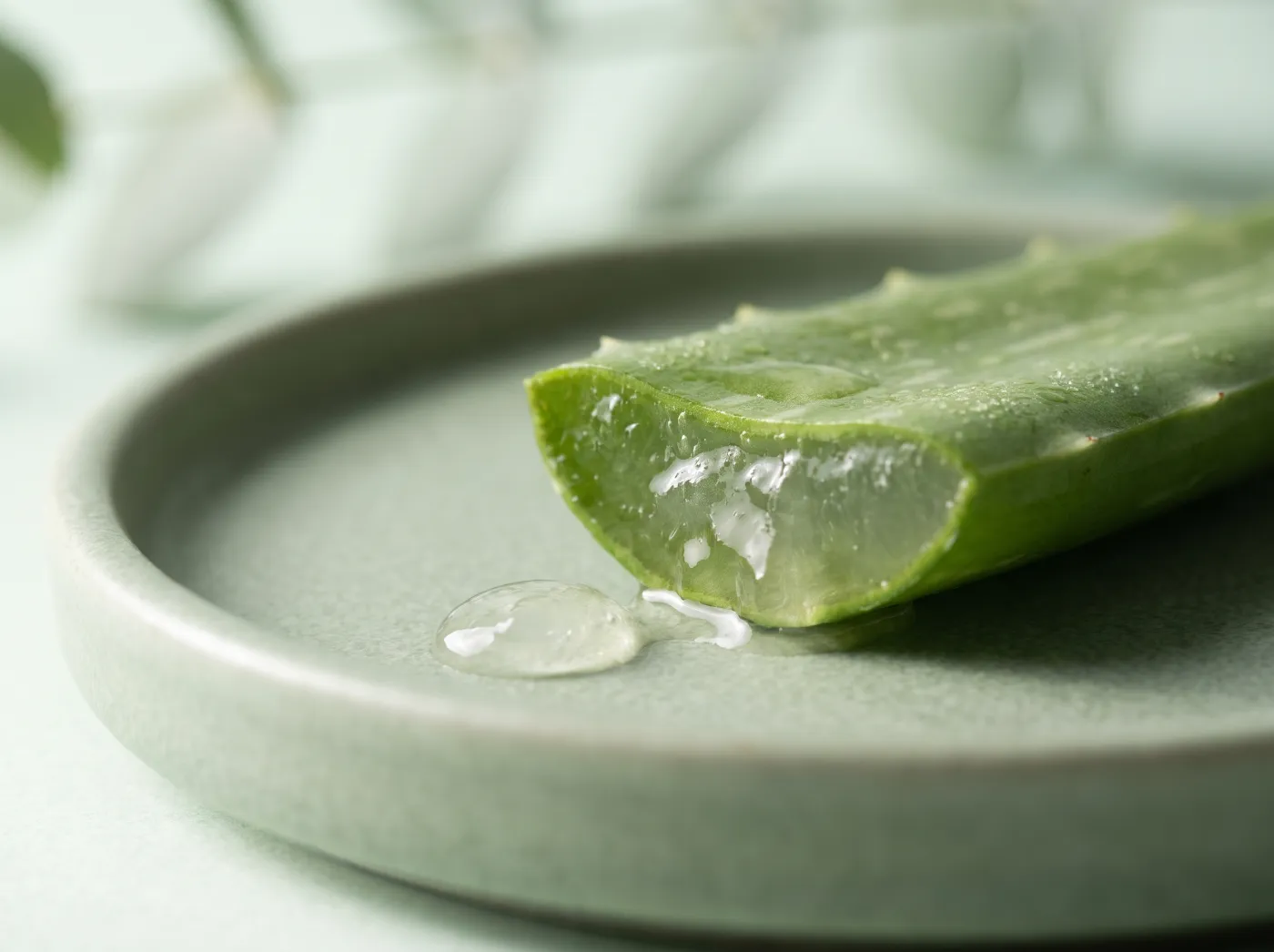
Aloe vera (Aloe barbadensis Miller) is a succulent plant whose leaf gel, rich in polysaccharides, is used as a hydrating cosmetic ingredient. In a trial on 20 women, a freeze-dried extract at 0.10 to 0.50% increased stratum corneum hydration3. Evidence remains more limited for other uses7.
Entry from our cosmetic ingredient glossary. Regulatory data from the European Commission's CosIng database1, safety according to the CIR expert panel2. Copy the identifiers in one click for your files.
Each result shows the protocol and the level of evidence. The higher the level, the better the result carries over to a finished formula.
From 0.25% after one application, and from 0.10% after 2 weeks, stratum corneum hydration increases compared with the vehicle. Water loss does not change: the authors point to a humectant effect3.
After a controlled UVB irradiation on the back, the gel significantly reduced redness at 48 hours. A reference cream did better. Single-center study on healthy irradiated skin: it does not describe a finished after-sun product4.
After UV irradiation, aloesin reduced pigmentation by 34%, arbutin by 43.5% and their combination by 63.3% compared with the control. This is an isolated molecule, not an aloe vera gel5.
The review attributes most of the effects of aloe vera to the polysaccharides in the leaf gel. It also points to the gel's potential to increase the skin penetration of other molecules6.
Controlled trials are still needed to establish the real efficacy of aloe vera in cosmetic science7. A 2021 review notes conflicting results in the literature on acemannan, a gel polysaccharide8.
The anthraquinones in the yellow latex of the leaf are phototoxic. The panel considers their level manageable below 50 ppm in cosmetic ingredients, and notes that several clinical studies of Aloe barbadensis preparations showed no phototoxicity. Skin contact reactions have been reported in isolated cases2.
This page summarizes published literature on a cosmetic ingredient. It does not describe the effect of a finished product, which depends on its formula, and it is not medical advice. Aloe vera is mostly studied for skin damage: only cosmetic results (hydration, comfort after sun exposure, skin tone) are included here. We did not retain any controlled study on hair.
The trials cited test a freeze-dried extract at 0.10 to 0.50% and, in the study on irradiated skin, a 97.5% gel. The CIR panel reports raw materials used at 0.1% or less, up to 20% in some products, and their aloe content ranges from 100% to 0.0005%2. The final concentration is set with the formulator, depending on the form (juice, gel, powder) and its aloe content.
Our white label catalog includes 51 formulas with aloe vera: the key active in 8 of them, a supporting ingredient in the others. Every category can be customized (formula, fragrance, packaging).
Key active in the gel mask and the ultra-light cream, also found in cleansers, serums and toners.
Key active in the body gel and the after-sun gel, also found in shower gels, men's, intimate and mom care.
Key active in the styling cream and the leave-in, also found in shampoos and conditioners.
In our formulas, it is most often paired with
Panthenol 26Vitamin E 17Argan oil 14Niacinamide 12Allantoin 11Four hydrating actives often combined in the same formula. They do not exclude each other.
| Aloe vera | Glycerin | Hyaluronic acid | Panthenol | |
|---|---|---|---|---|
| Main role | Hydration and comfort (humectant)1 | Reference humectant | Surface hydration | Hydration and barrier, hair care |
| Origin | Plant (leaf of the plant) | Plant or synthetic | Biotechnology | Synthetic, provitamin B5 |
| In the formula | Natural material: aloe and anthraquinone content must be controlled2 | Widely used, easy to formulate | Molecular weight changes the feel | Liquid (D-panthenol) or powder (DL-panthenol) |
Peer-reviewed studies and official regulatory sources, checked on November 2, 2026.

A product specialist reviews your request and gets back to you on the channel you prefer.