Services

Torn between two services?A project manager will guide you

Catalog

Explore the full catalog1,000+ formulas ready to carry your brand

Face careFull range

Serums, creams and targeted care, formulated with your actives.

Body careFull range

Moisturizing, nourishing and shower care: cream, butter or oil.

Specialty careFull range

Sun care, lips, intimate care and oral care.

Men, baby, makeupFull range

Shaving and beard, baby and mom, makeup.

Industries

All solutions by industryFormulas and formats for your business

Laboratory

Cosmetics manufacturing room with a row of stainless-steel mixers and an operator in white workwearOur factory in Aït MelloulISO 22716 and ISO 9001, visits by appointmentDiscover the factory

Resources

Green clay

The green clay we formulate is an illite (INCI ILLITE), a clay that CosIng classifies as an absorbent1. "Green clay" remains a trade name: other suppliers sell montmorillonites under it, with a different INCI2. It is mostly used in masks. Clinical trials specific to green clay are rare; the CIR panel judges these clays safe under the conditions of use3.

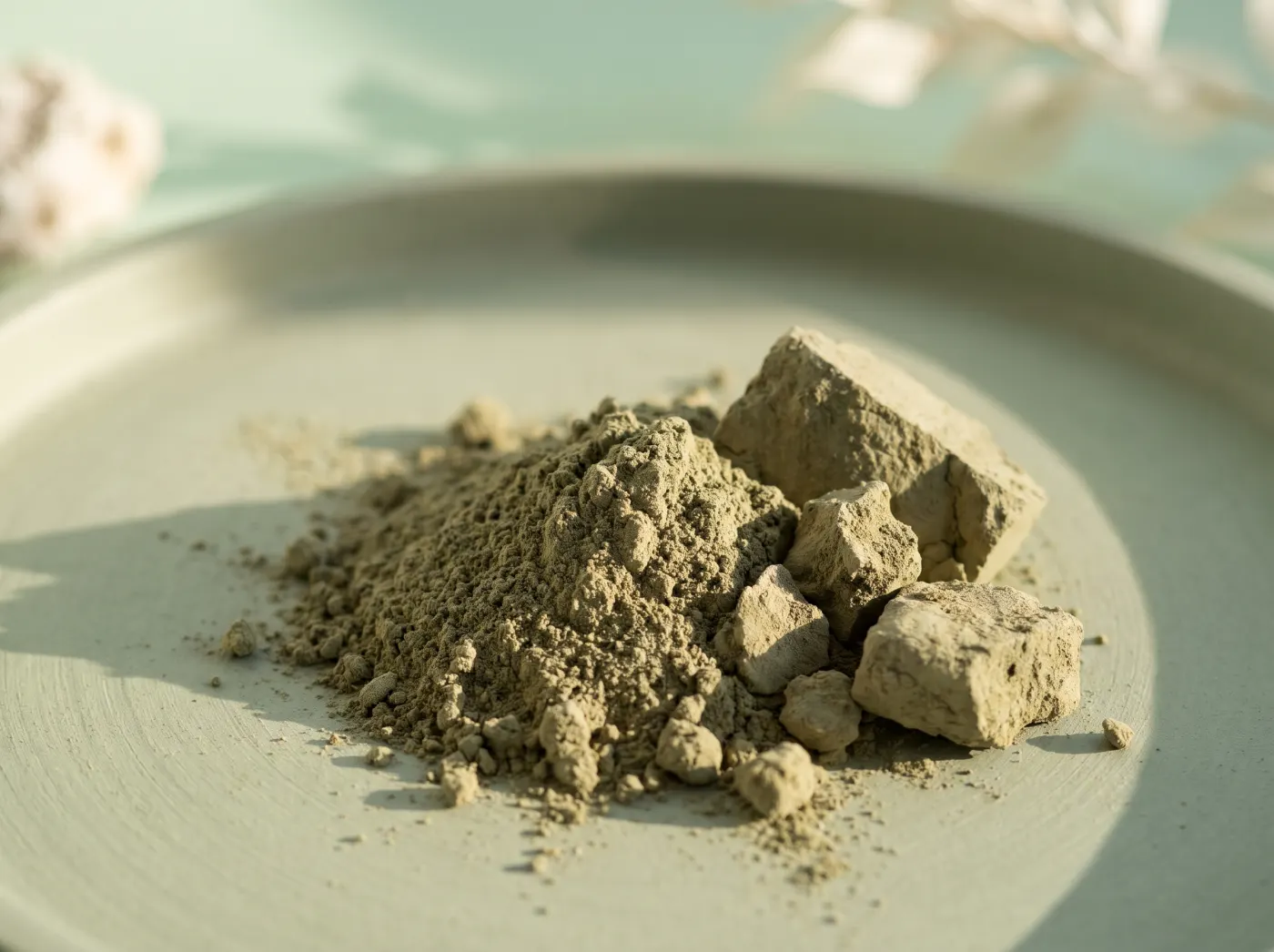
Green clay powder in macro view, fine grains on a sage green ceramic surface, raking light

Green clay at a glance

Entry from our cosmetic ingredient glossary. Regulatory data from the European Commission's CosIng database12, safety according to the CIR expert panel3. Copy the identifiers in one click for your files.

INCI name
ILLITEINCI of our green clay, per the supplier specification1
Other names
Green clayArgile verte. Trade name: other clays, such as montmorillonite, are also sold under it
CAS number
12173-60-3Illite1
Mineral nature
Illite, a layered clayComposition intermediate between montmorillonite and muscovite1
CosIng functions
Abrasive, absorbent, bulking agentAlso anticaking1
Appearance
Fine green to gray-green powderMixes with water into a paste; can also be formulated as a ready-to-use mask
EU status
No specific restrictionOnly the general mention on ozone-depleting substances appears1
Allergen to declare
No
Safety
Judged safe under the conditions of useCIR panel reservation for products that may be inhaled3

What the research says

Each result shows the protocol and the level of evidence. The higher the level, the better the result carries over to a finished formula.

Clinical trialReview or consensusLaboratory

Facial skinSkincare

A kaolin and bentonite mask: sebum, hydration, more even skin tone

Clinical trial
Mask with kaolin, bentonite, thermal water and panthenol2 applications per week, 4 weeks75 adults with oily or combination skinNo placebo group described

Sebum level, skin tone evenness, stratum corneum hydration and water loss all improved. Closed and open comedones fell by 46% and 66% at 4 weeks. Pore size did not change. This is not a green clay mask: the effect of the clay itself is not isolated from the rest of the formula7.

Montmorillonites and bentonites, related clays: a skin potential to confirm

Review
2024 reviewIn vitro, animal and preliminary clinical trials

The authors gather effects on sebum absorption, hydration and skin elasticity. They conclude that larger randomized trials are still needed to establish efficacy and safety5. These results concern montmorillonites, not illite.

Material and formulationFormulation

Adsorbent, excipient and texturizer at once

Review
2017 reviewDermocosmetics

Clays stabilize emulsions and suspensions, change rheology and adsorb or absorb. The review links each use to the properties of the mineral6.

Adsorption that works both ways

Review
2018 reviewBenefits and risks of clays

A clay can bind unwanted substances, but also release them, heavy metals included, through the skin or by ingestion. Hence the value of checking the raw material batch by batch4.

Paste mask: texture shifts with temperature

Laboratory
Clay masks-5 to 45 °C, 15 days

Viscosity and homogeneity vary with temperature; color, odor and pH remain stable11.

Peel-off mask with green clay and aloe vera

Laboratory
Design of experimentsPreliminary stability

The optimized formula is stable under normal storage conditions, and the preservative prevented microbial growth12.


Expert viewSafety

Eight natural clays judged safe, with a reservation on inhalation

Expert assessment
CIR panel 20268 natural clays

The panel judges kaolin safe under the conditions of use described. The same goes for the 7 other clays, illite and montmorillonite included according to the publication keywords, except for products that may be inhaled: data are insufficient there3.

Inhalation toxicity, particle size

Review
CIR report 2003Clays and silicates

In animals, inhalation toxicity is easy to demonstrate; particle size, concentration and mineral composition matter most. Clays have low oral toxicity13.

This page summarizes published literature on a cosmetic ingredient. It does not describe the effect of a finished product, which depends on its formula, and it is not medical advice. Clinical trials on green clay itself are rare: most studies are on kaolin or bentonite. One cited study was run by a cosmetics manufacturer; this is indicated in the sources.

Which products use green clay?

Our white label catalog includes 1 formula with green clay: the key active in 1 of them, a supporting ingredient in the others. Every category can be customized (formula, fragrance, packaging).

1Face

Oil-balancing mask: green clay combined with niacinamide, salicylic acid and soothing extracts.

In our formulas, it is most often paired with

Hyaluronic acid 1Salicylic acid 1Aloe vera 1

Green, white, red clay or rhassoul?

Four clays from the catalog, with different minerals. Cosmetic studies rarely compare them: the table describes the material, not an efficacy ranking.

Green clayWhite clay (kaolin)Red clayRhassoul
Dominant mineralIllite1Kaolinite, 1:1 clay with platelets under 2 µm8Illite, between montmorillonite and muscovite1Stevensite, a magnesium clay, with calcite, dolomite and quartz9
INCIILLITEKAOLIN10ILLITEMOROCCAN LAVA CLAY
EU regulationNo specific restriction12Annex IV for use as a colorant (CI 77004)10No specific restriction1Rhassoul entry in the glossary
Carmel catalog formulas1 formula7 formulasOn request6 formulas

Frequently asked questions about green clay

What is green clay?
It is a natural clay powder. The one we formulate is an illite1. "Green clay" is a trade name: other suppliers use it for montmorillonites2. CosIng recognizes absorbent, abrasive, bulking and anticaking functions for illite1.
Illite or montmorillonite: what is the difference?
They are two distinct clay minerals, with two INCI names and two CAS numbers. Illite has a composition intermediate between montmorillonite and muscovite1; montmorillonite is a complex aluminum and magnesium silicate2. Our green clay is an illite: the INCI to declare is ILLITE, CAS 12173-60-31.
What are the benefits of green clay in cosmetics?
It absorbs excess sebum and is worked into masks. A 2024 review on montmorillonites and bentonites, clays related to illite, describes a potential for sebum absorption, hydration and elasticity, while calling for larger trials5. We did not retain a controlled trial specific to illite or green clay.
Green clay or white clay: which should you choose?
White clay is kaolin, a 1:1 clay with fine platelets8. The green clay we formulate is an illite, a layered clay1. No peer-reviewed study separates them in a mask: the choice is made on texture, sensory effect and the target of the range.
Is green clay suitable for oily skin?
It is its most common use. The most complete clinical trial tested a kaolin and bentonite mask on 75 adults with oily or combination skin, with a better sebum level and better hydrated skin at 4 weeks7. The study is not on green clay alone and had no placebo group described.
Is green clay useful for hair?
We found no controlled trial on green clay and hair. It is used in hair masks for its absorbent function; this is a formulation use, with no dedicated clinical evidence to cite here.
Is green clay safe?
The CIR panel judges natural clays safe under the conditions of use, except for products that may be inhaled, for lack of sufficient data3. A natural clay can also contain or bind heavy metals4: ask for the certificate of analysis (heavy metals, microbiology) of each batch.
Can you manufacture a green clay mask for my brand?
Our ISO 22716 certified laboratory offers green clay formulas (powder, face mask, body mask) to customize, or a custom formula. Free samples are included.

Sources

Peer-reviewed studies and official regulatory sources, checked on November 3, 2026.

  1. European Commission. CosIng, entry ILLITE (CAS 12173-60-3). ec.europa.eu/growth/tools-databases/cosing
  2. European Commission. CosIng, entry MONTMORILLONITE (CAS 1318-93-0, EC 215-288-5). ec.europa.eu/growth/tools-databases/cosing
  3. Burnett CL, Bergfeld WF, Belsito DV, et al. Amended safety assessment of naturally-sourced clays as used in cosmetics Int J Toxicol. 2026;45(3_suppl):65S-107S. doi:10.1177/10915818261455355
  4. Gomes CSF. Healing and edible clays: a review of basic concepts, benefits and risks Environ Geochem Health. 2018;40(5):1739-1765. doi:10.1007/s10653-016-9903-4
  5. Zafar K, Lee A, Wang JY, et al. The potential cutaneous benefits of bentonites and montmorillonites Arch Dermatol Res. 2024;316(10):702. doi:10.1007/s00403-024-03456-5
  6. Moraes JDD, Bertolino SRA, Cuffini SL, et al. Clay minerals: properties and applications to dermocosmetic products and perspectives of natural raw materials for therapeutic purposes - a review Int J Pharm. 2017;534(1-2):213-219. doi:10.1016/j.ijpharm.2017.10.031
  7. Zhang X, Zhang Z, Tao H, et al. Comprehensive assessment of the efficacy and safety of a clay mask in oily and acne skin Skin Res Technol. 2023;29(11):e13513. doi:10.1111/srt.13513L'Oréal
  8. Awad ME, López-Galindo A, Setti M, et al. Kaolinite in pharmaceutics and biomedicine Int J Pharm. 2017;533(1):34-48. doi:10.1016/j.ijpharm.2017.09.056
  9. Moussout H, Ahlafi H, Aazza M, et al. Interfacial electrochemical properties of natural Moroccan Ghassoul (stevensite) clay in aqueous suspension Heliyon. 2020;6(3):e03634. doi:10.1016/j.heliyon.2020.e03634
  10. European Commission. CosIng, entry KAOLIN (CAS 1332-58-7, EC 310-194-1). ec.europa.eu/growth/tools-databases/cosing
  11. Zague V, de Almeida Silva D, Baby AR, et al. Clay facial masks: physicochemical stability at different storage temperatures J Cosmet Sci. 2007;58(1):45-51. PMID 17342267
  12. O'Reilly Beringhs A, Rosa JM, Stulzer HK, et al. Green clay and aloe vera peel-off facial masks: response surface methodology applied to the formulation design AAPS PharmSciTech. 2013;14(1):445-455. doi:10.1208/s12249-013-9930-8

  13. Elmore AR; Cosmetic Ingredient Review Expert Panel. Final report on the safety assessment of aluminum silicate, calcium silicate, magnesium aluminum silicate, magnesium silicate, magnesium trisilicate, sodium magnesium silicate, zirconium silicate, attapulgite, bentonite, Fuller's earth, hectorite, kaolin, lithium magnesium silicate, lithium magnesium sodium silicate, montmorillonite, pyrophyllite, and zeolite Int J Toxicol. 2003;22 Suppl 1:37-102. PMID 12851164

Carmel Cosmetics Labs product specialist with a brand founder

Tell us about your project

A product specialist reviews your request and gets back to you on the channel you prefer.

Lead EN – Demande de devis
Tell us about your project. A product specialist will get back to you shortly.
CONTACT INFORMATION
Name
PROJECT INFORMATION
Which cosmetics category interests you most?

By submitting this form, you agree to our terms of service and privacy policy.

No obligation. Your information stays confidential and is used only to prepare your quote.