Services

Torn between two services?A project manager will guide you

Catalog

Explore the full catalog1,000+ formulas ready to carry your brand

Face careFull range

Serums, creams and targeted care, formulated with your actives.

Body careFull range

Moisturizing, nourishing and shower care: cream, butter or oil.

Specialty careFull range

Sun care, lips, intimate care and oral care.

Men, baby, makeupFull range

Shaving and beard, baby and mom, makeup.

Industries

All solutions by industryFormulas and formats for your business

Our brands

Our own brands, developed and made in our laboratory.

Become a distributor of our brandsPharmacies, spas, shops and wholesalers

Laboratory

Cosmetics manufacturing room with a row of stainless-steel mixers and an operator in white workwearOur factory in Aït MelloulISO 22716 and ISO 9001, visits by appointmentDiscover the factory

Resources

Cucumber extract (Cucumis sativus)

Cucumber extract (Cucumis sativus) is declared in cosmetics as a skin conditioning agent12. The CIR panel judges it safe at use concentrations3. Evidence of efficacy remains thin: little work on the cosmetic extract, no controlled clinical trial retained here, and lab results that mostly concern leaves and stems45.

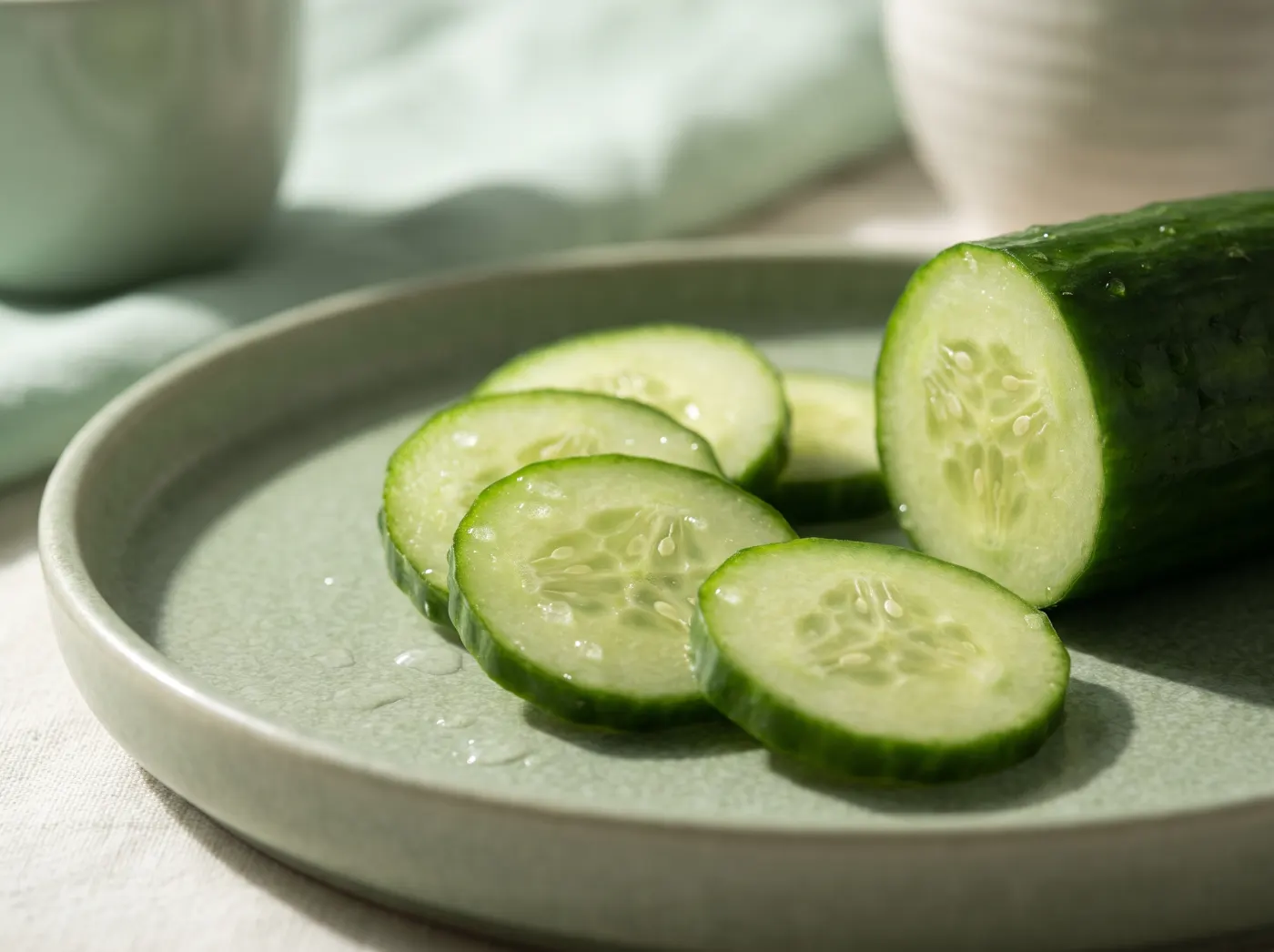
Fresh cucumber slices in macro view on a sage green ceramic surface

Cucumber extract at a glance

Entry from our cosmetic ingredient glossary. Regulatory data from the European Commission's CosIng database12 and Regulation (EC) 1223/20097, safety according to the CIR expert panel3. Copy the identifiers in one click for your files.

INCI name
CUCUMIS SATIVUS EXTRACTWhole plant extract1. Also exists as CUCUMIS SATIVUS FRUIT EXTRACT (fruit), with the same CAS and EC numbers2
Other names
Cucumber, cucumber extract
CAS number
89998-01-6
EC number
289-738-4
Botanical origin
Cucumis sativus L., CucurbitaceaeThe CosIng entries distinguish whole plant extract1 from fruit extract2: the part used is set in the specification
CosIng function
Skin conditioningThe fruit extract also declares the emollient function2
Standardization
No established markerNo reference active compound is established for the cosmetic extract in the sources consulted: the titer is set in the raw material specification
EU status
No restrictionNo annex listed in CosIng12; no mention of Cucumis in Annexes II and III of the consolidated text of 1 May 20257
Allergen to declare
Not listedAbsent from the fragrance allergen list of Regulation (EU) 2023/15458
Safety
Judged safe at use concentrationsCIR panel 2014: six cucumber-derived ingredients judged safe in current uses3

What the research says

Each result shows the protocol and the level of evidence. The higher the level, the better the result carries over to a finished formula.

Clinical trialReview or consensusLaboratory

SkinSkincare

Limited clinical evidence in the Cucumis genus

Review
2026 reviewCucumis genus (cucumber, melon and related species)In vitro, in vivo and clinical studies

More than 428 bioactive compounds are listed in the genus. The activities described rest on in vitro and in vivo studies and on limited clinical studies; the mechanisms remain poorly understood. The review covers the whole genus, not the cosmetic cucumber extract5.

An effect on melanin seen with leaves and stems

Laboratory
Methanolic extracts of six parts of the plantB16 mouse melanoma cells

Only the leaf and stem extracts slowed melanin production, by reducing tyrosinase expression without blocking the enzyme. Lutein is the active compound identified (IC50 of 170.7 µM). The fruit, the part commonly used in cosmetics, is not among the active extracts4.


Safety and allergyReviews

Judged safe by the CIR panel

Expert assessment
CIR panel 2014Six ingredients derived from Cucumis sativus

Safe in current uses and concentrations. Cucumber is a common food with no known notable adverse effect, and the assessment concerns skin exposure at low concentrations3.

An ingredient very common in facial wipes

Label analysis
178 facial wipes485 ingredients listed

Cucumis sativus appears in 20.2% of the wipes examined, among the plant-derived ingredients that can be allergenic. The study measures how often it is used on labels, not cases of allergy6.

This page summarizes published literature on a cosmetic ingredient. It does not describe the effect of a finished product, which depends on its formula, and it is not medical advice. For cucumber, the evidence is thin: we retained no controlled clinical trial on the cosmetic extract, and we say so rather than pad the list.

Which products use cucumber extract?

Our white label catalog includes 6 formulas with cucumber extract: the key active in 1 of them, a supporting ingredient in the others. Every category can be customized (formula, fragrance, packaging).

6Face

Key active in a soothing black seed cream; supporting active in eye care products, a BHA blemish care product and a retinol serum.

Cucumber, aloe vera, chamomile or centella asiatica?

Four plant extracts often combined in comfort care. They do not exclude each other.

CucumberAloe veraChamomileCentella asiatica
Botanical familyCucurbitaceae1AsphodelaceaeAsteraceaeApiaceae
Main roleSkin conditioning12Hydration and comfortSkin conditioning (flower extract)Soothing, hydration, comfort
Formulation watch pointFew clinical data on the extract5Aloin and anthraquinone content to controlCaution for people sensitized to AsteraceaeTriterpene content varies by extract
EU regulationNo restriction17No restrictionNo restrictionNo restriction

Frequently asked questions about cucumber extract

What is cucumber extract in cosmetics?
It is an extract of Cucumis sativus, a Cucurbitaceae, declared as CUCUMIS SATIVUS EXTRACT (whole plant) or FRUIT EXTRACT (fruit) in the ingredient list12. CosIng gives it the skin conditioning function1.
What are the benefits of cucumber for skin?
The evidence is thin. CosIng recognizes a skin conditioning role12 and the CIR judges it safe3, but we retained no controlled clinical trial on the cosmetic extract. The lab results on melanin concern leaves and stems, not the fruit4.

Is cucumber useful for the eye area?
It is present in several eye care products in our catalog, as a supporting active. None of the studies retained measures an effect of cucumber extract on dark circles or puffiness: the role of these formulas rests on the other actives, such as hyaluronic acid or caffeine.

What percentage of cucumber extract should you use?
The sources consulted give no usable extract concentration. The dose is set with the formulator, based on the raw material specification and the tolerance you are aiming for.
What can you pair cucumber extract with?
In our formulas, it is most often paired with panthenol, hyaluronic acid, centella asiatica, green tea and caffeine. These pairings are found mostly in eye care products. The stability of the final formula is checked with lab tests.
Is cucumber extract safe?
The CIR panel judges it safe in current uses3 and it appears in no European restriction annex127. It is very common in cosmetics, in up to 20.2% of the facial wipes examined6, which is why it shows up in lists of potentially allergenic ingredients. A tolerance test on the final formula remains the rule.
Can you manufacture a cucumber cream or eye care product for my brand?
Yes. Our ISO 22716 certified lab offers 6 cucumber formulas (soothing cream, eye care, face care) that you can customize, or a custom formula. Samples are free.

Sources

Peer-reviewed studies and official regulatory sources, checked on November 3, 2026.

  1. European Commission. CosIng, entry CUCUMIS SATIVUS EXTRACT (CAS 89998-01-6, EC 289-738-4). ec.europa.eu/growth/tools-databases/cosing
  2. European Commission. CosIng, entry CUCUMIS SATIVUS FRUIT EXTRACT (CAS 89998-01-6, EC 289-738-4). ec.europa.eu/growth/tools-databases/cosing
  3. Fiume MM, Bergfeld WF, Belsito DV, et al. Safety Assessment of Cucumis sativus (Cucumber)-Derived Ingredients as Used in Cosmetics. Int J Toxicol. 2014;33(2 suppl):47S-64S. doi:10.1177/1091581814526892
  4. Kai H, Baba M, Okuyama T. Inhibitory effect of Cucumis sativus on melanin production in melanoma B16 cells by downregulation of tyrosinase expression. Planta Med. 2008;74(15):1785-1788. doi:10.1055/s-0028-1088338
  5. El-Sayed HM, Mahrous EA, Rasheed DM, Abdel-Sattar E. Genus Cucumis: Traditional uses, phytochemistry, pharmacology, clinical application, and toxicology. Chin Herb Med. 2026;18(2):343-376. doi:10.1016/j.chmed.2026.02.005
  6. Aschenbeck KA, Warshaw EM. Allergenic Ingredients in Facial Wet Wipes. Dermatitis. 2017;28(6):353-359. doi:10.1097/der.0000000000000268
  7. European Parliament and Council. Regulation (EC) No 1223/2009 on cosmetic products, Annexes II and III, consolidated text of 1 May 2025. eur-lex.europa.eu
  8. European Commission. Règlement (UE) 2023/1545 amending Regulation (EC) 1223/2009 as regards the labeling of fragrance allergens. eur-lex.europa.eu
Carmel Cosmetics Labs product specialist with a brand founder

Tell us about your project

A product specialist reviews your request and gets back to you on the channel you prefer.

Lead EN – Demande de devis
Tell us about your project. A product specialist will get back to you shortly.
CONTACT INFORMATION
Name
PROJECT INFORMATION
Which cosmetics category interests you most?

By submitting this form, you agree to our terms of service and privacy policy.

No obligation. Your information stays confidential and is used only to prepare your quote.