Services

Torn between two services?A project manager will guide you

Catalog

Explore the full catalog1,000+ formulas ready to carry your brand

Face careFull range

Serums, creams and targeted care, formulated with your actives.

Body careFull range

Moisturizing, nourishing and shower care: cream, butter or oil.

Specialty careFull range

Sun care, lips, intimate care and oral care.

Men, baby, makeupFull range

Shaving and beard, baby and mom, makeup.

Industries

All solutions by industryFormulas and formats for your business

Our brands

Our own brands, developed and made in our laboratory.

Become a distributor of our brandsPharmacies, spas, shops and wholesalers

Laboratory

Cosmetics manufacturing room with a row of stainless-steel mixers and an operator in white workwearOur factory in Aït MelloulISO 22716 and ISO 9001, visits by appointmentDiscover the factory

Resources

Caffeine

Caffeine is an alkaloid of the methylxanthine family, used in cosmetics on the scalp and the eye area. In the lab, it stimulates the growth of cultured human hair follicles45. Clinically, a review of 9 trials (684 people) concludes in its favor, but with a moderate to very low level of evidence3.

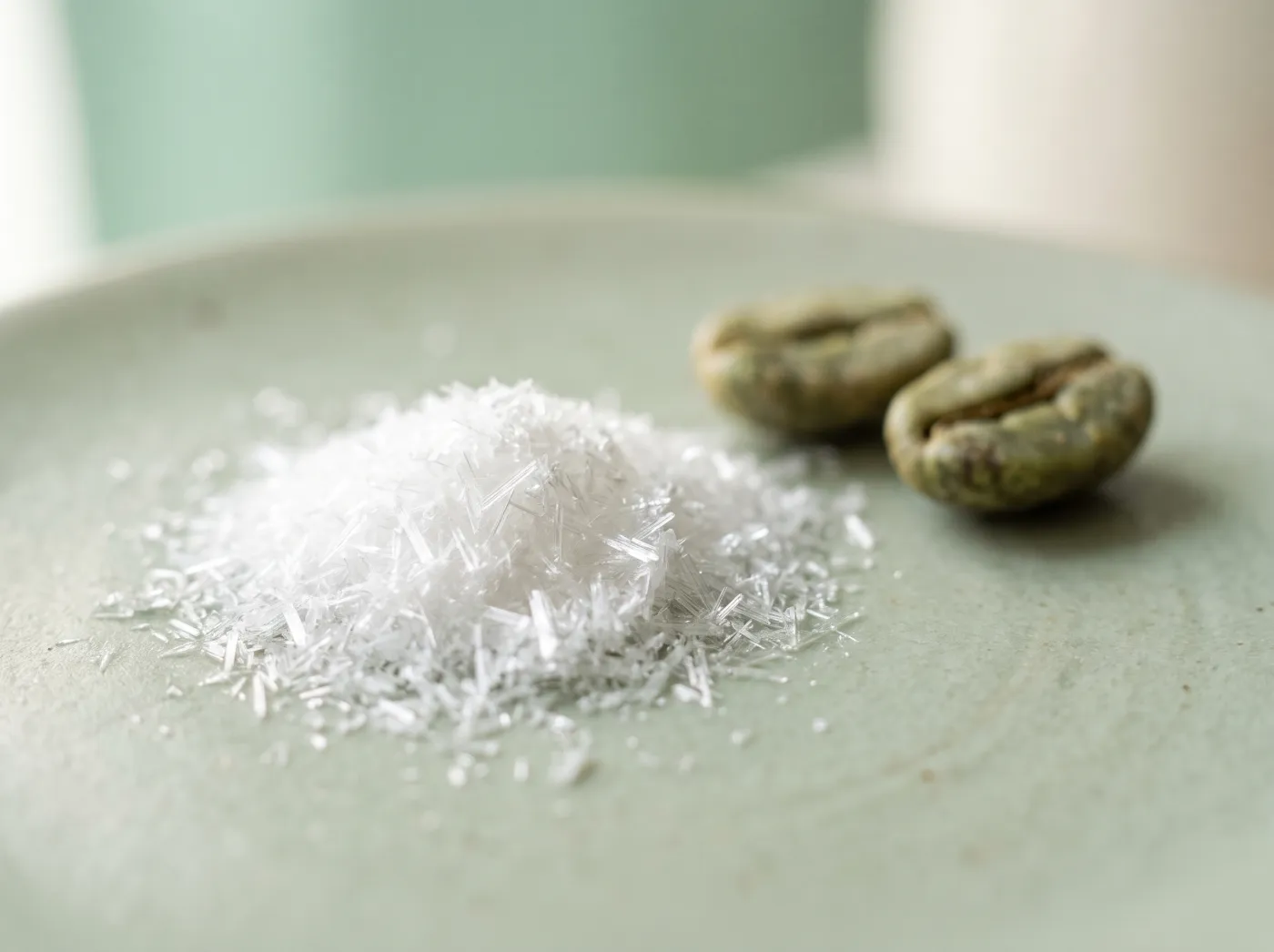
Fine needle-shaped caffeine crystals in macro view on a sage green ceramic surface

Caffeine at a glance

Entry from our cosmetic ingredient glossary. Regulatory data from the European Commission's CosIng database1, safety according to the CIR expert panel2. Copy the identifiers in one click for your files.

INCI name
CAFFEINE
Other names
Coffeinum, 1,3,7-trimethylxanthineEuropean Pharmacopoeia name: coffeinum1
CAS number
58-08-2
EC number
200-362-1
Formula
C₈H₁₀N₄O₂Molar mass 194.19 g/mol
CosIng function
Skin conditioning, perfuming"Skin conditioning" and "Perfuming" in the European nomenclature1
Appearance
White crystalline powderModerately soluble in water
EU status
No restrictionNot listed in the annexes of Regulation (EC) 1223/20091
Allergen to declare
No
Safety
Judged safe in cosmetics2024 CIR panel conclusion on methylxanthines, in the uses described2

What the research says

Each result shows the protocol and the level of evidence. The higher the level, the better the result carries over to a finished formula.

Clinical trialReview or consensusLaboratory

Scalp and hairHaircare

Nine clinical trials, fragile evidence

Review
2025 systematic review9 trials684 people

All the trials conclude in favor of caffeine on hair shedding or thinning, but the level of evidence is moderate for 3 trials, low for 1 and very low for 5. Many have no randomization, no placebo and no stated concentration. The authors call for better trials on well-defined products3.

Cultured follicles: growth stimulated

Laboratory
Cultured human folliclesCaffeine 0.001 to 0.005%In the presence of testosterone

Caffeine offsets the slowing of growth caused by testosterone4. It also lengthens the growth phase and stimulates the proliferation of hair matrix cells, with a stronger sensitivity in female follicles5.

Caffeine and adenosine shampoo

Clinical trial
Caffeine and adenosine shampoo3 months77 peopleComparison with baseline, no control group

Hair density increases and shedding decreases compared with baseline; hair diameter does not change significantly. 71.05% of participants say they are satisfied. Combination of two actives6.

DMG-Na and caffeine shampoo

Clinical trial
DMG-Na and caffeine shampoo24 weeks154 menDouble-blind, placebo-controlled

The number of hairs pulled out in the pull test drops by 2.8 on average, against a rise of 0.6 under placebo (p < 0.001). In 30 subjects, the phototrichogram shows more hairs, higher density and more hairs in the growth phase. Combination of two actives: the effect of caffeine alone is not isolated7.

Healthier-looking scalp, less hair shedding

Clinical trial
Shampoo and leave-on product24 weeksDouble-blind, placebo-controlled

A combination of niacinamide, panthenol, caffeine, piroctone olamine and zinc improved scalp condition and reduced hair shedding. The effect of caffeine on its own is not isolated8.


Eye areaSkincare

Eye area: limited evidence

Review
2024 reviewEye cream ingredients

The review ranks caffeine, with retinoids and vitamin C, among the promising ingredients for wrinkles and pigmentation spots in the periorbital area. It notes the absence of clinical trials specifically on eye creams and the wide variability of the studies10.

Diffusion of 2% caffeine in a cream

Laboratory
Creams with 2% caffeineFranz cells, synthetic membrane24 hours

Four formulated creams release more than 85% of the caffeine in 24 hours. With 2.5% dimethyl isosorbide and 2.5% ethoxydiglycol, diffusion exceeds that of three commercial creams: the formula influences how the active diffuses11.

Reviews and safetySyntheses

Mechanisms described by the reviews

Review
2013 review

The review describes a caffeine that crosses the skin barrier, present at 3% in common commercial topical formulas. It credits it with an action on lipolysis, antioxidant activity and stimulation of skin microcirculation: these are described mechanisms, not demonstrated effects on a finished product9.

Assessed as safe in cosmetics

Expert assessment
2024 CIR panelCaffeine, theobromine, theophylline

The panel judges caffeine safe in the practices and concentrations of use described in its assessment2.

This page summarizes published literature on a cosmetic ingredient. It does not describe the effect of a finished product, which depends on its formula, and it is not medical advice. For caffeine, clinical evidence is limited: few controlled trials, combinations of actives, concentrations often not stated, and several studies run or funded by manufacturers (indicated in the sources). We did not retain any controlled trial on dark circles or puffiness.

Concentrations used in studies

Commercial topical formulas most often contain 3% caffeine9; the creams tested for diffusion contain 2%11. Clinical trials on the scalp do not always state the concentration, which the review flags as a limit3. The final level is set with the formulator, depending on the format and the target.

Which products use caffeine?

Our white label catalog includes 13 formulas with caffeine: the key active in 2 of them, a supporting ingredient in the others. Every category can be customized (formula, fragrance, packaging).

7Face

Key active in the eye care product, also found in toners, scrubs and serums.

6Hair

Key active in the scalp scrub, also found in a shampoo.

In our formulas, it is most often paired with

Panthenol 10Vitamin E 7Licorice extract 5Niacinamide 5

Frequently asked questions about caffeine

What is caffeine in cosmetics?
It is an alkaloid of the methylxanthine family, declared as CAFFEINE on the label1. The CIR panel judges it safe in the cosmetic uses described2. It is used on the scalp and the eye area.
Does caffeine work for hair?
The evidence is limited. A review of 9 trials concludes in favor of caffeine, but with a moderate level of evidence for 3 trials, low for 1 and very low for 53. The best-designed trials test combinations of actives78: the effect of caffeine alone is not isolated.
Is caffeine useful for the eye area?
A review ranks it among the promising ingredients for the periorbital area, but notes the absence of clinical trials specifically on eye creams10. We did not retain any controlled trial on dark circles or puffiness.
What percentage of caffeine should you use?
Commercial topical formulas most often contain 3%9. Clinical trials on the scalp rarely state the concentration3. The dose is decided with the formulator, depending on the format and the target.
What should you pair caffeine with?
The trials cited combine it with adenosine6, DMG-Na7, or niacinamide, panthenol, piroctone olamine and zinc8. In our formulas, it is most often paired with panthenol, vitamin E, niacinamide, licorice extract and argan oil. The stability of the final formula is checked through lab testing.


Is caffeine safe in skincare?
The CIR panel judges it safe in the practices and concentrations of use described2 and it is not restricted in the EU1. During pregnancy, as with any skincare product, a healthcare professional's advice remains the rule.
Can you manufacture a caffeine product for my brand?
Yes. Our ISO 22716 certified lab offers 13 caffeine formulas (eye care, scalp scrubs, body care) that you can customize, or a custom formula. Samples are free.

Sources

Peer-reviewed studies and official regulatory sources, checked on November 2, 2026.

  1. European Commission. CosIng, entry CAFFEINE (CAS 58-08-2, EC 200-362-1). ec.europa.eu/growth/tools-databases/cosing
  2. Cherian PA, Bergfeld WF, Belsito DV, et al. Safety Assessment of Methylxanthines as Used in Cosmetics. Int J Toxicol. 2024;43(4 suppl):42-77. doi:10.1177/10915818241260282
  3. Szendzielorz E, Spiewak R. Caffeine as an Active Ingredient in Cosmetic Preparations Against Hair Loss: A Systematic Review of Available Clinical Evidence. Healthcare (Basel). 2025;13(4):395. doi:10.3390/healthcare13040395
  4. Fischer TW, Hipler UC, Elsner P. Effect of caffeine and testosterone on the proliferation of human hair follicles in vitro. Int J Dermatol. 2007;46(1):27-35. doi:10.1111/j.1365-4632.2007.03119.x
  5. Fischer TW, Herczeg-Lisztes E, Funk W, et al. Differential effects of caffeine on hair shaft elongation, matrix and outer root sheath keratinocyte proliferation, and transforming growth factor-β2/insulin-like growth factor-1-mediated regulation of the hair cycle in male and female human hair follicles in vitro. Br J Dermatol. 2014;171(5):1031-1043. doi:10.1111/bjd.13114
  6. Chen D, Yu F, Wang C, et al. Anti-hair loss effect of a shampoo containing caffeine and adenosine. J Cosmet Dermatol. 2024;23(9):2927-2933. doi:10.1111/jocd.16347Dingmageili Biotechnology
  7. Celleno L, Bussoletti C, Tolaini MV, et al. A Novel Approach Against Male Pattern Hair Loss With Topical Dimethylglycine Sodium Salt (DMG-Na) and Caffeine: Efficacy of a 24-Week, Double-Blind, Randomized, Placebo-Controlled Trial. J Cosmet Dermatol. 2025;24(8):e70390. doi:10.1111/jocd.70390Dr. Kurt Wolff
  8. Davis MG, Piliang MP, Bergfeld WF, et al. Scalp application of antioxidants improves scalp condition and reduces hair shedding in a 24-week randomized, double-blind, placebo-controlled clinical trial. Int J Cosmet Sci. 2021;43 Suppl 1:S14-S25. doi:10.1111/ics.12734Procter & Gamble
  9. Herman A, Herman AP. Caffeine's mechanisms of action and its cosmetic use. Skin Pharmacol Physiol. 2013;26(1):8-14. doi:10.1159/000343174
  10. Hamie H, Yassine R, Shoukfeh R, et al. A review of the efficacy of popular eye cream ingredients. Int J Womens Dermatol. 2024;10(2):e156. doi:10.1097/JW9.0000000000000156
  11. Reyes R, Abou-Dahech MS, Nguyen NG, et al. Skin penetration of caffeine from commercial eye creams and eye creams designed and optimized based on Hansen solubility parameters. Int J Pharm. 2023;639:122973. doi:10.1016/j.ijpharm.2023.122973
Carmel Cosmetics Labs product specialist with a brand founder

Tell us about your project

A product specialist reviews your request and gets back to you on the channel you prefer.

Lead EN – Demande de devis
Tell us about your project. A product specialist will get back to you shortly.
CONTACT INFORMATION
Name
PROJECT INFORMATION
Which cosmetics category interests you most?

By submitting this form, you agree to our terms of service and privacy policy.

No obligation. Your information stays confidential and is used only to prepare your quote.