












































Services

Torn between two services?A project manager will guide you

Catalog

Explore the full catalog1,000+ formulas ready to carry your brand

Face careFull range

Serums, creams and targeted care, formulated with your actives.

Body careFull range

Moisturizing, nourishing and shower care: cream, butter or oil.

Specialty careFull range

Sun care, lips, intimate care and oral care.

Men, baby, makeupFull range

Shaving and beard, baby and mom, makeup.

Industries

All solutions by industryFormulas and formats for your business

Laboratory

Cosmetics manufacturing room with a row of stainless-steel mixers and an operator in white workwearOur factory in Aït MelloulISO 22716 and ISO 9001, visits by appointmentDiscover the factory

Resources

Licorice root extract (Glycyrrhiza glabra)

Licorice root extract (Glycyrrhiza glabra) is declared in cosmetics as a skin conditioning and bleaching agent12. Its glabridin slows tyrosinase in the lab35, but the clinical trials test combinations8. Contact allergies are rare and documented by isolated cases121314.

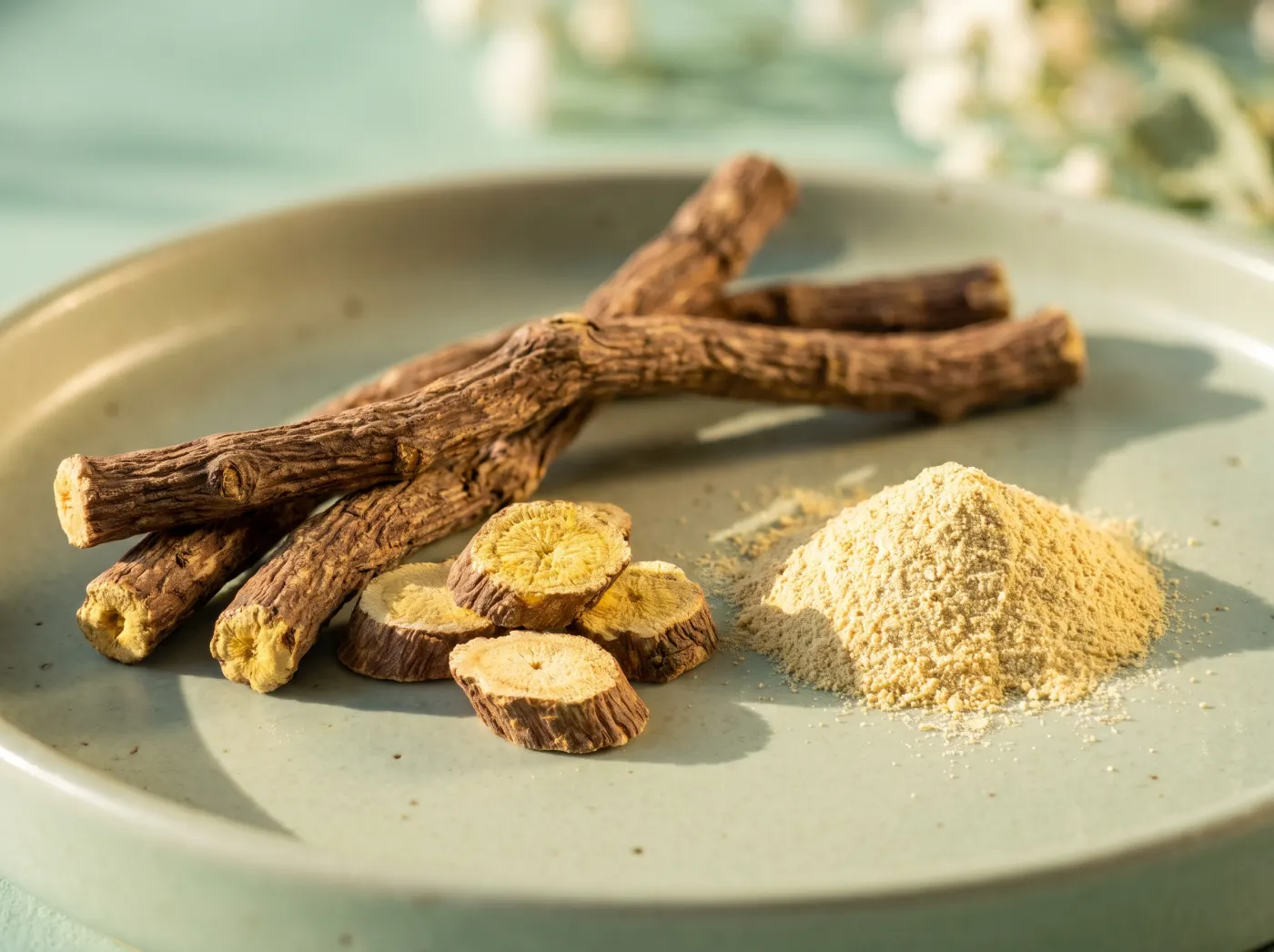
Dried licorice roots in macro view on a sage green ceramic surface

Licorice root extract at a glance

Entry from our cosmetic ingredient glossary. Regulatory data from the European Commission's CosIng database12 and Regulation (EC) 1223/200916. Copy the identifiers in one click for your files.

INCI name
GLYCYRRHIZA GLABRA ROOT EXTRACTAlso exists as GLYCYRRHIZA GLABRA RHIZOME/ROOT EXTRACT (roots and rhizomes), with the same CAS and EC numbers12
Other names
Licorice, licorice root, licorice root extract
CAS number
84775-66-6
EC number
283-895-2
Botanical origin
Glycyrrhiza glabra L., FabaceaeRoot extract for the main CosIng entry1; root and rhizome extract for the second2. Chinese licorice (G. uralensis) and G. inflata are other species
Compounds of interest
Glabridin, liquiritin, glycyrrhizic acidSeven compounds identified in an ethanolic extract: liquiritin, isoliquiritin, liquiritigenin, isoliquiritigenin, glycyrrhizic acid, 18β-glycyrrhetinic acid and glabridin5. Glabridin, a prenylated isoflavonoid from the root, is the chemical marker of G. glabra6
CosIng functions
Skin conditioning, smoothing, soothing, bleachingFunctions declared for the root extract, including "bleaching" (skin lightening) and "soothing"1. The root/rhizome entry declares skin conditioning only2
Standardization
Varies by extractA Romanian methanolic extract contains 13.9 mg/g of glycyrrhizin, the most abundant of ten compounds quantified10. The glabridin content is set in the raw material specification
EU status
No restrictionNo annex listed in CosIng12; no mention of Glycyrrhiza in Annexes II and III of the consolidated text of 1 May 202516
Allergen to declare
Not listedAbsent from the fragrance allergen list of Regulation (EU) 2023/154517. An added fragrance may contain some
Safety
Extract not assessed by the CIRThe CIR panel assessed isolated licorice molecules (glycyrrhetinic acid, glycyrrhizates), not the plant extract11

What the research says

Each result shows the protocol and the level of evidence. The higher the level, the better the result carries over to a finished formula.

Clinical trialReview or consensusLaboratory

FaceSkin tone and dark spots

Glabridin slows pigmentation in the lab

Laboratory
Glabridin, a licorice componentB16 mouse melanoma cells and guinea pig skin0.5% glabridin applied to the skin

Glabridin reduces tyrosinase activity in B16 cells at 0.1-1.0 µg/ml, with no detectable effect on their DNA synthesis. In guinea pigs, it limits the pigmentation and redness induced by UVB. Study by a cosmetics manufacturer, on the isolated molecule3.

Clear inhibition of the enzyme, but not in every model

Laboratory
Isolated glabridinTyrosinase, spectroscopy and zebrafishMolecular modeling

Glabridin inhibits tyrosinase reversibly (IC50 of 0.43 µmol/L). In the zebrafish model, it did not change melanin synthesis and proved toxic to the embryo: the in vitro result does not transfer as is4.

Glabridin, the most active component of a root extract

Laboratory
80% ethanolic extract of G. glabraB16F10 cells and in vivo modelMelanin and tyrosinase

The 80% ethanolic extract is the most active of the extracts tested. Of seven compounds identified, glabridin is the most potent and reduces the activity of the MITF factor, which controls the pigmentation enzymes5.

A licorice combination compared with 2% hydroquinone

Clinical trial
Cream combining emblica, licorice and belides60 days, 56 women (50 completed)Versus 2% hydroquinone, facial dark spots

No statistical difference between the two groups on the improvement of dark spots. The combination caused fewer mild side effects (2 volunteers versus 7). The trial tests a combination, not licorice alone8.

Few trials, short durations

Review
2018 systematic review30 clinical studies13 natural ingredients

Licorice extracts are among the agents that show a depigmenting effect. The authors stress the small number of trials, their short duration and the lack of long-term data7.

Eye area: glabridin is cited, but is not the best documented

Review
2020 reviewPigmentation of the eye areaNatural actives

Glabridin is among the natural actives reported as beneficial. The authors mainly retain alpha-arbutin, caffeine, cyanidin-3-glucoside and dihydrochalcone, and judge combinations of actives more effective than a single active9.

Safety and allergyReviews and cases

Licorice molecules judged safe, not the extract

Expert assessment
CIR panel 2007Glycyrrhetinic acid, glycyrrhizates and derivatives

These isolated molecules are judged safe at use concentrations; glycyrrhetinic acid up to 6% was neither irritating nor sensitizing in clinical tests. The report states that it does not cover plant extracts and asks to limit pesticides and toxic metals in the raw material11.

A few cases of contact allergy, rare

Case reports
Cases published between 1999 and 2021Licorice extracts in cosmetics

Contact allergies to a licorice extract in a cosmetic are described1213. A chromatography analysis points to licorice flavonoids14. The 2021 case involves Glycyrrhiza inflata, another species15. These isolated cases give no frequency.

An extract well tolerated in the hen's egg test, metals below the limit

Laboratory
Methanolic root extract (Romania)HET-CAM testMetal analysis

The HET-CAM test showed no irritation. Lead, cadmium, arsenic, nickel and cobalt stayed below the detection limit. A lab test on a single extract, which does not predict the tolerance of a cream10.

Glabridin, marker of European licorice

Review
2013 reviewPhytochemistry and biological activities

Glabridin is the chemical marker of G. glabra. It is mainly studied for its antioxidant effects; the review also notes an estrogen-like activity, a point to monitor in formulation6.

This page summarizes published literature on a cosmetic ingredient. It does not describe the effect of a finished product, which depends on its formula, and it is not medical advice. Licorice is also used in herbal medicine and food: only the cosmetic aspects are covered here. Clinical trials almost always test combinations or isolated glabridin, which is stated each time.

Which products use licorice root extract?

Our white label catalog includes 24 formulas with licorice root extract: the key active in 4 of them, a supporting ingredient in the others. Every category can be customized (formula, fragrance, packaging).

18Face

Key active in a face scrub and a brightening eye serum; supporting active in serums, cleansers, creams, masks and toners designed for dark spots and skin tone.

6Body

Key active in a salt scrub and an intimate musk; also present in an intimate gel, a body lotion, a creamy scrub and a tinted sun serum.

In our formulas, it is most often paired with

Panthenol 14Niacinamide 11Vitamin E 10Hyaluronic acid 8Vitamin C 7

Licorice, niacinamide, kojic acid or alpha-arbutin?

Four actives often combined in skin tone and dark spot care. They do not exclude each other.

Licorice root extractNiacinamideKojic acidAlpha-arbutin
OriginLicorice root, plant extract1Amide form of vitamin B3Metabolite of fungal originSynthetic molecule
Evidence cited hereLab studies and a trial on a combination38Clinical trials, see its pageClinical trials, see its pageClinical trials, see its page
Formulation watch pointGlabridin content varies by extract10; rare cases of allergy1213Stable, well documentedDose limited by regulationDose limited by regulation
EU regulationNo restriction116No restrictionAnnex III, 1% maximum (face and hands)Annex III, 2% (face) and 0.5% (body)

Frequently asked questions about licorice root extract

What is licorice root extract?
It is an extract of the root of Glycyrrhiza glabra, a Fabaceae, declared as GLYCYRRHIZA GLABRA ROOT EXTRACT (or ROOT/RHIZOME EXTRACT when rhizomes are included)12. Its chemical marker is glabridin6. The composition varies with the solvent and the extraction method10.
What are the benefits of licorice extract for skin?
In cosmetics, licorice is mostly studied for skin tone and dark spots. In the lab, glabridin slows tyrosinase345. In humans, the trials test combinations8, and a 2018 review notes few trials of short duration7. CosIng also recognizes a soothing role1.
What is glabridin?
It is a prenylated isoflavonoid from the root of Glycyrrhiza glabra, used as a marker of the species6. It is the most potent of the compounds tested in an ethanolic extract for slowing pigmentation in the lab5. Its content in an extract varies: it is set in the raw material specification.
What percentage of licorice extract should you use?
The studies cited give no usable extract concentration: they test isolated glabridin (0.5% in guinea pigs3) or a combination8. The dose is set with the formulator, based on the extract's titer.
What can you pair licorice extract with?
In our formulas, it is most often paired with panthenol, niacinamide, vitamin E, hyaluronic acid and vitamin C. Niacinamide appears with it in the salt scrub and in the dark spot cleansing gel. The stability of the final formula is checked with lab tests.
Is licorice extract safe?
EU regulation sets no restriction116, but the CIR has not assessed the extract itself, only isolated molecules11. Contact allergies to licorice extracts in cosmetics are reported, and are rare121314. A supplier analysis and a tolerance test on the final formula are still recommended.
Is licorice a skin lightener?
CosIng lists the "bleaching" function (skin lightening) for the root extract1. It acts on the look of dark spots by slowing pigmentation in the lab35, without the speed or scale of a regulated active such as kojic acid, limited to 1%. No quantified result is available for the extract alone.
Can you manufacture a licorice serum or scrub for my brand?
Yes. Our ISO 22716 certified lab offers 24 licorice extract formulas (serums, scrubs, cleansers, creams, masks, body care) that you can customize, or a custom formula. Samples are free.

Sources

Peer-reviewed studies and official regulatory sources, checked on November 3, 2026.

  1. European Commission. CosIng, entry GLYCYRRHIZA GLABRA ROOT EXTRACT (CAS 84775-66-6, EC 283-895-2). ec.europa.eu/growth/tools-databases/cosing
  2. European Commission. CosIng, entry GLYCYRRHIZA GLABRA RHIZOME/ROOT EXTRACT (CAS 84775-66-6, EC 283-895-2). ec.europa.eu/growth/tools-databases/cosing
  3. Yokota T, Nishio H, Kubota Y, Mizoguchi M. The inhibitory effect of glabridin from licorice extracts on melanogenesis and inflammation. Pigment Cell Res. 1998;11(6):355-361. doi:10.1111/j.1600-0749.1998.tb00494.xKanebo
  4. Chen J, Yu X, Huang Y. Inhibitory mechanisms of glabridin on tyrosinase. Spectrochim Acta A Mol Biomol Spectrosc. 2016;168:111-117. doi:10.1016/j.saa.2016.06.008
  5. Liu J, Xu X, Jian M, et al. Glycyrrhiza glabra extract as a skin-whitening Agent: Identification of active components and CRTC1/MITF pathway-inhibition mechanism. J Ethnopharmacol. 2025;349:119948. doi:10.1016/j.jep.2025.119948
  6. Simmler C, Pauli GF, Chen SN. Phytochemistry and biological properties of glabridin. Fitoterapia. 2013;90:160-184. doi:10.1016/j.fitote.2013.07.003
  7. Hollinger JC, Angra K, Halder RM. Are Natural Ingredients Effective in the Management of Hyperpigmentation? A Systematic Review. J Clin Aesthet Dermatol. 2018;11(2):28-37. PMID 29552273
  8. Costa A, Moisés TA, Cordero T, Alves CR, Marmirori J. Association of emblica, licorice and belides as an alternative to hydroquinone in the clinical treatment of melasma. An Bras Dermatol. 2010;85(5):613-620. doi:10.1590/s0365-05962010000500003
  9. Sawant O, Khan T. Management of periorbital hyperpigmentation: An overview of nature-based agents and alternative approaches. Dermatol Ther. 2020;33(4):e13717. doi:10.1111/dth.13717
  10. Semenescu I, Avram S, Similie D, et al. Phytochemical, Antioxidant, Antimicrobial and Safety Profile of Glycyrrhiza glabra L. Extract Obtained from Romania. Plants (Basel). 2024;13(23):3265. doi:10.3390/plants13233265
  11. Cosmetic Ingredient Review Expert Panel. Final report on the safety assessment of Glycyrrhetinic Acid, Potassium Glycyrrhetinate, Disodium Succinoyl Glycyrrhetinate, Glyceryl Glycyrrhetinate, Glycyrrhetinyl Stearate, Stearyl Glycyrrhetinate, Glycyrrhizic Acid, Ammonium Glycyrrhizate, Dipotassium Glycyrrhizate, Disodium Glycyrrhizate, Trisodium Glycyrrhizate, Methyl Glycyrrhizate, and Potassium Glycyrrhizinate. Int J Toxicol. 2007;26 Suppl 2:79-112. doi:10.1080/10915810701351228
  12. O'Connell RL, White IR, White JM, McFadden JP. Liquorice extract in a cosmetic product causing contact allergy. Contact Dermatitis. 2008;59(1):52. doi:10.1111/j.1600-0536.2008.01339.x
  13. Nishioka K, Seguchi T. Contact allergy due to oil-soluble licorice extracts in cosmetic products. Contact Dermatitis. 1999;40(1):56. doi:10.1111/j.1600-0536.1999.tb05986.x
  14. Kanoh H, Banno Y, Nakamura M, Seishima M. Contact allergy to liquorice flavonoids: analysis with liquid chromatography-mass spectrometry. Contact Dermatitis. 2016;74(3):191-192. doi:10.1111/cod.12511
  15. Gatica-Ortega ME, Pastor-Nieto MA. Allergic contact dermatitis to Glycyrrhiza inflata root extract in an anti-acne cosmetic product. Contact Dermatitis. 2021;85(4):454-455. doi:10.1111/cod.13872
  16. European Parliament and Council. Regulation (EC) No 1223/2009 on cosmetic products, Annexes II and III, consolidated text of 1 May 2025. eur-lex.europa.eu
  17. European Commission. Règlement (UE) 2023/1545 amending Regulation (EC) 1223/2009 as regards the labeling of fragrance allergens. eur-lex.europa.eu
Carmel Cosmetics Labs product specialist with a brand founder

Tell us about your project

A product specialist reviews your request and gets back to you on the channel you prefer.

Lead EN – Demande de devis
Tell us about your project. A product specialist will get back to you shortly.
CONTACT INFORMATION
Name
PROJECT INFORMATION
Which cosmetics category interests you most?

By submitting this form, you agree to our terms of service and privacy policy.

No obligation. Your information stays confidential and is used only to prepare your quote.