






PDRN (polydeoxyribonucleotide) is a mixture of DNA fragments, most often extracted from salmon or trout milt, and increasingly from plants. In cosmetics, it appears on the label under the INCI name “Sodium DNA”. The available trials are encouraging but small, and most concern injected PDRN, not serums.
Key takeaways
- PDRN is fragmented, purified DNA: historically an injectable drug, now also a K-beauty skincare active.
- On an INCI list, look for “Sodium DNA” (official function: skin conditioning).
- A 2026 systematic review found only 7 randomized trials and 183 participants: the evidence remains limited.
- A PDRN cosmetic cannot promise to “regenerate” or “heal”: those are medical claims.
- Plant-based and fermentation-derived versions exist for vegan brands.
What exactly is PDRN?
PDRN is a mixture of deoxyribonucleotides, meaning DNA fragments of varying lengths, obtained by extraction and then purification. Its original form is a drug, described in the review by Squadrito et al. (Frontiers in Pharmacology, 2017) as DNA derived from the milt of rainbow trout (Oncorhynchus mykiss) or chum salmon (Oncorhynchus keta), with molecular weights between 50 and 1,500 kDa.
Hence its nickname “salmon DNA” in the beauty press.
The kilodalton (kDa) is the unit of mass used for large molecules: the higher the number, the longer the DNA fragments. This parameter changes how the active behaves in the formula and on the skin.
What is the difference between PDRN and polynucleotides (PN)?
PDRN and polynucleotides belong to the same family of fragmented DNA; only chain length sets them apart. A review published in 2025 in Pharmaceutics proposes reserving the term PDRN for fragments under 1,500 kDa and the term PN for chains of 1,500 kDa or more.
This boundary is not yet an official standard. So always ask the supplier for the molecular weight distribution rather than relying on the trade name.
| Criterion | Short fragments | Polynucleotides (PN) |
|---|---|---|
| Nature | Purified DNA fragments | Purified DNA fragments |
| Size (2025 proposal) | < 1,500 kDa | ≥ 1,500 kDa |
| Original use | Injectable drug | Injectable devices in aesthetic medicine |
| Cosmetic use | Serums, creams, masks, patches | Rarer in topicals, often in combination |
| Common INCI name | Sodium DNA | Sodium DNA (depending on supplier) |
PDRN benefits: what does the science really prove?
PDRN’s benefits are documented in certain medical contexts, but the evidence in cosmetics remains thin. The systematic review published in Cureus in 2026 included only 7 randomized trials with 183 participants in total, covering skin rejuvenation, scar prevention and wound healing.
The authors consider the potential promising, especially for wounds, but point to small sample sizes and heterogeneous protocols. A 2026 narrative review on post-procedure recovery reaches the same conclusion.
On the topical side, a study published in PLOS ONE in July 2026 offers a more direct signal. Randomized, double-blind and split-face, it compared, in 31 women, an eye-contour cream with 0.1% medium-length fragmented DNA against a 0.1% retinol cream on the same base, over 4 weeks. The authors report roughly twice the improvement in crow’s feet wrinkles and dermal thickness with the tested active, backed by measured penetration.
These are still the results of a single, short study on a small group. As for the “PDRN before and after” photos on social media, often taken after injectable procedures, they prove nothing about a product applied to the skin surface.
How does PDRN work, according to research?
The pharmacological literature describes two mechanisms. First, the active stimulates adenosine A2A receptors: in the work cited by Squadrito et al., its effects disappear when this receptor is blocked by an antagonist. Second, its breakdown supplies nucleosides and nucleotides that cells recycle through the “salvage pathway”.
The salvage pathway is the route by which a cell reuses ready-made base fragments to build its DNA instead of synthesizing them from scratch. These mechanisms have mainly been studied as injections, gels or eye drops, in a medical setting.
For a formulator, a mechanism shown in pharmacology does not automatically carry over to a serum: everything depends on how much active actually reaches the skin.
Does a PDRN serum work like an injection?
No: an injection and a serum fall under different legal frameworks and different levels of evidence. An injection delivers the active directly into the dermis, under a doctor’s responsibility, whereas a serum must first cross the skin barrier.
Regulation (EC) No 1223/2009 defines a cosmetic product as a substance intended to be placed in contact with the external parts of the body, to clean, perfume, change their appearance, protect them or keep them in good condition. Anything injected is therefore, by definition, outside the scope of cosmetics.
| Injectable route | Cosmetic product | |
|---|---|---|
| Framework | Drug or medical device | Regulation (EC) 1223/2009 |
| Who administers it | Doctor | The user, at home |
| Route | Intradermal, subcutaneous, intramuscular | Applied to the skin |
| Available evidence | Clinical trials, mostly in wound healing | A few short trials, often sponsored or small |
| Permitted claims | Depending on the product’s authorization | Appearance, hydration, comfort, look of wrinkles if proven |
That is also why brands developing a dermocosmetic range for post-procedure care must talk about comfort and appearance, never medical recovery.
Under what INCI name does PDRN appear on the label?
On an ingredient list, this active most often appears under the INCI name “Sodium DNA”, the sodium salt of deoxyribonucleic acid. The EU cosmetic ingredients database assigns it a single function, “skin conditioning”, meaning keeping the skin in good condition, as the entry on Cosmile Europe.
The INCI name is the standardized international name of a cosmetic ingredient, mandatory on packaging in the European Union. Note: “Sodium DNA” says nothing about origin (fish, another animal or an alternative process), nor about molecular weight. Only the supplier dossier specifies it. To go further on active ingredient names, see also our pick of trending cosmetic ingredients for 2026.
What does “ppm” on bottles mean?
ppm (parts per million) expresses a concentration: 10,000 ppm equals 1%, i.e. 1 gram of active per 100 grams of product. A “1,000 ppm” serum therefore contains 0.1% active, the concentration used in the PLOS ONE study cited above.
But this figure means nothing without the molecular weight, the purity of the raw material and the formulation system, and it proves no efficacy.
Salmon PDRN or plant PDRN: which should your brand choose?
The choice between salmon PDRN and a plant version depends first on your positioning: an animal-derived active rules out any vegan claim. Non-marine alternatives are growing fast: according to a GreyB patent analysis, 73 of the 223 innovations filed on this active over twelve months, roughly a third, claim a non-marine source (plants, microbial fermentation or recombinant synthesis).
On the data side, a study published in the International Journal of Molecular Sciences in 2025 tested a low-molecular-weight fragmented DNA derived from peony (Paeonia lactiflora). After four weeks of topical application, the authors report faster skin barrier recovery and eye-area elasticity improved by about 4.25%. Here again, it is a single study.
If your brand is weighing up natural, biotech or synthetic actives more broadly, remember that “plant-based” does not mean “equivalent”: each source has its own body of evidence.
Which claims are allowed for a PDRN cosmetic in the EU?
A cosmetic based on fragmented DNA can claim proven cosmetic effects (hydration, comfort, appearance of fine lines), but never a therapeutic action. Regulation (EU) No 655/2013 sets six common criteria for every claim: legal compliance, truthfulness, evidential support, honesty, fairness and informed decision-making.
In practice, wording such as “repairs DNA”, “regenerates tissue”, “heals” or “injection effect” exposes the brand to reclassification as a drug or to a product withdrawal. For the full framework, read our guide to cosmetic claims regulation in the EU. In Morocco, apply the same caution and have the dossier validated before any market launch.
| Avoid | Possible wording (if proven by your tests) |
|---|---|
| Regenerates the skin | Visibly smoother skin after 4 weeks |
| Repairs cellular DNA | Contains Sodium DNA, a skin-conditioning active |
| Heals after an aesthetic procedure | Brings comfort and hydration to sensitized skin |
| Injection effect | Helps reduce the appearance of fine lines |
The manufacturer’s view: how to build PDRN into a formula
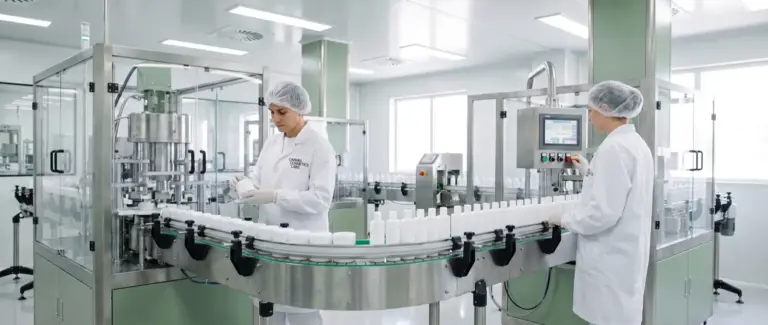
Adding this active to a range is first a matter of specifications and evidence, before it is a matter of dosage. At Carmel Cosmetics Labs, an ISO 22716 and ISO 9001 certified lab that has supported 500+ brands in 35+ countries, we follow this process for every new trending active:
- Set the positioning : vegan or not, target market (EU, Morocco, export), product type (serum, cream, eye patches).
- Choose the raw material : origin, molecular weight distribution, purity, certificate of analysis and supplier safety data.
- Formulate : pH, compatibility with other actives, preservative system and texture suited to a water-soluble active.
- Validate : stability and packaging compatibility tests, then the safety assessment required by Regulation 1223/2009 (read how to test the quality of your cosmetic products).
- Write the claims : only those that tests on the finished product can support.
- Produce : white label launch with an accessible MOQ.
The most visible mistakes on product pages in the market: a ppm dosage without molecular weight, an “injection effect” promise and a vegan claim on a salmon-derived active. All of them can be fixed at the formulation brief stage.
For a solid brief from the start, rely on our method for writing a cosmetic product specification. And if you want to launch a white label PDRN serum, we can explore a marine or plant-based formula.
Frequently asked questions
Is PDRN really made from salmon sperm?
Yes, for the original form. The pharmaceutical version is extracted from milt, that is, the semen of rainbow trout or chum salmon, because it provides very pure DNA. The active is then purified and fragmented: the finished product contains no identifiable fish cells or proteins. Plant-based and fermentation-derived versions also exist.
Is PDRN compatible with a routine containing retinol or vitamin C?
No major chemical incompatibility with these actives is documented in the literature reviewed. In practice, PDRN is water-soluble and fits well in an aqueous serum. In the 2026 PLOS ONE study, it was compared with retinol, not combined with it. For sensitive skin, introduce one new active at a time and watch tolerance.
Is PDRN suitable for sensitive or acne-prone skin?
Published studies report good tolerance, with no serious adverse effects in the randomized trials reviewed in 2026. That does not guarantee the tolerance of a specific formula: preservatives, fragrance and other actives matter as much as the fragmented DNA. For a product aimed at reactive skin, the brand must rely on its own tolerance tests on the finished product.
Can a PDRN cosmetic be certified organic or vegan?
DNA extracted from salmon is animal-derived: it is incompatible with a vegan claim. A vegan range needs a plant or fermentation source, with traceability documented by the supplier. For organic certification, eligibility depends on the chosen standard and on how the ingredient is obtained, to be checked case by case with the certification body.
How long does it take to see results?
The available topical studies last four weeks, with twice-daily application. No solid data supports promising a faster result. A brand that communicates a timeframe must back it with an efficacy test on its own product, with a described method and panel, to meet the evidential support criterion of Regulation 655/2013.
PDRN: what to remember before launching your product
PDRN is an active that comes from pharmacology, and its cosmetic use still rests on a small number of studies. Well chosen (origin, molecular weight, purity) and well formulated, it can support hydration and skin-appearance claims, provided it stays strictly within the cosmetic framework.
Want to test this active in your range? Free consultation for your white label PDRN formula : we will explore the marine or plant option with you, the claims dossier and a first run with an accessible MOQ, from our manufacturing site in Agadir.