











































Services

Torn between two services?A project manager will guide you

Catalog

Explore the full catalog1,000+ formulas ready to carry your brand

Face careFull range

Serums, creams and targeted care, formulated with your actives.

Body careFull range

Moisturizing, nourishing and shower care: cream, butter or oil.

Specialty careFull range

Sun care, lips, intimate care and oral care.

Men, baby, makeupFull range

Shaving and beard, baby and mom, makeup.

Industries

All solutions by industryFormulas and formats for your business

Our brands

Our own brands, developed and made in our laboratory.

Become a distributor of our brandsPharmacies, spas, shops and wholesalers

Laboratory

Cosmetics manufacturing room with a row of stainless-steel mixers and an operator in white workwearOur factory in Aït MelloulISO 22716 and ISO 9001, visits by appointmentDiscover the factory

Resources

Sage extract (Salvia officinalis)

Common sage (Salvia officinalis), a Lamiaceae, provides a leaf extract declared in cosmetics as a skin conditioning, tonic and antiseborrheic agent1. The 2026 CIR panel judges leaf- and oil-derived ingredients safe if formulated to avoid sensitization5. Some terpenes, including the thujone of the essential oil, call for vigilance910.
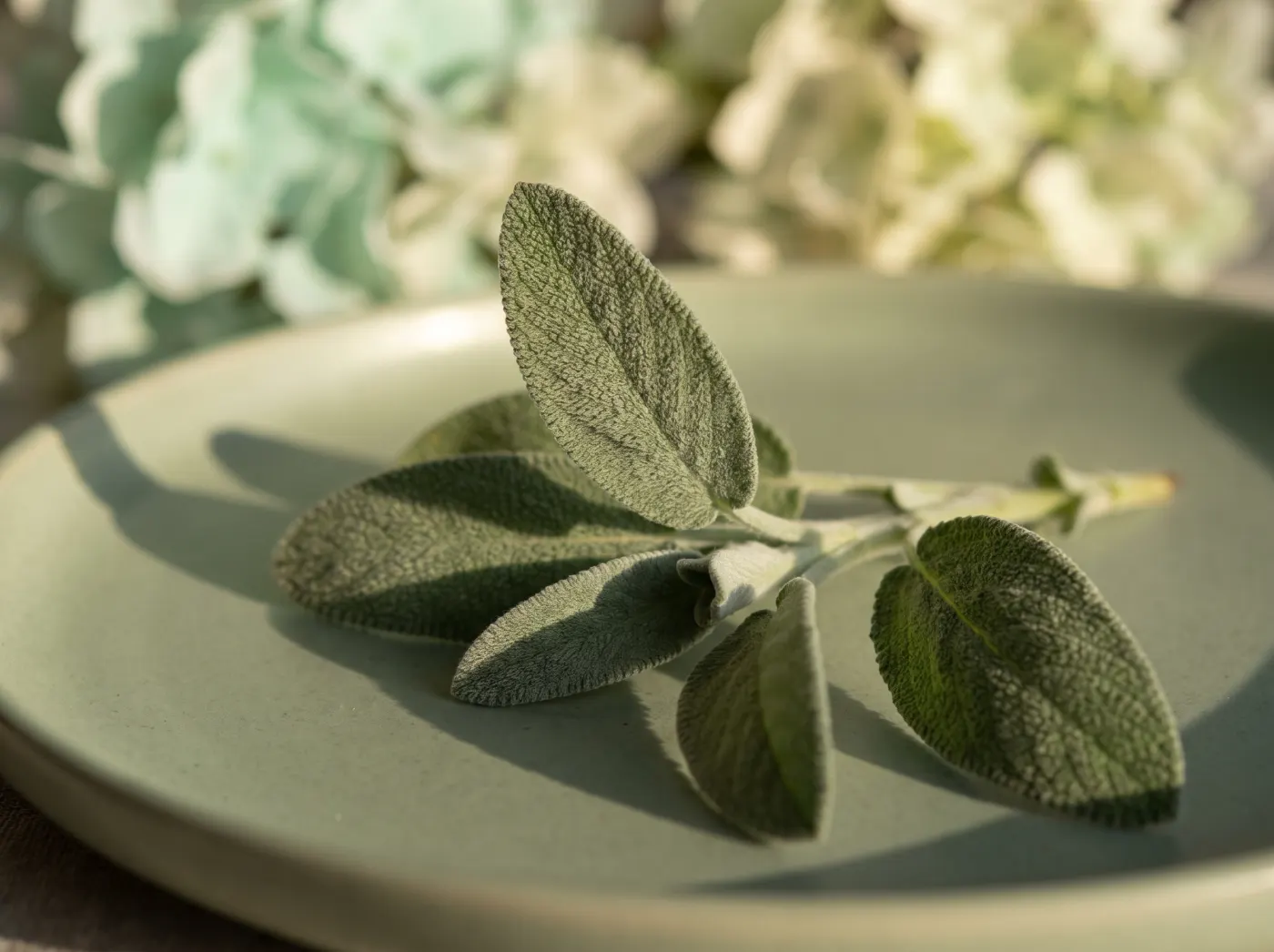
Dried common sage leaves in macro view on a sage green ceramic surface

Sage at a glance

Entry from our cosmetic ingredient glossary. Regulatory data from the European Commission's CosIng database12, restrictions under Regulation (EC) 1223/20093, safety according to the CIR expert panel5. Copy the identifiers in one click for your files.

INCI name
SALVIA OFFICINALIS LEAF EXTRACTUS name: SALVIA OFFICINALIS (SAGE) LEAF EXTRACT1. The flower, leaf and stem extract is a separate entry, with "fragrance" and "skin conditioning" functions2
Other names
Sage, common sage, garden sage
CAS number
84082-79-1 / 8022-56-8
EC number
282-025-9CosIng also gives a second, empty EC number ("-")1
Botanical origin
Salvia officinalis L., Lamiaceae (leaf)Leaf extract for this CosIng entry1
Compounds of interest
Phenolic diterpenes, thujone in the essential oilCarnosol and carnosic acid in the leaves7; α- and β-thujone measured in the essential oil, with wide variations from one commercial sample to another10
CosIng function
Antiseborrheic, cleansing, oral care, skin conditioning, tonicDeclared functions of the leaf extract1
Standardization
Varies with the extractFour leaf extracts obtained by maceration or ultrasound differ in composition and activities12: the grade is set in the raw material specification
EU status
No restrictionAbsent from Annexes II and III of the text consolidated on 1 May 2025, like thujone (search for "Salvia" and "thujone" in the text)3. The essential oil and thujone are controlled in the specification
Allergen to declare
Not listedNeither sage nor Salvia appears in the fragrance allergen list of Regulation (EU) 2023/15454. The CIR panel is, however, concerned about certain terpenes as potential sensitizers5
Safety
Judged safe if non-sensitizingCIR panel 2026: 6 of the 12 ingredients, those derived from the leaf and the oil, are safe as used if formulated to avoid sensitization; insufficient data for the other 65

What the research says

Each result shows the protocol and the level of evidence. The higher the level, the better the result carries over to a finished formula.

Clinical trialReview or consensusLaboratory

SkinSkincare

Less melanin in a reconstructed skin model

Laboratory
Ethanolic sage extract3D skin modelDark spots, GM-CSF mechanism

The extract reduced melanin production. It curbs GM-CSF expression in keratinocytes, via the p38 and JNK MAP kinases. Lab study on pigmentation, with no human trial11.

Less redness after experimental UV irradiation

Clinical trial
Extract rich in phenolic diterpenes at 2%Hydrophilic ointment, under occlusion40 healthy volunteersUV erythema test at 48 h, placebo controlled

UV-induced erythema is significantly lower than with placebo. The model is an experimental redness, compared with pharmaceutical controls: it is not a promise for a finished product7.

Leaves rich in bioactive compounds

Laboratory
4 extracts of leaves grown in CalabriaMaceration and ultrasoundUHPLC analysis

The extracts contain many bioactive compounds and scavenge reactive oxygen species. On cell models, they were judged safe, with low liver toxicity. Lab study12.

The delivery system decides what carnosol releases

Laboratory
Self-emulsifying systems with sageCream and gelFranz diffusion cells

Carnosol, a component of sage, is poorly soluble in water. The cream based on a self-emulsifying system released up to 80% of it, more than the gels. A formulation lesson, lab study13.

BodyBodycare

A sage extract stick reduces underarm odor

Clinical trial
Sage extract (dichloromethane fraction) at 200, 400 or 600 µg/mL45 volunteersSingle application, sensory evaluation at 2, 4 and 8 hPlacebo controlled, double blind

All three concentrations gave a significantly lower odor score than placebo at 2, 4 and 8 hours. The extract is a laboratory fraction, not a commercial leaf extract8.

Safety and allergyReviews and cases

Judged safe by the CIR panel, with conditions

Expert assessment
CIR panel 202612 ingredients derived from common sage

Six ingredients, derived from the leaf and the oil, are safe as used and at the concentrations described if formulated to avoid sensitization. Data are insufficient for the other six. The panel is concerned about certain terpenes as potential sensitizers and advises against combining the same constituents in a formula that mixes several botanicals5.

A thujone that is neurotoxic in animals

Review
2013 toxicology reviewThujone, herbal and botanical products

Thujone inhibits the GABA-A receptor and causes convulsions in animals; estimates of the acceptable daily intake by the oral route (herbs and food) are on the order of 3 to 7 mg per day. No value is given for the skin route9.

Sage essential oils with very variable content

Laboratory
7 commercial sage essential oilsGC-FID assay

Some oils are dominated by thujone, others contain none at all. The thujone content must therefore be specified material by material10.

A contact allergy to a sage extract

Case report
2011 case reportSalvia officinalis extract

A contact allergy attributed to a Salvia officinalis extract is described. An isolated case, which recalls that a reaction remains possible6.

This page summarizes published literature on a cosmetic ingredient. It does not describe the effect of a finished product, which depends on its formula, and it is not medical advice. Sage is also a medicinal and culinary plant: only the cosmetic aspects are covered here. Human trials concern laboratory extracts, not a commercial extract.

Which products use sage?

Our white label catalog includes 1 formula with sage: the key active in 1 of them, a supporting ingredient in the others. Every category can be customized (formula, fragrance, packaging).

1Body

Key active of the scalp freshness spray, with alum stone.

In our formulas, it is most often paired with

Hyaluronic acid 1Peppermint essential oil 1Niacinamide 1Panthenol 1Zinc PCA 1

Frequently asked questions about sage

What is common sage?
It is a plant of the Lamiaceae family, Salvia officinalis, whose leaf is used1. In cosmetics, the extract is declared SALVIA OFFICINALIS LEAF EXTRACT, with antiseborrheic, cleansing, tonic and skin conditioning functions1.
What are the benefits of sage for skin?
The cosmetic evidence is limited and comes from lab models: less melanin in a reconstructed skin11, less erythema after UV in 40 volunteers with a laboratory extract7, less underarm odor with an extract stick8. These trials are not a promise for a finished product.
Does sage contain thujone, and is it dangerous?
Thujone is measured in sage essential oil, with strong variations between oils10. It is neurotoxic in animals9. The European cosmetics regulation has no entry for thujone in its Annexes II and III3: the thujone content of an extract or an oil is controlled in the raw material specification.
What percentage of sage should you use?
The only skin trial with a stated concentration used a 2% extract in an ointment under occlusion, in a UV erythema test7. The CIR panel describes use concentrations without the summary giving figures5. The dose is set with the formulator, depending on the targeted effect and tolerance.
What should you pair sage with?
In our scalp freshness spray, it is paired with alum stone, niacinamide, zinc PCA, panthenol, hyaluronic acid and peppermint essential oil. The stability of the final formula is checked with laboratory tests.
Does sage carry any risks?
The CIR panel judges leaf-derived ingredients safe, provided they are formulated to avoid sensitization, and is concerned about certain terpenes5. A contact allergy to an extract is described6. No restriction appears in Annexes II and III3.
Can you manufacture a spray or a care product with sage for my brand?
Yes. Our ISO 22716 certified lab offers a sage formula (scalp freshness spray) to customize, or a custom formula. Free samples are included.

Sources

Peer-reviewed studies and official regulatory sources, checked on November 3, 2026.

  1. European Commission. CosIng, entry SALVIA OFFICINALIS LEAF EXTRACT (CAS 84082-79-1 / 8022-56-8, EC 282-025-9). ec.europa.eu/growth/tools-databases/cosing
  2. European Commission. CosIng, entry SALVIA OFFICINALIS FLOWER/LEAF/STEM EXTRACT (CAS 84082-79-1, EC 282-025-9). ec.europa.eu/growth/tools-databases/cosing
  3. European Parliament and Council. Regulation (EC) No 1223/2009 on cosmetic products, consolidated text of 1 May 2025 (Annexes II to VI). EUR-Lex. eur-lex.europa.eu
  4. Commission Regulation (EU) 2023/1545 of 26 July 2023 amending Regulation (EC) No 1223/2009 of the European Parliament and of the Council as regards labelling of fragrance allergens in cosmetic products (Annex III). eur-lex.europa.eu
  5. Raj PS, Bergfeld WF, Belsito DV, et al. Safety Assessment of Salvia officinalis (Sage)-Derived Ingredients as Used in Cosmetics. Int J Toxicol. 2026;45(1_suppl):88S-105S. doi:10.1177/10915818261425569
  6. Mayer E, Gescheidt-Shoshany H, Weltfriend S. Allergic contact dermatitis caused by Salvia officinalis extract. Contact Dermatitis. 2011;64(4):237-238. doi:10.1111/j.1600-0536.2010.01848.x
  7. Reuter J, Jocher A, Hornstein S, et al. Sage extract rich in phenolic diterpenes inhibits ultraviolet-induced erythema in vivo. Planta Med. 2007;73(11):1190-1191. doi:10.1055/s-2007-981583
  8. Shahtalebi MA, Ghanadian M, Farzan A, et al. Deodorant effects of a sage extract stick: Antibacterial activity and sensory evaluation of axillary deodorancy. J Res Med Sci. 2013;18(10):833-839. PMID 24497852
  9. Pelkonen O, Abass K, Wiesner J. Thujone and thujone-containing herbal medicinal and botanical products: toxicological assessment. Regul Toxicol Pharmacol. 2013;65(1):100-107. doi:10.1016/j.yrtph.2012.11.002
  10. Rasmussen LH, Rosenfjeld M. A rapid GC-FID method for determination of sabinene, β-pinene, α-thujone and β-thujone in the essential oil of Kitchen Sage (Salvia officinalis L.). J Chromatogr B Analyt Technol Biomed Life Sci. 2020;1149:122159. doi:10.1016/j.jchromb.2020.122159
  11. Kubo H, Moriyama M, Goto S, et al. Sage extract and ascorbic acid derivative inhibit melanogenesis via downregulating keratinocyte-derived GM-CSF. PLoS One. 2025;20(6):e0325242. doi:10.1371/journal.pone.0325242Kobayashi Pharmaceutical (fabricant)
  12. Ceramella J, Chavarria D, Iacopetta D, et al. Salvia officinalis L. leaf extracts: Chemical analysis and biological studies. J Ethnopharmacol. 2025;352:120193. doi:10.1016/j.jep.2025.120193
  13. Bodnár K, Papp B, Sinka D, et al. Development of Salvia officinalis-Based Self-Emulsifying Systems for Dermal Application: Antioxidant, Anti-Inflammatory, and Skin Penetration Enhancement. Pharmaceutics. 2025;17(2):140. doi:10.3390/pharmaceutics17020140
Carmel Cosmetics Labs product specialist with a brand founder

Tell us about your project

A product specialist reviews your request and gets back to you on the channel you prefer.

Lead EN – Demande de devis
Tell us about your project. A product specialist will get back to you shortly.
CONTACT INFORMATION
Name
PROJECT INFORMATION
Which cosmetics category interests you most?

By submitting this form, you agree to our terms of service and privacy policy.

No obligation. Your information stays confidential and is used only to prepare your quote.





