For skin
In a serum or cream, saffron fits into a radiance routine. Its petals and stigmas contain crocin and kaempferol, antioxidant compounds studied as sources of actives for cosmetic formulas.
Services
Catalog
Explore the full catalog1,000+ formulas ready to carry your brandFace careFull range
Serums, creams and targeted care, formulated with your actives.
Hair careFull range
From shampoo to leave-in, for every hair type.
Body careFull range
Moisturizing, nourishing and shower care: cream, butter or oil.
Hammam and naturalFull range
Black soap, argan and authentic Moroccan rituals.
Specialty careFull range
Sun care, lips, intimate care and oral care.
Industries
All solutions by industryFormulas and formats for your businessHospitality and wellness
Brands and creators
Our brands
Our own brands, developed and made in our laboratory.

 DermocosmeticsSublime CosmeticsFace, sun and body care for pharmacies and drugstores.Visit the website

 Hammam and spaLalla MamaMoroccan hammam rituals: black soap, rhassoul, oils and body care.Visit the website

 Equine careStallionGrooming care for horses: mane, coat and hooves.Visit the website
Laboratory
 Our factory in Aït MelloulISO 22716 and ISO 9001, visits by appointmentDiscover the factory
Cosmetics manufacturer based in Agadir
500+ brands35+ countries1,000+ formulas
Our factory in Aït Melloul
Up to 3 million units a yearVisits by appointment
Contract manufacturing, step by step
RegulationsCostsProject steps
Join our teams in Agadir
FormulationProductionQualityRegulatorySales
Resources
The crocus a purple flower that opens in early autumn.
Three threads bright red, the precious heart of every flower.
The harvest flower by flower, by hand, in October and November.
Red gold once dried, it releases its aroma and golden hue.
By the Carmel Cosmetics Labs R&D team · updated October 18, 2026
Saffron is the spice made from the dried stigmas of the saffron crocus (Crocus sativus): three red threads at the heart of a purple flower that opens in autumn. Its color comes from crocin, its taste from picrocrocin and its aroma from safranal. In cosmetics, crocus flower extract is declared as CROCUS SATIVUS FLOWER EXTRACT; the European CosIng database lists a perfuming function for it. In Morocco, its cultivation is tied to Taliouine, whose saffron has carried a designation of origin since 2010.
The dried stigmas of the crocus, picked by hand. This is the kitchen spice. In cosmetics, its extract is declared as CROCUS SATIVUS STIGMA EXTRACT.
An extract of the whole flowers of the saffron crocus, declared as CROCUS SATIVUS FLOWER EXTRACT. The CosIng database lists a perfuming function for it. This is the INCI name we use in our saffron formulas.
The root of a different plant, whose yellow pigment is curcumin. It colors and scents differently, and does not replace saffron in an INCI list.
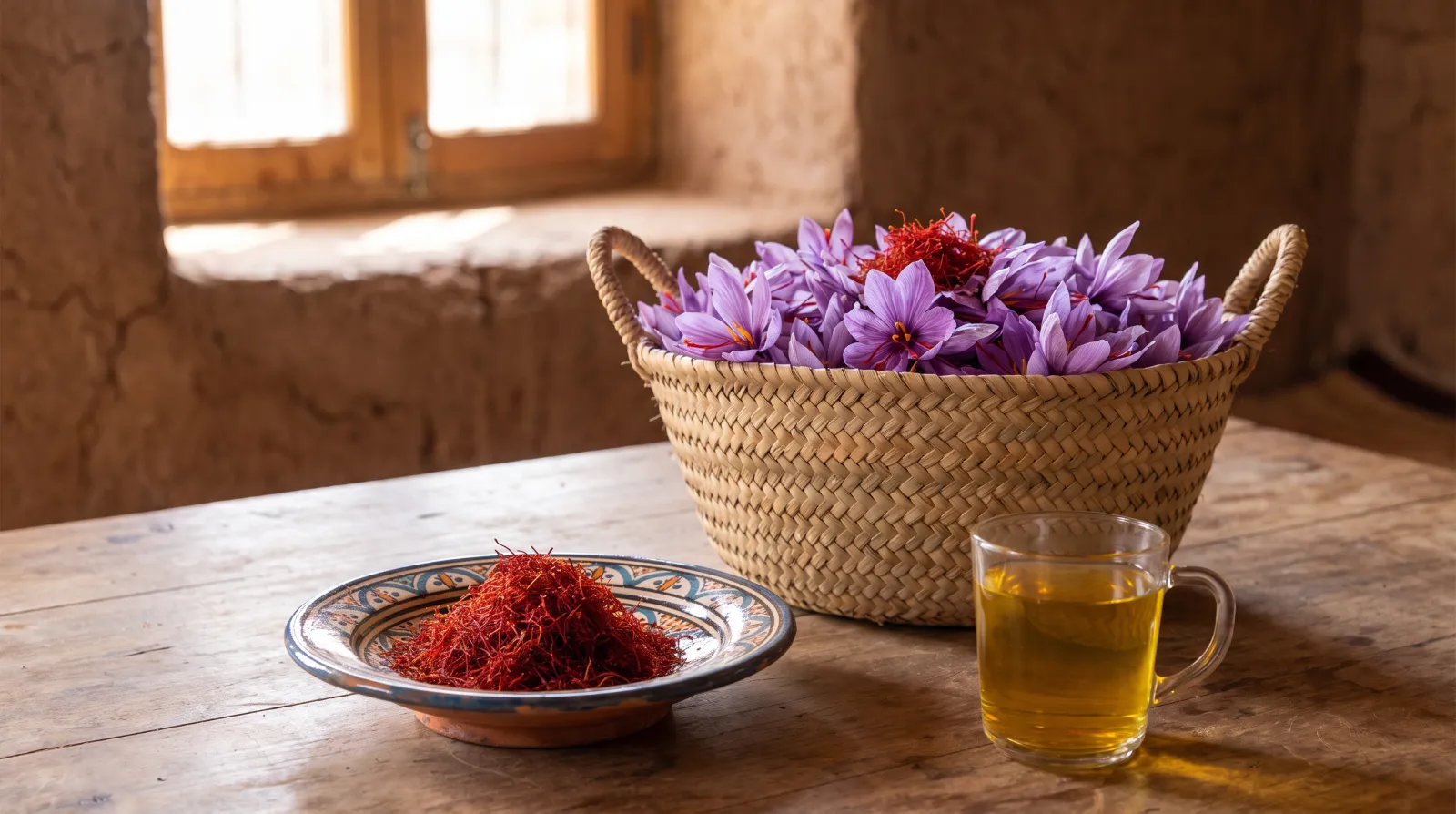
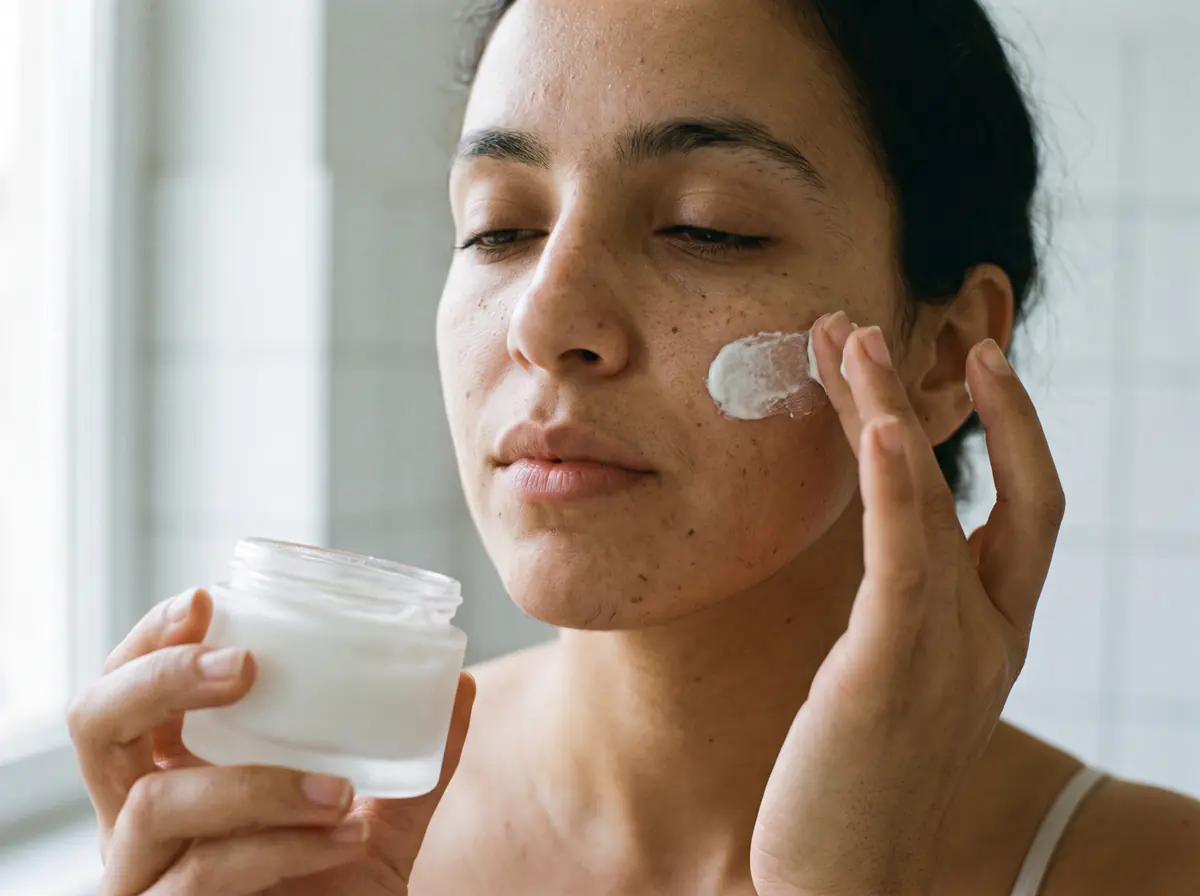
In a serum or cream, saffron fits into a radiance routine. Its petals and stigmas contain crocin and kaempferol, antioxidant compounds studied as sources of actives for cosmetic formulas.
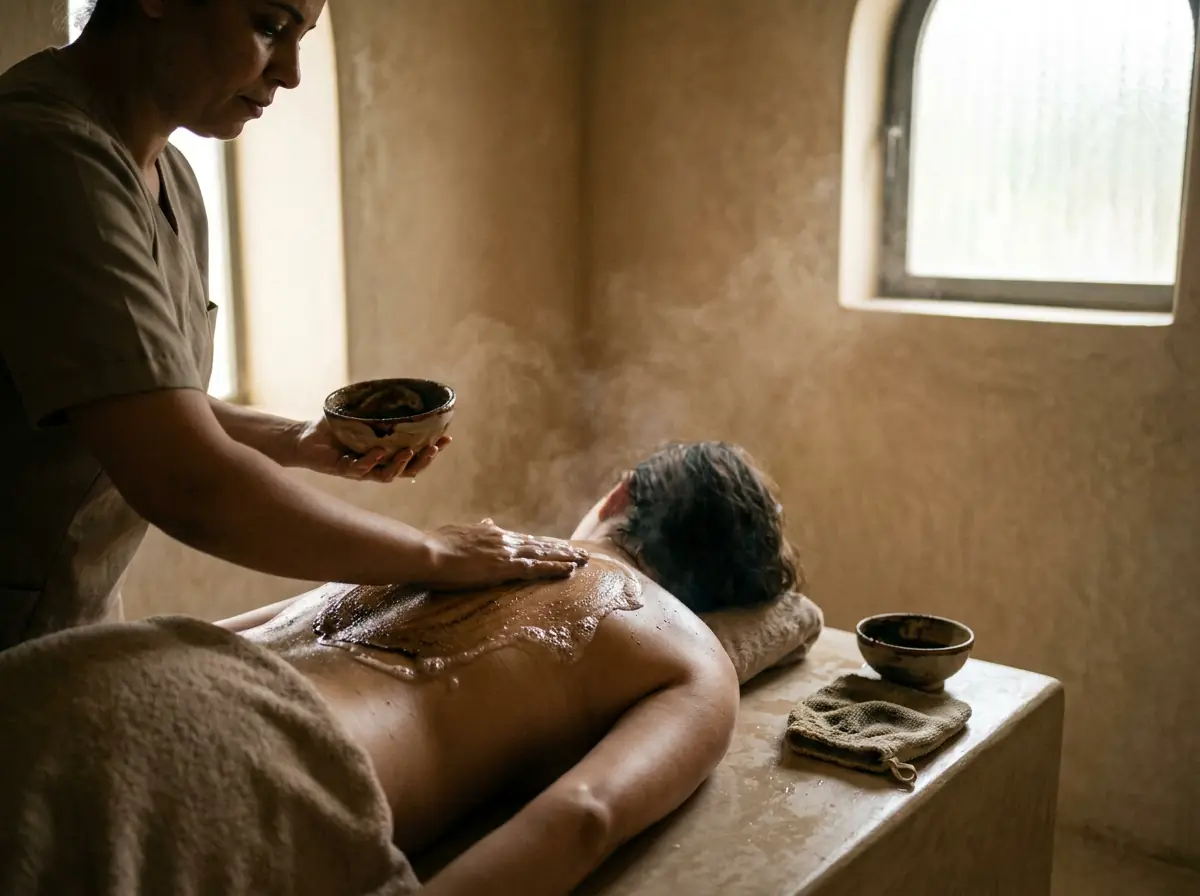
In a black soap or scrub, it adds a warm aroma and a golden note that recall the Moroccan hammam, while the formula base cleanses and softens the skin.
It gives the range a strong identity that is easy to tell: a rare spice, picked by hand, tied to the Taliouine terroir. The CosIng database lists a perfuming function for crocus flower extract.
As a serum, a few drops on clean skin, morning or evening, before the cream. The serum can be layered with other radiance care.
A saffron face scrub is massaged gently onto damp skin in small circles, avoiding the eye area, then rinsed off with lukewarm water.
Saffron black soap is applied to damp skin after the steam. Leave it on for a few minutes, then exfoliate with a kessa glove before rinsing.
We add it to serums, face scrubs, creams and black soaps ready to carry your brand. Pick a category to see the formulas.
Catalog products with saffron
What our formulators take into account when saffron goes into your product.
Often paired with
“Saffron” names the spice, but the INCI list depends on the part extracted: CROCUS SATIVUS FLOWER EXTRACT for the flower, CROCUS SATIVUS STIGMA EXTRACT for the stigmas. We use exactly the name on the supplier's data sheet.
Crocin, a water-soluble yellow-orange pigment, can color the formula. We adjust the shade and check color stability in the final packaging.
The flower extract has a perfuming function. We check the supplier's allergen declaration and list on the label those in Annex III of Regulation (EC) No 1223/2009 that exceed the thresholds.
The “Taliouine saffron” mention is reserved for material documented by the supplier. Traditional medicinal uses remain a tradition: your claims talk about radiance, softness and fragrance.
An order of the Ministry of Agriculture (no. 1355-10 of April 30, 2010) recognized the designation of origin “Safran de Taliouine”; it was amended in 2018.
According to a review published in 2019, it takes 150,000 to 200,000 flowers and about 400 hours of work to produce one kilogram of saffron.
Safranal, the molecule behind saffron's aroma, is almost absent from the fresh stigma: it forms during drying, which Moroccan producers traditionally do in the sun or in the shade.
In cosmetics, saffron first brings a warm aroma and a strong identity. Its petals and stigmas contain crocin and kaempferol, antioxidant compounds studied for skincare formulas. In a serum or cream, it supports a radiance routine alongside actives such as niacinamide or licorice extract.
The simplest way is a formulated product: a few drops of serum on clean skin before the cream, or a gentle scrub massaged onto damp skin and rinsed off. Homemade recipes steep threads in oil or milk, but they are neither dosed nor preserved. Always patch test on a small area first.
It depends on the part of the plant. Crocus flower extract is declared as CROCUS SATIVUS FLOWER EXTRACT, and the stigma extract, meaning the spice, as CROCUS SATIVUS STIGMA EXTRACT. The European CosIng database lists a perfuming function for the first, and antioxidant and skin conditioning functions for the second.
Each flower carries only three red threads, separated by hand. According to a scientific review published in 2019, it takes 150,000 to 200,000 flowers and about 400 hours of work to obtain one kilogram of saffron. The harvest, in October and November, relies mostly on female labor.
Its cultivation is historically tied to Taliouine and Taznakht, in the south of the country. In 2010, order no. 1355-10 of the Ministry of Agriculture recognized the designation of origin “Safran de Taliouine”, amended in 2018. Cultivation has also spread to other areas, such as the Haouz, Oulmès or Chefchaouen.
Infused threads appear in traditional recipes, but their concentration varies from one preparation to the next and crocin can stain skin or linen yellow. For a product on sale, a declared extract is preferred, built into a preserved and tested formula. If in doubt, patch test on a small area.
Yes. We add it to white label serums, face scrubs, creams and black soaps, or to an exclusive private label formula, made in our ISO 22716 factory in Morocco. Send your brief: the consultation is free and the formula selection comes with no commitment.
Send your brief: we formulate and manufacture in our ISO 22716 factory in Aït Melloul. Free consultation and formula selection, no commitment.