Services

Torn between two services?A project manager will guide you

Catalog

Explore the full catalog1,000+ formulas ready to carry your brand

Face careFull range

Serums, creams and targeted care, formulated with your actives.

Body careFull range

Moisturizing, nourishing and shower care: cream, butter or oil.

Specialty careFull range

Sun care, lips, intimate care and oral care.

Men, baby, makeupFull range

Shaving and beard, baby and mom, makeup.

Industries

All solutions by industryFormulas and formats for your business

Our brands

Our own brands, developed and made in our laboratory.
Become a distributor of our brandsPharmacies, spas, shops and wholesalers

Laboratory

Cosmetics manufacturing room with a row of stainless-steel mixers and an operator in white workwearOur factory in Aït MelloulISO 22716 and ISO 9001, visits by appointmentDiscover the factory

Resources

Rosewood essential oil

Rosewood essential oil comes from Aniba rosaeodora, a tree of the Lauraceae family1. It is composed overwhelmingly of linalool (93.6% in one oil studied)3, a fragrance allergen named in Annex III2. The tree is described as endangered after decades of extraction7: the origin of the material is an essential buying point.
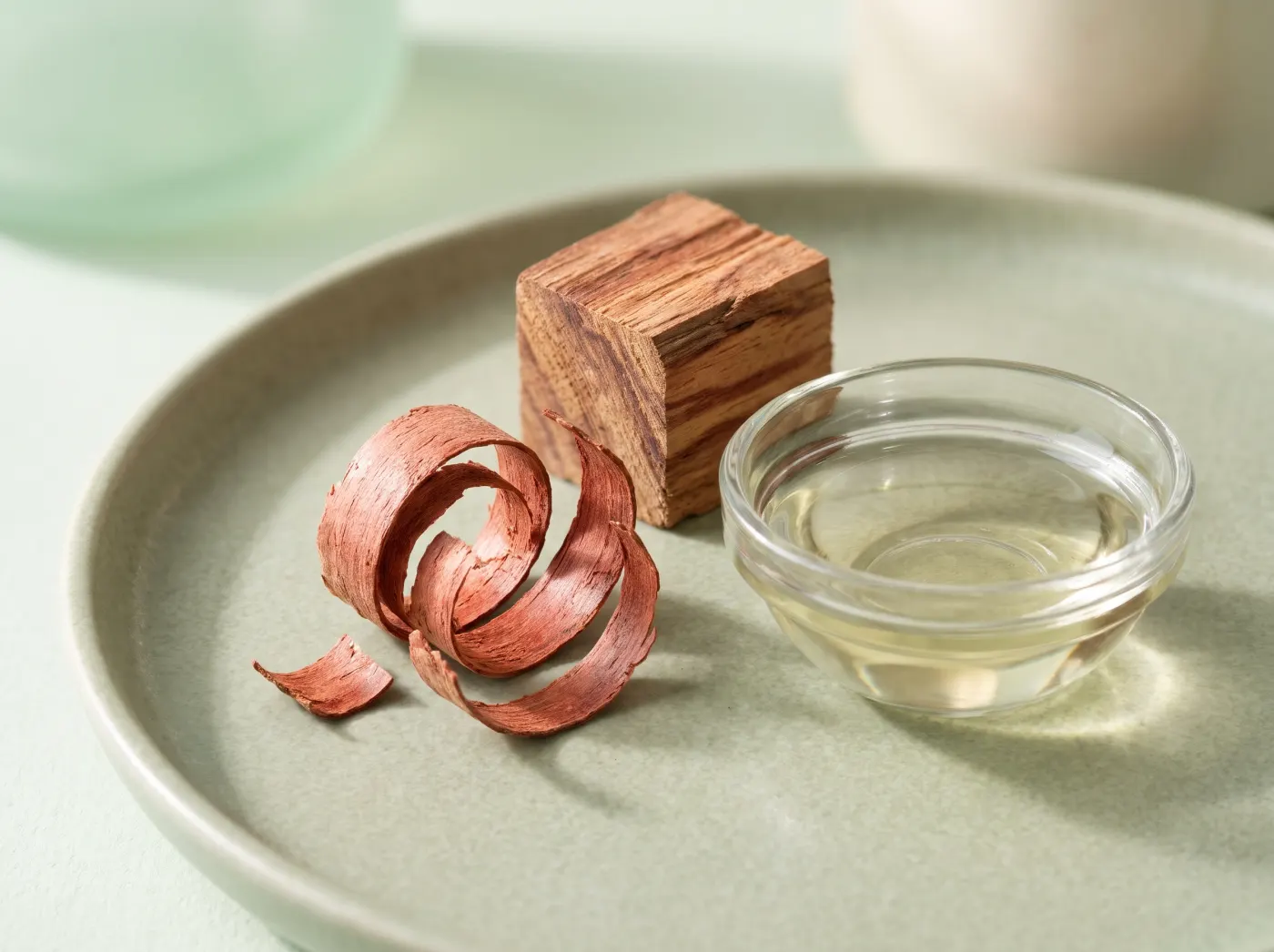
Rosewood essential oil in macro view, clear drops on a sage green ceramic surface, raking light

Rosewood oil at a glance

Entry from our cosmetic ingredient glossary. Regulatory data from the European Commission's CosIng database1 and from consolidated Regulation (EC) 1223/20092. Copy the identifiers in one click for your files.

INCI name
ANIBA ROSAEODORA WOOD OILUS INCI name: ANIBA ROSAEODORA (ROSEWOOD) WOOD OIL1
Other names
Rosewood essential oilRosewood oil, pau-rosa (Amazonian name)4. CosIng also lists a neighboring entry, ANIBA ROSAEODORA AMAZONICA WOOD OIL (CAS 93685-34-8)1
CAS number
8015-77-8
EC number
Not assignedCosIng gives no EC number for this CAS1
Botanical origin
Rosewood (Aniba rosaeodora, Lauraceae)CosIng: volatile oil obtained from the wood1. The oil can also be distilled from the leaves8
Composition
Linalool (88.6 to 93.6% in the oils studied)A. rosaeodora var. amazonica oil: 93.6% linalool3; pau-rosa leaf oil: 88.6%4. In other Aniba species, linalool ranges from 15.2 to 75.3% or gives way to 1-nitro-2-phenylethane and phellandrenes5
CosIng functions
Fragrance, perfuming, astringent, tonic, skin conditioning"Fragrance", "Perfuming", "Astringent", "Tonic" and "Skin conditioning"1
EU status
No annex of Regulation 1223/2009The name Aniba appears in no annex of the version consolidated on 1 May 20252
Allergen to declare
Not as an oil; linalool must be declaredThe oil is not named, but linalool, its overwhelming constituent, is (Annex III, line 84): it must be declared above 0.001% in a leave-on product and 0.01% in a rinse-off product2
Safety
No CIR assessment foundNo CIR panel report found on this oil. A documented point of caution: oxidized linalool is a frequent sensitizer in patch tests9

What the research says

Each result shows the protocol and the level of evidence. The higher the level, the better the result carries over to a finished formula.

Clinical trialReview or consensusLaboratory

Oil compositionChemistry

An oil almost pure in linalool

Laboratory
Aniba rosaeodora var. amazonicaComposition and in vitro activities

Linalool makes up 93.6% of the oil3. In the pau-rosa leaf oil analyzed in another study, it makes up 88.6%4.

Other Aniba species do not share the profile

Laboratory
Four Aniba speciesPará (Brazil)Chemistry and DNA barcodes

The oils of four Aniba species differ in their chemistry: 1-nitro-2-phenylethane (70.9 to 88.3%), linalool (15.2 to 75.3%), α-phellandrene and β-phellandrene. The compound family follows the genetics of the species5. The species must therefore be specified at purchase.

Origin and sustainabilitySourcing

A tree described as endangered

Review
2013 population genetics study

Aniba rosaeodora is described as an endangered Amazonian tree and a high-value non-timber forest resource6. After decades of predatory extraction, the species is judged at risk of extinction7.

Distilling leaves rather than cutting the tree

Laboratory
GC-MS and olfactometry analysisLeaves versus wood

Extracting the oil from the wood means felling the tree. Leaf oil is studied as a sustainable source: the analyses conclude that leaves can replace wood to obtain natural rosewood linalool87.

Linalool and contact allergyToxicology

Oxidized linalool often gives positive tests

Clinical study
5,511 consecutively tested peopleIVDK network, 2018 to 2020Oxidized linalool at 1%

Linalool hydroperoxides give 483 positive tests (8.8%). Many reactions were weak, doubtful or irritant: the authors point to a risk of false positives9. A review considers adding them to the European baseline series justified, with exposure thresholds still to be better defined10.

No tolerance data for the oil itself

Review
No data

The data above concern linalool, not rosewood oil. We found no published sensitization test on this oil: its linalool content means the formula must be protected from oxidation.

Skin: laboratory evidence onlySkincare

Antimicrobial and antioxidant activity in vitro

Laboratory
Oil and purified linaloolReference bacteriaABTS testMouse macrophages

The oil and linalool slow all the bacterial strains tested, with the lowest minimum concentration for S. aureus. To scavenge the ABTS radical, the EC50 is 15.46 µg/mL for the oil and 6.78 µg/mL for linalool. No cytotoxic effect on macrophages. This is a laboratory study: it says nothing about an effect on human skin3. We kept no cosmetic trial in humans.

This page summarizes published literature on a cosmetic ingredient. It does not describe the effect of a finished product, which depends on its formula, and it is not medical advice. Evidence is flagged by level: clinical trial, review or laboratory.

Which products can use rosewood oil?

No formula in our white label catalog features rosewood oil yet. Our formulation lab can add it to a custom formula or to a catalog formula. Its common uses:

Face

Facial care and scented waters with a rosy note, with attention to tolerance: the oil is mostly a fragrance ingredient.

Body

Massage oils, soaps, care candles and body milks with a soft floral and woody note.

Hair

Scented leave-in care and hair oils; we found no published study on hair.

Rosewood, geranium, ylang-ylang or copaiba?

Four essential oils often compared for their floral or woody notes. Their chemistry differs, and so does their labeling status.

RosewoodGeraniumYlang-ylangCopaiba
Dominant constituentsLinalool (93.6% in one oil studied)3β-citronellol (29.7%) and geraniol (14.6%) in one sample11Linalool, geranyl acetate, benzyl benzoate12β-caryophyllene (19.7 to 57.5% depending on the species)13
Annex IIIOil not named; linalool named (line 84)2Oil named (line 364)14Oil named (line 347)14Oil not named; beta-caryophyllene named (line 332)14

Frequently asked questions about rosewood oil

What is rosewood essential oil?
It is the volatile oil of Aniba rosaeodora, an Amazonian tree of the Lauraceae family1. Its INCI name is ANIBA ROSAEODORA WOOD OIL. It is composed overwhelmingly of linalool3.
What are the benefits of rosewood oil in cosmetics?
CosIng classifies it as a fragrance, perfuming, astringent, tonic and skin conditioning agent1. It is first of all a fragrance ingredient: we kept no cosmetic trial in humans. The available data come from the laboratory3.
Do I have to declare rosewood oil in the ingredient list?
Aniba rosaeodora oil is not named in Annex III. However, the linalool it contains in large quantity is (line 84): it must be declared above 0.001% in a leave-on product and 0.01% in a rinse-off product2.
Is rosewood an endangered species?
Yes, the Aniba rosaeodora tree is described as endangered: extracting the oil from the wood has long meant felling it67. For any order, ask the supplier for the species, the origin, the part distilled (wood or leaves) and the origin documents of the material.
Is rosewood oil allergenic?
Its skin tolerance is not documented in the studies we kept. Its main constituent, linalool, becomes sensitizing as it oxidizes: 8.8% of people tested with oxidized linalool react, with a risk of false positives9. Hence the value of air-protected packaging and tolerance tests on the finished product.
Are there alternatives to rosewood oil?
Natural linalool is found in other oils, such as some geraniums or ylang-ylang1512. The leaf oil of Aniba rosaeodora is studied as a sustainable source8. The choice depends on the note you want and the allergens to declare.
Can you manufacture a rosewood product for my brand?
Yes, we study its integration depending on raw material availability and traceability. Our ISO 22716 certified lab can add it to a customized catalog formula, or design it into a custom formula, with the allergen declaration calculated. Samples are free.

Sources

Peer-reviewed studies and official regulatory sources, checked on November 3, 2026.

  1. European Commission. CosIng, entry ANIBA ROSAEODORA WOOD OIL (CAS 8015-77-8, no EC number). ec.europa.eu/growth/tools-databases/cosing
  2. Regulation (EC) No 1223/2009 of the European Parliament and of the Council on cosmetic products, consolidated version of 1 May 2025 (Annexes II to VI). eur-lex.europa.eu
  3. Teles AM, Silva-Silva JV, Fernandes JMP, Calabrese KDS, Abreu-Silva AL, Marinho SC, et al. Aniba rosaeodora (Var. amazonica Ducke) Essential Oil: Chemical Composition, Antibacterial, Antioxidant and Antitrypanosomal Activity. Antibiotics (Basel). 2020;10(1):24. doi:10.3390/antibiotics10010024
  4. Dos Santos ÉRQ, Maia CSF, Fontes Junior EA, Melo AS, Pinheiro BG, Maia JGS. Linalool-rich essential oils from the Amazon display antidepressant-type effect in rodents. J Ethnopharmacol. 2018;212:43-49. doi:10.1016/j.jep.2017.10.013
  5. Xavier JKAM, Maia L, Figueiredo PLB, Folador A, Ramos AR, Andrade EH, et al. Essential Oil Composition and DNA Barcode and Identification of Aniba species (Lauraceae) Growing in the Amazon Region. Molecules. 2021;26(7):1914. doi:10.3390/molecules26071914
  6. Angrizani RC, Contim LA, Lemes MR. Development and characterization of microsatellite markers for the endangered Amazonian tree Aniba rosaeodora (Lauraceae). Appl Plant Sci. 2013;1(9):apps.1200516. doi:10.3732/apps.1200516
  7. Almeida MR, Fidelis CH, Barata LE, Poppi RJ. Classification of Amazonian rosewood essential oil by Raman spectroscopy and PLS-DA with reliability estimation. Talanta. 2013;117:305-11. doi:10.1016/j.talanta.2013.09.025
  8. d'Acampora Zellner B, Lo Presti M, Barata LE, Dugo P, Dugo G, Mondello L. Evaluation of leaf-derived extracts as an environmentally sustainable source of essential oils by using gas chromatography-mass spectrometry and enantioselective gas chromatography-olfactometry. Anal Chem. 2006;78(3):883-90. doi:10.1021/ac051337s
  9. Schubert S, Geier J, Brans R, Heratizadeh A, Kränke B, Schnuch A, et al. Patch testing hydroperoxides of limonene and linalool in consecutive patients-Results of the IVDK 2018-2020. Contact Dermatitis. 2023;89(2):85-94. doi:10.1111/cod.14332
  10. Ogueta IA, Brared Christensson J, Giménez-Arnau E, Brans R, Wilkinson M, Stingeni L, et al. Limonene and linalool hydroperoxides review: Pros and cons for routine patch testing. Contact Dermatitis. 2022;87(1):1-12. doi:10.1111/cod.14064
  11. Kačániová M, Vukic M, Vukovic NL, Čmiková N, Verešová A, Schwarzová M, et al. An In-Depth Study on the Chemical Composition and Biological Effects of Pelargonium graveolens Essential Oil. Foods. 2023;13(1):33. doi:10.3390/foods13010033
  12. Mrani SA, Zejli H, Azzouni D, Fadili D, Alanazi MM, Hassane SOS, et al. Chemical Composition, Antioxidant, Antibacterial, and Hemolytic Properties of Ylang-Ylang (Cananga odorata) Essential Oil: Potential Therapeutic Applications in Dermatology. Pharmaceuticals (Basel). 2024;17(10):1376. doi:10.3390/ph17101376
  13. Veiga Junior VF, Rosas EC, Carvalho MV, Henriques MG, Pinto AC. Chemical composition and anti-inflammatory activity of copaiba oils from Copaifera cearensis Huber ex Ducke, Copaifera reticulata Ducke and Copaifera multijuga Hayne--a comparative study. J Ethnopharmacol. 2007;112(2):248-54. doi:10.1016/j.jep.2007.03.005
  14. Commission Regulation (EU) 2023/1545 of 26 July 2023 amending Regulation (EC) No 1223/2009 of the European Parliament and of the Council as regards labelling of fragrance allergens in cosmetic products (Annex III). eur-lex.europa.eu
  15. Boukhris M, Simmonds MS, Sayadi S, Bouaziz M. Chemical composition and biological activities of polar extracts and essential oil of rose-scented geranium, Pelargonium graveolens. Phytother Res. 2013;27(8):1206-13. doi:10.1002/ptr.4853
Carmel Cosmetics Labs product specialist with a brand founder

Tell us about your project

A product specialist reviews your request and gets back to you on the channel you prefer.

Lead EN – Demande de devis
Tell us about your project. A product specialist will get back to you shortly.
CONTACT INFORMATION
Name
PROJECT INFORMATION
Which cosmetics category interests you most?

By submitting this form, you agree to our terms of service and privacy policy.

No obligation. Your information stays confidential and is used only to prepare your quote.