


















































Services

Torn between two services?A project manager will guide you

Catalog

Explore the full catalog1,000+ formulas ready to carry your brand

Face careFull range

Serums, creams and targeted care, formulated with your actives.

Body careFull range

Moisturizing, nourishing and shower care: cream, butter or oil.

Specialty careFull range

Sun care, lips, intimate care and oral care.

Men, baby, makeupFull range

Shaving and beard, baby and mom, makeup.

Industries

All solutions by industryFormulas and formats for your business

Our brands

Our own brands, developed and made in our laboratory.

Become a distributor of our brandsPharmacies, spas, shops and wholesalers

Laboratory

Cosmetics manufacturing room with a row of stainless-steel mixers and an operator in white workwearOur factory in Aït MelloulISO 22716 and ISO 9001, visits by appointmentDiscover the factory

Resources

Rosemary powder (Rosmarinus officinalis)

Rosemary powder is the dried, ground leaf of Rosmarinus officinalis; CosIng classifies it as fragrance and skin conditioning1. It differs from the distilled essential oil, which has its own page. Its non-volatile compounds, such as carnosic acid, are better studied in extracts45. No trial on the powder was retained.

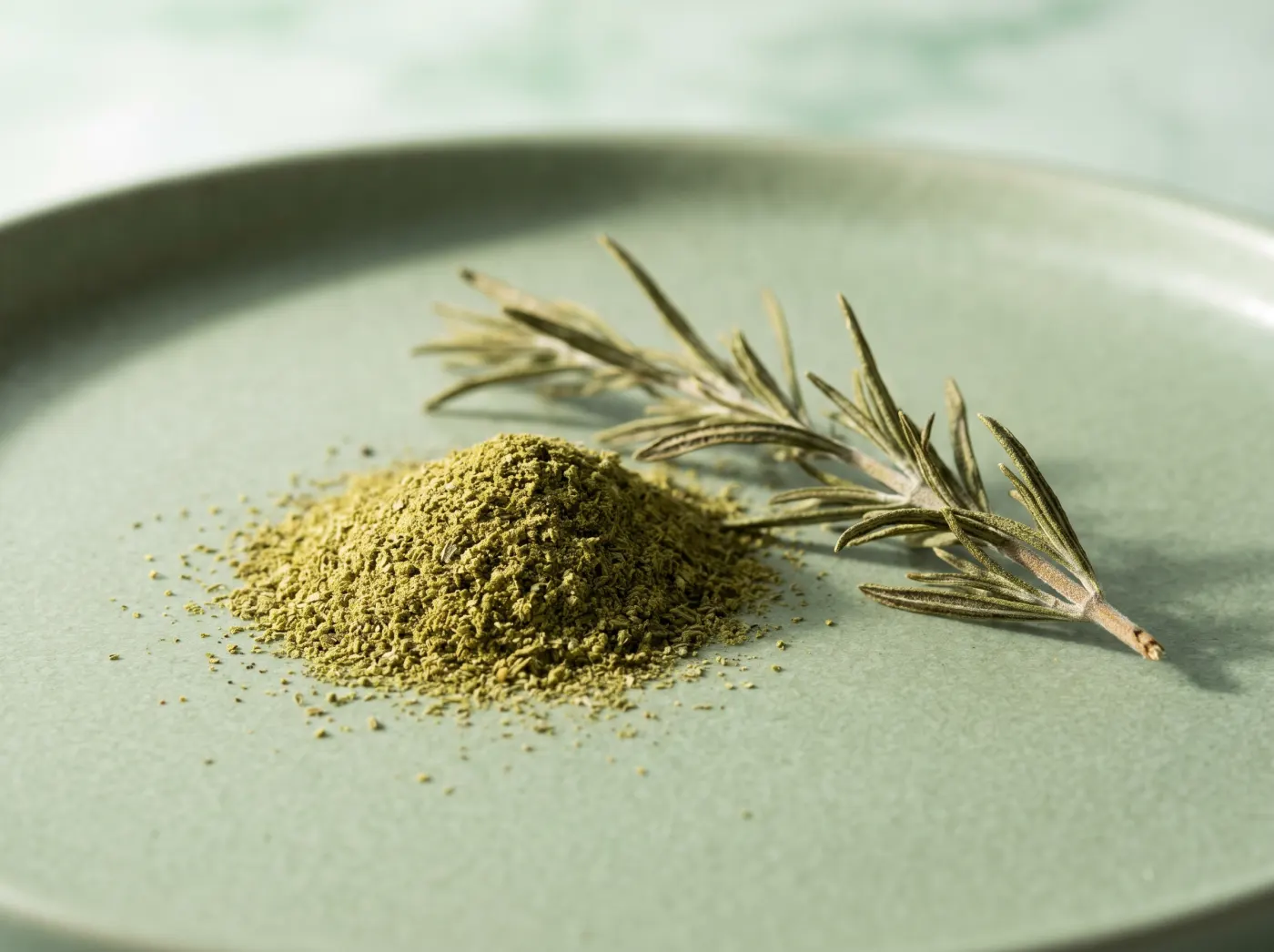
Rosemary powder in macro view, raw material on a sage green ceramic surface, raking light

Rosemary powder at a glance

Entry from our cosmetic ingredient glossary. Data from the European Commission's CosIng database1 and from consolidated Regulation (EC) No 1223/20092. Copy the identifiers in one click for your files.

INCI name
ROSMARINUS OFFICINALIS LEAF POWDERUS INCI name: ROSMARINUS OFFICINALIS (ROSEMARY) LEAF POWDER1
Other names
Rosemary leaf powder, powdered rosemaryGround rosemary leaf
CAS number
84604-14-8Same number as the leaf essential oil: the CAS number does not distinguish the powder from the oil1
EC number
283-291-9
Botanical origin
Rosemary (Rosmarinus officinalis L., Lamiaceae)CosIng: powder obtained from the leaf1. Botanical synonym: Salvia rosmarinus
Composition
Carnosic acid, carnosol, rosmarinic acid; volatile fraction not documentedThese non-volatile compounds are described mostly in extracts45. No content for the powder is given in the retained sources: it depends on the batch
CosIng functions
Fragrance, skin conditioning"Fragrance" and "Skin conditioning"1
EU status
No dedicated line in the annexesCosIng mentions no restriction for this powder1. The consolidated text of the regulation does not name Rosmarinus2
Allergen to declare
Not the powder, but some possible constituentsThe regulation names camphor (line 331), pinene (371) and limonene (88), constituents of rosemary oil, above 0.001% in leave-on products and 0.01% in rinse-off products23. For the powder, the volatile fraction is not documented: only the batch certificate of analysis allows a conclusion
Safety
No CIR or SCCS assessment retainedContact allergies to rosemary are described; tolerance is judged on the finished formula

What the research says

Each result shows the protocol and the level of evidence. The higher the level, the better the result carries over to a finished formula.

Clinical trialReview or consensusLaboratory

Leaf compoundsChemistry

Carnosic acid, an antioxidant compound of extracts

Review
2015 reviewRosemary and sage

Carnosic acid is described as antioxidant and antimicrobial, and increasingly used in food, nutrition and cosmetics. The roughly 400 articles and patents listed cover rosemary and sage extracts rich in carnosic acid, not the powder4.

Compounds that depend on extraction

Review
2026 reviewExtraction methods

Carnosic acid, carnosol, rosmarinic acid, 1,8-cineole and α-pinene are the main compounds; their recovery and stability vary with the solvent and the process. The review compares extraction techniques, not powders5.

SkinSkincare

Rosemary diterpenes protect keratinocytes against UVB

Laboratory
Formulation containing a rosemary extractHuman keratinocytes irradiated with UVBCompared with a formulation without rosemary

The formulation with rosemary extract (diterpenes, iridoids, flavanones) protects more against DNA damage and restores mitochondrial potential better than the one without rosemary. The authors link this effect to the diterpenes, but the mixture contains other plants, and human trials remain necessary6.

ToleranceSafety

Contact allergies to rosemary: extracts and raw material

Review
2014 review of published cases

Published cases show that extracts as well as raw material can cause a contact allergy. Carnosol is implicated, and two cases link rosemary and thyme through cross-reaction. The authors judge the incidence low but probably underestimated7.

A cleansing gel with rosemary extract in question

Case report
Cleansing gel, extract at 0.1%Patch test

A 23-year-old woman reacts to the cleansing gel (1% in water) and to rosemary leaf extract (0.1% in water), one of its ingredients8.

Cross-reactions with other Lamiaceae

Case report
Rosemary alcohol4 Lamiaceae species tested

In a man reacting to rosemary alcohol, tests are positive for 3 of the 4 Lamiaceae tested9.

This page summarizes published literature on a cosmetic ingredient. It does not describe the effect of a finished product, which depends on its formula, and it is not medical advice. Evidence is flagged by level: clinical trial, review or laboratory.

Which products can use rosemary powder?

No formula in our white label catalog features rosemary powder yet. Our formulation lab can add it to a custom formula or to a catalog formula. Its common uses:

Body

Traditional soaps with plant powders, dry plant scrubs.

Hair

Scalp scrubs and plant-based care. For the rosemary products in the catalog, see the essential oil page.

Frequently asked questions about rosemary powder

What is rosemary powder?
It is the dried, ground leaf of Rosmarinus officinalis1. Its INCI name is ROSMARINUS OFFICINALIS LEAF POWDER. It differs from the essential oil, obtained by distilling the plant.
What is the difference between rosemary powder and rosemary essential oil?
The powder contains the whole ground leaf, including non-volatile compounds such as carnosic acid45; the oil is only the distilled volatile fraction. They share the same CAS number1, but not the same composition or labeling. See our rosemary essential oil page for the composition of the oil and the scalp studies.
What are the benefits of rosemary powder in cosmetics?
CosIng classifies it as fragrance and skin conditioning1. No clinical trial on the powder was retained: work covers extracts, in the laboratory46. A brand should therefore stay cautious with its claims.
Is rosemary powder useful for hair?
Scalp studies cover rosemary oil, not the powder: they are summarized in our rosemary essential oil page. No study on the powder was retained here.
Do I have to declare allergens with rosemary powder?
The powder is not named in the regulation. Some volatile constituents of rosemary are (camphor, pinene, limonene), above 0.001% in leave-on products or 0.01% in rinse-off products23. The calculation is done on the finished product, from the batch analysis.
Can rosemary powder cause an allergy?
Contact allergies to rosemary are described, with extracts and raw material, as well as cross-reactions with other Lamiaceae79. Tolerance is checked on the finished formula, and a healthcare professional's advice comes first for reactive skin.
Can you make a rosemary powder product for my brand?
Yes. Our ISO 22716 certified lab can add rosemary powder to one of its catalog formulas to customize, or to a custom formula. Free samples are offered.

Sources

Peer-reviewed studies and official regulatory sources, checked on November 3, 2026.

  1. European Commission. CosIng, entry ROSMARINUS OFFICINALIS LEAF POWDER (CAS 84604-14-8, EC 283-291-9). ec.europa.eu/growth/tools-databases/cosing
  2. European Parliament and Council. Regulation (EC) No 1223/2009 on cosmetic products, consolidated version of 1 May 2025: Annex III, lines 88, 331 and 371; no entry naming Rosmarinus. eur-lex.europa.eu
  3. Commission Regulation (EU) 2023/1545 of 26 July 2023 amending Regulation (EC) No 1223/2009 of the European Parliament and of the Council as regards labelling of fragrance allergens in cosmetic products (Annex III). Lines 331 (camphor) and 371 (pinene). eur-lex.europa.eu
  4. Birtić S, Dussort P, Pierre FX, et al. Carnosic acid. Phytochemistry. 2015;115:9-19. PMID 25639596Auteurs affiliés à Naturex (industriel)
  5. Nevárez-Ramírez AJ, García-Aranda MI, Cabezas R, et al. Unlocking the Potential of Rosmarinus officinalis L.: Modern and Sustainable Strategies for the Extraction of Bioactive Metabolites for Cosmetic and Functional Food Applications. Foods. 2026;15(18):3247. PMID 42794032
  6. Sánchez-Marzo N, Pérez-Sánchez A, Barrajón-Catalán E, et al. Rosemary Diterpenes and Flavanone Aglycones Provide Improved Genoprotection against UV-Induced DNA Damage in a Human Skin Cell Model. Antioxidants (Basel). 2020;9(3):255. PMID 32245070
  7. Miroddi M, Calapai G, Isola S, et al. Rosmarinus officinalis L. as cause of contact dermatitis. Allergol Immunopathol (Madr). 2014;42(6):616-619. PMID 23827646
  8. Inui S, Katayama I. Allergic contact dermatitis induced by rosemary leaf extract in a cleansing gel. J Dermatol. 2005;32(8):667-669. PMID 16334869
  9. González-Mahave I, Lobesa T, Del Pozo MD, et al. Rosemary contact dermatitis and cross-reactivity with other labiate plants. Contact Dermatitis. 2006;54(4):210-212. PMID 16650096
Carmel Cosmetics Labs product specialist with a brand founder

Tell us about your project

A product specialist reviews your request and gets back to you on the channel you prefer.

Lead EN – Demande de devis
Tell us about your project. A product specialist will get back to you shortly.
CONTACT INFORMATION
Name
PROJECT INFORMATION
Which cosmetics category interests you most?

By submitting this form, you agree to our terms of service and privacy policy.

No obligation. Your information stays confidential and is used only to prepare your quote.