For skin
Honey attracts and holds water: the CosIng database lists emollient, humectant and moisturizing functions for it. In a clay mask or a gentle cleanser, it moisturizes and softens the skin, which stays comfortable after rinsing.
Services
Catalog
Explore the full catalog1,000+ formulas ready to carry your brandFace careFull range
Serums, creams and targeted care, formulated with your actives.
Hair careFull range
From shampoo to leave-in, for every hair type.
Body careFull range
Moisturizing, nourishing and shower care: cream, butter or oil.
Hammam and naturalFull range
Black soap, argan and authentic Moroccan rituals.
Specialty careFull range
Sun care, lips, intimate care and oral care.
Industries
All solutions by industryFormulas and formats for your businessHospitality and wellness
Brands and creators
Our brands
Our own brands, developed and made in our laboratory.

 DermocosmeticsSublime CosmeticsFace, sun and body care for pharmacies and drugstores.Visit the website

 Hammam and spaLalla MamaMoroccan hammam rituals: black soap, rhassoul, oils and body care.Visit the website

 Equine careStallionGrooming care for horses: mane, coat and hooves.Visit the website
Laboratory
 Our factory in Aït MelloulISO 22716 and ISO 9001, visits by appointmentDiscover the factory
Cosmetics manufacturer based in Agadir
500+ brands35+ countries1,000+ formulas
Our factory in Aït Melloul
Up to 3 million units a yearVisits by appointment
Contract manufacturing, step by step
RegulationsCostsProject steps
Join our teams in Agadir
FormulationProductionQualityRegulatorySales
Resources
The orange tree in bloom white flowers, rich in nectar.
The bee it gathers nectar, flower after flower.
The honeycomb the nectar ripens into honey in the wax cells.
The golden pour a light honey with an orange blossom aroma.
By the Carmel Cosmetics Labs R&D team · updated October 18, 2026
Orange blossom honey is a floral honey that bees produce from the nectar of orange blossoms (Citrus). Pale yellow, it keeps a fresh orange blossom aroma. Like any honey, it is mostly made of sugars, mainly fructose and glucose. In cosmetics, it is declared under the INCI name MEL: the European CosIng database lists emollient, humectant and moisturizing functions for it. It appears in masks, scrubs, bath oils and shampoos.
A honey that comes entirely or mainly from orange blossom nectar, with the taste, color and pollens that prove it. It is declared as MEL in the INCI list.
A honey from mixed nectars, with no dominant floral source. It is also declared as MEL, but it cannot carry the name of a flower.
A hydrosol, obtained by distilling orange blossoms. It is not a hive product: it scents and freshens the formula, without the humectant role of honey.
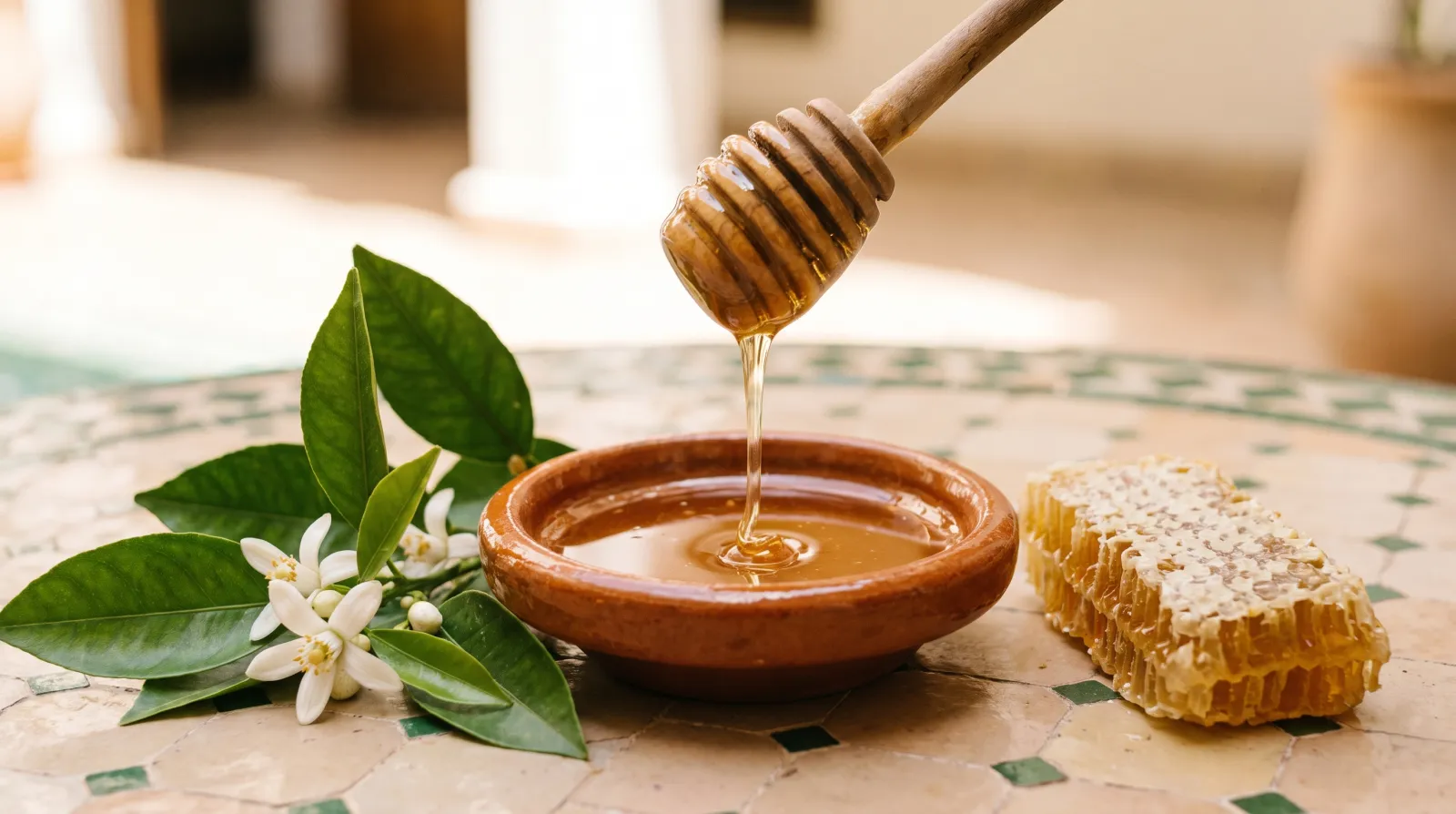
Honey attracts and holds water: the CosIng database lists emollient, humectant and moisturizing functions for it. In a clay mask or a gentle cleanser, it moisturizes and softens the skin, which stays comfortable after rinsing.
In a shampoo or hair mask, its humectant role helps keep lengths supple and easy to detangle. It pairs well with argan oil, which nourishes the fiber.
It brings a soft texture, an amber color and a story that is simple to tell. In a scrub, it binds the grains and makes the massage more pleasant.
As a mask, apply an even layer on clean skin, avoiding the eye area. Leave it on for a few minutes, then rinse with lukewarm water.
Bath oil is poured into warm water, and shower oil emulsifies on contact with water. The scrub is massaged onto damp skin, then rinsed off.
Shampoo is lathered on a wet scalp, then rinsed. The mask is applied to towel-dried lengths, before a thorough rinse.
We add it to face masks, bath and shower oils, scrubs and shampoos ready to carry your brand. Pick a category to see the formulas.
What our formulators take into account when orange blossom honey goes into your product.
Often paired with
The INCI list shows MEL, with no floral origin. The “orange blossom honey” mention is reserved for a honey whose supplier documents the floral origin with its certificate of analysis.
Quality varies from one honey to another: monitoring studies of Moroccan honeys have found residues in some batches. We require a certificate of analysis for every batch (residues, heavy metals).
Pure honey protects itself through its high sugar concentration; diluted in a water-based formula, it no longer does. The complete formula therefore receives a validated preservative system and is made with reverse osmosis water.
We add it at a moderate temperature to preserve its light shade and aroma. Your claims stay cosmetic: moisture, softness, comfort, with no therapeutic promise.
Under the international Codex Alimentarius standard, a honey can carry the name of a flower only if it comes entirely or mainly from that source, with the matching properties.
For blossom honey, the Codex sets at least 60 g of fructose and glucose per 100 g, and at most 20% water.
This aromatic molecule is one of the chemical markers of citrus honeys, along with hesperidin, a flavonoid typical of Citrus.
Honey is a humectant: it attracts water and helps skin hold it. The European CosIng database lists emollient, humectant and moisturizing functions for it. In a mask or a gentle cleanser, it leaves skin soft and comfortable, and softens clay masks, which can feel tight.
With a formulated mask, apply an even layer on clean skin, leave it on for a few minutes, then rinse with lukewarm water. In a homemade version, pure honey is sticky and runny; it is often mixed with a clay such as kaolin or rhassoul (ghassoul). Avoid the eye area and patch test on a small area first.
It is a honey produced from the nectar of orange blossoms. To carry this name, it must come entirely or mainly from that source, according to the Codex Alimentarius standard. It is pale yellow, with a fresh orange blossom aroma, and contains markers specific to citrus, such as methyl anthranilate.
Honey is declared as MEL in the INCI list. The European CosIng database lists emollient, humectant and moisturizing functions for it. The floral origin does not appear in this name: the “orange blossom honey” mention goes in the product name or description, provided the supplier documents it.
In a shampoo or hair mask, honey plays its humectant role: it helps keep lengths supple and easier to detangle. It is often paired with argan oil, which nourishes the fiber. In a finished product, it is dosed so it does not weigh hair down or feel sticky.
Not if it is well formulated. Honey dissolves in water: in a mask, cleanser or shampoo, it spreads through the formula and rinses off easily. Our formulators adjust its role to the texture wanted, pairing it with clays, oils or gels.
Yes. We add it to white label face and body masks, bath and shower oils, scrubs, cleansers and shampoos, or to an exclusive private label formula, made in our ISO 22716 factory in Morocco. The consultation is free and comes with no commitment.
Send your brief: we formulate and manufacture in our ISO 22716 factory in Aït Melloul. Free consultation and formula selection, no commitment.