For hair
Rich in oleic acid, it forms a film that seals the cuticle and holds moisture in the fiber. Dry, thick or curly lengths gain suppleness and softness, as a pre-shampoo oil treatment or in a mask.
Services
Catalog
Explore the full catalog1,000+ formulas ready to carry your brandFace careFull range
Serums, creams and targeted care, formulated with your actives.
Hair careFull range
From shampoo to leave-in, for every hair type.
Body careFull range
Moisturizing, nourishing and shower care: cream, butter or oil.
Hammam and naturalFull range
Black soap, argan and authentic Moroccan rituals.
Specialty careFull range
Sun care, lips, intimate care and oral care.
Industries
All solutions by industryFormulas and formats for your businessHospitality and wellness
Brands and creators
Our brands
Our own brands, developed and made in our laboratory.

 DermocosmeticsSublime CosmeticsFace, sun and body care for pharmacies and drugstores.Visit the website

 Hammam and spaLalla MamaMoroccan hammam rituals: black soap, rhassoul, oils and body care.Visit the website

 Equine careStallionGrooming care for horses: mane, coat and hooves.Visit the website
Laboratory
 Our factory in Aït MelloulISO 22716 and ISO 9001, visits by appointmentDiscover the factory
Cosmetics manufacturer based in Agadir
500+ brands35+ countries1,000+ formulas
Our factory in Aït Melloul
Up to 3 million units a yearVisits by appointment
Contract manufacturing, step by step
RegulationsCostsProject steps
Join our teams in Agadir
FormulationProductionQualityRegulatorySales
Resources
The olive tree a gnarled trunk, grown across Morocco.
The olives green, then black, picked at maturity.
The press the fruit crushed under a millstone, then pressed.
The oil a golden-green drop, ready for the formula.
By the Carmel Cosmetics Labs R&D team · updated October 18, 2026
Olive oil is the oil obtained by pressing the pulp of olives, the fruit of the olive tree (Olea europaea). In cosmetics, it is declared as OLEA EUROPAEA FRUIT OIL and acts as an emollient: it nourishes and softens dry hair, body skin and lips. It is made up mostly of oleic acid, with sterols, carotenoids and phenolic compounds. It appears in hair masks, oils, lip balms and black soap.
Rich in oleic acid, it forms an emollient film on the surface of the hair that seals the cuticle and holds in moisture. It suits dry, thick or curly lengths, as a pre-shampoo oil treatment or in a mask.
With a low molecular weight and a straight chain, it penetrates the hair shaft more. It is the most studied oil for limiting protein loss during washing.
In our masks and hair oils, olive oil is often paired with coconut, castor or argan oils: each brings its own texture and feel.
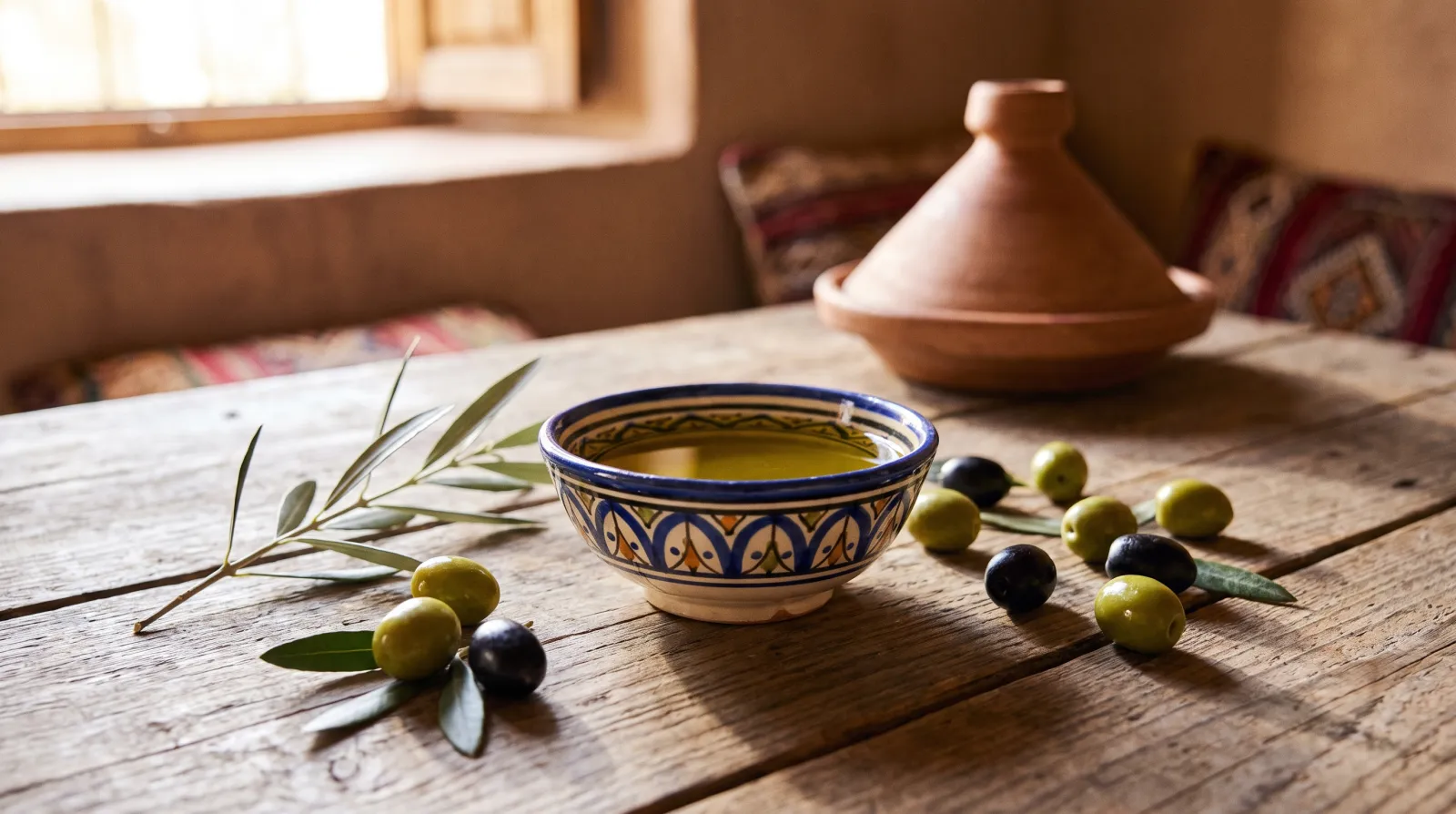
Rich in oleic acid, it forms a film that seals the cuticle and holds moisture in the fiber. Dry, thick or curly lengths gain suppleness and softness, as a pre-shampoo oil treatment or in a mask.
On the body and lips, it nourishes and softens dry areas. On the face, we pair it with oils richer in linoleic acid, which respect the skin barrier better.
It brings a rich feel, a name everyone knows and a strong Mediterranean identity. The European CosIng database lists skin conditioning and perfuming functions for it.
As a pre-shampoo oil treatment, once a week for example: a few drops spread over the lengths and ends, left on before shampooing. In a mask, it is applied after washing, then rinsed out.
Preferably in a blend, in a rinse-off cleansing oil or balm: it dissolves makeup and leaves skin supple. On sensitive skin, choose a formula where it is not the main ingredient.
On skin still damp after the shower, or in the hammam in black soap: applied to warm skin, it is rinsed off before scrubbing with a kessa glove.
We add it to hair masks, shampoos and conditioners, black soaps, lip balms and oils ready to carry your brand. Pick a category to see the formulas.
Catalog products with olive oil
What our formulators take into account when olive oil goes into your product.
Often paired with
A virgin oil keeps its green color, fruity smell and phenolic compounds; a refined oil is more neutral. We choose the grade according to the finish and fragrance targeted.
Oleic acid, the main component of olive oil, has been studied for its effect on the skin barrier with repeated application. For the face and sensitive skin, we pair it with oils rich in linoleic acid.
Like any unsaturated oil, it can go rancid: we check smell and color on receipt, add an antioxidant and follow the formula through stability testing.
The INCI list shows OLEA EUROPAEA FRUIT OIL. In a black soap, the oil is saponified with potash: it then appears under the name of its salt, POTASSIUM OLIVATE.
According to the International Olive Council, Morocco has 1.24 million hectares of olive groves, and the sector covers about a quarter of the country's edible oil needs.
Morocco is home to Tassaout, in the Marrakech region, the second largest collection of olive tree varieties in the world. The country is also a founding member of the International Olive Council.
In a survey of 70 herbalists in the Fès-Meknès region, the olive tree, called zaytoune, is among the plants cited for hair and nail care.
Olive oil forms an emollient film that seals the cuticle and holds moisture in the fiber. Dry, thick or curly hair becomes more supple, softer and easier to style. It penetrates the hair less than coconut oil: it works mostly on the surface, on the lengths and ends.
As a pre-shampoo oil treatment: spread a few drops over the lengths and ends, leave on, then wash. A second shampoo avoids a greasy look on fine hair. In a mask or conditioner, it is applied after washing and rinsed out.
Yes, but preferably in a blend. Its oleic acid has been studied for its effect on the skin barrier with pure, repeated application. In a face care product, it works better paired with oils rich in linoleic acid, or used in a rinse-off makeup remover. Patch test on a small area.
It nourishes and softens dry areas: elbows, knees, hands and lips. It is best applied on skin still damp after the shower, with a light massage. In a body lotion or butter, its rich texture pairs well with shea butter and lighter oils.
Virgin oil keeps its green color, fruity smell and phenolic compounds: it suits products that claim a natural character, such as black soap. Refined oil, more neutral in color and smell, blends better into a fragranced cream or a light-colored care product.
Its INCI name is OLEA EUROPAEA FRUIT OIL. The European CosIng database lists skin conditioning and perfuming functions for it. In a soap, the saponified oil is declared as POTASSIUM OLIVATE or SODIUM OLIVATE depending on the alkali used: potash for a soft black soap, soda for a solid soap.
Yes. We add it to white label hair masks, shampoos and conditioners, black soaps, lip balms and oils, or to an exclusive private label formula, made in our ISO 22716 factory in Morocco. Free samples and a free consultation.
Send your brief: we formulate and manufacture in our ISO 22716 factory in Aït Melloul. Free consultation and formula selection, no commitment.