


















































Services

Torn between two services?A project manager will guide you

Catalog

Explore the full catalog1,000+ formulas ready to carry your brand

Face careFull range

Serums, creams and targeted care, formulated with your actives.

Body careFull range

Moisturizing, nourishing and shower care: cream, butter or oil.

Specialty careFull range

Sun care, lips, intimate care and oral care.

Men, baby, makeupFull range

Shaving and beard, baby and mom, makeup.

Industries

All solutions by industryFormulas and formats for your business

Our brands

Our own brands, developed and made in our laboratory.

Become a distributor of our brandsPharmacies, spas, shops and wholesalers

Laboratory

Cosmetics manufacturing room with a row of stainless-steel mixers and an operator in white workwearOur factory in Aït MelloulISO 22716 and ISO 9001, visits by appointmentDiscover the factory

Resources

Chili pepper extract (Capsicum annuum)

Chili pepper extract (Capsicum annuum) comes from the fruit of a Solanaceae and contains capsaicin, the pungent component of chili pepper15. Applied to the lips, capsaicin causes a burning sensation and an increase in local blood flow and temperature6. The CIR panel notes possible irritation at low concentration and asks for caution4.

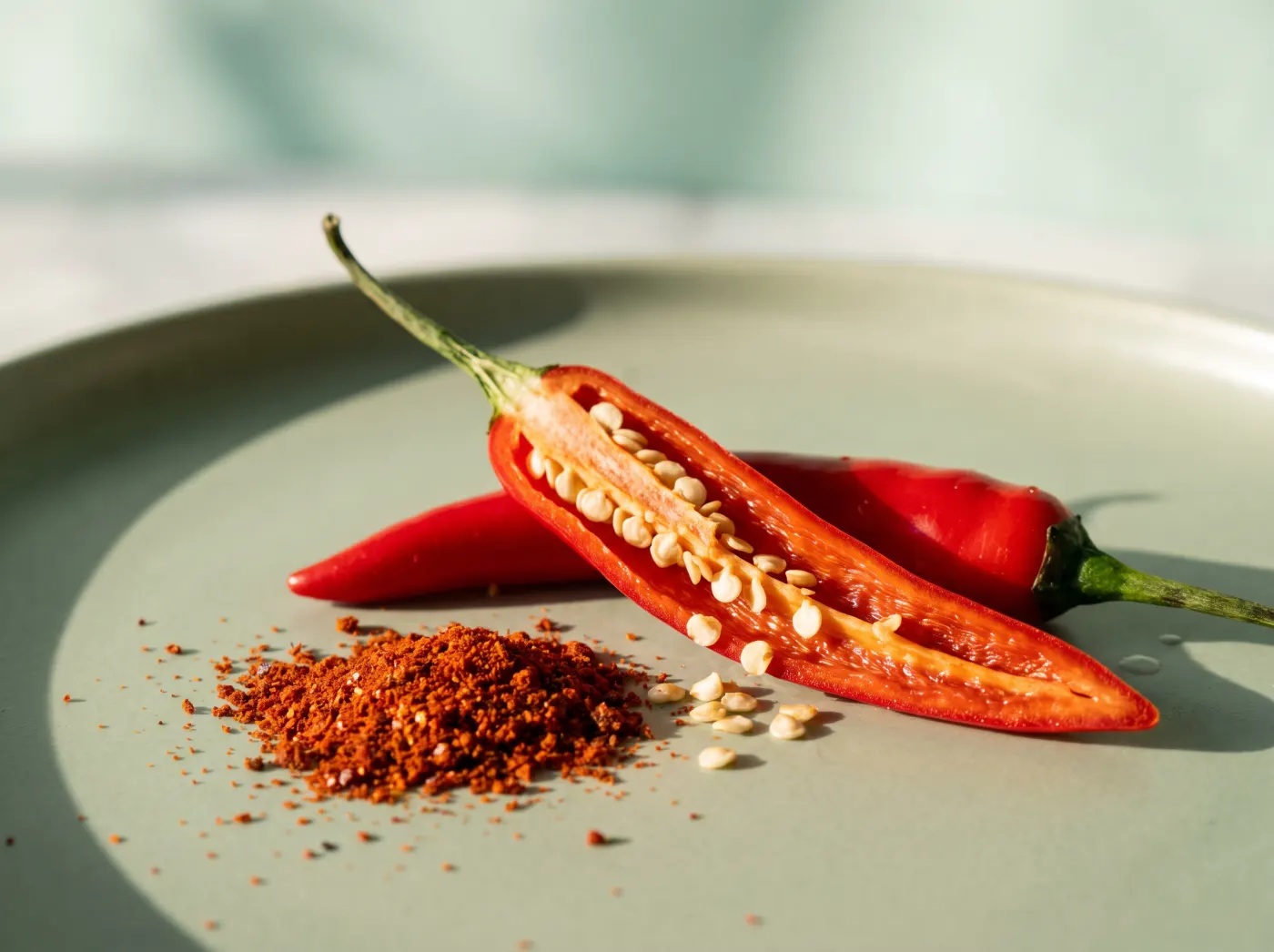
Dried chili peppers in macro view on a sage green ceramic surface

Chili pepper extract at a glance

Entry from our cosmetic ingredient glossary. Regulatory data from the European Commission's CosIng database1, restrictions under Regulation (EC) 1223/20092, safety according to the CIR expert panel4. Copy the identifiers in one click for your files.

INCI name
CAPSICUM ANNUUM FRUIT EXTRACTCosIng describes an extract of the fruits of Capsicum annuum L., Solanaceae1. The CIR report also covers Capsicum frutescens extracts and capsaicin4
Other names
Chili pepper, cayenne pepperThe lip care products in the catalog cite chili pepper extract, including a cayenne version
CAS number
84625-29-6
EC number
283-403-6
Botanical origin
Capsicum annuum L., Solanaceae (fruit)Fruit extract for this CosIng entry1
Compounds of interest
CapsaicinMain pungent component of chili pepper; it activates the TRPV1 receptor of sensory neurons5. A cosmetic extract can be obtained with hexane, ethanol or vegetable oil and contains all the compounds of the pepper4
CosIng function
Antiseborrheic, antimicrobial, antioxidant, astringent, hair conditioning, skin protectingFunctions declared in CosIng1: they are not claims. In our lip care products, the extract is used for the plumping sensation
Standardization
Varies with the extractThe capsaicin grade, and therefore the intensity of the heat, is set in the raw material specification
EU status
No restriction listedAbsent from Annexes II and III of the text consolidated on 1 May 2025 (search for "Capsicum", "capsaicin" and "chili pepper" in the text)2. The CIR panel nevertheless recommends caution with ingredients that contain capsaicin4
Allergen to declare
Not listedAbsent from the fragrance allergen list of Regulation (EU) 2023/15453
Safety
Irritating at low concentration2007 CIR report: the ingredients can irritate at low concentration; capsaicin increased the skin penetration of another active; aflatoxin to be excluded (≤ 15 ppb), no use where N-nitroso compounds can form4

What the research says

Each result shows the protocol and the level of evidence. The higher the level, the better the result carries over to a finished formula.

Clinical trialReview or consensusLaboratory

Skin and lipsSensation and irritation

On the lips: burning, blood flow and temperature go up

Clinical trial
Cream with 1% capsaicin against a control creamLips and tongueMeasurements at 5, 15 and 30 minutes

Capsaicin causes a burning sensation and increases local blood flow and temperature, without changing mechanical sensitivity. The effect is stronger on the lips than on the tongue. This sensory and vascular response underlies the warming effect; the study measures neither volume nor plumping6.

A burn followed by desensitization

Review
2019 reviewCapsaicin and sensory neurons

Capsaicin first excites sensory neurons, with a local burning sensation and a neurogenic reaction, then causes desensitization. At high exposure, structural changes in nerve endings are described. Hence the value of a measured dose5.

Less irritation with an encapsulated formula

Clinical trial
Gel with 0.25% capsaicin (chili oleoresin) in lipid nanocarriers30 volunteersComparison with a free chili gel and a commercial product

The irritation and discomfort felt are lower with the encapsulated formula than with the free chili gel and the commercial product. The nanocarriers also improved physical and chemical stability. Trial on a specific formula, not on a chili extract alone7.

Safety2007 CIR report

Limited use, up to 5%

Expert assessment
2007 CIR reportExtracts, resins, fruit powder and capsaicin

Chili-derived ingredients were used in 19 cosmetic products, at concentrations up to 5%. Capsaicin itself was not in common use. Contaminants were detected: aflatoxin and N-nitroso compounds4.

Human skin tests: little irritation at 0.025%

Clinical trial
Repeated patch test on 103 peopleCapsicum frutescens extract at 0.025%Commercial blend at 1-5% in 10 volunteers

At 0.025%, no clinically significant irritation or contact allergy. A blend containing 1 to 5% of extract caused very slight erythema in 1 volunteer out of 10 after 48 h. Provocative exposure tests also showed that capsaicin is irritating to the skin4.

Caution requested by the panel

Expert assessment
2007 CIR report

The ingredients can irritate at low concentration. Capsaicin increased the skin penetration of another active: the panel recommends caution. It asks for the absence of aflatoxin (≤ 15 ppb) and for these ingredients not to be used where N-nitroso compounds can form. Capsaicin is irritating to the eye in mice, rats and rabbits4.

This page summarizes published literature on a cosmetic ingredient. It does not describe the effect of a finished product, which depends on its formula, and it is not medical advice. Capsaicin is mostly studied for pain, outside the cosmetic scope: these uses are not covered here. No published study measuring a plumping effect on the lips was found.

Which products use chili pepper extract?

Our white label catalog includes 2 formulas with chili pepper extract, always as a supporting ingredient. Every category can be customized (formula, fragrance, packaging).

2Face

Common uses: lip care and glosses with a warming, plumping sensation.

In our formulas, it is most often paired with

Aker Fassi (tinted version) 1Shea butter 1Hydrolyzed collagen 1Sweet almond oil 1Menthol 1

Frequently asked questions about chili pepper extract

What is chili pepper extract?
It is an extract of the fruit of Capsicum annuum, a Solanaceae, declared CAPSICUM ANNUUM FRUIT EXTRACT1. It contains capsaicin, the pungent component of chili pepper5.
What does capsaicin do on the lips?
On the lips, capsaicin causes a burning sensation and increases local blood flow and temperature6. This explains the warming feel of plumping glosses and lip care. No study found measures a gain in volume: the announced effect remains sensory.
What percentage of chili pepper extract should you use?
The CIR report cites chili-derived ingredients used up to 5%4, and a repeated patch test with 0.025% of extract without significant irritation in 103 people4. The dose is set with the formulator according to the desired heat intensity and with a tolerance test.
Is chili pepper extract irritating?
Yes, it can be: the CIR panel states that these ingredients can irritate at low concentration4, and capsaicin produces a burning sensation5. An encapsulated formula with 0.25% capsaicin was less irritating than a free chili gel in 30 volunteers7.
What precautions apply to chili pepper extract?
The CIR panel recommends caution, notes the eye irritation of capsaicin in animals and asks for the absence of aflatoxin4. We recommend avoiding the eye area and running a tolerance test on the finished product. The regulation sets no limit for this extract2.
What should you pair chili pepper extract with?
In our lip care products, it is paired with menthol, hydrolyzed collagen, hyaluronic acid, sweet almond, castor, sesame and coconut oils, and shea butter. The stability of the final formula is checked with laboratory tests.
Can you manufacture a plumping gloss or lip care product for my brand?
Yes. Our ISO 22716 certified lab offers 2 lip care products with chili pepper extract (plumping gloss, volumizing care) to customize, or a custom formula. Free samples are included.

Sources

Peer-reviewed studies and official regulatory sources, checked on November 3, 2026.

  1. European Commission. CosIng, entry CAPSICUM ANNUUM FRUIT EXTRACT (CAS 84625-29-6, EC 283-403-6). ec.europa.eu/growth/tools-databases/cosing
  2. European Parliament and Council. Regulation (EC) No 1223/2009 on cosmetic products, consolidated text of 1 May 2025 (Annexes II to VI). EUR-Lex. eur-lex.europa.eu
  3. Commission Regulation (EU) 2023/1545 of 26 July 2023 amending Regulation (EC) No 1223/2009 of the European Parliament and of the Council as regards labelling of fragrance allergens in cosmetic products (Annex III). eur-lex.europa.eu
  4. Cosmetic Ingredient Review Expert Panel. Final report on the safety assessment of capsicum annuum extract, capsicum annuum fruit extract, capsicum annuum resin, capsicum annuum fruit powder, capsicum frutescens fruit, capsicum frutescens fruit extract, capsicum frutescens resin, and capsaicin. Int J Toxicol. 2007;26(Suppl 1):3-106. doi:10.1080/10915810601163939
  5. Ilie MA, Caruntu C, Tampa M, et al. Capsaicin: Physicochemical properties, cutaneous reactions and potential applications in painful and inflammatory conditions. Exp Ther Med. 2019;18(2):916-925. doi:10.3892/etm.2019.7513
  6. Boudreau SA, Wang K, Svensson P, et al. Vascular and psychophysical effects of topical capsaicin application to orofacial tissues. J Orofac Pain. 2009;23(3):253-264. PMID 19639105
  7. Anantaworasakul P, Anuchapreeda S, Yotsawimonwat S, et al. Nanomaterial Lipid-Based Carrier for Non-Invasive Capsaicin Delivery; Manufacturing Scale-Up and Human Irritation Assessment. Molecules. 2020;25(23):5575. doi:10.3390/molecules25235575
Carmel Cosmetics Labs product specialist with a brand founder

Tell us about your project

A product specialist reviews your request and gets back to you on the channel you prefer.

Lead EN – Demande de devis
Tell us about your project. A product specialist will get back to you shortly.
CONTACT INFORMATION
Name
PROJECT INFORMATION
Which cosmetics category interests you most?

By submitting this form, you agree to our terms of service and privacy policy.

No obligation. Your information stays confidential and is used only to prepare your quote.