Judged safe by the CIR panel
Expert assessment2018 CIR panelChamomilla recutita-derived ingredients
Safe in current uses and concentrations, provided they are formulated to be non-sensitizing. The panel also asks that impurities in botanical materials be limited through good manufacturing practices3.
Contact allergy: rare, but documented
Review2002 reviewAsteraceae (Compositae)
At least 15 species of the family, including German and Roman chamomile and calendula, have been suspected of sensitizing. For German chamomile, widely used, sensitization remains rare; sesquiterpene lactones are the main allergens4.
People already sensitized react
Case series12 people sensitized to chamomileTests with preparations
8 of 12 people reacted to preparations containing chamomile (herbal tea, creams, balms, oil). The authors advise people allergic to this family against topical use of Asteraceae-based products5.
A flower compound that degrades into a reactive molecule
LaboratoryIn vitro assay-guided fractionationKeratinoSens and LLNA
Tonghaosu, a polyacetylene from the flower, is unstable: as it ages, it forms a reactive compound, potentially sensitizing in the LLNA test. Extract aging is therefore a control point6.
A case of contact urticaria with a wet wipe
Clinical case2022 case report
Contact urticaria attributed to the chamomile in a wet wipe is described. An isolated case, which is a reminder that a reaction remains possible7.
Two plants, and frequent substitutions
Review2010 and 2011 reviews
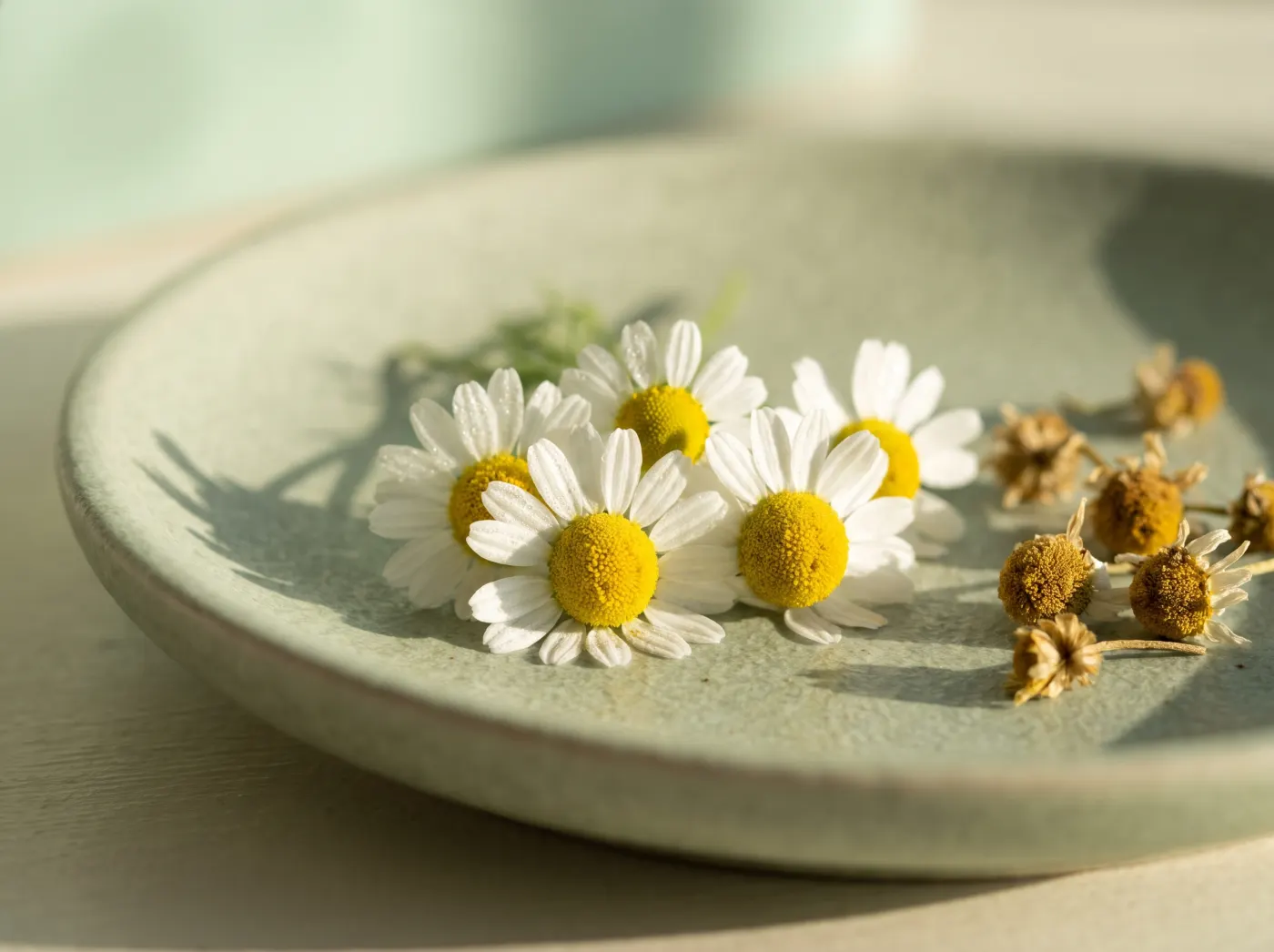
German chamomile (Chamomilla recutita) and Roman chamomile (Chamaemelum nobile) are two distinct plants12. Market material is often adulterated or replaced by related species13: botanical identification is part of the specification.