


















































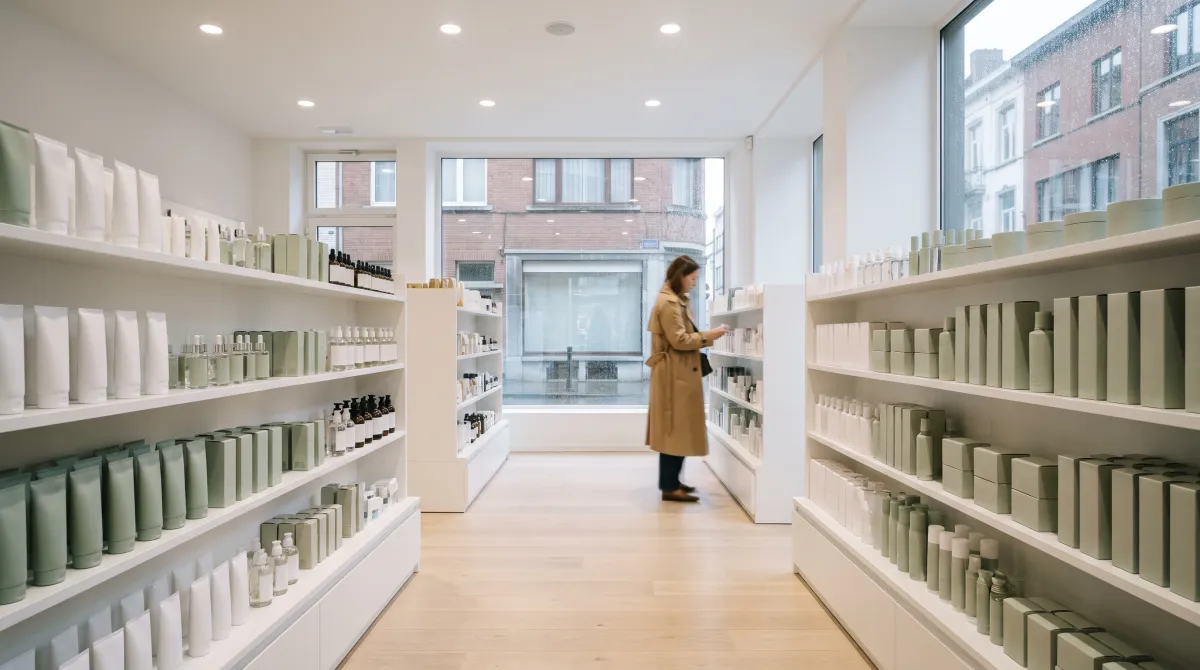
The best-selling cosmetics in Belgium are skincare and makeup: this group accounts for 43.6% of the $2.89 billion of cosmetics the country imported in 2025 (UN Comtrade). Fragrances follow (18.9%), then deodorants and bath products (14%), and hair care (11.1%).
Key takeaways
- Skincare and makeup lead: $1,258.5M imported in 2025 (HS code 3304), and skincare remains the top category of the market according to Euromonitor.
- Fragrances are surging: imports up 15.4% between 2024 and 2025, the fastest growth of the six families studied.
- Supermarkets come first, followed by drugstores (Kruidvat, Di), pharmacies and e-commerce, which is gaining share under the influence of social media.
- Retailer private labels: 40.3% of food and drugstore sales by value in 2025 (PLMA), but national brands still dominate cosmetics.
- Labeling by region: the function and directions for use must appear in French, Dutch or German depending on the region of sale.
Method: since there is no public ranking of sales by category, we cross-check the imports reported by Belgium to UN Comtrade (extraction of October 17, 2026, current dollars), the summary from Euromonitor International, the 2026 PLMA report and retailer data. Imports give an order of magnitude, not exact consumption.
What are the best-selling cosmetics in Belgium?
Skincare, makeup and sun care form by far the largest family of cosmetics sold in Belgium, with $1,258.5 million imported in 2025. The HS code (Harmonized System) is the international customs nomenclature that classifies every good; code 3304 covers creams, serums, sun protection, and eye, lip and nail products.
| Rank | Category | HS code | 2025 imports ($M) | Share | Change 2024-2025 |
|---|---|---|---|---|---|
| 1 | Skincare, makeup, sun care, manicure | 3304 | 1,258.5 | 43.6% | +1.9% |
| 2 | Perfumes and eaux de toilette | 3303 | 546.8 | 18.9% | +15.4% |
| 3 | Deodorants, shaving, bath products | 3307 | 404.4 | 14.0% | +8.5% |
| 4 | Hair care (shampoos, colorants, hairsprays) | 3305 | 320.2 | 11.1% | +12.7% |
| 5 | Soaps and skin cleansing products | 3401 | 233.5 | 8.1% | +13.4% |
| 6 | Oral hygiene | 3306 | 125.3 | 4.3% | +0.9% |
| Total | 2,888.7 | 100% | +7.1% |
This ranking matches the reading from Euromonitor International: skincare consolidates its first place, while makeup drives growth. One caveat: across these six codes, Belgium exported $3,175.6M in 2025, more than it imported, because part of the flows transit through the country before being re-exported. For a comparison with a neighboring market, see our ranking of the best-selling cosmetics in France.
Why does skincare dominate the Belgian cosmetics market?
Skincare dominates because demand is shifting toward accessible dermocosmetics sold beyond pharmacies alone. According to Euromonitor International, renewed consumer confidence supports both premium dermocosmetics and a more refined mass offer, and CeraVe is pulling the mass dermocosmetics segment.
Dermocosmetics are skincare products formulated for sensitive skin, developed with a dermatological approach and long reserved for pharmacies. In Belgium, these products are now reaching drugstores and e-commerce.
Another signal: skincare and makeup imported from South Korea rose from $16.9M in 2023 to $30.5M in 2025 (UN Comtrade), up 81% in two years. K-beauty is thus widening the skincare aisle beyond the historic European brands. To see which products drive this movement, read our analysis of the ten best-selling dermocosmetics in Europe.
Where do Belgians buy their cosmetics?
Supermarkets remain the top sales channel for cosmetics in Belgium, ahead of drugstores, pharmacies, perfumeries and e-commerce. Euromonitor International points to the leadership of mass retail, but also to the fast growth of health and beauty stores and of online platforms driven by social media.
| Channel | Retailers or players | Key figure | Best sellers |
|---|---|---|---|
| Mass retail | Delhaize, Colruyt, Carrefour, Aldi, Lidl | Top channel (Euromonitor) | Hygiene, hair care, everyday care, private labels |
| Health and beauty drugstores | Kruidvat, Di | Kruidvat: more than 300 stores; Di: about a hundred points of sale in Belgium | Makeup, face care, accessible dermo, K-beauty |
| Pharmacies and parapharmacies | Independent pharmacies and groups | 4,951 pharmacies, of which 4,658 open to the public (SIRIUS Insight) | Dermocosmetics, sun care, care for sensitive skin |
| Perfumeries and selective retail | ICI Paris XL, Sephora (since June 2026) | First Belgian Sephora opened on June 25, 2026 | Prestige fragrances, makeup and skincare |
| E-commerce | Pure players and retailer websites | Share rising (Euromonitor) | Viral skincare, K-beauty, restocking |
Drugstores play a central role. Kruidvat reports more than 3,500 employees and more than 300 stores in Belgium, with an average of ten openings a year, according to Kruidvat (press release of August 14, 2025). Di, refocused on beauty since 2016, is mainly present in Brussels and Wallonia. Parapharmacy refers to health and beauty products sold without a prescription, in pharmacies or in dedicated spaces.
Selective retail is moving too: Sephora opened its first Belgian store on June 25, 2026 at Docks Bruxsel, with more than 270 m² and more than 90 brands, according to Paris Match Belgique.
What is the role of retailer private labels in Belgian cosmetics?
Retailer private labels carry real weight in Belgium, with 40.3% of sales by value and 56.7% by volume in 2025, but they remain a minority in cosmetics. These figures from the 2026 PLMA report, drawn from NielsenIQ panels, cover all fast-moving consumer goods and not beauty alone.
A retailer private label (store brand) is a brand owned by the retailer that sells it, not by the manufacturer that produces it. The PLMA notes that national brands still dominate categories where innovation and emotional attachment matter, including cosmetics, and that this is particularly true of Belgium.
In 2025, national brand sales in euros grew 4.2% in Belgium, against 2.8% for private labels, on a panel of €23.9 billion.
For a retailer, the challenge is therefore to offer private labels that compete on texture, tolerance and packaging. See the criteria buyers use to choose a private label manufacturer, as well as our explanation of the difference between white label and private label.
Where do the cosmetics sold in Belgium come from?
France is Belgium’s top supplier of skincare and makeup, with $286.1M in 2025, ahead of the Netherlands and Italy. These three countries account for more than half of imports under code 3304.
| Supplier country | Skincare and makeup imported in 2025 ($M, HS 3304) |
|---|---|
| France | 286.1 |
| Netherlands | 232.1 |
| Italy | 154.0 |
| Germany | 79.5 |
| United Kingdom | 76.0 |
| United States | 55.3 |
| China | 38.0 |
| South Korea | 30.5 |
| Spain | 29.5 |
| Morocco | 2.35 |
Morocco’s share remains modest: $2.35M of skincare and makeup and $0.52M of fragrances sold to Belgium in 2025. There is therefore room to grow in a market that is partly French-speaking and close by. For the big picture, see our 2025 ranking of Moroccan cosmetics exports to Europe.
What are the cosmetics trends in Belgium in 2026?
The cosmetics trends in Belgium in 2026 are accessible dermocosmetics, K-beauty, the rise of fragrance and ingredient transparency.
- Mass dermocosmetics: skincare with a dermatological approach sold in drugstores and online, no longer only in pharmacies (Euromonitor).
- K-beauty: Korean imports of skincare and makeup up 81% between 2023 and 2025 (UN Comtrade).
- Fragrance: imports up 15.4% in 2025, a family that also benefits from the arrival of Sephora.
- Sun protection and transparency: Detic, the Belgian industry federation, ran “Soleil malin” campaigns in 2025 and promoted the COSMILE Europe app, reaching more than 500,000 consumers according to its 2025 Detic activity report.
Detic is the association that represents the cosmetics sector in Belgium and Luxembourg; its members cover more than 90% of the Belgian market by volume, according to belgiancosmetics.be.
What do you need to sell cosmetics in Belgium?
To sell cosmetics in Belgium, you need a product that complies with Regulation (EC) No 1223/2009, notified on the CPNP portal and labeled in the language of the region of sale. The CPNP (Cosmetic Products Notification Portal) is the European portal where every product is declared before it is placed on the market.
- Choose your channel: each one imposes its own formats, price and level of proof.
- Build the file: safety report and Product Information File (PIF), the technical file kept available for the authorities.
- Notify the product on the CPNP before the first sale, including any label translation, states the FPS Public Health (SPF Santé publique).
- Adapt the label to the region of sale (see the table below).
- Prepare cosmetovigilance: report serious undesirable effects to the FPS without delay.
| Region of sale | Mandatory language for function and directions for use |
|---|---|
| Brussels-Capital | French and Dutch |
| Flanders | Dutch |
| Wallonia | French |
| German-speaking Belgium | German |
Source: FPS Public Health, page updated on June 22, 2026. For the full set of European requirements, see our guide to the standards to meet when exporting cosmetics to Europe, and our regulatory and PIF support if you want to delegate building the file.
The manufacturer’s view
Design your packaging for the Benelux from the start. Plan a bilingual French-Dutch carton and label before the first production run: reprinting afterward costs more than leaving text space up front.
Choose the category before the channel. Face care and makeup concentrate demand, but also competition. A well-targeted product, with a clear cosmetic promise and justified claims, holds up better than an overly broad range.
At Carmel Cosmetics Labs, in Agadir, we manufacture white label and contract-manufactured products under ISO 22716 good manufacturing practices and the ISO 9001 standard, in compliance with Regulation (EC) No 1223/2009. We have supported more than 500 brands in more than 35 countries, with an accessible MOQ.
Frequently asked questions
What is the best-selling beauty product in Belgium?
No public source names a single product. By category, skincare comes first according to Euromonitor. Product rankings, such as the best sellers on online retail sites, change every month and mostly reflect social media trends, especially around K-beauty and viral skincare.
How big is the Belgian cosmetics market?
The detailed panels from Euromonitor or NielsenIQ are paid and do not publish a recent free total. The best open indicator remains foreign trade: $2.89 billion of finished cosmetics imported in 2025, up 7.1% year on year. This figure includes re-exported flows and does not measure retail sales.
Are cosmetics cheaper in drugstores than in pharmacies in Belgium?
Gaps depend on brands and promotions, and no recent public study systematically compares the two channels. The trend Euromonitor observes is rather a convergence: drugstores are adding skincare with a dermatological approach, while pharmacies keep the advantage of advice and products reserved for pharmacies.
Can you sell a cosmetic labeled only in French in Belgium?
Yes in Wallonia, where French is enough for the function and directions for use. However, a product sold in Brussels must also carry these statements in Dutch, and a product sold in Flanders must carry them in Dutch. For national distribution, a trilingual label avoids retranslations.
Are retailer private labels growing in beauty in Belgium?
Private labels account for 40.3% of fast-moving consumer goods sales by value, one of the highest rates in Europe according to the PLMA. But in 2025, national brands grew faster than private labels in Belgium, and cosmetics is one of the categories where they still dominate. There is room for well-formulated, well-presented private labels.
Conclusion
Among the best-selling cosmetics in Belgium, skincare and makeup dominate, fragrance is accelerating, and drugstores and e-commerce are gaining ground. Success comes down to a well-chosen category, a label adapted to each region and a formula that stands up to national brands.
Preparing a range for the Belgian market, under your own brand or as a retailer private label? Discover our offer as a cosmetics manufacturer for Belgian brands and book a free consultation tailored to your distribution channel.