











































An oil made almost entirely of methyl salicylate
LaboratoryMethyl salicylate makes up 98.04% of the oil in one analysis1 and 95% in another, with 4.64% asarone2.
Services
Catalog
Explore the full catalog1,000+ formulas ready to carry your brandFace careFull range
Serums, creams and targeted care, formulated with your actives.
Hair careFull range
From shampoo to leave-in, for every hair type.
Body careFull range
Moisturizing, nourishing and shower care: cream, butter or oil.
Hammam and naturalFull range
Black soap, argan and authentic Moroccan rituals.
Specialty careFull range
Sun care, lips, intimate care and oral care.
Industries
All solutions by industryFormulas and formats for your businessHospitality and wellness
Brands and creators
Our brands
Our own brands, developed and made in our laboratory.

 DermocosmeticsSublime CosmeticsFace, sun and body care for pharmacies and drugstores.Visit the website

 Hammam and spaLalla MamaMoroccan hammam rituals: black soap, rhassoul, oils and body care.Visit the website

 Equine careStallionGrooming care for horses: mane, coat and hooves.Visit the website
Laboratory
 Our factory in Aït MelloulISO 22716 and ISO 9001, visits by appointmentDiscover the factory
Cosmetics manufacturer based in Agadir
500+ brands35+ countries1,000+ formulas
Our factory in Aït Melloul
Up to 3 million units a yearVisits by appointment
Contract manufacturing, step by step
RegulationsCostsProject steps
Join our teams in Agadir
FormulationProductionQualityRegulatorySales
Resources
Wintergreen essential oil is obtained from the leaves of Gaultheria fragrantissima7. It is almost entirely methyl salicylate: 98.04% and 95% in two analyses12. The oil is not named in Annex III, but methyl salicylate is: limits depend on the product, banned for children under 6 except in toothpaste, declaration above 0.001% in leave-on products89.
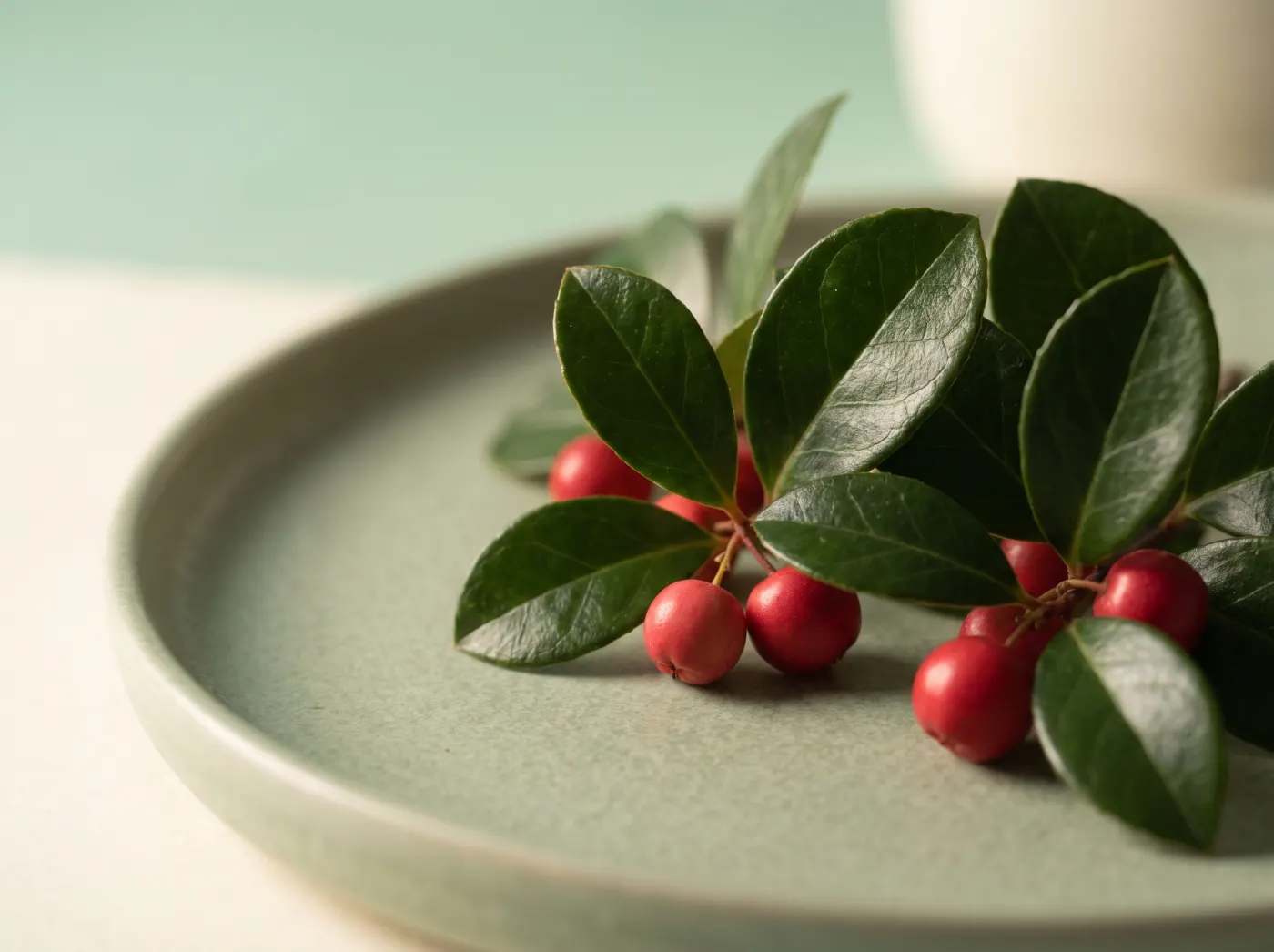
Entry from our cosmetic ingredient glossary. Regulatory data from the European Commission's CosIng database7, Regulation (EU) 2023/15458 and the consolidated Regulation (EC) No 1223/20099. The CosIng entry for this oil gives neither a CAS nor an EC number.
Each result shows the protocol and the level of evidence. The higher the level, the better the result carries over to a finished formula.
Methyl salicylate makes up 98.04% of the oil in one analysis1 and 95% in another, with 4.64% asarone2.
The oil has at most 22 identified compounds. Linalool, phenol, vetispirane and ethyl salicylate are present in commercial oils from both countries. When the oil is adulterated with synthetic salicylate, methyl salicylate does not change, but the minor compounds drop and a synthesis marker, dimethyl 2-hydroxyterephthalate, rises3. A chromatographic analysis of each batch is therefore useful.
In children under 6, a teaspoon (5 mL) or less of wintergreen oil, which contains 98% methyl salicylate, is involved in several well-documented deaths. The authors consider the risk underestimated by the general public4.
Excessive application or accidental ingestion of methyl salicylate preparations causes salicylate poisoning, sometimes fatal. The product appears every year in the US poison control database, for adults and children alike5.
With 8 patches, the peak plasma concentration of methyl salicylate is 29.5 ng/mL, versus 16.8 ng/mL with 4 patches; its terminal half-life is 3.0 hours. The authors conclude a relatively low systemic exposure, even with an unrealistic number of patches6.
This page summarizes published literature on a cosmetic ingredient. It does not describe the effect of a finished product, which depends on its formula, and it is not medical advice. Evidence is flagged by level: clinical trial, review or laboratory.
No formula in our white label catalog features wintergreen oil yet. Our formulation lab can add it to a custom formula or to a catalog formula. Its common uses:
Very limited use: the methyl salicylate limit is 0.05% in face makeup and 0.002% in eye makeup.
Fragrance of balms and massage oils, within the methyl salicylate limit of each product type and with no product intended for children under 6.
Shampoos and rinse-off care (0.06% limit); leave-on sprays limited to 0.009%.
Four aromatic materials sometimes combined in the same care fragrance. Their regulatory status differs: check it before choosing.
| Wintergreen | Clove | Camphor | Boswellia | |
|---|---|---|---|---|
| Substance named in Annex III | Methyl salicylate, line 3249 | Eugenol, line 719 | Camphor, line 3318 | α-pinene and β-pinene, line 3718 |
| Oil or resin named in Regulation (EU) 2023/1545 | No: no line for Gaultheria89 | Yes: Eugenia caryophyllus oil, line 3568 | Not applicable: a chemical substance is named8 | No: no line for Boswellia or frankincense89 |
| Concentration limit | Yes, by product: 0.002% to 2.52% methyl salicylate9 | None: declaration only89 | None: declaration only8 | None for the material; peroxide value below 10 mmol/L for pinene8 |
Peer-reviewed studies and official regulatory sources, checked on November 3, 2026.

A product specialist reviews your request and gets back to you on the channel you prefer.