Services

Torn between two services?A project manager will guide you

Catalog

Explore the full catalog1,000+ formulas ready to carry your brand

Face careFull range

Serums, creams and targeted care, formulated with your actives.

Body careFull range

Moisturizing, nourishing and shower care: cream, butter or oil.

Specialty careFull range

Sun care, lips, intimate care and oral care.

Men, baby, makeupFull range

Shaving and beard, baby and mom, makeup.

Industries

All solutions by industryFormulas and formats for your business

Our brands

Our own brands, developed and made in our laboratory.

Become a distributor of our brandsPharmacies, spas, shops and wholesalers

Laboratory

Cosmetics manufacturing room with a row of stainless-steel mixers and an operator in white workwearOur factory in Aït MelloulISO 22716 and ISO 9001, visits by appointmentDiscover the factory

Resources

Oregano (Origanum vulgare)

Oregano (Origanum vulgare, Lamiaceae) is an aromatic plant whose oil is mostly carvacrol or thymol depending on the chemotype45. Its dried, ground leaf has the INCI name ORIGANUM VULGARE LEAF, which CosIng classifies as skin conditioning1. Cosmetic studies cover the oil, in the laboratory, and also report cases of irritation710. No trial on the powder was retained.

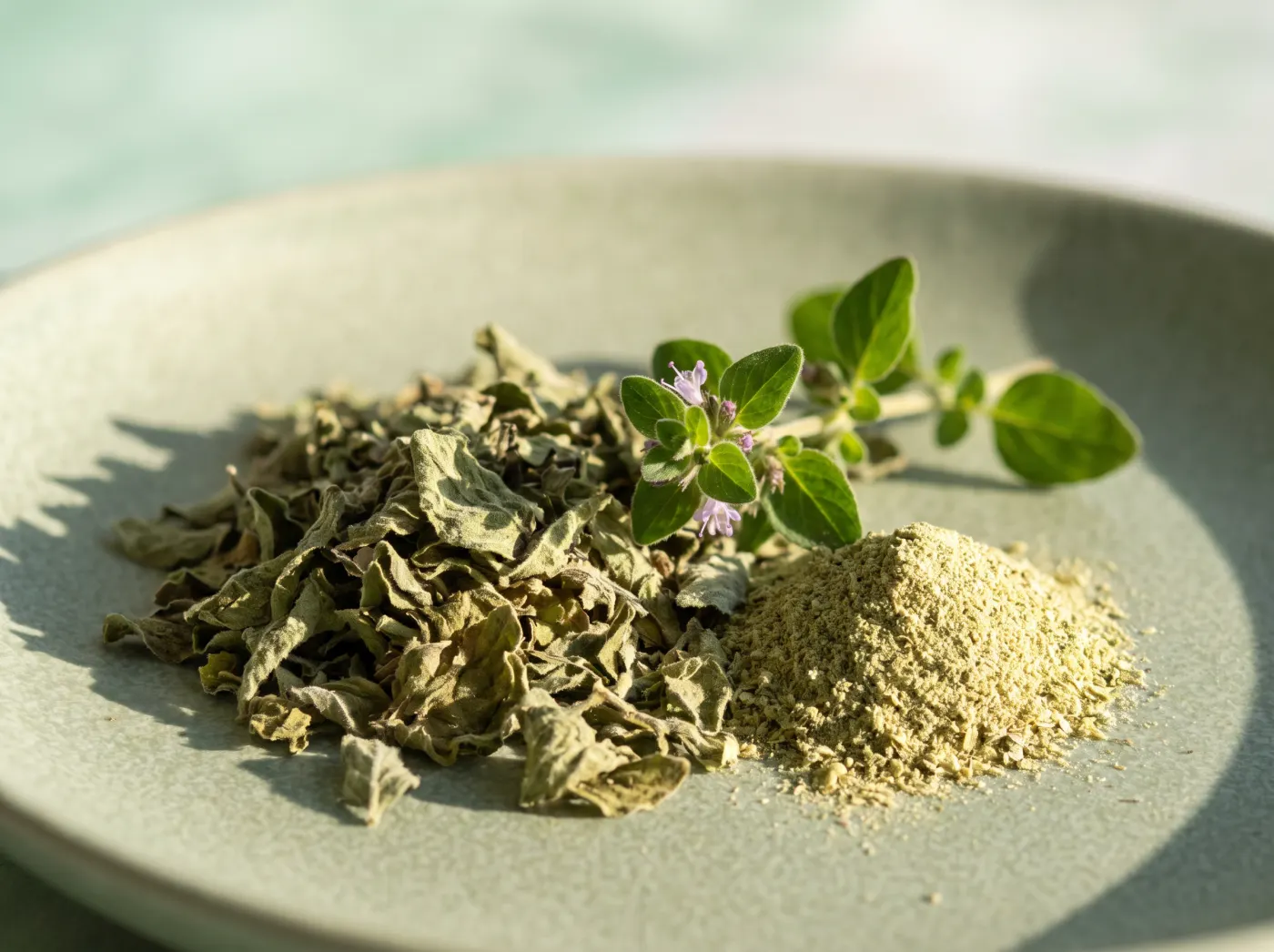
Oregano in macro view, raw material on a sage green ceramic surface, raking light

Oregano at a glance

Entry from our cosmetic ingredient glossary. Data from the European Commission's CosIng database1, consolidated Regulation (EC) No 1223/20092 and Regulation (EU) 2023/15453. Copy the identifiers in one click for your files.

INCI name
ORIGANUM VULGARE LEAFDried, shredded leaves of Origanum vulgare, per the CosIng description1
Other names
Common oreganoWild marjoram
CAS / EC number
84012-24-8 / 281-670-3CAS and EC numbers from the CosIng entry1
Botanical origin
Common oregano (Origanum vulgare L., Lamiaceae)Aromatic plant of the Lamiaceae family6. Distinct from marjoram (Origanum majorana)
Composition
Powder: not documented. Oil: carvacrol, thymol, p-cymene, γ-terpineneAcross 502 plants from 17 countries, the oil is mostly sabinene, myrcene, p-cymene, 1,8-cineole, γ-terpinene, linalool, thymol and carvacrol, with three chemotypes4. Sicilian genotypes rich in carvacrol or in thymol are described5
CosIng functions
Skin conditioningFunction from the CosIng entry ORIGANUM VULGARE LEAF1
EU status
No dedicated entry in Annexes II and IIIThe consolidated text of the regulation does not name Origanum2. No restriction specific to the plant was found
Allergen to declare
Not oregano, but some constituentsLinalool (line 84) and β-caryophyllene (line 332), cited among the compounds of oregano oils4, are named above 0.001% in leave-on products and 0.01% in rinse-off products23. Carvacrol and thymol are not. For the powder, batch analysis tells what applies
Safety
No CIR or SCCS assessment retainedTolerance is judged on the finished formula and on the batch certificate of analysis

What the research says

Each result shows the protocol and the level of evidence. The higher the level, the better the result carries over to a finished formula.

Clinical trialReview or consensusLaboratory

CompositionChemistry

Three chemotypes across 502 European plants

Laboratory
502 plants, 17 countries, 51 populationsGas chromatography

The oil compound content ranges from 0.03% to 4.6%. Depending on the share of cymyl, sabinyl or linalool and linalyl acetate compounds, three chemotypes are defined. The cymyl and acyclic pathways dominate in Mediterranean climates, the sabinyl pathway in continental climates4.

Carvacrol or thymol chemotype: a more or less complex oil

Laboratory
Two genotypes from SicilyDried leaves and flowersHydrodistillation

The carvacrol-rich genotype has a less complex profile and more carvacrol than the thymol-rich one. The oils show strong antimicrobial activity in vitro5.

Thymol and carvacrol, two pivotal molecules

Review
2025 review

Oregano oil is rich in thymol and carvacrol, compounds described as antioxidant and antimicrobial; they are also present in the extracts6.

SkinSkincare

Fewer oxidative stress markers in keratinocytes

Laboratory
Characterized oregano essential oilHuman NCTC 2544 keratinocytesStimulated with interferon-γ and histamine

The oil reduces reactive oxygen species, ICAM-1, iNOS, COX-2, the DNA damage marker 8-OHdG and the metalloproteinases MMP-1 and MMP-12, and promotes cell migration in a scratch test. A cell culture result on the oil, not on the powder7.

A cosmeceutical interest that is mostly antimicrobial

Review
2022 reviewOregano essential oil

The review ties the cosmeceutical interest of the oil to thymol and carvacrol. Work mostly covers antimicrobial activity and micro- and nanoemulsion formulations for topical application8.

An isolated glucoside reduces pigmentation in culture

Laboratory
Origanoside, a molecule isolated from oreganoB16 cells and Hs68 fibroblasts12 mice, gel for 10 days

Origanoside reduces the expression of MITF, tyrosinase and TRP-2 in culture; in mice, the skin lightens. A single isolated molecule, no human trial: the result applies neither to the powder nor to a finished product9.


ToleranceSafety

An irritation reaction after using the essential oil

Case report
Oregano essential oilUnusual use of the oil

A 2020 publication describes an irritation reaction of the skin after an unusual use of oregano essential oil10. An isolated case: it gives no frequency.

Oregano among the spices patch tested

Clinical trial
55 people suspected of contact allergySpices at 10 and 25% in petrolatum

Concordant results at 10 and 25% are most frequent with ginger (7 participants), nutmeg (5) and oregano (4). Only three participants show a response judged relevant, all spices combined11.

This page summarizes published literature on a cosmetic ingredient. It does not describe the effect of a finished product, which depends on its formula, and it is not medical advice. Evidence is flagged by level: clinical trial, review or laboratory.

Which products can use oregano?

No formula in our white label catalog features oregano yet. Our formulation lab can add it to a custom formula or to a catalog formula. Its common uses:

Body

Traditional soaps and plant powder scrubs, aromatic massage oils.

Hair

Hair care with aromatic plants, as an extract or a supporting powder.

Frequently asked questions about oregano

What is oregano in cosmetics?
It is common oregano (Origanum vulgare, Lamiaceae)6, used as a leaf powder, an extract or an essential oil. Its oil is mostly carvacrol or thymol depending on the chemotype45.
What are the benefits of oregano for the skin?
No clinical trial on the powder was retained. Studies cover the oil: reduced oxidative stress markers in cultured keratinocytes7, and a mostly antimicrobial interest according to a review8. A brand should therefore stay cautious with its claims.
What is the INCI name of oregano powder?
ORIGANUM VULGARE LEAF: CosIng describes this INCI name as the dried, shredded leaves of Origanum vulgare, with CAS 84012-24-8 and EC 281-670-31. The essential oil has its own INCI name, ORIGANUM VULGARE LEAF OIL.
What is the difference between oregano powder and oregano essential oil?
The powder is the ground leaf; the essential oil is the distilled volatile fraction, concentrated in thymol or carvacrol depending on origin45. The studies cited here cover the oil; it is also the oil that caused an irritation reaction10. The two are not interchangeable in a formula.
Do I have to declare allergens with oregano?
Oregano is not named in the regulation, but some constituents of its oils are, such as linalool and β-caryophyllene23. They must appear in the ingredient list above 0.001% in leave-on products or 0.01% in rinse-off products. The calculation is done on the finished product, from the batch analysis.
Can oregano cause an allergy or irritation?
In a series of spice patch tests, oregano was among those that gave concordant results (4 participants)11. Irritation is described with the essential oil10. Tolerance is checked on the finished formula, and a healthcare professional's advice comes first for reactive skin.
Can you make an oregano product for my brand?
Yes. Our ISO 22716 certified lab can add oregano to one of its catalog formulas to customize, or to a custom formula. Free samples are offered.

Sources

Peer-reviewed studies and official regulatory sources, checked on November 3, 2026.

  1. European Commission. CosIng, entry for the INCI name ORIGANUM VULGARE LEAF: CAS 84012-24-8, EC 281-670-3, skin conditioning function (accessed November 3, 2026). ec.europa.eu/growth/tools-databases/cosing
  2. European Parliament and Council. Regulation (EC) No 1223/2009 on cosmetic products, consolidated version of 1 May 2025: Annex III, lines 84 (linalool) and 332; no entry naming Origanum. eur-lex.europa.eu
  3. Commission Regulation (EU) 2023/1545 of 26 July 2023 amending Regulation (EC) No 1223/2009 of the European Parliament and of the Council as regards labelling of fragrance allergens in cosmetic products (Annex III). Line 332: β-caryophyllene. eur-lex.europa.eu
  4. Lukas B, Schmiderer C, Novak J. Essential oil diversity of European Origanum vulgare L. (Lamiaceae). Phytochemistry. 2015;119:32-40. PMID 26454793
  5. Zinno P, Guantario B, Lombardi G, et al. Chemical Composition and Biological Activities of Essential Oils from Origanum vulgare Genotypes Belonging to the Carvacrol and Thymol Chemotypes. Plants (Basel). 2023;12(6):1344. PMID 36987032
  6. Nurzyńska-Wierdak R, Walasek-Janusz M. Chemical Composition, Biological Activity, and Potential Uses of Oregano (Origanum vulgare L.) and Oregano Essential Oil. Pharmaceuticals (Basel). 2025;18(2):267. PMID 40006079
  7. Avola R, Granata G, Geraci C, et al. Oregano (Origanum vulgare L.) essential oil provides anti-inflammatory activity and facilitates wound healing in a human keratinocytes cell model. Food Chem Toxicol. 2020;144:111586. PMID 32679285
  8. Bora L, Avram S, Pavel IZ, et al. An Up-To-Date Review Regarding Cutaneous Benefits of Origanum vulgare L. Essential Oil. Antibiotics (Basel). 2022;11(5):549. PMID 35625193

  9. Liang CH, Chou TH, Ding HY. Inhibition of melanogensis by a novel origanoside from Origanum vulgare. J Dermatol Sci. 2010;57(3):170-177. PMID 20071152

  10. Lauriola MM, Sena P, De Bitonto A, et al. Irritant contact dermatitis after a curious therapeutic use of oregano essential oil. Contact Dermatitis. 2020;83(2):129-130. PMID 32232859
  11. Futrell JM, Rietschel RL. Spice allergy evaluated by results of patch tests. Cutis. 1993;52(5):288-290. PMID 8299390
Carmel Cosmetics Labs product specialist with a brand founder

Tell us about your project

A product specialist reviews your request and gets back to you on the channel you prefer.

Lead EN – Demande de devis
Tell us about your project. A product specialist will get back to you shortly.
CONTACT INFORMATION
Name
PROJECT INFORMATION
Which cosmetics category interests you most?

By submitting this form, you agree to our terms of service and privacy policy.

No obligation. Your information stays confidential and is used only to prepare your quote.