Services

Torn between two services?A project manager will guide you

Catalog

Explore the full catalog1,000+ formulas ready to carry your brand

Face careFull range

Serums, creams and targeted care, formulated with your actives.

Body careFull range

Moisturizing, nourishing and shower care: cream, butter or oil.

Specialty careFull range

Sun care, lips, intimate care and oral care.

Men, baby, makeupFull range

Shaving and beard, baby and mom, makeup.

Industries

All solutions by industryFormulas and formats for your business

Our brands

Our own brands, developed and made in our laboratory.

Become a distributor of our brandsPharmacies, spas, shops and wholesalers

Laboratory

Cosmetics manufacturing room with a row of stainless-steel mixers and an operator in white workwearOur factory in Aït MelloulISO 22716 and ISO 9001, visits by appointmentDiscover the factory

Resources

Amyris essential oil (West Indian sandalwood): not a true sandalwood

The INCI AMYRIS BALSAMIFERA BARK OIL designates amyris, a tree of the Rutaceae family1, not a sandalwood, which belongs to the genus Santalum. Its oil is dominated by valerianol, elemol and eudesmol isomers, not by the santalols of true sandalwood4. It is not named in Annex III2, unlike Santalum album oil3.

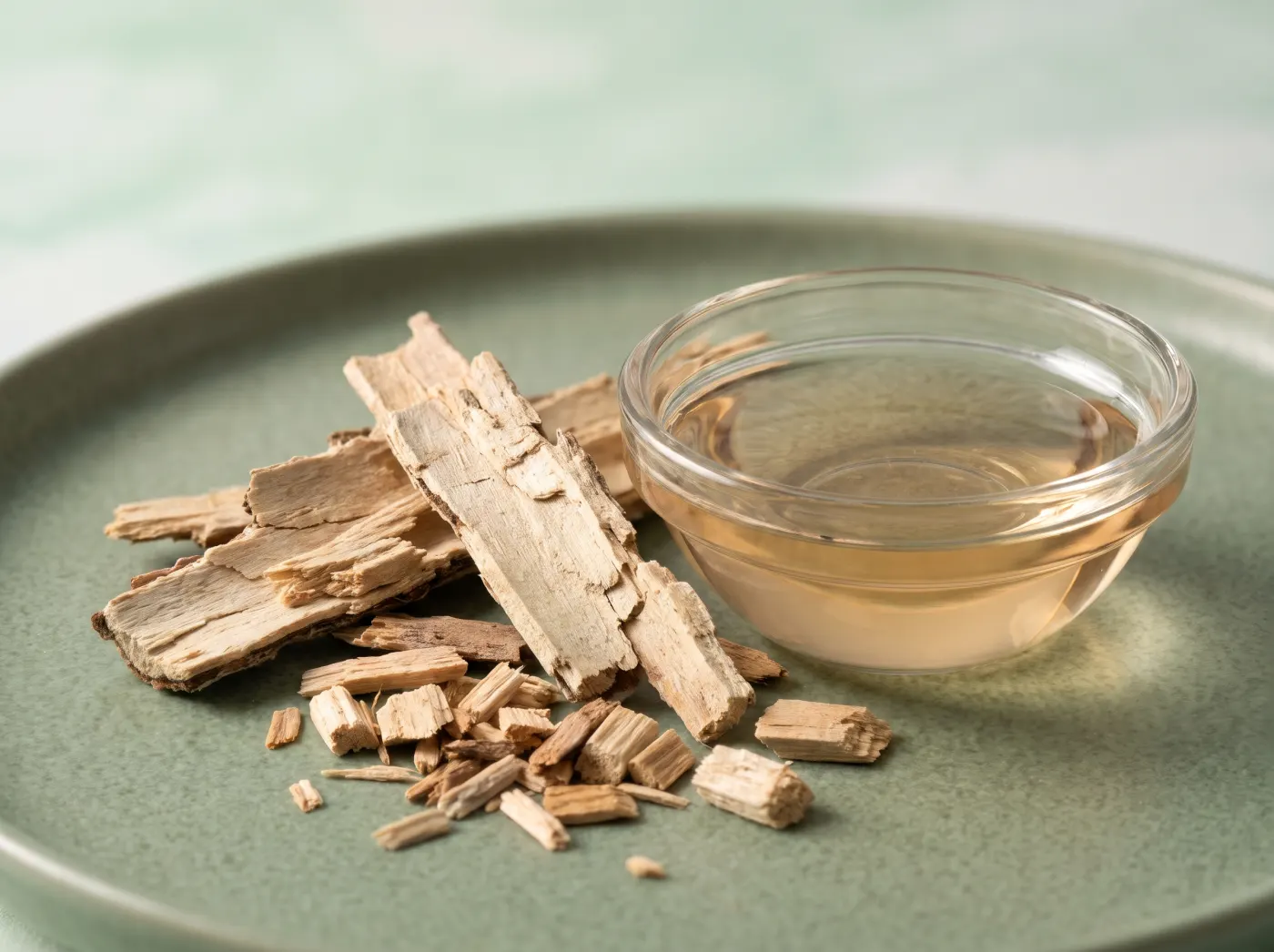
Amyris essential oil, known as West Indian sandalwood, in macro view, an amber drop on a sage green ceramic surface, raking light

Amyris oil at a glance

Entry from our cosmetic ingredient glossary. Regulatory data from the European Commission's CosIng database1 and from consolidated Regulation (EC) 1223/20092. Copy the identifiers in one click for your files.

INCI name
AMYRIS BALSAMIFERA BARK OILWarning: this INCI is not a sandalwood's. True sandalwood is written SANTALUM ALBUM OIL3
Other names
Amyris, West Indian sandalwoodWest Indian sandalwood, amyris oil. "Sandalwood" here is a trade name, not a botanical name4
CAS number
8015-65-4 / 90320-49-3
EC number
291-076-6Linked to CAS 90320-49-3; no EC number for CAS 8015-65-41
Botanical origin
Amyris (Amyris balsamifera, Rutaceae)CosIng: volatile oil distilled from the bark1. Studies on commercial oils speak of wood oil4
Composition
Valerianol, elemol, eudesmol isomers, caryophylleneProfile found in commercial oils containing amyris4. No α- or β-santalol: these are the markers of Santalum album4
CosIng functions
Fragrance, perfuming"Fragrance" and "Perfuming"1
EU status
No annex of Regulation 1223/2009The name amyris appears in no annex of the version consolidated on 1 May 2025. Santalum album oil (line 367) and santalol (line 341) are, however, named in Annex III23
Allergen to declare
Not as an oil; check batch by batchThe oil is not named. But caryophyllene, reported as dominant in some samples4, is named in Annex III (beta-caryophyllene, line 332): it must be declared above 0.001% in leave-on products and 0.01% in rinse-off products3. Confirm on the batch certificate of analysis
Safety
No CIR assessment foundNo CIR panel report found on this oil, and no skin tolerance data specific to amyris

What the research says

Each result shows the protocol and the level of evidence. The higher the level, the better the result carries over to a finished formula.

Clinical trialReview or consensusLaboratory

What a "sandalwood" oil really containsChemistry

Six commercial "sandalwood" oils, none compliant with the standard

Laboratory
6 oils sold as sandalwoodGC-MSISO 3518:2002 standard

Only one oil contains both the α- and β-santalols of Santalum album. In three samples, valerianol, elemol, eudesmol isomers and caryophyllene dominate: this is the signature of amyris. Two others are synthetic blends. The label was correct for only three products out of six4.

Even true sandalwood oils depart from the standard

Laboratory
Commercial and historical oilsGC-MS

No oil analyzed meets the 90% santalol standard, and only about half meet recent ISO standards. Most Santalum album oils contain 50 to 70% santalols. The authors propose at least 43% α-santalol and 18% β-santalol5.

A material exposed to fraud

Review
2023 review

Sandalwood essential oils are among the botanical ingredients at risk of adulteration, most often by substitution or dilution for financial reasons6. Requiring a batch analysis is essential.


Studies on amyrisLittle data

Tick repellent in the laboratory, unrelated to cosmetics

Laboratory
Ixodes scapularis and Amblyomma americanum ticksFilter paper and cloth-covered finger

At 827 µg of amyris oil per cm² of paper, 80% then 55% of A. americanum nymphs are repelled after 2 h then 4 h. The study says nothing about use or tolerance on skin7. We found no cosmetic skin trial with amyris oil.

True sandalwood, to avoid confusionAllergy

Santalum album oil gives positive patch tests

Clinical study
IVDK networkPeople tested in a targeted way

Sandalwood oil gives 1.8% positive tests among 10,930 people tested from 2010 to 20198, and 1.4% in the 2010 to 2014 analysis9. These results concern Santalum album: they do not carry over to amyris, whose tolerance is not documented. A specialist review details the allergens of sandalwood oil10.

This page summarizes published literature on a cosmetic ingredient. It does not describe the effect of a finished product, which depends on its formula, and it is not medical advice. Evidence is flagged by level: clinical trial, review or laboratory. Very few studies exist on West Indian sandalwood: this page says so.

Which products can use amyris oil?

No formula in our white label catalog features amyris oil yet. Our formulation lab can add it to a custom formula or to a catalog formula. Its common uses:

Face

Rare in facial care: the oil is mostly a woody fragrance ingredient, and its skin tolerance is not documented.

Body

Massage oils, soaps, care candles and body creams with a soft woody note, often sold as an economical "sandalwood".

Hair

Scented hair oils and leave-in care; we found no published study on hair.

West Indian sandalwood, true sandalwood, rosewood or copaiba?

Four oils with woody notes, only one of which is a true sandalwood. Their chemistry differs, and so does their labeling status.

West Indian sandalwood (amyris)True sandalwood (Santalum album)RosewoodCopaiba
Dominant constituentsValerianol, elemol, eudesmol isomers, caryophyllene4α- and β-santalols: 50 to 70% of commercial oils5Linalool (93.6% in one oil studied)11β-caryophyllene (19.7 to 57.5% depending on the species)12
Annex IIIOil not named2Oil named (line 367); santalol named (line 341)3Oil not named; linalool named (line 84)2Oil not named; beta-caryophyllene named (line 332)3

Frequently asked questions about amyris oil

Is West Indian sandalwood a true sandalwood?
No. The INCI AMYRIS BALSAMIFERA BARK OIL designates amyris, a tree of the Rutaceae family1. True sandalwood is Santalum album, whose oil contains mostly santalols, absent from amyris4. "West Indian sandalwood" is a trade name.
What is the composition of amyris oil?
In commercial oils containing amyris, valerianol, elemol, eudesmol isomers and caryophyllene dominate4. The exact composition varies: always ask for the batch certificate of analysis.
What are the benefits of sandalwood oil in cosmetics?
CosIng classifies amyris oil as a fragrance and perfuming agent1. It is first of all a woody fragrance ingredient. We found no cosmetic skin trial: the available study is about tick repellency in the laboratory7.
Do I have to declare amyris oil in the ingredient list?
Amyris oil is not named in Annex III, unlike Santalum album oil (line 367)23. The caryophyllene it may contain is named (beta-caryophyllene, line 332): its declaration depends on its level in the finished product, above 0.001% in leave-on and 0.01% in rinse-off products3.
How can you tell a true sandalwood from a fake?
Only analysis can. In the study of six oils sold as sandalwood, none met the ISO 3518:2002 standard, and only one contained both expected santalols4. Sandalwood oil is exposed to adulteration6. Ask for the full botanical name and a batch analysis.
Is amyris oil allergenic?
Its skin tolerance is not documented in the studies we kept. The allergy data found under "sandalwood oil" concern Santalum album89 and do not apply to amyris. Tolerance tests on the finished product remain the rule.
Can you manufacture a sandalwood product for my brand?
Yes, we study the integration of a sandalwood note depending on raw material availability, and the label states the real ingredient (amyris or Santalum album). Our ISO 22716 certified lab can add it to a customized catalog formula, or design it into a custom formula. Samples are free.

Sources

Peer-reviewed studies and official regulatory sources, checked on November 3, 2026.

  1. European Commission. CosIng, entry AMYRIS BALSAMIFERA BARK OIL (CAS 8015-65-4 / 90320-49-3, EC 291-076-6). ec.europa.eu/growth/tools-databases/cosing
  2. Regulation (EC) No 1223/2009 of the European Parliament and of the Council on cosmetic products, consolidated version of 1 May 2025 (Annexes II to VI). eur-lex.europa.eu
  3. Commission Regulation (EU) 2023/1545 of 26 July 2023 amending Regulation (EC) No 1223/2009 of the European Parliament and of the Council as regards labelling of fragrance allergens in cosmetic products (Annex III). eur-lex.europa.eu
  4. Kucharska M, Frydrych B, Wesolowski W, Szymanska JA, Kilanowicz A. A Comparison of the Composition of Selected Commercial Sandalwood Oils with the International Standard. Molecules. 2021;26(8):2249. doi:10.3390/molecules26082249
  5. Howes MJ, Simmonds MS, Kite GC. Evaluation of the quality of sandalwood essential oils by gas chromatography-mass spectrometry. J Chromatogr A. 2004;1028(2):307-12. doi:10.1016/j.chroma.2003.11.093
  6. Gafner S, Blumenthal M, Foster S, Cardellina JH, Khan IA, Upton R. Botanical Ingredient Forensics: Detection of Attempts to Deceive Commonly Used Analytical Methods for Authenticating Herbal Dietary and Food Ingredients and Supplements. J Nat Prod. 2023;86(2):460-472. doi:10.1021/acs.jnatprod.2c00929
  7. Carroll JF, Paluch G, Coats J, Kramer M. Elemol and amyris oil repel the ticks Ixodes scapularis and Amblyomma americanum (Acari: Ixodidae) in laboratory bioassays. Exp Appl Acarol. 2010;51(4):383-92. doi:10.1007/s10493-009-9329-0
  8. Geier J, Schubert S, Reich K, Skudlik C, Ballmer-Weber B, Brehler R, et al. Contact sensitization to essential oils: IVDK data of the years 2010-2019. Contact Dermatitis. 2022;87(1):71-80. doi:10.1111/cod.14126

  9. Warshaw EM, Zug KA, Belsito DV, Fowler JF, DeKoven JG, Sasseville D, et al. Positive Patch-Test Reactions to Essential Oils in Consecutive Patients From North America and Central Europe. Dermatitis. 2017;28(4):246-252. doi:10.1097/DER.0000000000000293


  10. de Groot AC, Schmidt E. Essential Oils, Part VI: Sandalwood Oil, Ylang-Ylang Oil, and Jasmine Absolute. Dermatitis. 2017;28(1):14-21. doi:10.1097/DER.0000000000000241
  11. Teles AM, Silva-Silva JV, Fernandes JMP, Calabrese KDS, Abreu-Silva AL, Marinho SC, et al. Aniba rosaeodora (Var. amazonica Ducke) Essential Oil: Chemical Composition, Antibacterial, Antioxidant and Antitrypanosomal Activity. Antibiotics (Basel). 2020;10(1):24. doi:10.3390/antibiotics10010024
  12. Veiga Junior VF, Rosas EC, Carvalho MV, Henriques MG, Pinto AC. Chemical composition and anti-inflammatory activity of copaiba oils from Copaifera cearensis Huber ex Ducke, Copaifera reticulata Ducke and Copaifera multijuga Hayne--a comparative study. J Ethnopharmacol. 2007;112(2):248-54. doi:10.1016/j.jep.2007.03.005
Carmel Cosmetics Labs product specialist with a brand founder

Tell us about your project

A product specialist reviews your request and gets back to you on the channel you prefer.

Lead EN – Demande de devis
Tell us about your project. A product specialist will get back to you shortly.
CONTACT INFORMATION
Name
PROJECT INFORMATION
Which cosmetics category interests you most?

By submitting this form, you agree to our terms of service and privacy policy.

No obligation. Your information stays confidential and is used only to prepare your quote.