











































Services

Torn between two services?A project manager will guide you

Catalog

Explore the full catalog1,000+ formulas ready to carry your brand

Face careFull range

Serums, creams and targeted care, formulated with your actives.

Body careFull range

Moisturizing, nourishing and shower care: cream, butter or oil.

Specialty careFull range

Sun care, lips, intimate care and oral care.

Men, baby, makeupFull range

Shaving and beard, baby and mom, makeup.

Industries

All solutions by industryFormulas and formats for your business

Our brands

Our own brands, developed and made in our laboratory.

Become a distributor of our brandsPharmacies, spas, shops and wholesalers

Laboratory

Cosmetics manufacturing room with a row of stainless-steel mixers and an operator in white workwearOur factory in Aït MelloulISO 22716 and ISO 9001, visits by appointmentDiscover the factory

Resources

Cardamom oil (essential oil)

Cardamom essential oil is the volatile oil of the dried seeds of Elettaria cardamomum7. Its main constituents are 1,8-cineole and α-terpinyl acetate1. The oil is not named in Regulation (EU) 2023/1545, but several of its constituents are: limonene, linalyl acetate, terpineol8. No cosmetic clinical study was kept.
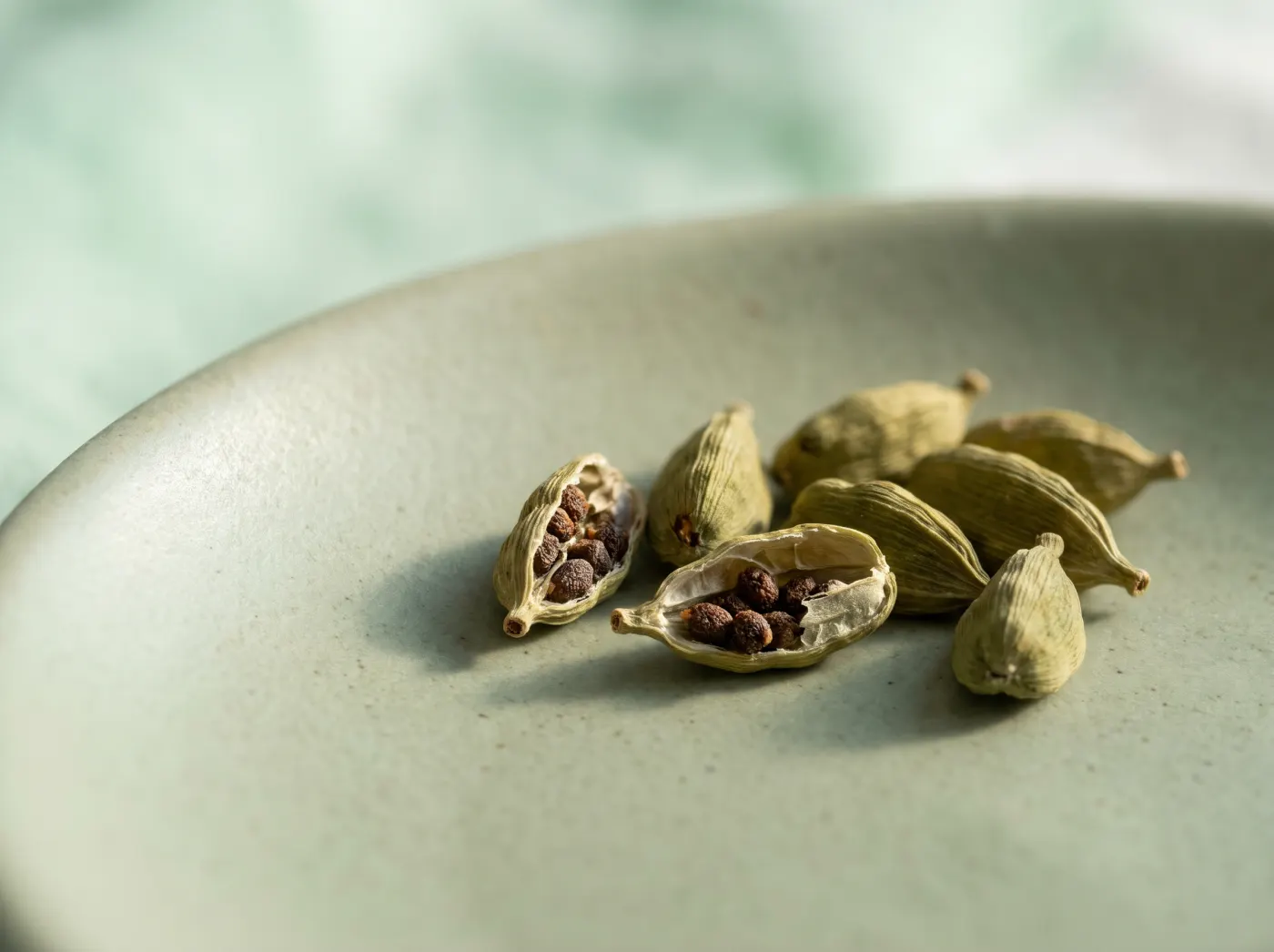
Cardamom essential oil in macro view, clear drops on a sage green ceramic surface, raking light

Cardamom oil at a glance

Entry from our cosmetic ingredient glossary. Regulatory data from the European Commission's CosIng database7, from Regulation (EU) 2023/15458 and from consolidated Regulation (EC) No 1223/20099. Copy the identifiers in one click for your files.

INCI name
ELETTARIA CARDAMOMUM SEED OIL
Other names
Cardamom essential oilCardamom oil. Not to be confused with black cardamom, another spice covered in the literature1
CAS number
8000-66-6 / 85940-32-5
EC number
288-922-1Linked to CAS 85940-32-5; CosIng gives no EC number for CAS 8000-66-67
Botanical origin
Cardamom (Elettaria cardamomum, Zingiberaceae)CosIng: volatile oil obtained from the dried ripe seeds7
Composition
1,8-cineole, α-terpinyl acetateMain constituents of green and black cardamom according to a 2022 review1. CosIng also cites sabinene, α-terpineol, borneol, limonene and terpinene7. Depending on the extraction process tested, limonene reaches 40.54% or eucalyptol 24.31%3
CosIng functions
Fragrance, tonic"Fragrance", "Perfuming" and "Tonic"7
EU status
Not named in the annexesThe oil appears neither in Regulation (EU) 2023/1545 nor in Annex III consolidated as of 1 May 2025, and CosIng indicates no specific restriction789
Allergen to declare
No mention specific to the oil; constituents namedDepending on the oil, constituents named by the regulation may be present: limonene (line 88), linalyl acetate (337), terpineol (343) in Regulation (EU) 2023/15458, linalool (line 84) and geraniol (line 78) in the consolidated Annex III9. Each is declared above 0.001% in leave-on products and 0.01% in rinse-off products in the finished product
Safety
No CIR or SCCS assessment foundNo CIR report or SCCS opinion on this oil in our searches; CosIng lists none7. Limonene and linalool are among the most frequent constituents of the oils that caused contact allergies6

What the research says

Each result shows the protocol and the level of evidence. The higher the level, the better the result carries over to a finished formula.

Clinical trialReview or consensusLaboratory

Oil compositionChemistry

1,8-cineole and α-terpinyl acetate

Review
2022 reviewGreen and black cardamom

GC-MS analysis identifies 1,8-cineole and α-terpinyl acetate as the main components1.

An oil rich in monoterpenes

Laboratory
GC-MS analysisSeed oil2026 study

The oil is abundant in monoterpenes, with α-terpinyl acetate predominating2. A 2023 study also finds linalool, linalyl acetate, α-terpineol and 1,8-cineole in it4.

The extraction process changes the profile

Laboratory
GC-MS analysis14 volatile compoundsHydrodistillation with DIC pretreatment2026 study

Limonene dominates (up to 40.54%), followed by eucalyptol (up to 24.31%). Depending on pretreatment time and temperature, the levels of 3-carene, eucalyptol, α-citral or geraniol vary3. Comparing batches therefore requires a certificate of analysis.

Fragrance useFragrance

Essential oils as sources of cosmetic fragrance

Review
2021 review

Essential oils are sources of fragrance for cosmetics. Linalool, geraniol, limonene, citronellol and citral are widely used fragrance components5. Several are among the substances to be declared.

SafetyToxicology

Widespread terpenes in allergenic oils

Review
2016 review

Limonene, linalool and α-pinene are among the important constituents of more than 20 essential oils that caused contact allergies6. We found no tolerance data specific to cardamom oil.

This page summarizes published literature on a cosmetic ingredient. It does not describe the effect of a finished product, which depends on its formula, and it is not medical advice. Evidence is flagged by level: clinical trial, review or laboratory. For cardamom, the cosmetic evidence is weak: no clinical study was kept.

Which products use cardamom oil?

Our white label catalog includes 1 formula with cardamom oil, always as a supporting ingredient. Every category can be customized (formula, fragrance, packaging).

1Raw materials and more

In our formulas, it is most often paired with

Rosemary essential oils 1

Cardamom, ginger or eucalyptus oil?

Two Zingiberaceae and a eucalyptus, three essential oils whose chemistry, and therefore labeling, differs.

CardamomGingerEucalyptus
Dominant constituents1,8-cineole and α-terpinyl acetate1α-zingiberene, citral, geranyl acetate depending on the oil101,8-cineole, more than 50% of Eucalyptus globulus oil6
Regulation (EU) 2023/1545Oil not named; linalyl acetate, limonene and terpineol named8Oil not named; citral, citronellol, limonene and geranyl acetate named8Eucalyptus globulus oil named (line 355)8
Carmel catalog formulas1 formula2 formulas2 formulas

Frequently asked questions about cardamom oil

What is cardamom essential oil?
It is the volatile oil obtained from the dried ripe seeds of Elettaria cardamomum7. Its INCI name is ELETTARIA CARDAMOMUM SEED OIL. Its main constituents are 1,8-cineole and α-terpinyl acetate1.
What are the benefits of cardamom in cosmetics?
CosIng classes it as a fragrance and tonic7. It is first of all a fragrance ingredient: we kept no cosmetic clinical trial, and the studies found concern the composition of the oil123.
Do I have to declare cardamom oil in the ingredient list?
The oil appears in the list under its INCI name, like any ingredient. It is named neither in Regulation (EU) 2023/1545 nor in Annex III89. Several constituents it may contain are: limonene, linalyl acetate, terpineol, linalool, geraniol. They are declared above 0.001% in leave-on products and 0.01% in rinse-off products in the finished product, depending on their content in the oil used. Check with the technical data sheet.
What is the composition of cardamom oil?
Mostly 1,8-cineole and α-terpinyl acetate12, with linalool, linalyl acetate and α-terpineol4. The proportion depends on the oil and its extraction process: limonene at 40.54% in one trial, eucalyptol at 24.31% in another3.
Is cardamom oil risky?
We found neither a CIR assessment nor an SCCS opinion on this oil. Several of its constituents, such as limonene and linalool, are frequent in the oils that caused contact allergies6: tolerance tests on the finished product are required. During pregnancy, as with any skincare product, a healthcare professional's advice remains the rule.
Is cardamom the same as other spices of the same name?
Not always. The literature distinguishes green cardamom and black cardamom1. This page covers Elettaria cardamomum, the glossary INCI7. Check the species and the INCI on the technical data sheet.
Can you manufacture a cardamom product for my brand?
Yes. Our ISO 22716 certified lab offers one cardamom formula (mouth spray) that you can customize, or a custom formula. Samples are free.

Sources

Peer-reviewed studies and official regulatory sources, checked on November 3, 2026.

  1. Abdullah, Ahmad N, Tian W, et al. Recent advances in the extraction, chemical composition, therapeutic potential, and delivery of cardamom phytochemicals. Front Nutr. 2022;9:1024820. doi:10.3389/fnut.2022.1024820
  2. Hitl M, Radovanović K, Urumović K, et al. Queen of spices, cardamom (Elettaria cardamomum (L.) Maton, Zingiberaceae): in vitro assessment of biological potential. Molecules. 2026;31(14):2430. doi:10.3390/molecules31142430
  3. Teresa-Martínez GD, Rodriguez-Castillo P, Alonzo-Macías M, et al. Modulation of the volatile profile of cardamom (Elettaria cardamomum) essential oil by non-thermal instant controlled pressure drop (DIC) technology: a novel approach in food processing. Food Sci Nutr. 2026;14(1):e71395. doi:10.1002/fsn3.71395
  4. Pavarino M, Marengo A, Cagliero C, et al. Elettaria cardamomum (L.) Maton essential oil: an interesting source of bioactive specialized metabolites as inhibitors of acetylcholinesterase and butyrylcholinesterase. Plants (Basel). 2023;12(19):3463. doi:10.3390/plants12193463
  5. Sharmeen JB, Mahomoodally FM, Zengin G, Maggi F. Essential oils as natural sources of fragrance compounds for cosmetics and cosmeceuticals. Molecules. 2021;26(3):666. doi:10.3390/molecules26030666
  6. de Groot AC, Schmidt E. Essential oils, part III: chemical composition. Dermatitis. 2016;27(4):161-169. doi:10.1097/DER.0000000000000193
  7. European Commission. CosIng, entry ELETTARIA CARDAMOMUM SEED OIL (CAS 8000-66-6 / 85940-32-5, EC - / 288-922-1). ec.europa.eu/growth/tools-databases/cosing
  8. Commission Regulation (EU) 2023/1545 of 26 July 2023 amending Regulation (EC) No 1223/2009 of the European Parliament and of the Council as regards labelling of fragrance allergens in cosmetic products (Annex III). eur-lex.europa.eu
  9. Regulation (EC) No 1223/2009 of the European Parliament and of the Council on cosmetic products, consolidated version of 1 May 2025 (Annex III). eur-lex.europa.eu
  10. Höferl M, Stoilova I, Wanner J, et al. Composition and comprehensive antioxidant activity of ginger (Zingiber officinale) essential oil from Ecuador. Nat Prod Commun. 2015;10(6):1085-1090. doi:10.1177/1934578x1501000672
Carmel Cosmetics Labs product specialist with a brand founder

Tell us about your project

A product specialist reviews your request and gets back to you on the channel you prefer.

Lead EN – Demande de devis
Tell us about your project. A product specialist will get back to you shortly.
CONTACT INFORMATION
Name
PROJECT INFORMATION
Which cosmetics category interests you most?

By submitting this form, you agree to our terms of service and privacy policy.

No obligation. Your information stays confidential and is used only to prepare your quote.





