












































In 2025, the European Union imported €83.7 million of Moroccan beauty products, up from €77.0 million in 2021 and roughly six times the US market (as an order of magnitude, euros against dollars). Europe already builds many of its formulas on Moroccan ingredients: essential oils (€29.8M, +36% since 2021), vegetable oils including argan (€20.0M) and plant extracts (€11.2M). The next step is under way: in January-July 2026, Moroccan skincare and makeup imports grew 77% and hair care tripled (Eurostat).
Key figures
- €83.7M for the 10 beauty categories the EU-27 imported from Morocco in 2025, against €77.0M in 2021.
- €29.8M of Moroccan essential oils (HS 3301): number one in the ranking, up 36% since 2021.
- +77% for Moroccan skincare and makeup in January-July 2026 (€5.36M, against €3.03M a year earlier), and ×3 for hair care.
- +68% for Moroccan perfumes between 2021 and 2025, and +122% for hair preparations.
- 59% of EU purchases go to France (€49.8M), Morocco’s first customer in Europe, mostly as ingredients. Finished products enter mainly through the Netherlands and Belgium.
- 22%: the share of finished products in the basket in January-July 2026, up from 19% a year earlier.
Source for all values: Eurostat Comext (dataset DS-045409, EU trade by HS code), extracted on October 8, 2026, in current euros, EU-27 imports from Morocco. The method is set out at the end of the article. We published the same analysis for the United States: Moroccan beauty exports to the US.
What is the 2025 ranking of Moroccan beauty products imported by the EU?
Essential oils lead with €29.77M, ahead of vegetable oils including argan (€20.00M) and plant extracts (€11.18M). Perfumes are the leading finished product, in fourth place with €7.15M and up 68% in five years.
| Rank | Category | HS code | 2025 (€M) | 2021 (€M) | 2021-2025 |
|---|---|---|---|---|---|
| 1 | Essential oils | 3301 | 29.77 | 21.92 | +36% |
| 2 | Vegetable oils, including argan | 1515.90 | 20.00 | 20.47 | −2% |
| 3 | Plant extracts | 1302.19 | 11.18 | 13.77 | −19% |
| 4 | Perfumes and eaux de toilette | 3303 | 7.15 | 4.26 | +68% |
| 5 | Clays and minerals, probably including rhassoul | 2508 / 2530 | 7.06 | 5.77 | +22% |
| 6 | Skincare and makeup | 3304 | 4.18 | 5.94 | −30% |
| 7 | Hair preparations and shampoos | 3305 | 1.85 | 0.83 | +122% |
| 8 | Shaving, bath, deodorants | 3307 | 1.42 | 2.88 | −51% |
| 9 | Soaps, probably including black soap | 3401 | 0.69 | 1.02 | −33% |
| 10 | Oral hygiene | 3306 | 0.43 | 0.14 | +204% |
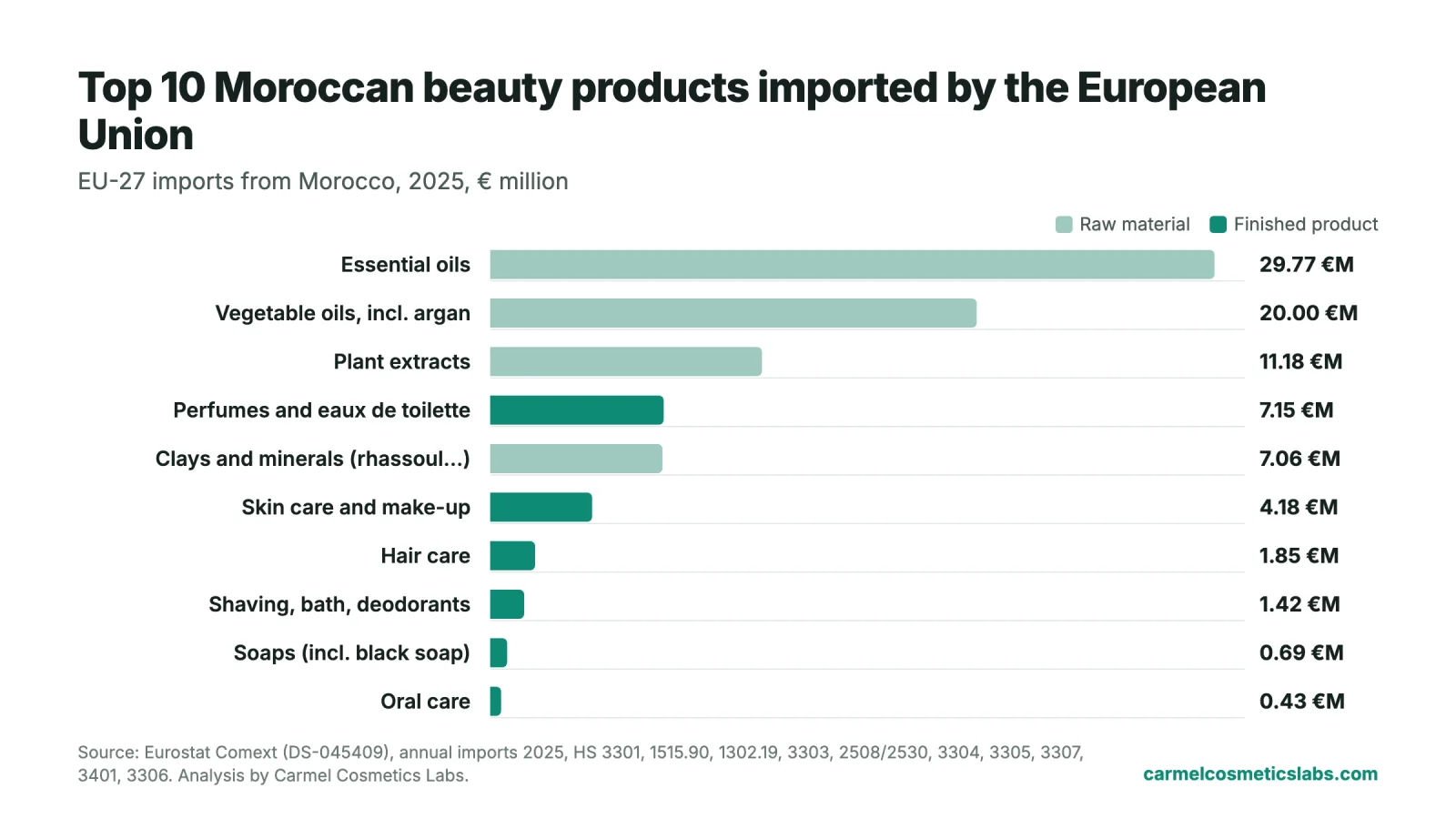
Essential oils have grown every year since 2021, from €21.92M to €29.77M. Vegetable oils remain steady at around €20M. Among finished products with significant values, perfumes and hair preparations have grown the most over five years.
What do the first seven months of 2026 show?
From January to July 2026, the basket grew 7% (€54.82M against €51.32M). Vegetable oils rose 27%, skincare 77% and hair care tripled, while essential oils eased 14% and perfumes 42%.
| Category | Jan.-Jul. 2025 (€M) | Jan.-Jul. 2026 (€M) | Change |
|---|---|---|---|
| Essential oils | 18.67 | 16.14 | −14% |
| Vegetable oils / argan | 11.97 | 15.14 | +27% |
| Plant extracts | 6.16 | 7.02 | +14% |
| Skincare and makeup | 3.03 | 5.36 | +77% |
| Clays and minerals | 4.83 | 4.36 | −10% |
| Hair preparations | 0.86 | 2.60 | +203% |
| Perfumes | 4.46 | 2.59 | −42% |
| Shaving, bath, deodorants | 0.89 | 0.60 | −33% |
| Soaps | 0.45 | 0.34 | −24% |
| Oral hygiene | 0.00 | 0.66 | n.s. |
Over seven months, finished products reached €12.15M, against €9.69M a year earlier: their share of the basket rose from 19% to 22%. This is the most encouraging signal in the data, driven by skincare, hair care and oral hygiene.
Read the small lines with care. On values below €1M, such as soaps or oral hygiene, a single order can move the figure by more than 50%. Eurostat monthly data are also revised for several months after publication.
Ingredients and finished products: where does the value sit today?
In 2025, €68.0M of the €83.7M imported by the EU were ingredients (essential oils, vegetable oils, extracts, clays) and €15.7M were finished products. The pattern is similar in the United States, where about 85% of the value is ingredients. European brands formulate with Moroccan ingredients; the opportunity now is to make more of those finished products in Morocco.
Average prices per kilo, calculated from the values and weights declared to Eurostat, show ingredients moving up the value chain: oils under code 1515.90 rose from about €19/kg in 2021 to €27/kg in 2025, and other essential oils (3301.29) from €72/kg to €104/kg. Skincare under code 3304.99 rose from €20/kg to €35/kg.
Essential oils: the largest item, and growing
Rosemary, neroli, white wormwood, rockrose, orange blossom: Morocco distils a wide range of aromatic plants. EU imports of Moroccan essential oils rose every year between 2021 and 2025. The dip in early 2026 (−14%) remains to be confirmed over the full year.
Argan oil: steady in value, higher priced per kilo
Argan oil is pressed from the kernels of the argan tree (Argania spinosa), which grows only in south-western Morocco. It has no customs code of its own and sits under code 1515.90, which also covers other vegetable oils. That code has stayed around €20M a year since 2021, with a rising average price. For buyers, what matters is the grade and the controls: acidity, peroxide value and batch traceability.
Rhassoul and black soap: icons hidden in the figures
Rhassoul (or ghassoul) is a Moroccan clay traditionally used to wash skin and hair. With no customs code of its own, it probably sits within clays and minerals (€7.06M in 2025), a category that also includes industrial clays. Black soap, the traditional hammam paste, is likely included in the €0.69M under code 3401.
Which European countries buy Moroccan beauty products?
France is Morocco’s first beauty customer in Europe, with 59% of EU purchases (€49.77M in 2025), well ahead of the Netherlands (€11.31M), Spain (€6.50M) and Belgium (€6.00M). French buyers mostly purchase ingredients; finished products account for €2.46M.
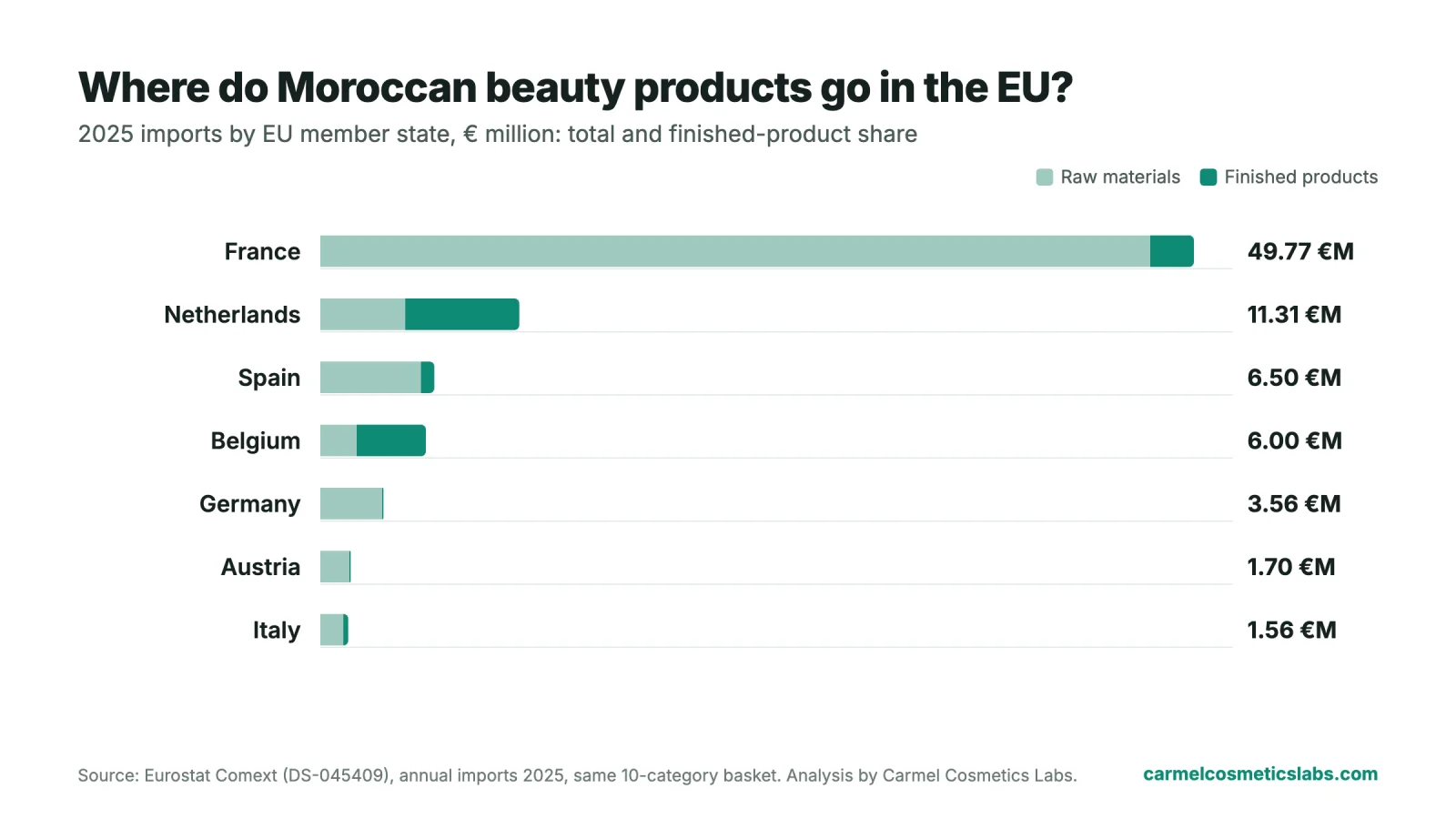
Moroccan finished products enter mainly through the Netherlands (€6.49M) and Belgium (€3.95M), which together account for two thirds of the €15.7M. Both countries host the EU’s main ports of entry, so part of these goods is probably redistributed to other member states. Germany, one of Europe’s largest cosmetics markets, buys almost only Moroccan ingredients so far (€3.51M of €3.56M), which leaves room for finished products.
Why is the context favourable to Moroccan cosmetics in Europe?
Trade in industrial products between Morocco and the EU has been fully liberalised under the Association Agreement, in force since 2000. For a finished cosmetic, the real requirement is compliance with Regulation (EC) No 1223/2009, which applies in the same way whatever the country of manufacture.
The EU-Morocco Association Agreement
Signed in 1996, the Association Agreement entered into force on March 1, 2000. According to the European Commission, trade in industrial products is fully liberalised and the EU is Morocco’s first trading partner (33.7% of its trade in goods in 2025). As with any preferential agreement, the product must meet the rules of origin to benefit: have your product’s origin status confirmed by your customs broker.
The EU Cosmetics Regulation: what to plan for
Regulation (EC) No 1223/2009 applies to every cosmetic placed on the EU market, wherever it is made. The usual path, detailed in our guide to exporting cosmetics from Morocco to Europe:
- Appoint a Responsible Person established in the EU, whose name and address appear on the label.
- Have a qualified assessor carry out the product’s safety assessment.
- Compile the Product Information File (PIF): formula, raw materials, stability, compatibility, claim support.
- Notify the product on the CPNP, the EU cosmetic products notification portal, before placing it on the market.
- Manufacture under good manufacturing practice (ISO 22716) and adapt the labelling to each country of sale.
The M-Beauty opportunity: from signature ingredients to Moroccan brands
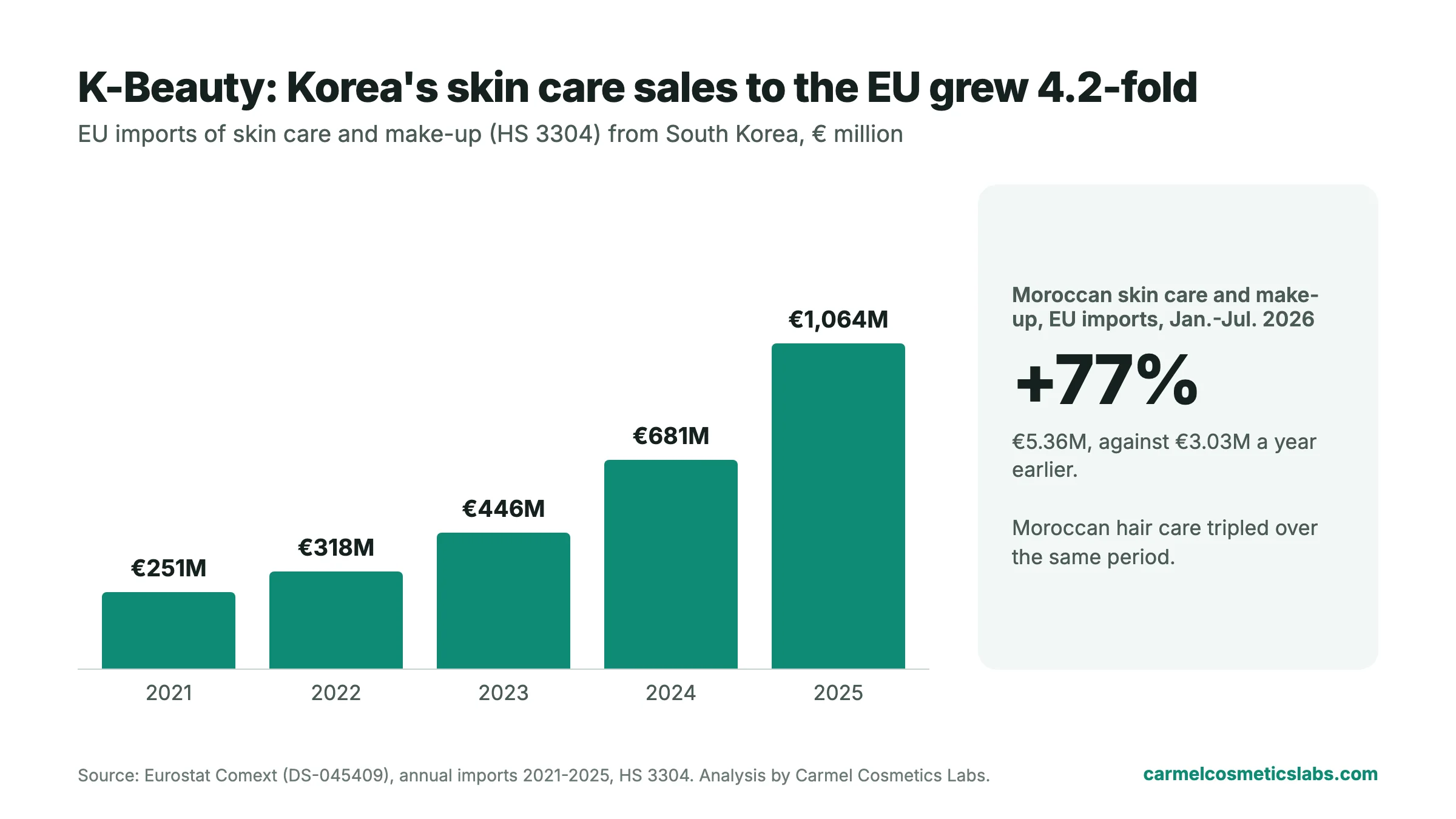
M-Beauty is the name we propose for Moroccan beauty sold as brands and finished products, building on ingredients European consumers already know. The size of the prize is clear from Korea’s example: EU imports of Korean skincare and makeup reached €1,064M in 2025, 4.2 times the 2021 level.
What K-Beauty built in Europe
EU imports of Korean skincare and makeup (HS 3304) went from €251.5M in 2021 to €318.1M in 2022, €446.0M in 2023, €681.1M in 2024 and €1,064.0M in 2025. Across all finished products (perfumes, skincare, hair care, hygiene, soaps), Korea went from €269M to €1,176M in five years. It shows how quickly a beauty origin can grow in Europe once it is carried by brands.
Morocco’s strengths in the European market
Morocco has what Korea had to invent: signature ingredients European consumers already recognise. Argan oil, rose water from Kelaat M’Gouna, rhassoul, black soap and the hammam ritual. It also has proximity: a few hours’ flight from Paris or Madrid, liberalised market access and a large diaspora in France, Spain, Belgium and the Netherlands.
Value is created at the finished-product stage: the same argan oil is worth about €27/kg in bulk at the EU border, and much more once formulated, filled and sold under a brand. Moroccan manufacturers already make finished products that meet the EU regulation from the formula stage, and the 2026 figures show European buyers are turning to them.
Method and data limits
- Source: Eurostat Comext, dataset DS-045409 (“EU trade since 1988 by HS2-4-6 and CN8”), queried through the official API on October 8, 2026. Reporter: EU-27; partner: Morocco; flow: imports; values in current euros.
- Basket of 10 categories: HS 3301 (essential oils), 1515.90 (fixed vegetable oils, including argan), 1302.19 (plant extracts), 3303 (perfumes), 2508 and 2530 (clays and minerals), 3304 (skincare and makeup), 3305 (hair care), 3307 (shaving, bath, deodorants), 3401 (soaps), 3306 (oral hygiene).
- Ingredients = 3301, 1515.90, 1302.19, 2508 and 2530. Finished products = 3303 to 3307 and 3401.
- Limits: several codes include non-cosmetic uses (food or industrial oils in 1515.90, industrial clays in 2508, pharmaceutical extracts in 1302.19). The reporting country is the country of entry into the EU, not always the country of consumption. 2026 data are provisional.
- Comparison with the United States: our US study uses US Census Bureau data in dollars; the two values are comparable only as an order of magnitude.
Frequently asked questions
How much Moroccan beauty product does Europe import?
In 2025, the EU-27 imported €83.7M of Moroccan beauty products across the 10 categories studied, up from €77.0M in 2021: €68.0M of ingredients and €15.7M of finished products (Eurostat Comext).
What is the leading Moroccan beauty product imported into Europe?
Essential oils (HS 3301), with €29.77M in 2025, ahead of vegetable oils including argan (€20.00M) and plant extracts (€11.18M).
Which European country buys the most Moroccan cosmetics?
France, with €49.77M in 2025, or 59% of the EU total, mostly as ingredients. For finished products, the Netherlands (€6.49M) and Belgium (€3.95M) lead.
Are there customs duties on Moroccan cosmetics sold in the EU?
Trade in industrial products is fully liberalised under the EU-Morocco Association Agreement, provided the rules of origin are met. Have a customs broker confirm the treatment of your HS code.
Can a cosmetic made in Morocco be sold in Europe?
Yes, if it complies with Regulation (EC) No 1223/2009: a Responsible Person established in the EU, a safety assessment, a Product Information File, CPNP notification and compliant labelling. The country of manufacture is not an obstacle.
Conclusion: from signature ingredients to brands
Europe is Morocco’s largest beauty market, about six times the United States. It already trusts Moroccan ingredients, and the first seven months of 2026 show it buying more Moroccan finished products: skincare up 77%, hair care tripled, and a finished-product share rising from 19% to 22%. Korea’s growth in Europe shows how far a beauty origin can go once it is carried by brands.
At Carmel Cosmetics Labs, a cosmetics manufacturer in Agadir certified ISO 22716 and ISO 9001, we formulate and manufacture finished products designed for the EU market from the formula stage, including white label, with the Product Information File and CPNP notification. To discuss your project, book a free consultation.