











































Services

Torn between two services?A project manager will guide you

Catalog

Explore the full catalog1,000+ formulas ready to carry your brand

Face careFull range

Serums, creams and targeted care, formulated with your actives.

Body careFull range

Moisturizing, nourishing and shower care: cream, butter or oil.

Specialty careFull range

Sun care, lips, intimate care and oral care.

Men, baby, makeupFull range

Shaving and beard, baby and mom, makeup.

Industries

All solutions by industryFormulas and formats for your business

Our brands

Our own brands, developed and made in our laboratory.

Become a distributor of our brandsPharmacies, spas, shops and wholesalers

Laboratory

Cosmetics manufacturing room with a row of stainless-steel mixers and an operator in white workwearOur factory in Aït MelloulISO 22716 and ISO 9001, visits by appointmentDiscover the factory

Resources

Green tea (Camellia sinensis)

Green tea (Camellia sinensis) provides a leaf extract rich in catechins, including EGCG35, used in cosmetics as an antioxidant and astringent1. The CIR panel judges it safe if it is not sensitizing2. Clinical trials are rare and mixed: less sebum with 5% purified EGCG6, no clinical difference for a 10% cream combined with an oral supplement9.
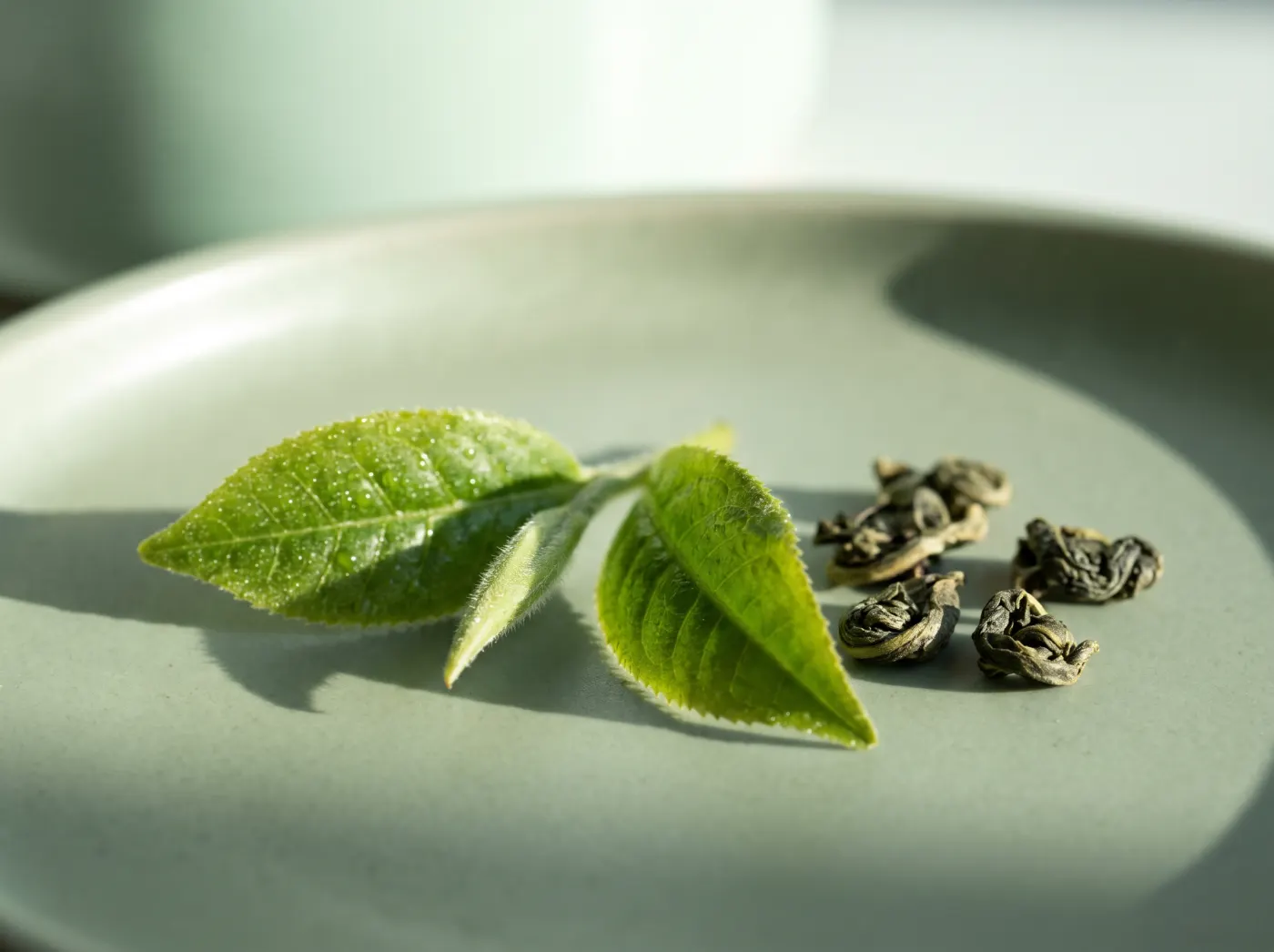
Dried green tea leaves in macro view on a sage green ceramic surface

Green tea at a glance

Entry from our cosmetic ingredient glossary. Regulatory data from the European Commission's CosIng database1, safety according to the CIR expert panel2. Copy the identifiers in one click for your files.

INCI name
CAMELLIA SINENSIS LEAF EXTRACTAlso exists as bud extract, leaf and stem extract, hydrolyzed or fermented1
Other names
Green tea, tea leaf extractCamellia sinensis (L.) O. Kuntze3
CAS number
84650-60-2
EC number
283-519-7
Botanical origin
Camellia sinensis, TheaceaeCosIng describes the extract of tea plant leaves1. Green tea is the unoxidized leaf
Compounds of interest
Catechins, including EGCGPolyphenols of fresh leaves3. EGCG (epigallocatechin gallate) is the most studied catechin5
CosIng function
Antioxidant, astringent, tonic, humectant, skin conditioningThe entry lists other functions (fragrance, oral care, etc.)1
Standardization
Varies by extractThe trials use extracts or purified EGCG: their catechin content is not comparable. Possible interactions with emulsifiers4
EU status
No restrictionNot listed in the annexes of Regulation (EC) 1223/2009 in CosIng1
Allergen to declare
Not listedNo annex indicated in CosIng for the leaf extract
Safety
Judged safe if non-sensitizing2019 CIR panel: leaf extracts safe in current uses, formulated to be non-sensitizing; insufficient data for parts other than the leaf2

What the research says

Each result shows the protocol and the level of evidence. The higher the level, the better the result carries over to a finished formula.

Clinical trialReview or consensusLaboratory

Facial skinSkincare

Less sebum with 5% EGCG

Clinical trial
Cream with 5% EGCG, 2% L-carnitine or both4 weeks90 participantsRandomized, three groups

Sebum drops significantly in all three groups (p < 0.01). The EGCG group and the combination group reduce sebum more than L-carnitine alone. This is purified EGCG, not a green tea extract6.

Elasticity and skin tone, with an encapsulated extract

Clinical trial
Green tea extract in chitosan microparticles8 weeks29 womenSplit-face, double-blind versus placebo

At 4 weeks, elasticity (R2) is better on the treated side (0.748 versus 0.722), and the melanin index drops at 6 weeks (282.7 versus 295.6). Photos show fewer wrinkles, with no sign of irritation. Encapsulation is part of the formula tested8.

No clinical difference with a 10% cream

Clinical trial
10% cream + 300 mg oral extract twice a day8 weeks40 womenDouble-blind versus placebo

No significant difference in the clinical assessment of photoaging, with more perceived irritation in the green tea group. Biopsies show more elastic tissue in the treated group. The oral plus topical combination makes it impossible to isolate the effect of the cream9.

A green tea cream with no overall effect on elasticity

Clinical trial
Green tea cream60 days10 menCutometer, on the cheeks

Only the R6 parameter changes significantly; the authors conclude there is no marked overall effect on elastic properties. Very small sample10.

ScalpHaircare

Less sebum on an oily scalp

Clinical trial
Hair lotion with 2% extract28 days20 volunteersSebumeter

Scalp sebum drops significantly at 21 and 28 days (p ≤ 0.024), with no irritation. Small trial, no placebo group mentioned in the abstract7.

Laboratory and safetyReviews and cells

Antioxidant in the lab, not a sunscreen

Laboratory
EGCGReconstructed skin exposed to UVB

EGCG reduces apoptosis markers (p53, Fas, 8-OHdG) and the activation of JNK and p38 induced by UVB. This laboratory result does not make an extract a sunscreen: it does not replace UV protection11.

Antioxidant activities mostly in vitro

Review
2015 reviewPolyphenols and skin aging

Cell studies show antioxidant and photoprotective activities; few clinical studies exist after application to the skin. The review also discusses interactions with emulsifiers and the influence of the formula on penetration4.

Six controlled trials among 21 studies

Review
2025 scoping review6 in vitro studies, 9 reviews, 6 controlled trials

The authors conclude that research on molecular carriers and their application to human skin is still needed5.

Judged safe by the CIR panel

Expert assessment
2019 CIR panelCamellia sinensis-derived ingredients

Leaf-derived ingredients are safe in current uses and concentrations, provided they are formulated to be non-sensitizing. Cosmetic exposure is far below that from the drink. Data are insufficient for parts other than the leaf2.

This page summarizes published literature on a cosmetic ingredient. It does not describe the effect of a finished product, which depends on its formula, and it is not medical advice. Clinical trials on green tea are small, often old or run with different preparations (extract, purified EGCG, microparticles): the results are not interchangeable.

Concentrations used in studies

The trials cited test very different preparations: a 2% extract in a hair lotion7, 5% purified EGCG6 and a 10% extract in a cream, combined with an oral supplement9. These values cannot be compared: the concentration of a formula is set with the formulator, based on the catechin titer of the extract.

Which products use green tea?

Our white label catalog includes 12 formulas with green tea: the key active in 3 of them, a supporting ingredient in the others. Every category can be customized (formula, fragrance, packaging).

9Face

Key active in the mattifying fluid and the sun water, also found in eye creams, a toner, masks, a scrub, a cleanser and serums.

1Body

Key active in the two-phase sun water.

2Hair

Key active in the green tea and coffee scalp scrub, supporting active in a shampoo.

Green tea, vitamin C, vitamin E or caffeine?

Four actives often combined in antioxidant or toning care. They do not exclude each other.

Green teaVitamin CVitamin ECaffeine
Main roleAntioxidant, astringent, tonic1Radiance, antioxidantAntioxidant, comfortTonic, scalp, eye area
NaturePlant extract, variable composition4Molecule, stable derivative formMolecule, acetate formMolecule (alkaloid)
Point to watch in a formulaCatechin content to specify, interactions with emulsifiers4Form and packaging to choose for stabilityFat-soluble, goes in the oil phaseEasy to formulate
EU regulationNo restriction1No restrictionNo restrictionNo restriction

Frequently asked questions about green tea

What is green tea in cosmetics?
It is a leaf extract of Camellia sinensis, declared as CAMELLIA SINENSIS LEAF EXTRACT1. It is rich in catechins, including EGCG3. In cosmetics, it is used as an antioxidant, astringent and tonic.
What are the benefits of green tea for skin?
The evidence is mixed. An encapsulated extract improved elasticity and the melanin index in 29 women8, and 5% purified EGCG reduced sebum in 90 participants in 4 weeks6. By contrast, a 10% cream combined with an oral supplement showed no clinical difference9.
What percentage of green tea should you use?
The trials test 2% extract in a hair lotion7, 5% purified EGCG6 and 10% extract in a cream9, with no direct comparison. The dose is set with the formulator based on the catechin titer of the extract.
What should you pair green tea with?
In our formulas, it is most often paired with panthenol, centella asiatica, vitamin E, hyaluronic acid and niacinamide. The stability of the final formula, with its polyphenols, is checked through lab testing.
Does green tea protect from the sun?
No, not on its own. In the lab, EGCG limits markers of damage after UVB11, but these results do not make an extract a sunscreen. Sun care relies on UV filters and appropriate protection.
Is green tea safe?
The CIR panel judges leaf extracts safe in current uses, provided they are not sensitizing, and cosmetic exposure is far below that from the drink2. More frequent perceived irritation was reported with a 10% cream9. During pregnancy, a healthcare professional's advice remains the rule.
Can you manufacture a mattifying fluid or a green tea product for my brand?
Yes. Our ISO 22716 certified lab offers 12 green tea formulas (mattifying fluids, sun water, scalp scrub, masks, eye creams) that you can customize, or a custom formula. Samples are free.

Sources

Peer-reviewed studies and official regulatory sources, checked on November 3, 2026.

  1. European Commission. CosIng, entry CAMELLIA SINENSIS LEAF EXTRACT (CAS 84650-60-2, EC 283-519-7). ec.europa.eu/growth/tools-databases/cosing
  2. Becker LC, Bergfeld WF, Belsito DV, et al. Safety Assessment of Camellia sinensis-Derived Ingredients As Used in Cosmetics Int J Toxicol. 2019;38(3 suppl):48S-70S. doi:10.1177/1091581819889914
  3. Zheng XQ, Zhang XH, Gao HQ, et al. Green Tea Catechins and Skin Health Antioxidants (Basel). 2024;13(12):1506. doi:10.3390/antiox13121506
  4. Zillich OV, Schweiggert-Weisz U, Eisner P, Kerscher M. Polyphenols as active ingredients for cosmetic products Int J Cosmet Sci. 2015;37(5):455-464. doi:10.1111/ics.12218
  5. Febrinasari RP, Benedictus B, Tan K, et al. Green tea as a cosmetic agent for skin aging: a scoping review Avicenna J Phytomed. 2025;15(5):1393-1407. doi:10.22038/ajp.2025.25449
  6. Detudom P, Kamanamool N, Paichitrojjana A, Udompataikul P, Udompataikul M. Efficacy of anti-sebum moisturizing cream containing 2% l-carnitine and 5% epigallocatechin gallate in seborrhea: a randomized clinical trial J Cosmet Dermatol. 2023;22(11):3058-3064. doi:10.1111/jocd.15816
  7. Nualsri C, Lourith N, Kanlayavattanakul M. Development and clinical evaluation of green tea hair tonic for greasy scalp treatment J Cosmet Sci. 2016;67(3):161-166. PMID 29394016
  8. Wisuitiprot W, Ingkaninan K, Jones S, Waranuch N. Effect of green tea extract loaded chitosan microparticles on facial skin: a split-face, double-blind, randomized placebo-controlled study J Cosmet Dermatol. 2022;21(9):4001-4008. doi:10.1111/jocd.14707
  9. Chiu AE, Chan JL, Kern DG, Kohler S, Rehmus WE, Kimball AB. Double-blinded, placebo-controlled trial of green tea extracts in the clinical and histologic appearance of photoaging skin Dermatol Surg. 2005;31(7 Pt 2):855-860. doi:10.1111/j.1524-4725.2005.31731
  10. Mahmood T, Akhtar N, Khan BA, Shoaib Khan HM, Saeed T. Changes in skin mechanical properties after long-term application of cream containing green tea extract Aging Clin Exp Res. 2011;23(5-6):333-336. doi:10.1007/BF03325232
  11. Kim SY, Kim DS, Kwon SB, et al. Protective effects of EGCG on UVB-induced damage in living skin equivalents Arch Pharm Res. 2005;28(7):784-790. doi:10.1007/BF02977343
Carmel Cosmetics Labs product specialist with a brand founder

Tell us about your project

A product specialist reviews your request and gets back to you on the channel you prefer.

Lead EN – Demande de devis
Tell us about your project. A product specialist will get back to you shortly.
CONTACT INFORMATION
Name
PROJECT INFORMATION
Which cosmetics category interests you most?

By submitting this form, you agree to our terms of service and privacy policy.

No obligation. Your information stays confidential and is used only to prepare your quote.





