













































Morocco imported 5 080 million dirhams of finished cosmetics in 2025, and the bill rose a further 7,9% over the first eight months of 2026. This Carmel Cosmetics Labs study reconstructs fifteen years of customs data, tariff line by tariff line: where these products come from, their cost in foreign currency, and the share Moroccan industry could recapture. All data and the scoring framework are published at the end of the article.
Key takeaways
- 5 080 million dirhams of finished cosmetics imported in 2025, or 5,08 billion dirhams, compared with 169 million dollars in 2010: a 3,3-fold increase in fifteen years.
- +7,9% from January to August 2026 compared with the same period in 2025.
- 64% of purchases come from the European Union, with 26% from France alone; China rose from 10th to 4th among suppliers in ten years.
- 1 dirham exported for every 9,8 imported, excluding ship and aircraft supplies, which account for nearly half of reported exports.
- 3,5 billion dirhams of imports with high or very high substitution potential, within a range of 1,9 to 4,3 billion depending on how strict the assessment is.
- 875 million dirhams in imports avoided per year if the industry captures 25% of this potential, 810 to 2 800 direct jobs, and 11,9 billion dirhams avoided over ten years in the 2035 scenario.
Sources: Moroccan customs (ADIL, 2025 statistics by tariff line), Office des Changes, Bank Al-Maghrib and UN Comtrade. Superscript numbers refer to the source list at the end of the article. We have published the corresponding analysis of exports to the United States: Moroccan cosmetics exports to the USA.
A 3,3-fold increase in the import bill over fifteen years
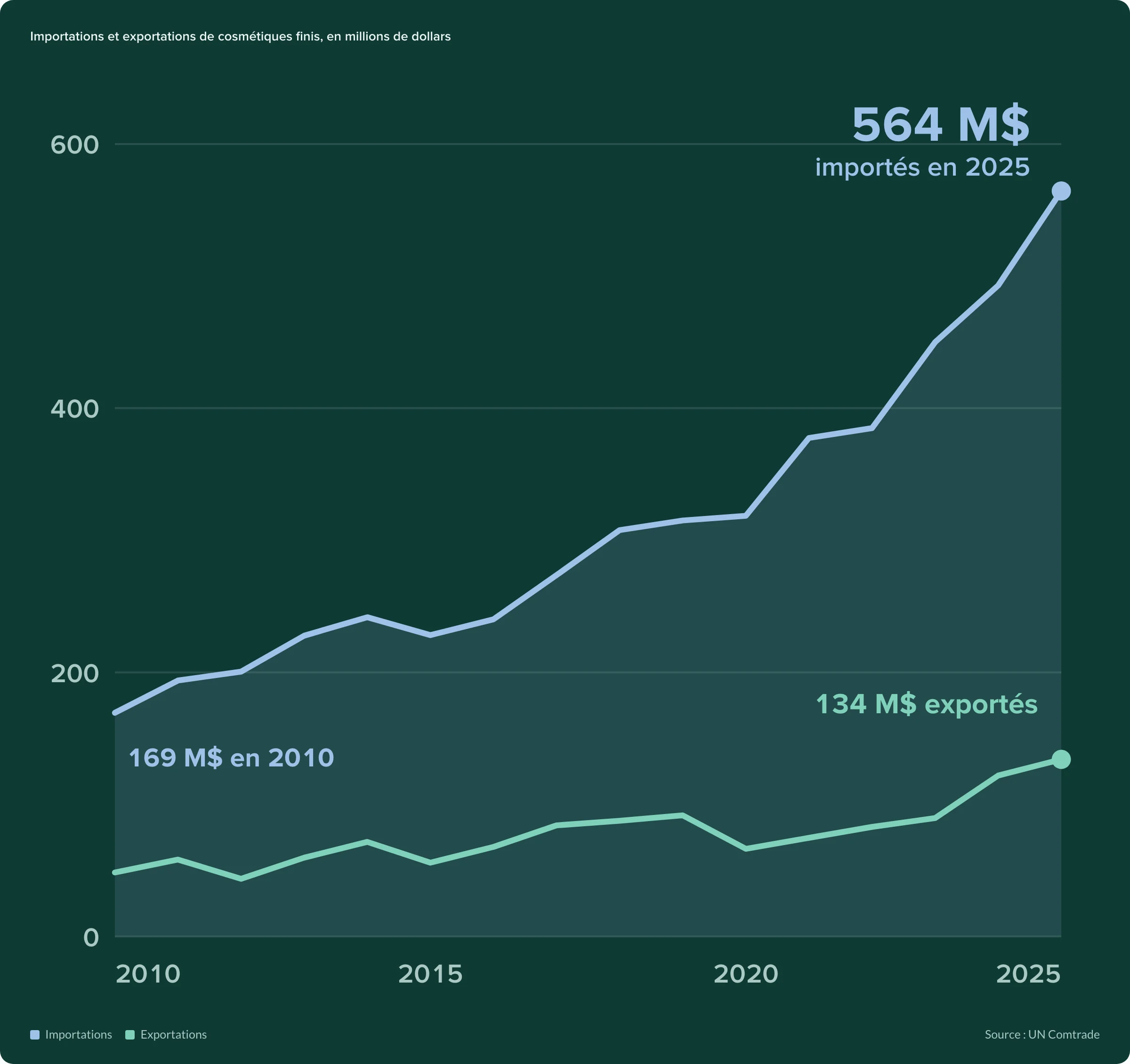
Morocco purchased 169 million dollars of finished cosmetics from abroad in 2010 and 564 million in 2025, an average increase of 8,4% per year5. The pandemic caused only a brief pause in 2020.
Growth continues: from January to August 2026, the official category reached 3 141 million dirhams, up 7,9% year on year33.
All product categories are growing, primarily in volume
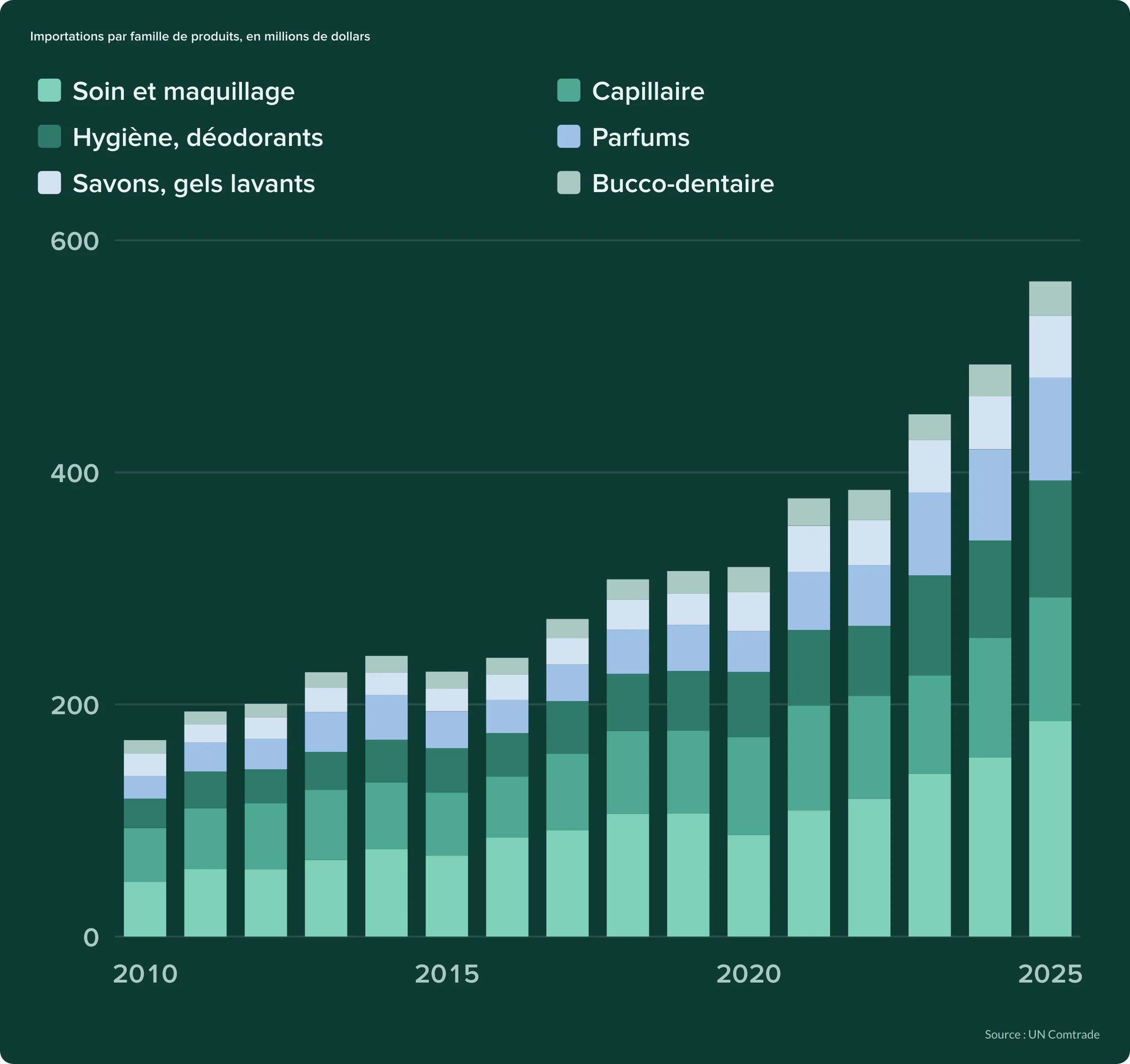
Skincare and makeup imports have quadrupled, as have perfumes and personal hygiene products. Growth is driven primarily by volume: Moroccans are consuming more and switching from soap to shower gel.
Cleansing gel imports have increased 12-fold since 2010, almost entirely through volume growth. Skincare combines both effects: 2,3 times the tonnage and a 56% increase in price per kilogram5.
Europe supplies two-thirds, while China gains ground
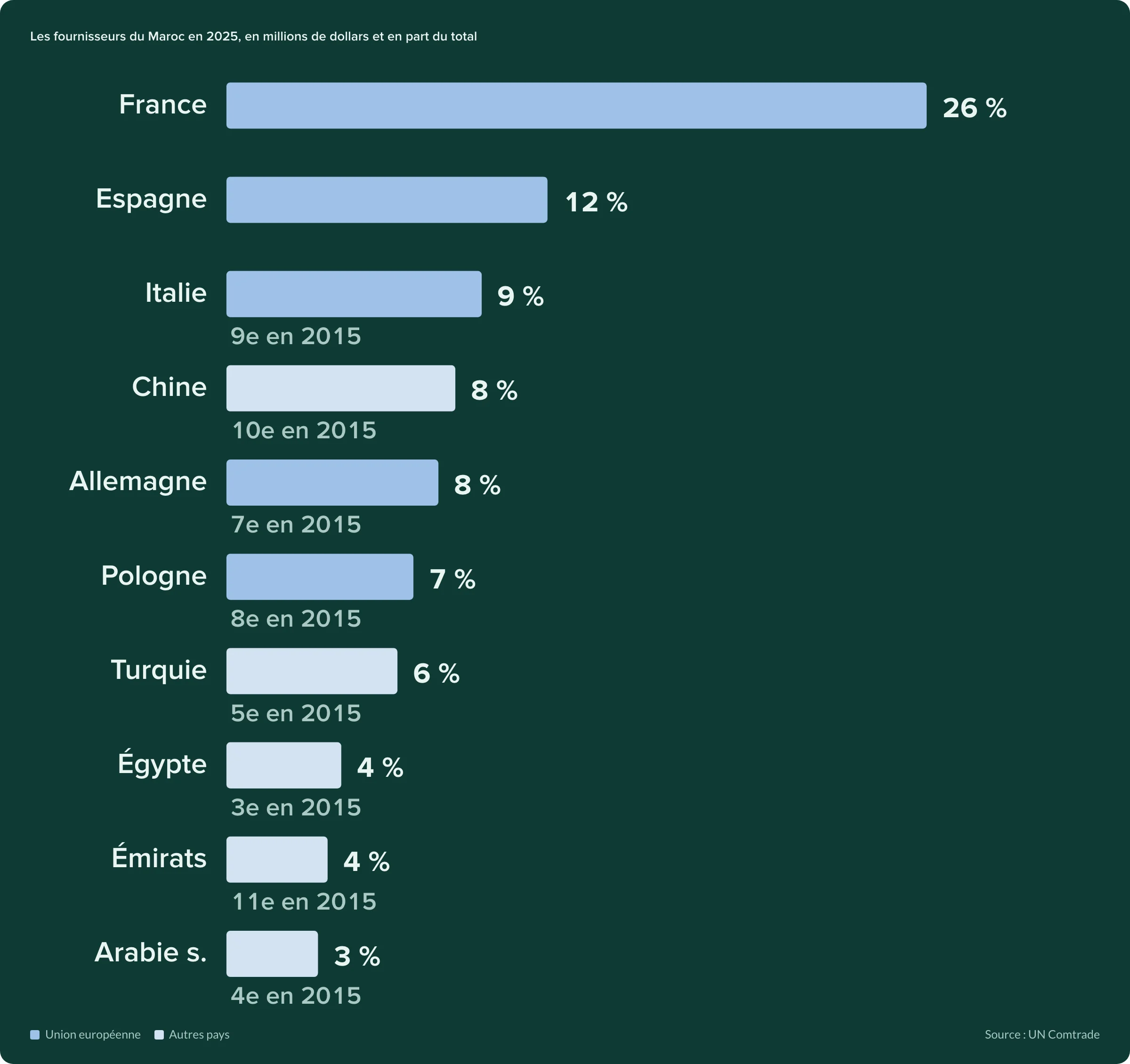
The European Union accounts for 64% of purchases, with France alone supplying 26%, down from 31% in 2015. These products have entered Morocco duty-free since 201232.
China rose from 10th to 4th in ten years and dominates makeup. Saudi Arabia and Egypt mainly supply shampoos and toothpastes5,1. In total, the Middle East supplied 99,7 million dollars of finished cosmetics to Morocco in 2025, detailed in our study on Moroccan cosmetics exports to the Middle East.
One dirham exported for nearly ten imported
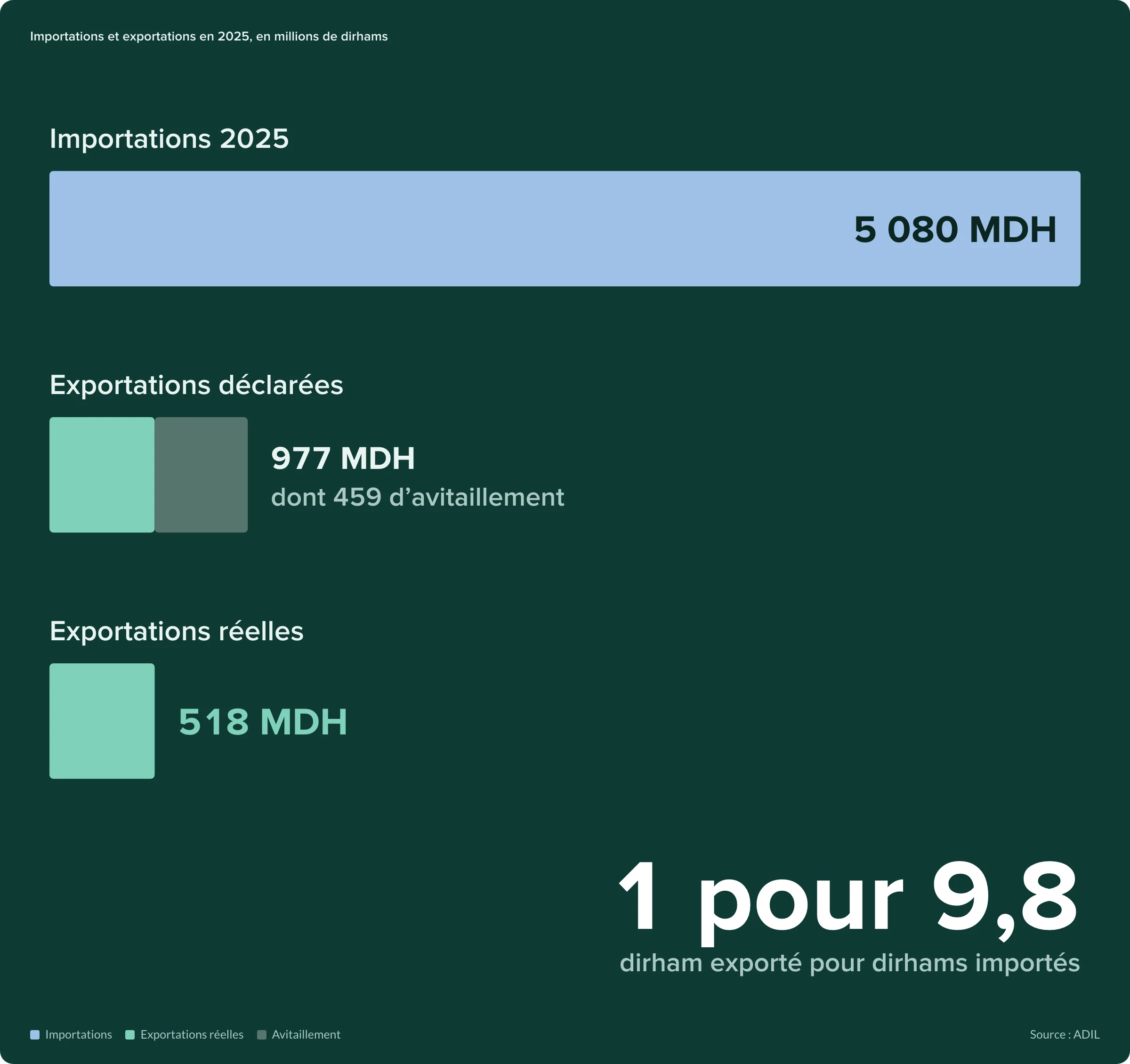
The sector reports 977 million dirhams in exports. But 459 million, nearly half, consists of ship and aircraft supplies: branded perfumes that are supplied to ships and aircraft and are not manufactured in Morocco1.
Excluding ship and aircraft supplies, actual exports fall to 518 million dirhams. For every dirham exported, the country imports 9,8. In Europe, the EU purchased 83,7 million euros of Moroccan beauty products in 2025, 81% of them in bulk: see our study on Moroccan cosmetics exports to Europe.
Creams, perfumes and shampoos lead
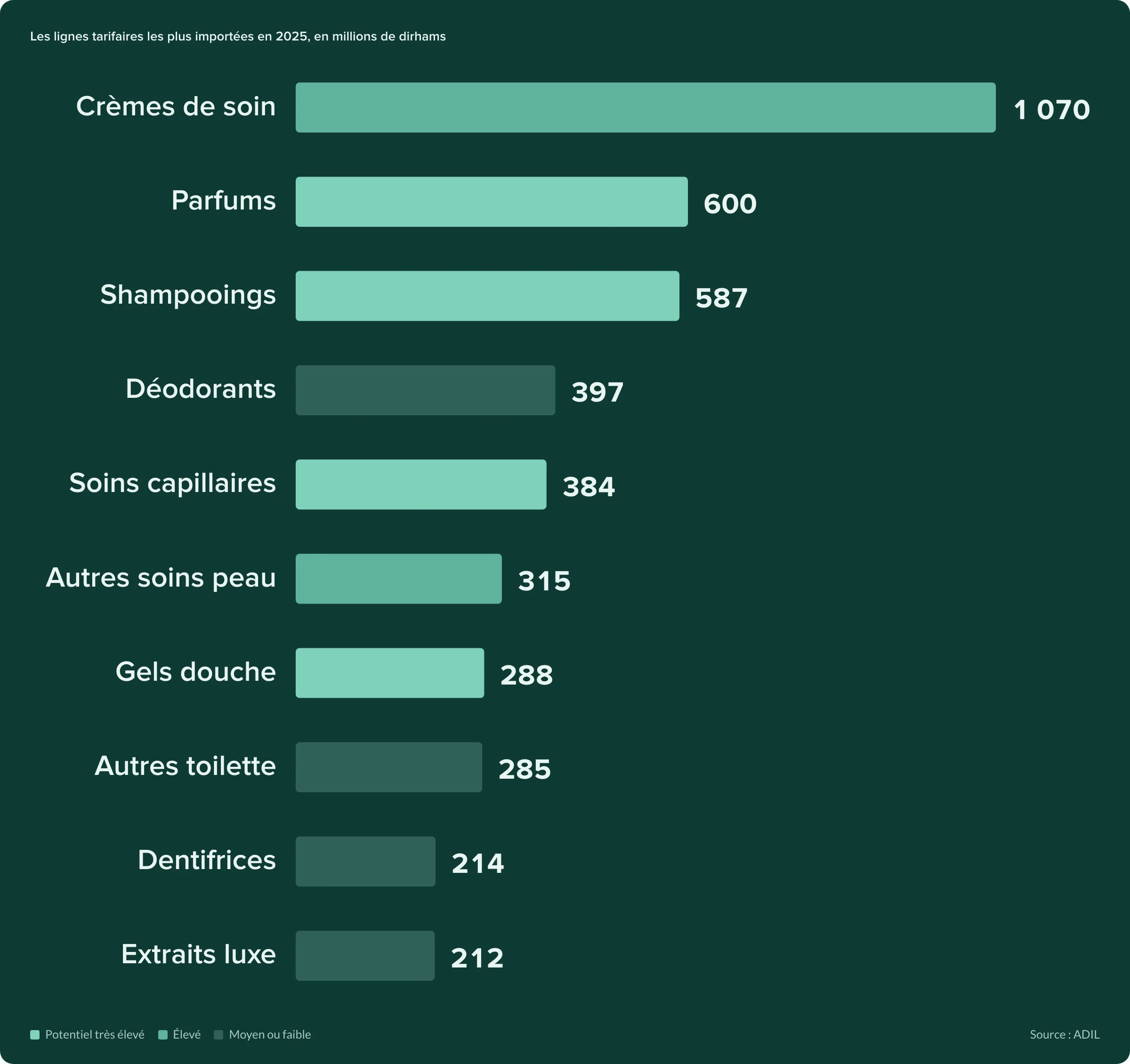
The leading import tariff line is creams, emulsions and skincare oils: 1,07 billion dirhams. Next come perfumes (600 million), shampoos (587 million) and deodorants (397 million)1.
These are mass-market products, heavy and inexpensive per kilogram: 28 dirhams for imported shampoo and 33 for shower gel. At these prices, transport and packaging give local manufacturing an advantage.
3,5 billion dirhams to recapture
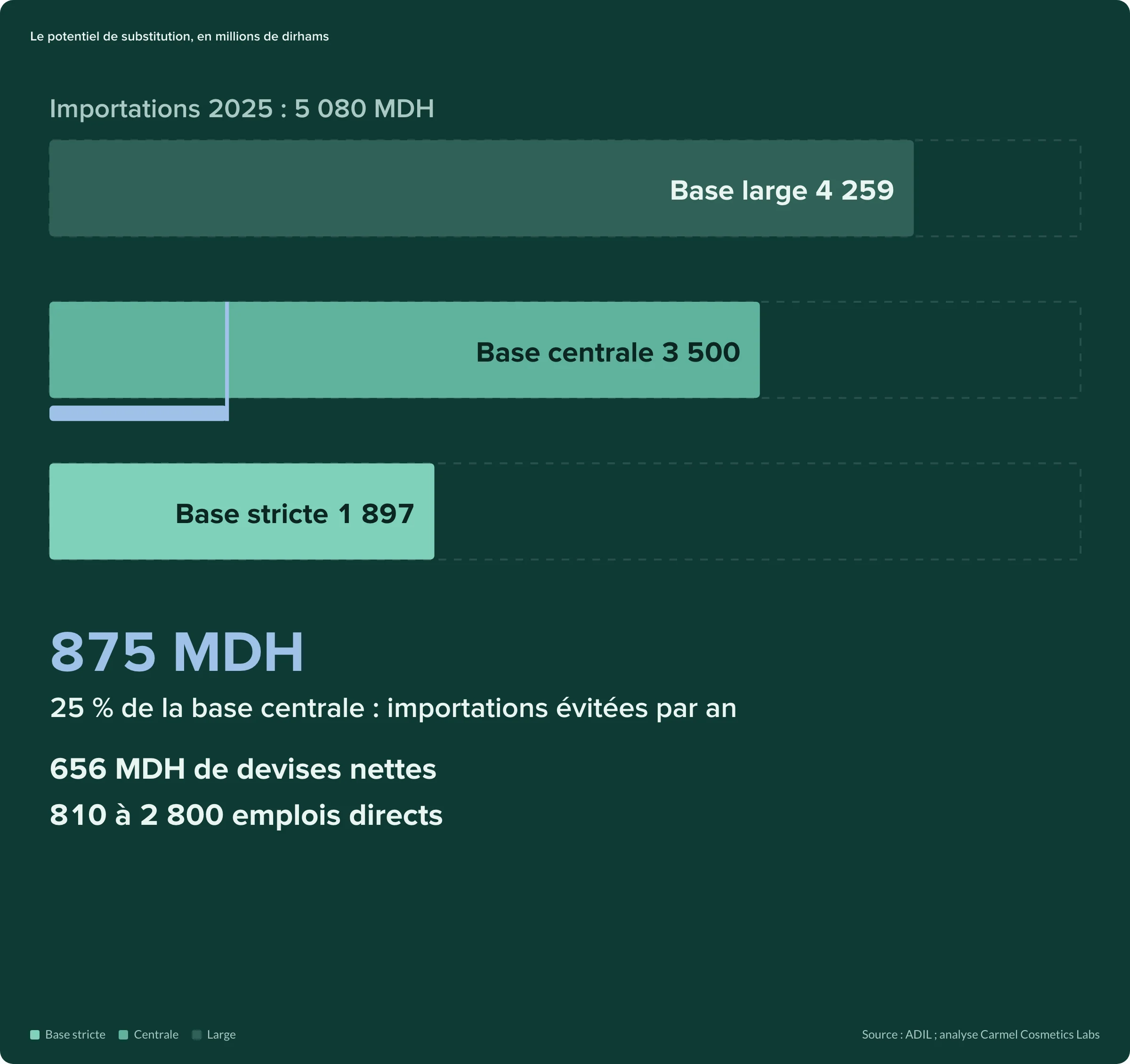
Each tariff line is scored on five criteria: volume, price per kilogram, ease of manufacturing, brand influence and Moroccan expertise. The potential reaches 3,5 billion dirhams, ranging from 1,9 to 4,3 billion depending on how strict the assessment is. The full scoring framework is published below.
Capturing 25% would avoid 875 million dirhams of imports per year. This represents approximately 656 million in net foreign currency savings, 3 to 6 industrial facilities and 810 to 2 800 direct jobs11,12,9.
Egypt has done it
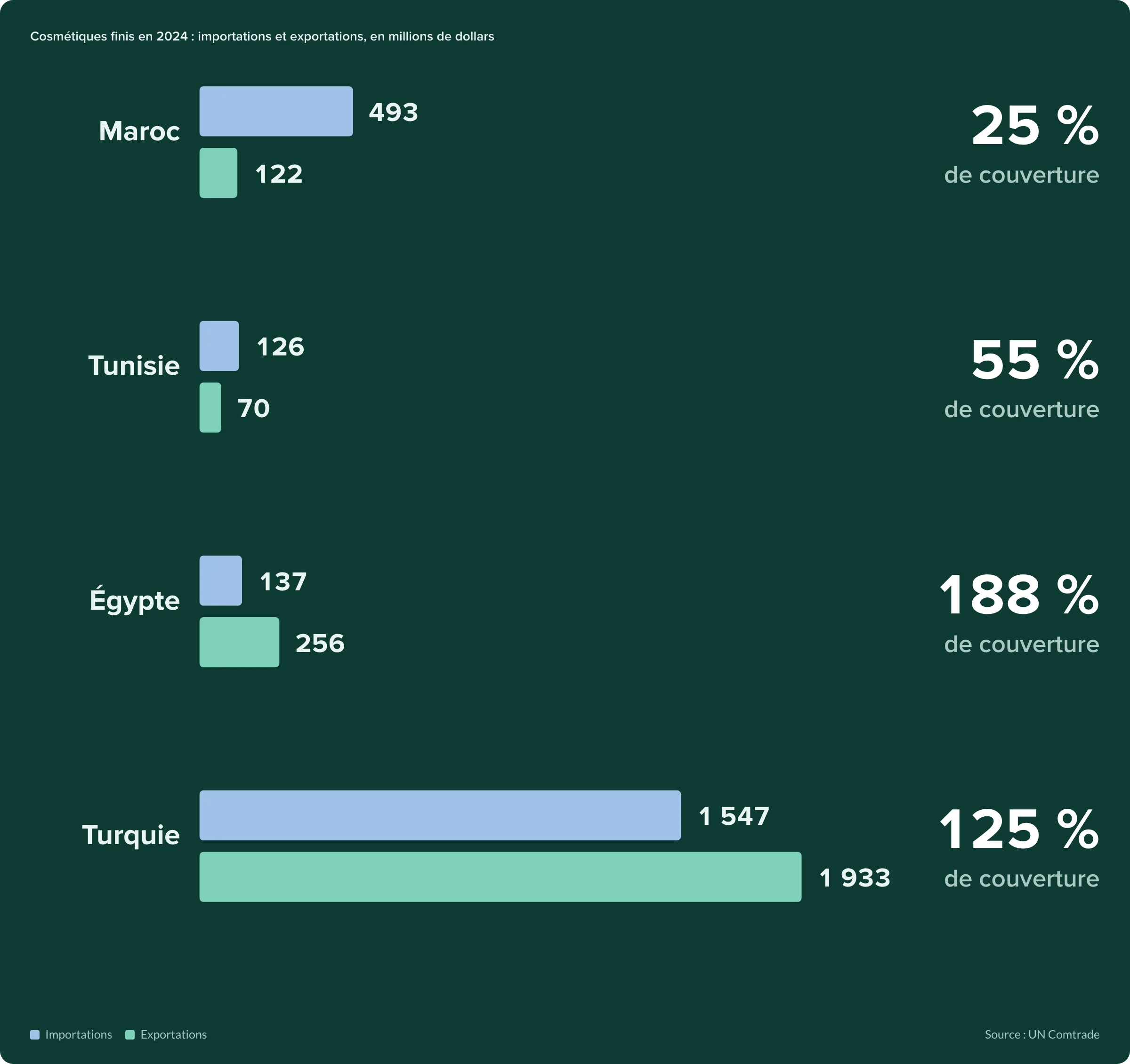
Between 2015 and 2024, Egypt reduced its cosmetics imports by 42% while its exports grew by 25%. It now exports nearly twice as much as it imports. Turkey is also a net exporter, and Tunisia’s exports cover more than half of its imports5.
Over the same period, Moroccan imports more than doubled. Morocco is the only one of the four countries to import more than four times what it exports.
What if nothing changes by 2035?
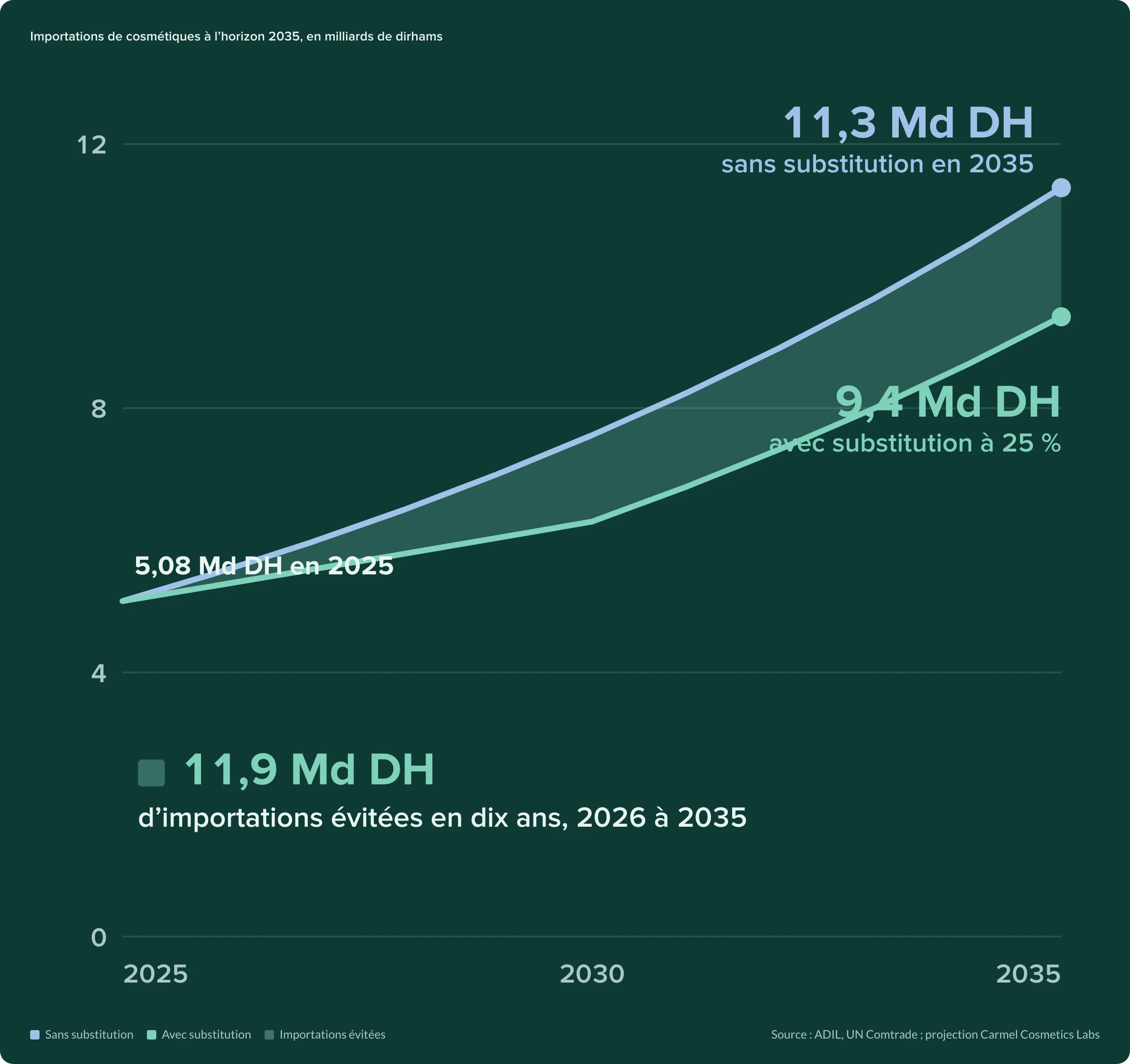
If imports maintain their 2010-2025 growth rate of 8,4% per year, the bill will reach 11 338 million dirhams in 2035, more than double today’s figure, and Morocco will have spent around 81 billion dirhams in foreign currency over ten years. Even with growth slowing to 5% per year, the 2035 bill would exceed 8,3 billion, with a cumulative total of 67 billion5,1.
If the industry gradually captures 25% of the central estimate by 2030, then maintains that share, avoided imports will reach 1 953 million dirhams per year in 2035 and 11,9 billion cumulatively over ten years, including 8,9 billion in net foreign currency savings after paying for imported materials.
In employment terms, bringing this production to Morocco would represent 1 800 to 6 200 direct jobs in 7 to 13 industrial facilities by 2035, and 4 600 to 15 700 jobs including indirect employment, using the ratio observed by the Banque de projets11,12,8. These jobs would be based in regions where the industry already operates, around Agadir, Casablanca and Tangier, in an industry where the Investment Charter rewards projects whose workforce includes at least 30% women28,20.
Import substitution: an industrial policy priority
Since 2020, import substitution has been a pillar of the Ministry of Industry and Trade’s policy, and the King has made it a priority for national sovereignty. Several Moroccan cosmetics brands already show that products made in Morocco can compete with imports.
Dec. 2020 Launch of the Banque de projets. Of the 183 billion dirhams in annual imports targeted, “34 billion dirhams can be replaced by local production,” according to the minister at the time7. The specialty chemicals sector accounts for 2 billion dirhams of the 2021-2023 target8.
March 2023 Royal message for National Industry Day. Faced with “heavy dependence on imports,” industrial sovereignty “is a central priority”15.
March 2023 Domestic preference in public procurement. Decree 2-22-431 requires needs to be defined “on the basis of products of Moroccan origin” (art. 5). It applies a 15% upward adjustment to bids from competitors not established in Morocco (art. 147) and reserves 30% of contracts for micro, small and medium-sized enterprises (art. 148)19.
2023 Investment Charter. Combined incentives can cover up to 30% of investment: a 5% sector incentive for industry and an additional 3% for a project that increases local content20. Since November 2025, a scheme for micro, small and medium-sized enterprises has covered projects worth 1 to 50 million dirhams21.
Apr. 2025 Progress report to Parliament. 1 905 projects identified, 95 billion dirhams in import substitution potential, 126 billion dirhams in investment and more than 177 000 direct jobs9. These are potential outcomes reported by project sponsors, not imports already replaced.
Nov. 2025 Made in Morocco label. It requires at least 40% of production costs to be incurred in Morocco. IMANOR oversees the process22.
July 2026 Throne Speech. “Strengthening national sovereignty and strategic self-sufficiency” are established as major priorities for industrial development16.
Cosmetics in the Banque de projets
The Banque de projets website organizes its project profiles by industry, including “Cosmetics” and “Soap and detergent”10. Four profiles cover finished products:
The four cosmetics project profiles in the Banque de projets
- Profile no. 37, “Cosmetics manufacturing.” It targets toothpaste and shampoo (HS 3304 to 3306). It puts imports at 152 million dollars in 2016 and 197 million dollars in 2019, and cites “the potential for local businesses to compete with international brands”11.
- Profile no. 136, “Hygiene and cosmetics.” Shampoo, shower gel, toothpaste: the opportunity would be to “develop a local brand that better addresses the needs” of the population12.
- Profile no. 224, “Aerosol manufacturing and packaging.” Deodorants, hairsprays and shaving foams, with potential for white label manufacturing for third parties13.
- Profile no. 319, natural cosmetics. It focuses on argan oil, prickly pear seed oil and rhassoul (ghassoul) clay, and states that imports cover 80% of the market14.
The ministry does not publish a cosmetics-specific progress report. Neither the number of cosmetics projects selected or in production nor the value of imports already replaced in this sector is public. In his July 2026 review of his term in office, the minister cited successes in construction materials and technical textiles without mentioning cosmetics18.
Facilitate and support manufacturing investment. Support tools exist, but they are fragmented. The Investment Charter offers incentives covering up to 30% of investment, with an additional 3% for local content. Since November 2025, its scheme for micro, small and medium-sized enterprises has covered projects worth 1 to 50 million dirhams, with chemicals among the listed sectors20,21. Banque de projets profiles refer to the ISTITMAR, IDMAJ and TAEHIL programs, Mezzanine PME and the Industrial Development Fund, as well as land in Agadir, Had Soualem or Selouane10,11. The Made in Morocco label, launched in November 2025, and domestic preference in public procurement complete the framework22,19. What the cosmetics industry lacks is dedicated support: a single point of contact for funding applications, faster AMMPS registration for locally manufactured products, and help connecting with retailers and brands that currently import23.
Barriers and opportunities
What holds the industry back
- Dependence on inputs. Surfactants, fragrance compounds and packaging are largely imported. Industrial fragrance compounds (3302.90) cost 499 million dirhams in 2025, +80% since 20221.
- Competition from duty-free imports. Two documented closures are attributed to tariff removal. In 2010, Beiersdorf put its Nivea factory in Berrechid up for sale27. In 2024, Unilever announced the closure of its detergent and bouillon factories in Aïn Sebaâ, switching to supplies from Egypt26.
- Informal trade and smuggling, which the FCP denounces as “unfair competition” amid “uncontrolled imports”25. No recent figures measure their scale.
- Retailer private label products manufactured abroad. In 2015, more than 80% of store brand products sold in Morocco were made abroad29.
What supports growth
- Regulations that apply to everyone. AMMPS registration (circular 771 of 2023, TARKHISS platform) is mandatory for both imported and local products and is required for customs clearance23.
- Major retail chains. The six leading chains generated 40,9 billion dirhams in revenue in 202430. The minister encourages them to aim for 80% local products17. Local manufacturing of their private label products is the most direct way to achieve this.
- Public procurement (hospitals, boarding schools, government bodies), with a 15% domestic preference19.
- An export-oriented natural ingredients sector. Essential oils generated 392 million dirhams in exports in 2025, compared with 16 million dirhams in imports1. 93% of argan oil is exported in bulk31. Processing these materials in Morocco increases both added value and local content.
- Recent investments. In 2024, the Mutandis complex in Berrechid (285 million dirhams) opened a cosmetics factory with an annual capacity of 4 000 metric tons. The ministry presented it as an industrial sovereignty project28.
Proposed actions
- Target tariff lines with very high potential first (shampoos, haircare, shower gels, mass-market perfumes, bath salts): 1,9 billion dirhams in imports. Skincare creams come next (1,07 billion dirhams), with a large share of these products purchased by major retail chains.
- Secure contracts for local manufacturing of retailer private label products with retail chains, supported by the Made in Morocco label.
- Use the Investment Charter, including the 3% local content incentive and the scheme for micro, small and medium-sized enterprises, to support filling and packaging lines.
- Create a single support office for the cosmetics industry that brings together assistance from the Charter, Maroc PME and the Banque de projets, speeds up AMMPS registration for products made in Morocco, and connects manufacturers with retailers and brands that import.
- Publish sector-specific progress reports on cosmetics projects in the Banque de projets and the imports they have replaced, to measure the actual impact of these measures.
Do you currently import cosmetics for your retail chain or brand? Carmel Cosmetics Labs develops and manufactures more than 1 000 formulas ready for your brand at its ISO 22716-certified factory in Agadir: view the white label catalog or book a Free consultation. To compare Morocco with Turkey, Poland and China: where to manufacture cosmetics in 2026.
The data in detail
All study data, available to verify and reuse with source attribution.
Scoring framework by tariff line
Each tariff line receives a score from 1 to 5 on five criteria: volume (25%), price per kilogram (20%), ease of manufacturing (20%), low brand influence (20%) and Moroccan expertise, measured by actual exports relative to imports (15%). Very high starts at 4,0, high at 3,4 and medium at 2,8. Equal weighting leaves the central estimate unchanged.
| HS code | Product and rationale | MDH | Volume | Price/kg | Ease of manufacturing | Brand | Expertise | Score | Potential |
|---|---|---|---|---|---|---|---|---|---|
| 3401.30.00.00 | Shower gels, liquid soapsliquid surfactants, limited brand differentiation | 288 | 4,45 | Very high | |||||
| 3305.10.00.90 | Shampoossurfactants in an aqueous phase, mass-market products | 587 | 4,35 | Very high | |||||
| 3303.00.00.20 | Perfumes and eaux de toilettefilling alcohol-based perfumes; strong brand influence at the premium end | 600 | 4,20 | Very high | |||||
| 3305.90.00.90 | Conditioners, masks, oilsconditioners, masks, oils: simple to manufacture | 384 | 4,05 | Very high | |||||
| 3307.30.00.00 | Scented bath salts and bath preparationssalts and bath preparations: simple blending | 39 | 4,05 | Very high | |||||
| 3304.99.91.00 | Creams, emulsions, skincare oilsstandard emulsion; strong brand image in skincare, but retailer private label products are widespread | 1 070 | 3,70 | High | |||||
| 3307.49.00.00 | Home fragranceshome fragrances: diffusers, candles, sprays | 147 | 3,60 | High | |||||
| 3304.99.99.00 | Other skincare productsgels, serums, masks: established formulation expertise | 315 | 3,55 | High | |||||
| 3401.11.10.00 | Toilet soap barssoapmaking: dedicated line, commodity product | 57 | 3,45 | High | |||||
| 3307.41.00.00 | Incense, bakhour (for burning)incense, bakhour: artisanal and semi-industrial production | 14 | 3,45 | High | |||||
| 3307.90.90.90 | Other toiletriesmiscellaneous toiletries, including wipes | 285 | 3,35 | Medium | |||||
| 3307.10.00.90 | Other shaving / aftershave productsaftershave: simple lotions | 6 | 3,10 | Medium | |||||
| 3307.20.00.00 | Deodorants, antiperspirantssimple roll-ons and sticks, more demanding aerosol production | 397 | 2,95 | Medium | |||||
| 3306.90.00.00 | Mouthwashes and other productsmouthwashes: simple to manufacture, health-related brand image | 59 | 2,95 | Medium | |||||
| 3303.00.00.10 | Alcohol-free perfumesalcohol-free perfumes, scented oils | 12 | 2,90 | Medium | |||||
| 3307.10.00.10 | Shaving creamssimple shaving creams, aerosol foams | 15 | 2,75 | Low | |||||
| 3306.10.00.00 | Toothpastestoothpaste: dedicated line, dominant brands | 214 | 2,75 | Low | |||||
| 3305.30.00.00 | Hairspraysaerosol hairsprays | 4 | 2,50 | Low | |||||
| 3304.91.00.00 | Powderspressed powders: pressing, pigments | 58 | 2,35 | Low | |||||
| 3304.10.00.00 | Lip makeuplipsticks: casting, color matching | 139 | 2,30 | Low | |||||
| 3304.30.00.00 | Manicure, pedicurenail polish: solvents, safety | 50 | 2,25 | Low | |||||
| 3303.00.00.90 | Other perfumes (extracts)luxury extracts: value tied to the brand | 212 | 2,15 | Low | |||||
| 3305.20.00.00 | Permanent waving and straighteningrelaxers: specialized alkaline chemistry | 17 | 2,00 | Low | |||||
| 3304.20.00.00 | Eye makeupmascaras, eyeliners: specialized equipment | 97 | 1,85 | Low |
Import tariff lines in 2025
| HS code | Product | MDH | Metric tons | DH/kg | Export | EU* | Leading suppliers (million dirhams) | Potential |
|---|---|---|---|---|---|---|---|---|
| 3304.99.91.00 | Creams, emulsions, skincare oils | 1 070 | 6 679 | 160 | 66 | 79 % | France 436, Spain 190, Poland 123, China 53 | High |
| 3303.00.00.20 | Perfumes and eaux de toilette | 600 | 9 051 | 66 | 199 | 58 % | France 176, China 119, UAE 86, Poland 76 | Very high |
| 3305.10.00.90 | Shampoos | 587 | 20 764 | 28 | 22 | 50 % | France 149, Saudi Arabia 135, Egypt 98, Germany 48 | Very high |
| 3307.20.00.00 | Deodorants, antiperspirants | 397 | 3 961 | 100 | 5 | 66 % | Poland 87, Germany 70, Italy 64, Turkey 37 | Medium |
| 3305.90.00.90 | Conditioners, masks, oils | 384 | 7 292 | 53 | 22 | 46 % | Italy 57, Spain 47, France 43, Turkey 34 | Very high |
| 3304.99.99.00 | Other skincare products | 315 | 1 557 | 203 | 185 | 64 % | France 104, Italy 38, Spain 33, Korea 26 | High |
| 3401.30.00.00 | Shower gels, liquid soaps | 288 | 8 601 | 33 | 16 | 83 % | France 109, Italy 42, Germany 39, Spain 32 | Very high |
| 3307.90.90.90 | Other toiletries | 285 | 2 694 | 106 | 2 | 78 % | Italy 120, France 56, Germany 24, Turkey 17 | Medium |
| 3306.10.00.00 | Toothpastes | 214 | 4 635 | 46 | 1 | 37 % | Egypt 64, China 26, Slovakia 19, Germany 18 | Low |
| 3303.00.00.90 | Other perfumes (extracts) | 212 | 188 | 1133 | 379 | 89 % | France 160, Spain 22, Switzerland 10, United States 7 | Low |
| 3307.49.00.00 | Home fragrances | 147 | 2 599 | 56 | 11 | 53 % | Spain 37, UAE 23, Turkey 21, France 20 | High |
| 3304.10.00.00 | Lip makeup | 139 | 1 142 | 122 | 18 | 33 % | China 65, Germany 23, Turkey 18, France 16 | Low |
| 3304.20.00.00 | Eye makeup | 97 | 399 | 243 | 2 | 55 % | Germany 34, China 26, Turkey 12, France 8 | Low |
| 3306.90.00.00 | Mouthwashes and other products | 59 | 852 | 69 | 3 | 84 % | Spain 23, Italy 13, France 7, Germany 5 | Medium |
| 3304.91.00.00 | Powders | 58 | 497 | 118 | 5 | 33 % | China 29, Spain 9, Turkey 7, Italy 3 | Low |
| 3401.11.10.00 | Toilet soap bars | 57 | 3 148 | 18 | 0 | 48 % | Turkey 26, Spain 22, UK 4, France 3 | High |
| 3304.30.00.00 | Manicure, pedicure | 50 | 679 | 74 | 1 | 37 % | China 21, Poland 8, Turkey 6, Netherlands 5 | Low |
| 3307.30.00.00 | Scented bath salts and bath preparations | 39 | 2 147 | 18 | 33 | 94 % | Spain 26, Italy 5, Poland 3, France 2 | Very high |
| 3305.20.00.00 | Permanent waving and straightening | 17 | 209 | 81 | 0 | 3 % | Brazil 10, South Africa 5, Turkey 1, Italy 1 | Low |
| 3307.10.00.10 | Shaving creams | 15 | 338 | 44 | 1 | 7 % | UK 8, Turkey 4, India 1, China 1 | Low |
| 3307.41.00.00 | Incense, bakhour (for burning) | 14 | 404 | 34 | 2 | 2 % | UAE 6, India 4, Saudi Arabia 2, Indonesia 1 | High |
| 3303.00.00.10 | Alcohol-free perfumes | 12 | 215 | 54 | 1 | 36 % | China 5, France 4, Saudi Arabia 1, Oman 1 | Medium |
| 3307.10.00.90 | Other shaving / aftershave products | 6 | 177 | 34 | 1 | 49 % | UK 2, Poland 1, Italy 1, UAE 1 | Medium |
| 3305.30.00.00 | Hairsprays | 4 | 106 | 39 | 0 | 44 % | Turkey 2, Spain 1, France 0, Hungary 0 | Low |
Source: ADIL1. * EU share among the tariff line’s ten leading suppliers.
Imports by product category in 2025
| SH | Category | MDH | Million euros | Metric tons | DH/kg | Exports (million dirhams) | Share |
|---|---|---|---|---|---|---|---|
| 3304 | Skincare and makeup | 1 732 | 164 | 10 973 | 158 | 278 | 34,1 % |
| 3305 | Hair preparations | 991 | 94 | 28 371 | 35 | 45 | 19,5 % |
| 3307 | Hygiene, shaving, deodorants, bath, home fragrance | 912 | 86 | 12 824 | 71 | 54 | 17,9 % |
| 3303 | Perfumes and eaux de toilette | 824 | 78 | 9 453 | 87 | 579 | 16,2 % |
| 3401 | Toilet soaps, cleansing gels | 346 | 33 | 11 783 | 29 | 17 | 6,8 % |
| 3306 | Oral hygiene | 276 | 26 | 5 504 | 50 | 4 | 5,4 % |
| Total within scope | 5 080 | 482 | 78 908 | 64 | 977 | 100 % |
Source: ADIL1; BAM average exchange rate for 20253.
Top 15 suppliers, 2025 and 2015
| Rank | Country | USD million, 2025 | MDH 2025 | 2025 share | 2015 rank | 2015 share | Change |
|---|---|---|---|---|---|---|---|
| 1 | France | 146,0 | 1 365 | 25,9 % | 1 | 31,2 % | ×2,0 |
| 2 | Spain | 66,9 | 626 | 11,9 % | 2 | 8,6 % | ×3,4 |
| 3 | Italy | 53,2 | 498 | 9,4 % | 9 | 4,8 % | ×4,9 |
| 4 | China | 47,7 | 446 | 8,5 % | 10 | 4,6 % | ×4,6 |
| 5 | Germany | 44,2 | 413 | 7,8 % | 7 | 5,0 % | ×3,9 |
| 6 | Poland | 39,0 | 365 | 6,9 % | 8 | 4,8 % | ×3,6 |
| 7 | Turkey | 35,7 | 334 | 6,3 % | 5 | 5,4 % | ×2,9 |
| 8 | Egypt | 24,0 | 224 | 4,2 % | 3 | 6,7 % | ×1,6 |
| 9 | United Arab Emirates | 21,1 | 197 | 3,7 % | 11 | 4,0 % | ×2,3 |
| 10 | Saudi Arabia | 19,1 | 179 | 3,4 % | 4 | 5,4 % | ×1,5 |
| 11 | United States | 9,6 | 90 | 1,7 % | 13 | 2,4 % | ×1,7 |
| 12 | United Kingdom | 8,7 | 82 | 1,5 % | 6 | 5,2 % | ×0,7 |
| 13 | India | 6,2 | 58 | 1,1 % | 14 | 1,7 % | ×1,6 |
| 14 | South Korea | 5,8 | 54 | 1,0 % | 39 | 0,1 % | ×47,1 |
| 15 | Switzerland | 4,9 | 46 | 0,9 % | 15 | 1,5 % | ×1,4 |
Source: UN Comtrade5.
Product breakdown, 2010 and 2025
| SH | Product | 2010 (US$ million) | USD million, 2025 | Value | Volume | Price per kg |
|---|---|---|---|---|---|---|
| 3304.99 | Skincare (creams…) | 40,6 | 148,7 | ×3,7 | ×2,3 | ×1,6 |
| 3303.00 | Perfumes | 19,6 | 88,6 | ×4,5 | ×3,1 | ×1,5 |
| 3305.10 | Shampoos | 28,2 | 63,1 | ×2,2 | ×1,9 | ×1,2 |
| 3307.20 | Deodorants | 12,0 | 42,6 | ×3,6 | ×1,7 | ×2,1 |
| 3305.90 | Other hair care | 17,5 | 41,2 | ×2,4 | ×2,0 | ×1,2 |
| 3307.90 | Other personal hygiene | 5,6 | 34,0 | ×6,1 | ×2,0 | ×3,1 |
| 3401.30 | Cleansing gels | 2,6 | 30,9 | ×12,1 | ×9,3 | ×1,3 |
| 3306.10 | Toothpastes | 10,2 | 23,0 | ×2,3 | ×1,4 | ×1,6 |
| 3401.11 | Toilet soaps | 4,2 | 18,1 | ×4,4 | ×2,4 | ×1,8 |
| 3307.49 | Home fragrances | 3,9 | 16,1 | ×4,2 | ×2,0 | ×2,1 |
| 3304.10 | Lip makeup | 1,7 | 15,0 | ×8,8 | ×6,2 | ×1,4 |
| 3304.20 | Eye makeup | 2,2 | 10,4 | ×4,8 | ×2,0 | ×2,4 |
Source: UN Comtrade, 6-digit subheadings5.
Official Office des Changes series, 2019 to 2026
| Year | MDH | Thousand t | Change |
|---|---|---|---|
| 2019 | 2 687 | 47 | |
| 2020 | 2 625 | 51 | -2,3 % |
| 2021 | 2 952 | 55 | +12,5 % |
| 2022 | 3 419 | 53 | +15,8 % |
| 2023 | 3 987 | 54 | +16,6 % |
| 2024 | 4 308 | 62 | +8,1 % |
| 2025 (prov.) | 4 611 | 65 | +7,0 % |
| Jan.-Aug. 2026 | 3 141 | 42,3 | +7,9 % year on year |
Sources: Bank Al-Maghrib, annual reports3,4; Office des Changes33.
Actual exports: destinations
| Country | MDH | Share |
|---|---|---|
| France | 132 | 25,5 % |
| United States | 49 | 9,5 % |
| Saudi Arabia | 44 | 8,5 % |
| Brazil | 34 | 6,5 % |
| Paraguay | 31 | 6,0 % |
| Spain | 26 | 5,1 % |
| Tunisia | 22 | 4,3 % |
| Belgium | 22 | 4,3 % |
| United Arab Emirates | 20 | 3,9 % |
| Mauritania | 12 | 2,3 % |
Source: ADIL, excluding ship and aircraft supplies1.
Jobs and investment by scenario
| Scenario | Production (MDH/year) | Investment (MDH) | Direct jobs | Facilities |
|---|---|---|---|---|
| Conservative: 10 % | 350 | 105 to 210 | 320 to 1 100 | 1 to 2 |
| Proactive: 25 % | 875 | 262 to 525 | 810 to 2 800 | 3 to 6 |
| Ambitious: 40 % | 1 400 | 420 to 840 | 1 300 to 4 400 | 5 to 9 |
Ratios from Banque de projets fact sheets no. 37, 136, 224 and 319 and the April 2025 review11,12,13,14,9.
Tunisia, Egypt, Turkey: comparison table
| Country | 2024 imports (US$ million) | 2024 exports (US$ million) | Export-to-import ratio | Imports per capita ($) | Imports 2015-2024 | Exports 2015-2024 |
|---|---|---|---|---|---|---|
| Morocco | 493 | 122 | 25 % | 12,9 | +116 % | +118 % |
| Tunisia | 126 | 70 | 55 % | 10,3 | -3 % | +1 % |
| Egypt | 137 | 256 | 188 % | 1,2 | -42 % | +26 % |
| Turkey | 1 547 | 1 933 | 125 % | 18,1 | +57 % | +80 % |
Sources: UN Comtrade5; World Bank34.
2026-2035 projection, year by year
Assumptions: imports follow the average growth recorded from 2010 to 2025 (8,4 % per year, in current dollars); the share that can be substituted is the central estimate, or 69 % of imports; the substitution rate rises linearly from 0 in 2025 to 25 % in 2030, then stays at 25 %; the imported content of local production is 25 %. These are approximate estimates, not forecasts: slower growth of 5 % per year would result in a 2035 import bill of 8 275 MDH instead of 11 338.
| Year | Trend-based imports (MDH) | Substitution rate | Imports avoided | Imports with substitution | Net foreign exchange savings | Direct jobs |
|---|---|---|---|---|---|---|
| 2026 | 5 505 | 5 % | 190 | 5 315 | 142 | 180 to 600 |
| 2027 | 5 965 | 10 % | 411 | 5 554 | 308 | 380 to 1 300 |
| 2028 | 6 464 | 15 % | 668 | 5 796 | 501 | 620 to 2 100 |
| 2029 | 7 004 | 20 % | 965 | 6 039 | 724 | 890 to 3 100 |
| 2030 | 7 589 | 25 % | 1 307 | 6 282 | 980 | 1 210 to 4 100 |
| 2031 | 8 224 | 25 % | 1 416 | 6 807 | 1 062 | 1 310 to 4 500 |
| 2032 | 8 911 | 25 % | 1 535 | 7 377 | 1 151 | 1 420 to 4 900 |
| 2033 | 9 656 | 25 % | 1 663 | 7 993 | 1 247 | 1 540 to 5 300 |
| 2034 | 10 463 | 25 % | 1 802 | 8 661 | 1 352 | 1 670 to 5 700 |
| 2035 | 11 338 | 25 % | 1 953 | 9 385 | 1 465 | 1 810 to 6 200 |
| 2026-2035 cumulative total | 81 120 | 11 910 | 69 210 | 8 932 |
Sources: ADIL1; UN Comtrade5; employment ratios from fact sheets no. 37 and 13611,12.
Employment and social impact of the 2035 scenario
In 2035, production relocated to Morocco under the 25 % scenario (1 953 MDH per year) represents:
- 1 800 to 6 200 direct jobs, based on ratios in the Banque de projets fact sheets (between 0,9 and 3,2 jobs per million dirhams in revenue)11,12;
- 4 600 to 15 700 jobs including indirect jobs, using the ratio of 1,5 indirect jobs per direct job reported in the April 2022 Banque de projets review8;
- 7 to 13 medium-sized industrial facilities and 590 to 1 170 MDH in cumulative investment11,12,13,14;
- mainly production and technical jobs, in areas where the industry is already established: Agadir for natural ingredients, Casablanca and Berrechid for large-scale production, and Tangier for exports to Europe. The Mutandis complex in Berrechid, inaugurated in 2024, created 250 direct jobs with 285 MDH in investment28;
- an industry that encourages employment for women: the Investment Charter offers an additional 3 % incentive for projects in which women hold at least 30 % of jobs20;
- upstream, the processing of argan oil and natural ingredients, 93 % of which are currently exported in bulk, with potential estimated by the World Bank at 17 000 jobs by 203531.
These figures exclude jobs preserved in distribution, the impact on tax revenue, and job losses among importers, none of which are estimated here.
Imported content of local production
Manufacturing in Morocco does not eliminate all imports. In the 2025 materials and packaging purchases of Carmel Cosmetics Labs35, 47 % consisted of packaging manufactured in Morocco (with imported resins and cardboard accounting for 40 % of its value), 12 % of Moroccan plant oils and extracts, and 41 % of technical raw materials imported directly or through distributors. The FCP estimates that the sector imports 90 % of its raw materials24. With materials and packaging accounting for just over a third of production value, the imported content of local production is around 25 %, ranging from 22 to 30 %. The study uses 25 %, with 40 % as a conservative assumption.
Scope and methodology
The study covers finished perfumery, cosmetics and personal hygiene products as classified in the Moroccan 10-digit customs nomenclature:
- 3303 perfumes and eaux de toilette; 3304 skincare, makeup, sun care and manicure products;
- 3305 hair preparations; 3306 oral hygiene;
- 3307 shaving products, deodorants, bath products and home fragrances (excluding contact lens products);
- 3401.11 toilet soaps and 3401.30 skin cleansing gels (excluding household soaps).
Excluded are food flavorings (3302.10, 734 MDH in 2025), laundry detergents (3402.50), diapers and sanitary pads (9619), and tariff lines labeled “containing cannabis.” Essential oils (3301) and plant oils such as argan oil (1515) are considered separately: Morocco is a net exporter of these products.
Three sources complement each other. Customs data (ADIL) provides the value, weight and top ten suppliers for each tariff line in 20251. The Office des Changes, as reported by Bank Al-Maghrib, provides the official 2019-2025 series for the category “perfumery, toiletries and cosmetic preparations”3,4. UN Comtrade provides historical data for 2010-2025 in dollars and a breakdown by country5. Amounts in dirhams are converted using the 2025 average exchange rates from Bank Al-Maghrib: 1 USD = 9,351 DH, 1 EUR = 10,550 DH3.
The three sources are consistent: 4 735 MDH for headings 3303 to 3307 according to ADIL, 4 611 MDH according to the Office des Changes (provisional figure), and US$ 564 million according to Comtrade for 3303 to 3307 and the whole of heading 3401 (including household soaps). Values are CIF (cost, insurance and freight).
Limitations
- Several 10-digit tariff lines were introduced on January 1, 2025 (3304.99.91, 3305.10.90, 3305.90.90, 3307.90.90). Detailed data for these lines is therefore only available for 2025. Historical data is based on 4-digit headings (Comtrade) and the Office des Changes series.
- ADIL lists only the top ten suppliers for each tariff line. Country rankings are based on Comtrade.
- Imports also include products intended for ship and aircraft supplies, particularly branded perfumes. Their share is not reported separately in the statistics, which slightly inflates perfume imports.
- The imported share of production value (25 %) is based on purchases by a single manufacturer, supplemented by FCP data. It varies by product and production run size.
- No public source measures the share of products manufactured in Morocco on retail shelves. A shelf survey is being prepared for the next edition.
- The size of the domestic market is not officially published. Public estimates range from €600 to 800 million, or around 8 billion DH according to the FCP24. The study therefore focuses on customs trade flows.
- The potential scores and the share of imported inputs (40 %) are analyst assessments, explained above.
Sources
- ADII, ADIL: product fact sheets, 2025 statistics by tariff line, agreements and duties (data collected on October 10, 2026). www.douane.gov.ma
- ADII, customs tariff, chapter 33 (January 1, 2022 edition). www.douane.gov.ma
- Bank Al-Maghrib, 2025 annual report: table A5.1 (Office des Changes), table A7.1 (exchange rates), reserves. www.bkam.ma
- Bank Al-Maghrib, annual reports from 2020 to 2024, table A5.1 (2019 to 2023 series). www.bkam.ma
- United Nations, UN Comtrade: Moroccan imports and exports, HS 3303 to 3307 and 3401, 2010 to 2025, by trading partner. comtradeplus.un.org
- Office des Changes, 2025 foreign trade (provisional figures), reported by FNH on February 2, 2026. fnh.ma
- Attijariwafa bank and the Ministry of Industry, press release on Banque de projets, December 14, 2020. www.attijariwafabank.com
- Aujourd’hui le Maroc, “Ryad Mezzour provides an update to Parliament,” April 13, 2022. aujourdhui.ma
- Le Matin, “Morocco has 1 905 industrial import substitution projects,” April 15, 2025. lematin.ma
- Ministry of Industry and Trade, Banque de projets: cosmetics and soap and detergent sectors. banquedeprojets.mcinet.gov.ma
- Banque de projets, fact sheet no. 37, “Manufacturing cosmetic products.” banquedeprojets.mcinet.gov.ma
- Banque de projets, fact sheet no. 136, “Hygiene and cosmetics.” banquedeprojets.mcinet.gov.ma
- Banque de projets, fact sheet no. 224, “Aerosol manufacturing and packaging.” banquedeprojets.mcinet.gov.ma
- Banque de projets, fact sheet no. 319, “Natural cosmetics manufacturing facility.” banquedeprojets.mcinet.gov.ma
- Royal message to the 1st National Industry Day, March 29, 2023. www.maroc.ma
- Throne speech of July 29, 2026, full text (Hespress). fr.hespress.com
- Hespress, “Mezzour: Moroccans increasingly favor local products,” May 21, 2024. fr.hespress.com
- FNH, “Ryad Mezzour: behind the scenes of five years of industrial policy,” July 31, 2026. fnh.ma
- Decree no. 2-22-431 of March 8, 2023 on public procurement (articles 5, 147, 148). newweb.ofppt.ma
- Decree no. 2-23-1 of February 16, 2023, main support scheme under the Investment Charter (Official Bulletin no. 7174). casainvest.ma
- Le360, “Investment Charter: the support scheme for micro, small and medium-sized businesses is now operational,” November 8, 2025. fr.le360.ma
- Médias24, “The Ministry of Industry launches a new Made in Morocco label,” November 3, 2025. medias24.com
- AMMPS, circular 771 D/DMP/18 of October 25, 2023 on cosmetics and personal hygiene products. www.ammps.gov.ma
- Infomédiaire, “The Moroccan cosmetics market reaches 8 billion dirhams” (FCP), January 27, 2021. www.infomediaire.net
- MAP Business, “Chemicals and related industries: five questions for Abed Chagar, FCP president,” May 20, 2021. www.mapbusiness.ma
- Consonews, “Unilever, manufacturer of Omo and Knorr products, leaves Morocco,” March 29, 2024. consonews.ma
- Bladi.net, Nivea factory in Berrechid put up for sale, October 29, 2010. www.bladi.net
- Boursenews, inauguration of the Mutandis industrial complex in Berrechid, March 19, 2024. boursenews.ma
- Le360, “Mass retail: operators invest in store brands,” June 26, 2015. fr.le360.ma
- Le360, grocery retail (Competition Council opinion), July 5, 2025. fr.le360.ma
- Bladi.net, citing the World Bank (Country Private Sector Diagnostic 2026) on bulk argan oil exports, August 16, 2026. www.bladi.net
- Le Matin, tariff dismantling: EU products enter duty-free, 2012. lematin.ma
- Office des Changes, imports and exports by key product, January to August 2026 (provisional figures), and August 2026 monthly indicators. www.oc.gov.ma
- World Bank, total population in 2024 (indicator SP.POP.TOTL). data.worldbank.org
- Carmel Cosmetics Labs, breakdown of 2025 raw material and packaging purchases, aggregated internal data.
Data collected on October 10, 2026. Study conducted by Carmel Cosmetics Labs, an ISO 22716 and ISO 9001 certified cosmetic contract manufacturer in Agadir (B1006 ZI Aït Melloul, Greater Agadir).