Services

Torn between two services?A project manager will guide you

Catalog

Explore the full catalog1,000+ formulas ready to carry your brand

Face careFull range

Serums, creams and targeted care, formulated with your actives.

Body careFull range

Moisturizing, nourishing and shower care: cream, butter or oil.

Specialty careFull range

Sun care, lips, intimate care and oral care.

Men, baby, makeupFull range

Shaving and beard, baby and mom, makeup.

Industries

All solutions by industryFormulas and formats for your business

Our brands

Our own brands, developed and made in our laboratory.

Become a distributor of our brandsPharmacies, spas, shops and wholesalers

Laboratory

Cosmetics manufacturing room with a row of stainless-steel mixers and an operator in white workwearOur factory in Aït MelloulISO 22716 and ISO 9001, visits by appointmentDiscover the factory

Resources

Xanthan gum in cosmetics

Xanthan gum is a polysaccharide produced by fermentation of Xanthomonas bacteria5. In cosmetics, it thickens, gels and stabilizes emulsions16. It is a texture ingredient: no study we kept attributes a skincare effect to it. The CIR panel and EFSA judge it safe, each within its own scope34.

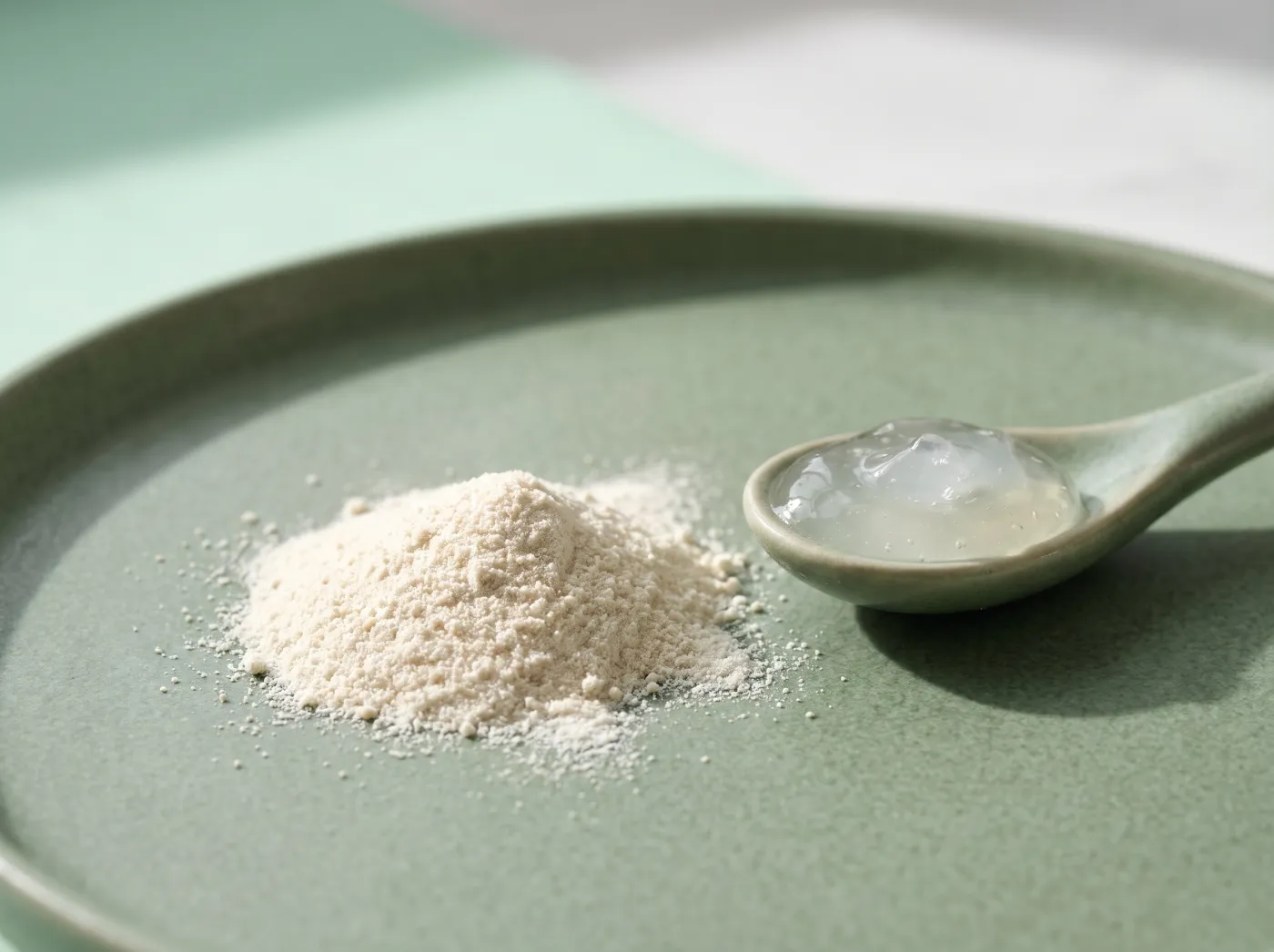
Xanthan gum powder, macro view on a sage green ceramic surface

Xanthan gum at a glance

Entry from our cosmetic ingredient glossary. Regulatory data from the European Commission's CosIng database1 and Regulation (EC) 1223/20092, safety according to the CIR expert panel3. Copy the identifiers in one click for your files.

INCI name
XANTHAN GUM
Other names
Xanthan gumGummi xanthanum (European Pharmacopoeia, according to CosIng)1; E 415 as a food additive4
CAS number
11138-66-2
EC number
234-394-2
Chemical nature
High molecular weight polysaccharideGlucose, mannose and glucuronic acid units, with acetyl and pyruvyl groups5
CosIng functions
Binding, gel forming, emulsion stabilizing, viscosity controlling"Binding", "gel forming", "emulsion stabilising" and "viscosity controlling", among others1
Origin
Bacterial fermentationXanthomonas grown in a medium containing glucose, sucrose or starch6
Appearance
Light powderDisperses in water, which it thickens
EU status
No restrictionAbsent from annexes II to VI of Regulation (EC) 1223/2009 as consolidated on May 1, 20252
Allergen to declare
NoAbsent from the fragrance allergen list of Regulation (EU) 2023/1545
Safety
Judged safe in cosmeticsCIR panel 2016, with 33 other microbial gums: safe in the present practices of use and concentrations3

What the research says

Each result shows the protocol and the level of evidence. The higher the level, the better the result carries over to a finished formula.

Clinical trialReview or consensusLaboratory

Texture and stabilityFormulation

The reference polymer of thickened emulsions

Laboratory
Emulsions with 1% polymerSensory and physico-chemical analysis

Compared with two alginates, xanthan gum serves as the bio-sourced reference polymer: the residual films of the emulsions are similar, but each polymer leaves its own texture signature on application. The study is linked to an alginate producer7.

Paired with a carbomer, adhesive hydrogels

Laboratory
8 hydrogelsRheology, adhesion, sensory analysis

Combinations of a type C carbomer with xanthan gum, or with a copolymer carbomer, are the most promising for products that stick to the skin. The two selected hydrogels release about 80% of the model caffeine in 5 hours8.

A historic thickener of liquid formulas

Review
2023 review

Xanthan gum is traditionally used as a thickener of liquid formulas and an emulsion stabilizer. Its structure changes with temperature and pH9.


Manufacturing and originBiotechnology

An aerobic fermentation of Xanthomonas

Review
2 reviews from 2023

The gum is produced by batch fermentation in a medium of glucose, sucrose or starch. The cost of sugar pushes research toward cheaper substrates, such as agri-food waste56.

SafetyExpert assessments

34 microbial gums judged safe in cosmetics

Expert assessment
CIR panel 2016Animal and clinical data

The panel concludes that these gums, xanthan gum included, are safe in the present practices of use and concentrations3.

No acceptable daily intake needed in food

Expert assessment
EFSA 2017Oral route, additive E 415

Xanthan gum is probably not absorbed intact and is fermented by gut flora. No adverse effect at the highest doses tested, no genotoxicity. Adults tolerated up to 214 mg per kg per day for 10 days, with occasional abdominal discomfort. This result concerns ingestion, not the skin4.

This page summarizes published literature on a cosmetic ingredient. It does not describe the effect of a finished product, which depends on its formula, and it is not medical advice. Some of the studies cited were run or funded by manufacturers; this is shown in the sources. Xanthan gum is a texture ingredient: no cosmetic clinical trial we kept isolates a skincare effect, and this page suggests none. The studies cited cover manufacturing, texture and safety.

Which products can use xanthan gum?

No formula in our white label catalog features xanthan gum yet. Our formulation lab can add it to a custom formula or to a catalog formula. Its common uses:

Face

Thickener and stabilizer of gels, serums, creams and lotions; helps keep particles in suspension.

Body

Texture and stability of body lotions, shower gels and scrubs.

Hair

Texture of shampoos, styling gels and conditioners.

Xanthan gum, alginates, carbomer or carrageenan?

Four polymers that thicken or gel aqueous formulas. The figures below come from two texture studies; they do not point to an absolute best choice.

Xanthan gumAlginatesCarbomerKappa carrageenan
OriginBacterial fermentation5Brown algaeSynthetic polymerRed algae
What the studies showClassic reference texture in 1% emulsions7Its own texture signature; the gelled version is more viscoelastic7Higher complex viscosity than kappa carrageenan in hydrogels8Lower viscosity than the type C carbomer in the same study8
Role in the hydrogels testedSecondary polymer, combined with the carbomer8Not tested in this studyMain polymer8Main polymer8

Frequently asked questions about xanthan gum

What is xanthan gum?
It is a high molecular weight polysaccharide, produced by fermentation of bacteria of the genus Xanthomonas5. In cosmetics, it is used to thicken, gel and stabilize emulsions ("gel forming", "emulsion stabilising" and "viscosity controlling" functions in CosIng)1.
Where does xanthan gum come from: is it natural?
It is of biotechnological origin: a bacterium makes it from a sugar, glucose, sucrose or starch6. It is not extracted from a plant. Whether it is called natural depends on the standard you target; the type of starting sugar varies by supplier and is set in the specification.
Is xanthan gum safe?
The CIR panel judges it safe in the present practices of use and concentrations3 and it is not restricted in the EU2. EFSA did not find it necessary to set an acceptable daily intake for the food additive E 4154; this opinion concerns ingestion, not the skin.
What percentage of xanthan gum should you use?
European regulation sets no ceiling2. The texture study cited tests it with 1% polymer in an emulsion7. The actual dose depends on the target texture, the other thickeners and the surfactant system: it is set through laboratory trials.
Does xanthan gum hydrate skin?
No trial we kept shows it. It is chosen for texture and stability, not for a skincare effect: CosIng does give it a skin conditioning function1, but we found no study that isolates it.
Xanthan gum or carbomer: which to choose?
The choice depends on the texture and stability you want, and they can be combined: the study cited finds combinations of a carbomer with xanthan gum promising8. The decision is made in the lab, on formula trials.
Can you formulate a stabilized gel or cream for my brand?
Yes. Our ISO 22716 certified lab develops the texture and stability of each formula, starting from a catalog formula to customize or a custom formula. Free samples are included.

Sources

Peer-reviewed studies and official regulatory sources, checked on November 3, 2026.

  1. European Commission. CosIng, entry XANTHAN GUM (CAS 11138-66-2, EC 234-394-2). ec.europa.eu/growth/tools-databases/cosing
  2. European Parliament and Council. Regulation (EC) No 1223/2009 on cosmetic products, consolidated version of May 1, 2025: no entry for xanthan gum in annexes II to VI. eur-lex.europa.eu
  3. Fiume MM, Heldreth B, Bergfeld WF, et al. Safety Assessment of Microbial Polysaccharide Gums as Used in Cosmetics. Int J Toxicol. 2016;35(1 Suppl):5S-49S. doi:10.1177/1091581816651606
  4. EFSA Panel on Food Additives and Nutrient Sources added to Food (ANS), Mortensen A, Aguilar F, et al. Re-evaluation of xanthan gum (E 415) as a food additive. EFSA J. 2017;15(7):e04909. doi:10.2903/j.efsa.2017.4909

  5. Rashidi AR, Azelee NIW, Zaidel DNA, et al. Unleashing the potential of xanthan: a comprehensive exploration of biosynthesis, production, and diverse applications. Bioprocess Biosyst Eng. 2023;46(6):771-787. doi:10.1007/s00449-023-02870-9

  6. Dey R, Chatterji BP. Sources and methods of manufacturing xanthan by fermentation of various carbon sources. Biotechnol Prog. 2023;39(6):e3379. doi:10.1002/btpr.3379
  7. Terescenco D, Hadj Benali L, Canivet F, et al. Bio-sourced polymers in cosmetic emulsions: a hidden potential of the alginates as thickeners and gelling agents. Int J Cosmet Sci. 2021;43(5):573-587. doi:10.1111/ics.12732ALGAIA
  8. Parente ME, Ochoa Andrade A, Ares G, et al. Bioadhesive hydrogels for cosmetic applications. Int J Cosmet Sci. 2015;37(5):511-518. doi:10.1111/ics.12227
  9. Jadav M, Pooja D, Adams DJ, Kulhari H. Advances in xanthan gum-based systems for the delivery of therapeutic agents. Pharmaceutics. 2023;15(2):402. doi:10.3390/pharmaceutics15020402
Carmel Cosmetics Labs product specialist with a brand founder

Tell us about your project

A product specialist reviews your request and gets back to you on the channel you prefer.

Lead EN – Demande de devis
Tell us about your project. A product specialist will get back to you shortly.
CONTACT INFORMATION
Name
PROJECT INFORMATION
Which cosmetics category interests you most?

By submitting this form, you agree to our terms of service and privacy policy.

No obligation. Your information stays confidential and is used only to prepare your quote.