Services

Torn between two services?A project manager will guide you

Catalog

Explore the full catalog1,000+ formulas ready to carry your brand

Face careFull range

Serums, creams and targeted care, formulated with your actives.

Body careFull range

Moisturizing, nourishing and shower care: cream, butter or oil.

Specialty careFull range

Sun care, lips, intimate care and oral care.

Men, baby, makeupFull range

Shaving and beard, baby and mom, makeup.

Industries

All solutions by industryFormulas and formats for your business

Laboratory

Cosmetics manufacturing room with a row of stainless-steel mixers and an operator in white workwearOur factory in Aït MelloulISO 22716 and ISO 9001, visits by appointmentDiscover the factory

Resources

Rosehip oil

Rosehip oil is extracted from the seeds of wild roses. The INCI name ROSA MOSCHATA SEED OIL designates Rosa moschata or Rosa eglanteria1; the trade also sells oils of Rosa rubiginosa or Rosa canina under this name23. Rich in linoleic and linolenic acids4, it oxidizes quickly6. Clinical evidence in cosmetics is thin9.

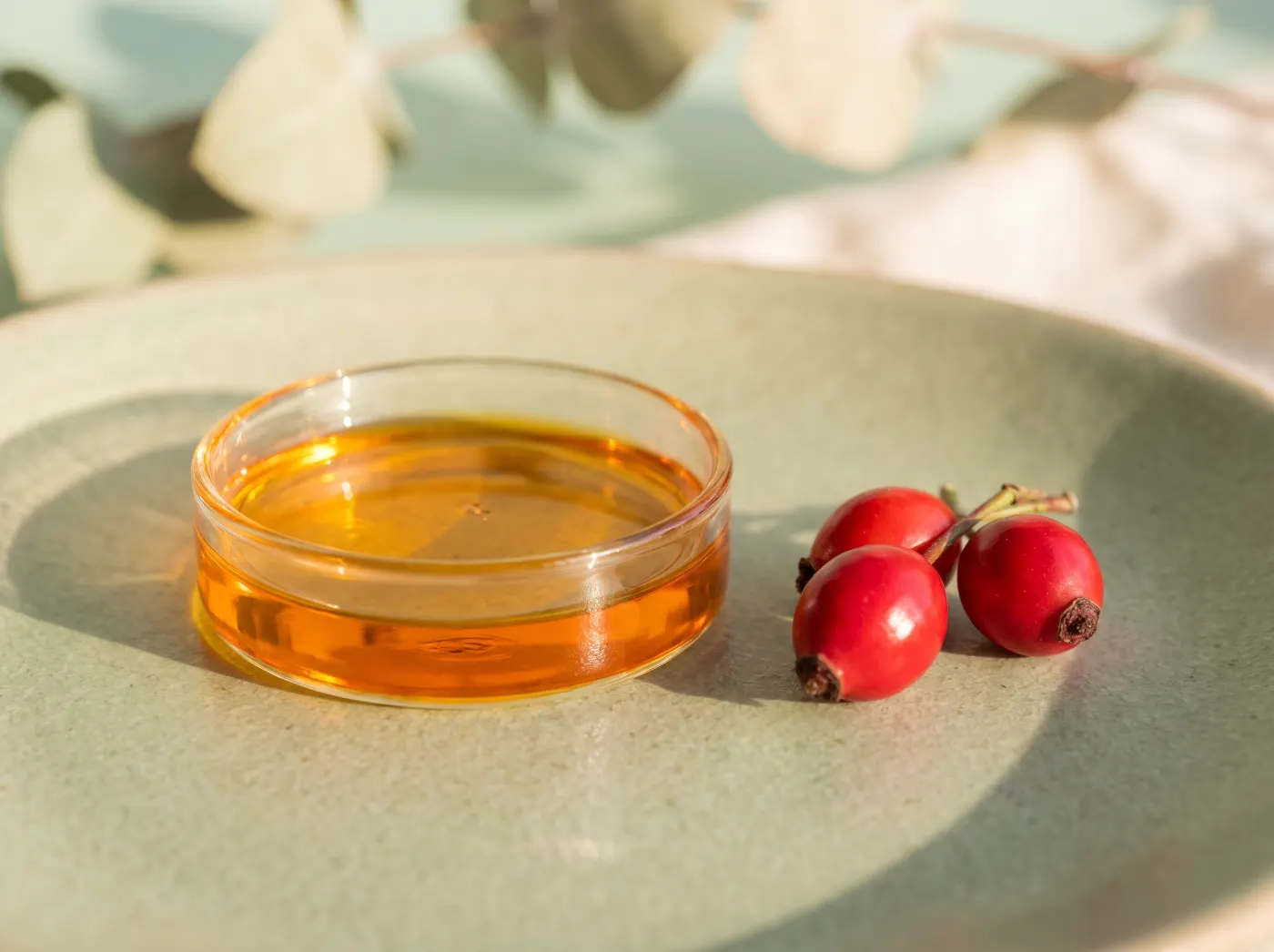
Orange-tinted rosehip oil in macro view, a clear drop on a sage green ceramic surface, raking light

Rosehip oil at a glance

Entry from our cosmetic ingredient glossary. Regulatory data from the European Commission's CosIng database123. Trade names group several species: check the species of your batch. Copy the identifiers in one click for your files.

INCI name
ROSA MOSCHATA SEED OILOil from the seeds of the musk rose, Rosa moschata, or of Rosa eglanteria (Rosaceae)1
Neighboring INCI
ROSA RUBIGINOSA SEED OILTo declare if the batch comes from Rosa rubiginosa, the "rosa mosqueta" of the literature27. ROSA CANINA FRUIT OIL for Rosa canina3
Other names
Rosehip, rosehip oilRosa mosqueta. The same common name covers several species of wild roses
CAS number
Not assigned in CosIngRosa moschata and Rosa rubiginosa: no number. Rosa canina: 84696-47-9 and 84603-93-03
Botanical origin
Seeds of wild rosesThe literature mostly studies Rosa canina459 and Rosa rubiginosa7
Composition
Linoleic 49 to 54%, linolenic 16 to 18%Also oleic 15 to 18%, palmitic and stearic under 3.2%, in three Rosa canina batches from Turkey4. Rosa rubiginosa: rich in α-linolenic acid7
Minor constituents
Tocopherols, carotenoids, phytosterolsUp to 1,125 mg/kg of tocopherols and 6,485 mg/kg of phytosterols in two cold-pressed Rosa canina oils5
CosIng functions
Emollient, skin conditioning"Skin conditioning - emollient"1
EU status
No specific restrictionNo annex concerned in CosIng; general mention on ozone-depleting substances for Rosa canina13
Allergen to declare
NoOne case of contact allergy to a "Rosa mosqueta" oil has been published11
Safety
No dedicated CIR assessment retainedThe CIR panel judged 244 vegetable oils used in cosmetics safe12

What the research says

Each result shows the protocol and the level of evidence. The higher the level, the better the result carries over to a finished formula.

Clinical trialReview or consensusLaboratory

Composition and materialChemistry

A polyunsaturated oil, rich in micro-constituents

Laboratory
2 cold-pressed Rosa canina oilsLaboratory analysis

Acid, peroxide and anisidine values, as well as iron and copper contents, indicate good quality. Protection against oxidation comes from the antioxidant content and the degree of unsaturation5.

The least stable of four oils compared

Laboratory
Rancimat at 373 KRosehip, sunflower, olive, jojoba

Induction time is longest for jojoba, then olive and sunflower; rosehip is the shortest. The ranking follows the polyunsaturated content. In a formula, plan for an antioxidant and storage away from air and light6.

Extraction, composition and applications

Review
2024 reviewWild rose seed oil

The review describes the extraction methods, composition and biological activities of the oil, then its applications in food, pharmacy and cosmetics8.


Skin and bodySkincare, bodycare

Skin marks after surgery: insufficient evidence

Review
2024 review2 human clinical trialsRosa canina oil

The authors note a lack of high-quality studies. They report some signs of a reduction in the size and redness of marks, but judge the evidence insufficient to recommend the oil9.

Pregnancy stretch marks: little evidence for all topicals

Review
2015 reviewTopical prevention

Rosehip is not cited. The authors conclude that reliable prevention methods are rare and that topical products lack solid randomized trials10.

Tolerance and safetySafety

One reported case of contact allergy

Case report
Letter to the editor, 2018"Rosa mosqueta" oil

Contact allergy to a rosehip oil is documented. It is an isolated case, with no known frequency11.

244 vegetable oils assessed by the CIR panel

Expert assessment
CIR panel 2017Cosmetic vegetable oils

The panel concludes that these oils are safe in cosmetic use. Check the report list for the exact species of your batch12.

This page summarizes published literature on a cosmetic ingredient. It does not describe the effect of a finished product, which depends on its formula, and it is not medical advice. No quality cosmetic clinical trial specific to rosehip oil was retained: the page relies on material analyses and reviews. The most numerous studies are on medical uses, which this page does not cover.

Which products use rosehip oil?

Our white label catalog includes 7 formulas with rosehip oil: the key active in 2 of them, a supporting ingredient in the others. Every category can be customized (formula, fragrance, packaging).

1Face

Supporting oil in the vitamin C cream.

5Body

Mother care oil, cleansing cream, supporting oil in body milks and post-pregnancy care.

1Hair

Supporting oil in the soothing scalp serum.

In our formulas, it is most often paired with

Panthenol 4Hyaluronic acid 3Niacinamide 3

Rosehip, jojoba, avocado or coconut oil?

Four oils often combined in a body or mother care range. Their chemistry differs, so their behavior in a formula does too.

Rosehip oilJojoba oilAvocado oilCoconut oil
Chemical naturePolyunsaturated oil: linoleic and linolenic dominant4Liquid wax: about 98% wax esters13Oil: oleic 52 to 67% for the Hass variety14Oil: 92.1% saturated fatty acids, of which 47.7% lauric acid15
EU regulationNo specific restriction1No restrictionNo restrictionNo restriction
Carmel catalog formulas7 formulas25 formulas15 formulas69 formulas

Frequently asked questions about rosehip oil

What is rosehip oil, and which species does it come from?
It is the oil of wild rose seeds. The INCI name ROSA MOSCHATA SEED OIL designates the musk rose, Rosa moschata, or Rosa eglanteria1. The literature mostly studies Rosa canina49 and Rosa rubiginosa, the "rosa mosqueta"7, which have other INCI names23. The exact species of a batch is read in the supplier specification.
What are the benefits of rosehip oil in cosmetics?
CosIng classifies it as an emollient and skin conditioning agent1. It is rich in linoleic and linolenic acids4 and in antioxidant micro-constituents5. We retained no quality cosmetic clinical trial measuring a specific benefit: it is mostly a formulation oil.
Rosehip oil and stretch marks: what does the science say?
The reference review on topical prevention of pregnancy stretch marks does not cite rosehip and concludes that reliable methods are rare10. For skin marks after surgery, a 2024 review judges the evidence insufficient to recommend the oil9. An oil that is comfortable in massage remains a care use, with no demonstrated effect on stretch marks.
Is rosehip oil comedogenic, and is it suitable for oily skin?
We retained no official or peer-reviewed source giving a comedogenicity rating for this oil, so this page gives no figure. Tolerance on a given skin is checked with tests on the finished formula.
Why does rosehip oil go rancid quickly?
Because it is rich in polyunsaturated fatty acids. In a comparison of four oils, rosehip resists oxidation the least, behind jojoba, olive and sunflower6. An antioxidant, an opaque bottle and cool storage limit rancidity.
Is rosehip oil safe, including during pregnancy?
No restriction applies to the ingredient in the EU1. One case of contact allergy to a "Rosa mosqueta" oil has been published11. The CIR panel judged 244 vegetable oils used in cosmetics safe12. During pregnancy, as with any skincare product, a healthcare professional's advice remains the rule.
Can you manufacture a rosehip oil or care product for my brand?
Our ISO 22716 certified laboratory offers 7 rosehip oil formulas (pure oil, mother care, cleansing creams, body milks) to customize, or a custom formula. Free samples are included.

Sources

Peer-reviewed studies and official regulatory sources, checked on November 3, 2026.

  1. European Commission. CosIng, entry ROSA MOSCHATA SEED OIL (no CAS number). ec.europa.eu/growth/tools-databases/cosing
  2. European Commission. CosIng, entry ROSA RUBIGINOSA SEED OIL (no CAS number). ec.europa.eu/growth/tools-databases/cosing
  3. European Commission. CosIng, entry ROSA CANINA FRUIT OIL (CAS 84696-47-9 / 84603-93-0, EC 283-652-0). ec.europa.eu/growth/tools-databases/cosing
  4. Özcan M. Nutrient composition of rose (Rosa canina L.) seed and oils J Med Food. 2002;5(3):137-140. doi:10.1089/10966200260398161
  5. Grajzer M, Prescha A, Korzonek K, et al. Characteristics of rose hip (Rosa canina L.) cold-pressed oil and its oxidative stability studied by the differential scanning calorimetry method Food Chem. 2015;188:459-466. doi:10.1016/j.foodchem.2015.05.034
  6. Fagoaga C, Moreno A, Fernández-Julián N, Castellano G. Oxidative stability and kinetics of oxidation of rosehip, sunflower, olive and jojoba oils Antioxidants (Basel). 2026;15(5):646. doi:10.3390/antiox15050646
  7. D'Espessailles A, Dossi CG, Espinosa A, et al. Dietary Rosa mosqueta (Rosa rubiginosa) oil prevents high diet-induced hepatic steatosis in mice Food Funct. 2015;6(9):3109-3116. doi:10.1039/c5fo00741k
  8. Saini A, Kaur R, Kumar S, et al. New horizon of rosehip seed oil: extraction, characterization for its potential applications as a functional ingredient Food Chem. 2024;437(Pt 1):137568. doi:10.1016/j.foodchem.2023.137568


  9. Belkhelladi M, Bougrine A. Rosehip extract and wound healing: a review J Cosmet Dermatol. 2024;23(1):62-67. doi:10.1111/jocd.15971
  10. Korgavkar K, Wang F. Stretch marks during pregnancy: a review of topical prevention Br J Dermatol. 2015;172(3):606-615. doi:10.1111/bjd.13426
  11. Ochando-Ibernón G, Schneller-Pavelescu L, Silvestre-Salvador JF. Allergic contact dermatitis caused by "Rosa mosqueta" oil Contact Dermatitis. 2018;79(4):259-260. doi:10.1111/cod.13083
  12. Burnett CL, Fiume MM, Bergfeld WF, et al. Safety assessment of plant-derived fatty acid oils Int J Toxicol. 2017;36(3 Suppl):51S-129S. doi:10.1177/1091581817740569
  13. Gad HA, Roberts A, Hamzi SH, et al. Jojoba oil: an updated comprehensive review on chemistry, pharmaceutical uses, and toxicity Polymers (Basel). 2021;13(11):1711. doi:10.3390/polym13111711
  14. Flores M, Saravia C, Vergara CE, et al. Avocado oil: characteristics, properties, and applications Molecules. 2019;24(11):2172. doi:10.3390/molecules24112172
  15. Orsavova J, Misurcova L, Ambrozova JV, et al. Fatty acids composition of vegetable oils and its contribution to dietary energy intake and dependence of cardiovascular mortality on dietary intake of fatty acids Int J Mol Sci. 2015;16(6):12871-12890. doi:10.3390/ijms160612871
Carmel Cosmetics Labs product specialist with a brand founder

Tell us about your project

A product specialist reviews your request and gets back to you on the channel you prefer.

Lead EN – Demande de devis
Tell us about your project. A product specialist will get back to you shortly.
CONTACT INFORMATION
Name
PROJECT INFORMATION
Which cosmetics category interests you most?

By submitting this form, you agree to our terms of service and privacy policy.

No obligation. Your information stays confidential and is used only to prepare your quote.