











































Services

Torn between two services?A project manager will guide you

Catalog

Explore the full catalog1,000+ formulas ready to carry your brand

Face careFull range

Serums, creams and targeted care, formulated with your actives.

Body careFull range

Moisturizing, nourishing and shower care: cream, butter or oil.

Specialty careFull range

Sun care, lips, intimate care and oral care.

Men, baby, makeupFull range

Shaving and beard, baby and mom, makeup.

Industries

All solutions by industryFormulas and formats for your business

Laboratory

Cosmetics manufacturing room with a row of stainless-steel mixers and an operator in white workwearOur factory in Aït MelloulISO 22716 and ISO 9001, visits by appointmentDiscover the factory

Resources

Pumpkin seed oil

Pumpkin seed oil is pressed from the seeds of Cucurbita pepo9. It contains mostly unsaturated fatty acids, with linoleic acid first, plus tocopherols and phytosterols1. CosIng classifies it as an emollient and a skin conditioning agent9. We found no cosmetic clinical trial of the oil applied to the skin.
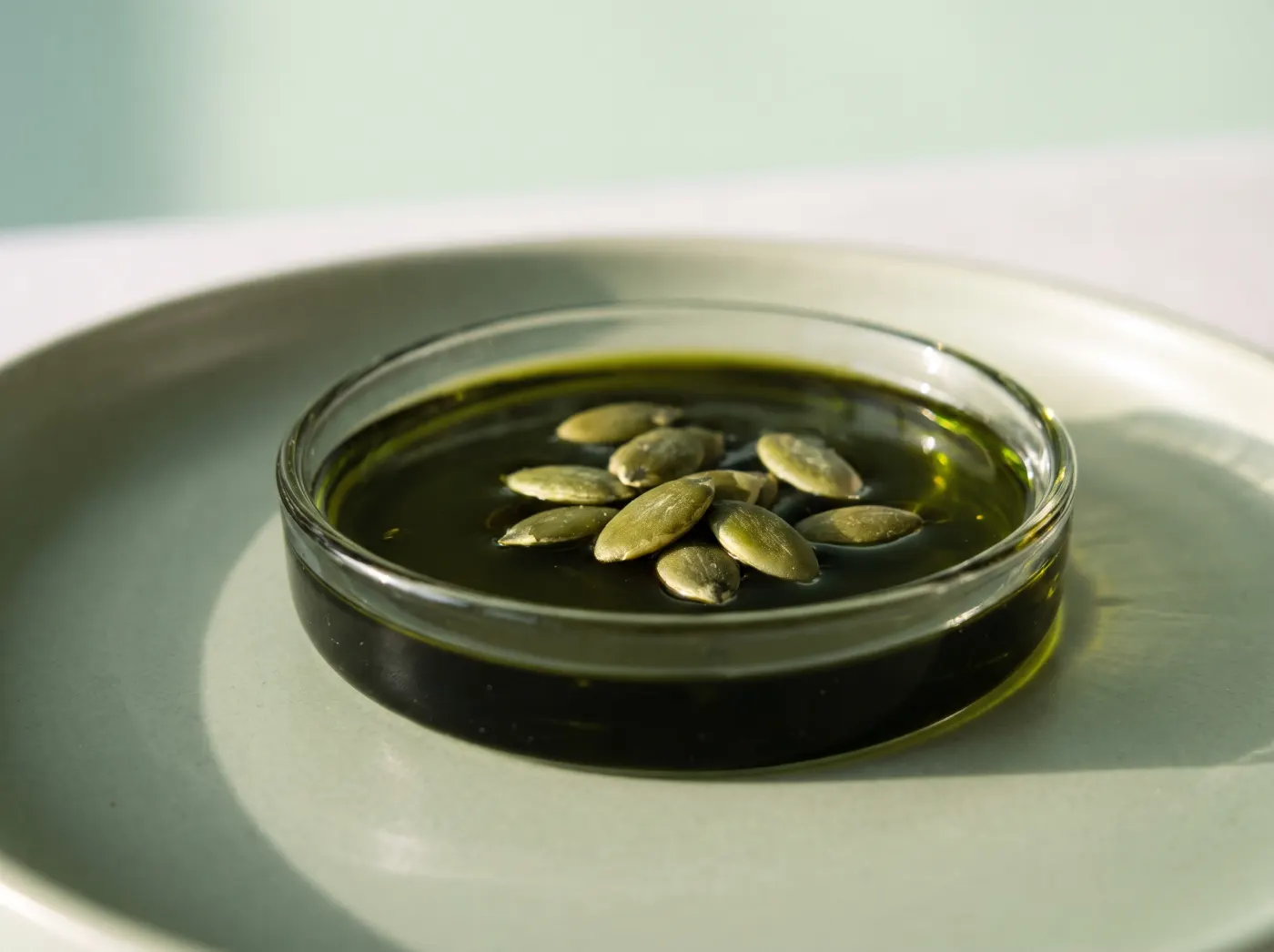
Dark green pumpkin seed oil in macro view, a thick drop on a sage green ceramic surface

Pumpkin seed oil at a glance

Entry from our cosmetic ingredient glossary. Regulatory data from the European Commission's CosIng database9. Copy the identifiers in one click for your files.

INCI name
CUCURBITA PEPO SEED OILUS INCI name: Cucurbita pepo (pumpkin) seed oil9
Other names
Pumpkin seed oilPumpkin seed oil; squash seed oil
CAS number
8016-49-7CosIng also lists 89998-03-89
EC number
289-741-0Number linked to CAS 89998-03-8 in CosIng9
Botanical origin
Squash (Cucurbitaceae)Oil obtained by pressing the seeds of the squash Cucurbita pepo L.9
Composition
Unsaturated fatty acids, linoleic acid firstWith tocopherols, phytosterols and phenolic acids; composition varies with the cultivar and the extraction method1
Minor compounds
Polyphenols, phytoestrogens, carotenoids, squaleneAccording to a 2022 review, which also notes that the production process changes their content2
CosIng functions
Emollient, skin conditioning"Skin conditioning - emollient" and "skin conditioning"9
EU status
No restriction specific to the ingredientNot listed in Annexes II to VI of Regulation (EC) 1223/2009, consolidated May 1, 2025; only the general mention on ozone-depleting substances appears in CosIng910
Allergen to declare
NoNot listed in Annex III or in the fragrance allergen list of Regulation (EU) 2023/154510
Safety (CIR, SCCS)
No assessment retainedWe did not retain a CIR or SCCS assessment specific to this oil

What the research says

Each result shows the protocol and the level of evidence. The higher the level, the better the result carries over to a finished formula.

Clinical trialReview or consensusLaboratory

Composition and materialChemistry

Mostly unsaturated fatty acids

Review
2024 reviewExtraction, constituents

The oil contains a high proportion of unsaturated fatty acids, mainly linoleic acid, with tocopherols, phytosterols and phenolic acids1. Yield and composition vary with the cultivar and the extraction method1.

One oil among fourteen analyzed by chromatography

Laboratory
Gas chromatography14 vegetable oils

Pumpkin seed oil is one of fourteen oils whose fatty acid methyl esters were measured. Palmitic, oleic and linoleic acids dominate across all the oils tested3.

A stable cream with 20% oil

Laboratory
Formulation study12 weeks at 25 and 40 °C

An oil-in-water emulsion containing 20% pumpkin seed oil, vitamin E oil and beeswax stayed physically and microbiologically stable. Adding vitamin E has a synergistic effect on the α-tocopherol content (combination index 0.98)4.

Skin and bodySkincare, bodycare

Mostly laboratory studies

Review
2022 reviewComposition, activities, safety

The review states that most studies are run in vitro and support an antioxidant and antimicrobial activity. It notes use of the oil in the cosmetic and pharmaceutical industries2. We found no controlled trial measuring hydration or the skin barrier with this oil alone.

Hair and scalpHaircare

An oral trial, outside the cosmetic field

Clinical trial
Randomized double-blind trial76 men400 mg a day by mouth, 24 weeks

This trial covers hormone-related hair loss and a swallowed supplement, not an applied oil. We do not repeat its results: they are medical and do not carry over to a cosmetic product5.

In mice, an oil applied at 10%

Laboratory
Male mice10% oil, 6 days a week, 3 weeks

In a model where testosterone slows regrowth, the 10% oil raised the share of follicles in the growth phase to 75 ± 5.3%, versus 44.4 ± 15% with testosterone alone6. This is an animal model: the result does not carry over directly to humans.

Evidence judged limited by the reviews

Review
2025 reviewsOils, onion juice, rosemary and others

The reviews point to small samples, short durations, studies on combined products, a lack of comparison with references and conflicts of interest. They call for better designed trials78.

This page summarizes published literature on a cosmetic ingredient. It does not describe the effect of a finished product, which depends on its formula, and it is not medical advice. Several of the studies cited were run or funded by industry; this is indicated in the sources.

Which products use pumpkin seed oil?

Our white label catalog includes 2 formulas with pumpkin seed oil, always as a supporting ingredient. Every category can be customized (formula, fragrance, packaging).

2Hair

Supporting oil in hair oils, scalp care and leave-in care.

In our formulas, it is most often paired with

Wheat germ oil 2Sweet almond oil 1Avocado oil 1

Pumpkin seed, sesame, soybean or mustard oil?

Four seed oils often mixed up in ingredient lists. Their composition and regulatory status differ.

Pumpkin seed oilSesame oilSoybean oilMustard oil
CompositionMostly unsaturated, linoleic acid first1Lignans (sesamin, sesamol), tocopherols, phytosterols11Triglycerides of oleic, linoleic and saturated acids12Yellow mustard oil: 42.8% erucic acid13
EU regulationNo specific restrictionNo specific restrictionNo specific restrictionAllyl isothiocyanate banned (Annex II)10
Carmel catalog formulas2 formulas3 formulas2 formulas1 formula

Frequently asked questions about pumpkin seed oil

What is pumpkin seed oil?
It is the oil pressed from the seeds of the squash Cucurbita pepo9. It contains mostly unsaturated fatty acids, with linoleic acid first1. Its INCI name is CUCURBITA PEPO SEED OIL.
What are the benefits of pumpkin seed oil in cosmetics?
CosIng classifies it as an emollient and a skin conditioning agent9. The available reviews mostly describe laboratory studies (antioxidant, antimicrobial activity)2. We found no controlled trial measuring its cosmetic effect alone on the skin.
Is pumpkin seed oil good for hair?
No peer-reviewed study found for this page measures the effect of a pumpkin seed hair product applied on humans. The existing controlled trial covers an oral supplement and a medical endpoint5. The reviews judge the evidence limited78. In formulation, it is used as a supporting oil in a hair oil.
Does pumpkin seed oil stop hair loss?
We do not claim it. The available data come from an oral trial5 and a mouse model6, and the reviews call for stronger studies78. A cosmetic product cannot claim this effect.
What is the composition of pumpkin seed oil?
Mostly unsaturated fatty acids (linoleic acid first), tocopherols, phytosterols and phenolic acids1. Contents vary with the cultivar and the extraction1.
Is pumpkin seed oil safe?
No restriction applies to the ingredient in the EU910. We retained no CIR or SCCS assessment for this oil: the tolerance of a formula is checked with tests on the finished product. During pregnancy, as with any skincare product, a healthcare professional's advice remains the rule.
Can you manufacture a pumpkin seed oil product for my brand?
Yes. Our ISO 22716 certified lab offers 2 formulas that contain it, as a supporting oil in hair oils, which you can customize, or a custom formula. Samples are free.

Sources

Peer-reviewed studies and official regulatory sources, checked on November 3, 2026.

  1. Hu Z, Hu C, Li Y, et al. Pumpkin seed oil: a comprehensive review of extraction methods, nutritional constituents, and health benefits. J Sci Food Agric. 2024;104(2):572-582. doi:10.1002/jsfa.12952
  2. Šamec D, Loizzo MR, Gortzi O, et al. The potential of pumpkin seed oil as a functional food: a comprehensive review of chemical composition, health benefits, and safety. Compr Rev Food Sci Food Saf. 2022;21(5):4422-4446. doi:10.1111/1541-4337.13013
  3. Orsavova J, Misurcova L, Ambrozova JV, et al. Fatty acids composition of vegetable oils and its contribution to dietary energy intake and dependence of cardiovascular mortality on dietary intake of fatty acids. Int J Mol Sci. 2015;16(6):12871-12890. doi:10.3390/ijms160612871
  4. Ong TS, Chu CC, Tan CP, Nyam KL. Preparation and evaluation pumpkin seed oil-based vitamin E cream formulations for topical application. J Oleo Sci. 2020;69(4):297-306. doi:10.5650/jos.ess19250
  5. Cho YH, Lee SY, Jeong DW, et al. Effect of pumpkin seed oil on hair growth in men with androgenetic alopecia: a randomized, double-blind, placebo-controlled trial. Evid Based Complement Alternat Med. 2014;2014:549721. doi:10.1155/2014/549721
  6. Hajhashemi V, Rajabi P, Mardani M. Beneficial effects of pumpkin seed oil as a topical hair growth promoting agent in a mice model. Avicenna J Phytomed. 2019;9(6):499-504. doi:10.22038/AJP.2019.13463
  7. Ahmed A, Alali AM, Abdullah E, et al. Herbal remedies for hair loss: a review of efficacy and safety. Skin Appendage Disord. 2025;11(4):360-371. doi:10.1159/000542876
  8. Bikash C. Topical alternatives for hair loss: beyond the conventional. Int J Trichology. 2025;17(1):13-19. doi:10.4103/ijt.ijt_8_23
  9. European Commission. CosIng, entry CUCURBITA PEPO SEED OIL (CAS 8016-49-7 / 89998-03-8, EC 289-741-0). CosIng 75438
  10. European Parliament and Council. Regulation (EC) No 1223/2009 on cosmetic products, consolidated version of May 1, 2025 (Annexes II to VI, Article 17). EUR-Lex. EUR-Lex 1223/2009
  11. Oboulbiga EB, Douamba Z, Compaoré-Sérémé D, et al. Physicochemical, potential nutritional, antioxidant and health properties of sesame seed oil: a review. Front Nutr. 2023;10:1127926. doi:10.3389/fnut.2023.1127926
  12. European Commission. CosIng, entry GLYCINE SOJA OIL (CAS 8001-22-7, EC 232-274-4). CosIng 34121
  13. Li C, Cai B, Li W, et al. Processing characteristics, typical components, and biological activities of yellow mustard seed oil. J Food Sci. 2026;91(7):e71237. doi:10.1111/1750-3841.71237
Carmel Cosmetics Labs product specialist with a brand founder

Tell us about your project

A product specialist reviews your request and gets back to you on the channel you prefer.

Lead EN – Demande de devis
Tell us about your project. A product specialist will get back to you shortly.
CONTACT INFORMATION
Name
PROJECT INFORMATION
Which cosmetics category interests you most?

By submitting this form, you agree to our terms of service and privacy policy.

No obligation. Your information stays confidential and is used only to prepare your quote.
